
Management Courses in South Africa: A Practical Guide
Management courses in South Africa range from short CPD programmes to NQF-registered certificates, diplomas, degrees and postgraduate qualifications, and the right one depends on whether you need to supervise a team, run a practice or satisfy a regulatory requirement. For financial advisors and financial service providers (FSPs), the choice matters more than it does in many industries, because a practice principal carries management duties under FAIS alongside obligations under FICA and POPIA.
Who this is for: independent brokers, regulated brokers, FSP applicants and compliance officers who want to build management capability without losing sight of their regulatory duties.
This guide explains what management study covers, how South African qualification levels work, how to study while running a practice, and how to choose a programme that supports compliant, sustainable practice management.
What do management courses actually teach?
Management courses teach the principles of planning, organising, leading and controlling people, money and operations. The exact subjects vary by provider, but the core content is consistent across most programmes.
The South African Qualifications Authority (SAQA) lists a Higher Certificate in Management as a 120-credit qualification at NQF Level 5. According to SAQA, its stated focus includes management principles, finance, marketing, operations, people management and leadership. Its exit outcomes extend to supervision, teamwork, labour law, diversity management, project management, operations management, finance, customer service and managing change.
Typical subjects across management study include:
- Principles of management: planning, decision-making, delegation and performance measurement
- Financial management: budgeting, cash flow, cost control and reading financial statements
- People management: recruitment, performance reviews, labour law and conflict resolution
- Operations and project management: workflow design, quality control and delivery against deadlines
- Marketing and customer service: client acquisition, retention and service standards
- Leadership and change management: guiding a team through new regulation or new systems
For a financial advisor, the last three subjects are rarely abstract. A practice that adds a second adviser, moves to a new client-management system or responds to the Conduct of Financial Institutions (COFI) Bill is, in effect, running a change project.
Which levels of management qualification exist in South Africa?
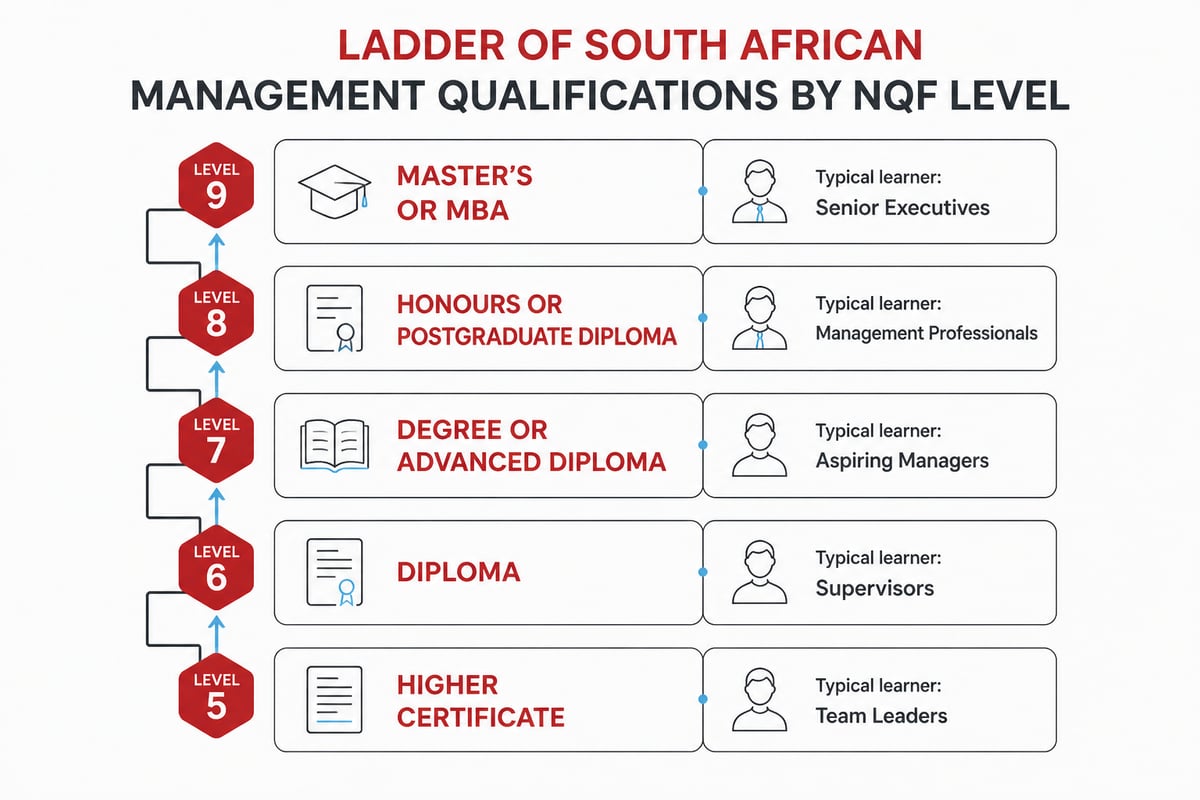
South Africa pairs management qualifications with the National Qualifications Framework (NQF), which ranks learning from Level 1 to Level 10. Knowing the level tells you how demanding a programme is and how it fits into a longer study path.
| NQF level | Typical qualification | Suited to |
|---|---|---|
| Level 4 | National Certificate or short learnership | Team leaders and administrators moving into supervision |
| Level 5 | Higher Certificate in Management | New managers and practice owners without formal study |
| Level 6 | Diploma in Management or Business Management | Experienced managers formalising their skills |
| Level 7 | Bachelor's degree or Advanced Diploma | Senior managers and aspiring executives |
| Level 8 | Honours degree or Postgraduate Diploma | Specialisation in strategy, finance or leadership |
| Level 9 | Master's degree, including MBA | Executive leadership and research |
Because quality assurance matters, check any programme before you pay. SAQA’s searchable qualifications register shows the title, NQF level, credits, registration status and quality-assurance body for each qualification. A short course with no NQF registration may still be useful for CPD, but it will not carry the same weight as a registered qualification when you apply for a role or further study.
Is there an MSc or master's management degree available?
Yes, postgraduate management study is widely available, although the title varies by country and institution. In South Africa, the usual Level 9 routes are the Master of Business Administration (MBA), a Master of Commerce in a management discipline or a Master of Management. The "MSc Management" title is more common in the United Kingdom, where it is typically a one-year taught master's, and some South African graduates choose to study abroad or online.
For practice owners, a master's degree is rarely the first step. It makes most sense once you have a clear strategic goal, such as building a multi-adviser practice, preparing for a merger or moving into an executive role at a larger FSP. Entry usually requires a bachelor's degree and relevant work experience, though some institutions consider recognition of prior learning.
How can I study management while running a practice?
You can study management through full-time campus study, part-time evening classes, distance learning, online programmes or short blended courses, and most practising advisors choose part-time or distance formats. The best format is the one you will finish.
Consider these routes:
- Distance or online study: flexible hours and no commuting, but it demands self-discipline and reliable connectivity.
- Part-time contact classes: evenings or weekends, with the structure and peer discussion that some learners prefer.
- Short CPD courses: a few hours to a few weeks, suited to a single topic such as supervision or project management.
- Recognition of prior learning (RPL): SAQA notes that the Higher Certificate in Management can be achieved partly through RPL, with learners assessed individually against the qualification's exit-level outcomes. If you have run a practice for ten years without formal study, this can shorten the path.
Before enrolling, set aside realistic study time. A practice principal who is also the key individual under FAIS, the Information Officer under POPIA and the person overseeing FICA controls has limited free hours, so build a study calendar around your quietest months rather than a month-end or audit period.
Why does management training matter for financial advisors and FSPs?
Management training matters because many advisors are technically strong but have never been trained to manage people, risk or a business, and regulation now expects those skills. A 2025 study on workforce readiness in the Western Cape, published by Taylor & Francis, reports that many managers are underqualified and identifies demand for managerial skills across several sectors. The study does not focus on financial services, but it reflects a wider pattern: people are promoted into management on technical merit and then learn the job under pressure.
Skills mismatches in the labour market are widely discussed, which supports the case for deliberate, targeted study rather than ad hoc learning.
In an FSP, management weaknesses tend to show up as compliance failures:
- Representatives who are never properly supervised, creating FAIS fit-and-proper and competence gaps
- Client files that lack complete FICA verification because nobody owns the process
- Personal information held in unprotected spreadsheets, creating POPIA exposure
- A Risk Management and Compliance Programme (RMCP) that was drafted once and never reviewed
Management skills such as delegation, monitoring and documentation address each of these. Good management is not separate from compliance. It is how compliance is carried out day to day.

What management skills do advisors need most?
The management skills advisors need most are the ones that keep a regulated practice running consistently without depending on one person. Four areas deserve priority.
Supervision and delegation
FAIS places responsibility for representatives on the FSP. Learning how to set expectations, review work and document supervision gives you evidence of oversight that an inspection will look for.
Financial and operational control
Understanding budgeting, margins and cash flow helps you decide when to hire, how to price services and whether the practice can fund compliance monitoring and training. It also helps you plan for the cost of regulatory change.
Risk and compliance management
Risk management is a core management discipline. Applied to a practice, it means identifying where FICA, POPIA and FAIS risks sit, assigning an owner to each, and testing the controls on a schedule.
Change and project management
New legislation, new product providers and new systems all need planning. A simple project plan with a named owner, a deadline and a review point turns a regulatory update into a manageable task.
How do I choose the right management course?
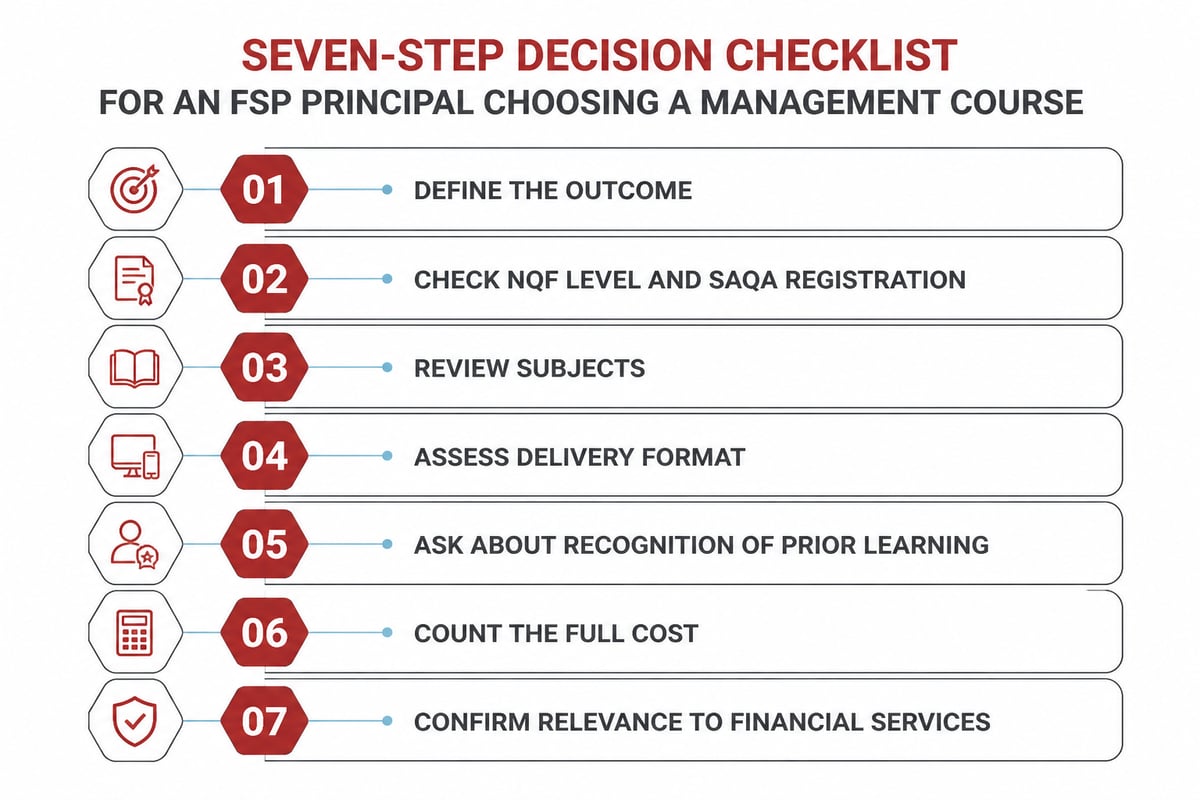
Choose a management course by matching your current role, your goal and your available time to a registered, quality-assured programme. A short process prevents expensive mistakes.
- Define the outcome. Do you want to supervise representatives, run a larger practice, move into a compliance officer role or qualify for postgraduate study?
- Check the NQF level and registration. Use the SAQA register to confirm the qualification title, credits and status.
- Review the subjects. Look for finance, people management, risk and operations rather than generic content only.
- Assess the delivery format. Make sure the timetable, assessment method and support suit a working practice.
- Ask about RPL. If you have substantial experience, find out whether it can count towards credits.
- Count the full cost. Include tuition, materials, exam fees and the time away from client work.
- Look for relevance. A programme that uses financial services examples will transfer more readily to your practice.
What are the most in-demand courses, and where do regulatory exams fit?
The Western Cape study identifies demand for managerial skills across areas including project management, manufacturing, supply and distribution, and health. For FSPs, a second category matters just as much: regulatory and compliance training.
Management study builds general capability, while regulatory training keeps you permitted to practise. Representatives who have not yet met the FSCA's competency requirements need to pass the relevant Regulatory Examinations (RE), and a principal who manages a team has an interest in how well prepared those people are. RE Exam Training from Holistic Compliance Management Solutions (Pty) Ltd supports advisors preparing for these examinations, which pairs naturally with a management qualification that builds the supervisory skills to oversee them.
Many practices also need focused training on:
- FICA: customer due diligence, record-keeping, suspicious transaction reporting and the RMCP
- POPIA: lawful processing, security safeguards, operator agreements and breach notification
- FAIS: fit-and-proper requirements, continuous professional development and conduct standards
- COFI: preparing governance and conduct processes for the new market-conduct framework
How do I put management learning into practice in an FSP?
You put management learning into practice by turning each topic into a documented control with an owner, a frequency and a record. A qualification only pays off if it changes how the practice runs.
Use this implementation checklist as a starting point:
- Appoint owners. Name the key individual, the FICA compliance officer and the POPIA Information Officer, and confirm each has the time and training for the role.
- Document supervision. Record how you review representatives' advice files, how often, and what happens when you find a gap.
- Review the RMCP. Check that it reflects your current client types, products and delivery channels, and diarise a yearly review.
- Map personal information. List what client data you collect, where it is stored, who can access it and how long you keep it.
- Schedule monitoring. Set a quarterly check of FICA files, POPIA safeguards and FAIS record-keeping, with results reported to the principal.
- Plan training. Maintain a calendar of CPD, regulatory exam preparation and refresher training for everyone in the practice.
- Close the loop. Track every finding to a corrective action with a date and a responsible person.
Hypothetical example: a practice principal could set a supervision schedule that reviews a sample of each representative's files each month and logs findings in a simple register, creating a documented record of oversight.
Independent monitoring adds a second line of defence. Holistic Compliance Management Solutions (Pty) Ltd offers independent compliance services to FSPs and provides a free FICA course for clients, with CPD points awarded on completion.
FAQ
What are the subjects of management?
The core subjects are management principles, finance, marketing, operations, people management and leadership. Many programmes add project management, labour law, customer service and change management.
How can I study management?
You can study management full-time on campus, part-time, through distance learning or online, or through short CPD courses. Check the qualification's NQF level and registration on the SAQA register, and ask whether recognition of prior learning can shorten your studies.
Do management courses count as CPD for FSP representatives?
That depends on the course and on whether the provider's content is recognised for CPD purposes. Confirm with the provider and with your own compliance records before relying on a course to meet your annual CPD requirement.
Start by mapping your own gaps: list your management, FAIS, FICA and POPIA responsibilities, mark where you lack formal training, and check any qualification you are considering on the SAQA register. If your priority is regulatory competence, the team at Holistic Compliance Management Solutions (Pty) Ltd can prepare you through RE Exam Training and independent compliance support. Schedule FICA training and take the first practical step by choosing a course to Register Now with Holistic Compliance Management Solutions (Pty) Ltd, which covers the training your practice needs to run sustainably under changing regulation.