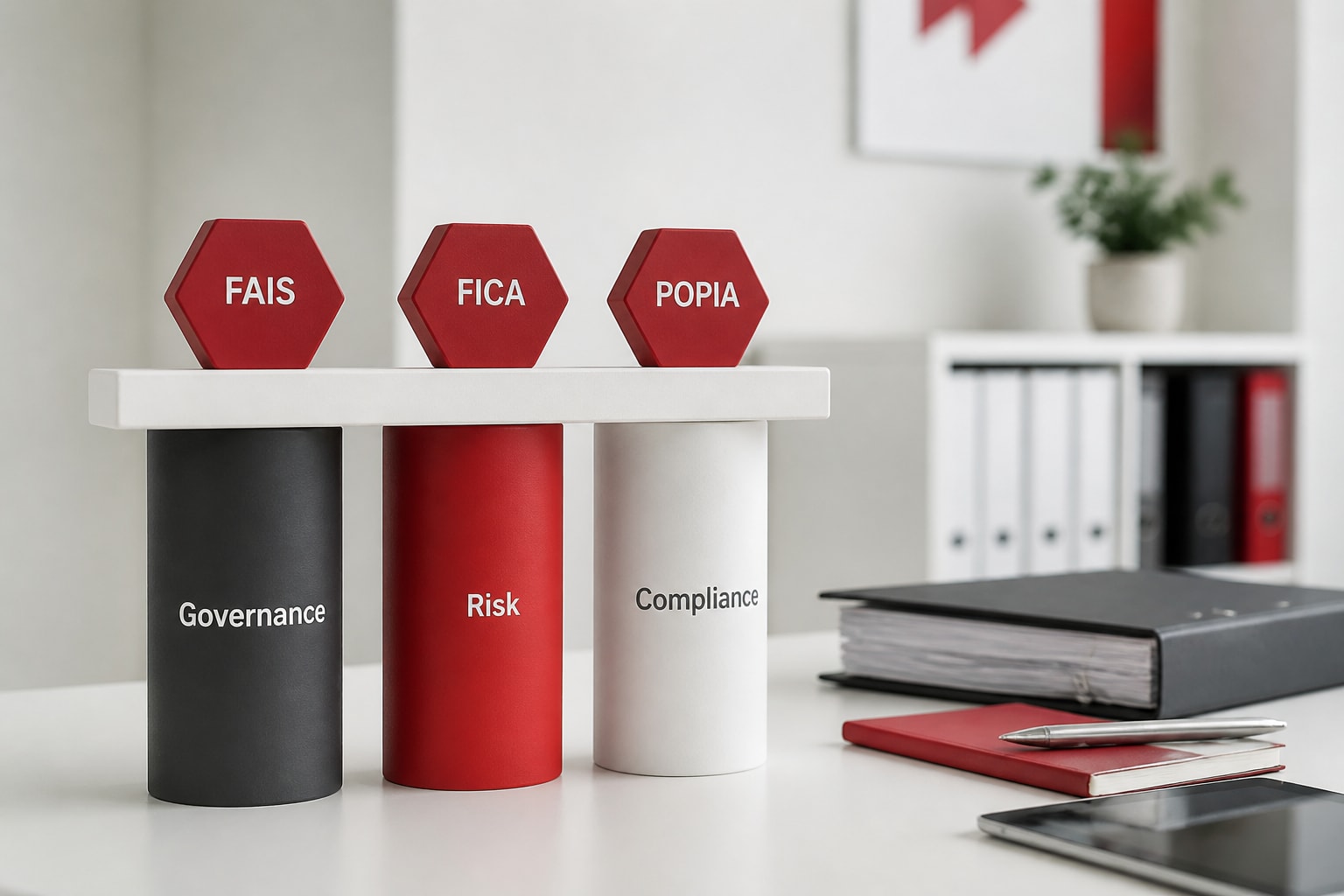
Governance, Risk and Compliance (GRC) Explained for FSPs
Who this is for: independent brokers, regulated brokers, FSP applicants and compliance officers in South Africa.
Governance and risk compliance, usually shortened to GRC, is the coordinated approach an organisation uses to direct its activities, manage uncertainty and meet its legal obligations. For a South African financial services provider (FSP), that means linking how the practice is run with the risks it faces and the duties set by the FSCA, the Financial Intelligence Centre and the Information Regulator under FAIS, FICA and POPIA. This article explains each component, how they connect, and how an independent broker practice can build a workable GRC system without a large compliance department.
What Does Governance, Risk and Compliance Mean for an FSP?
GRC is a single management discipline made up of three connected parts: governance sets direction and accountability, risk management identifies and controls threats, and compliance proves that rules are followed. In an FSP, the three are easiest to understand through the questions they answer.
- Governance: Who is responsible for what, and how are decisions made and recorded?
- Risk: What could go wrong, how likely is it, and what is the impact on clients and the practice?
- Compliance: Are we meeting the specific requirements of FAIS, FICA, POPIA and, as it develops, the Conduct of Financial Institutions (COFI) Bill?
Treating these as separate projects is common in small practices. The key person handles FICA documents, someone else deals with the FSCA return, and POPIA sits in a folder nobody opens. GRC replaces that fragmentation with one view of the practice, so that a gap in one area is visible in the others.
How Governance, Risk and Compliance Work Together
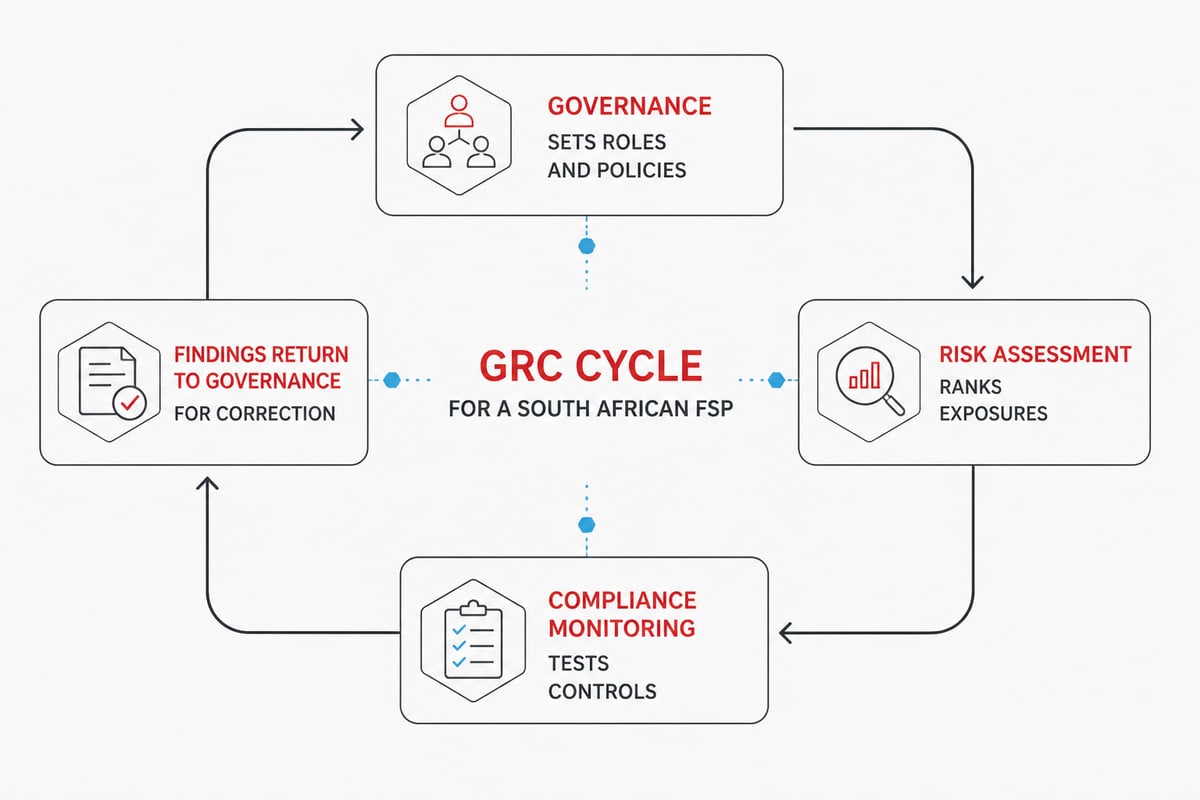
The three components form a cycle in which governance sets the rules, risk assessment shows where those rules matter most, and compliance monitoring tests whether they are working.
Governance comes first because it assigns authority. In a licensed FSP, the key individual and the representatives carry defined responsibilities under FAIS. Governance records who approves new product providers, who signs off the compliance report, and who responds when the FSCA asks questions.
Risk assessment then ranks what matters. A practice that handles large lump-sum investments faces different money-laundering exposure from one that sells funeral cover. A practice storing client medical information carries heavier POPIA exposure than one that does not.
Compliance monitoring closes the loop. It checks that controls exist and operate, records findings, and feeds them back to governance for correction. Without that feedback, the cycle stops and the practice only discovers its weaknesses during an inspection.
The Regulatory Framework Behind GRC in South Africa
South African FSPs operate under four overlapping regimes, each of which a GRC system must address.
FAIS and the FSCA
The Financial Advisory and Intermediary Services Act governs licensing, fit-and-proper requirements, representative supervision, conflicts of interest management and client record-keeping. FSPs must appoint a compliance officer where required and submit the compliance reports and returns the FSCA prescribes. Regulatory examinations for representatives form part of the fit-and-proper framework.
FICA and the RMCP
The Financial Intelligence Centre Act requires accountable institutions to identify and verify clients, report suspicious and unusual transactions, keep records, and maintain a Risk Management and Compliance Programme (RMCP). The RMCP is the document in which a practice records how it assesses money-laundering and terrorist-financing risk and which controls it applies. A generic template left unchanged is a frequent weakness, because the programme must reflect the practice's own clients, products and delivery channels.
POPIA
The Protection of Personal Information Act sets conditions for lawful processing of personal information. For a broker, that includes information officer registration, consent and purpose specification, security safeguards, operator agreements with product providers and software suppliers, and a breach response procedure.
COFI
The Conduct of Financial Institutions Bill is intended to consolidate market conduct regulation for financial institutions. Practices should follow its progress and build governance habits, such as documented fair-treatment-of-customers outcomes, that translate to a new framework.
Governance Risk Examples Common in Broker Practices
Governance risks are weaknesses in oversight, accountability or decision-making that can lead to regulatory breaches, financial loss or reputational damage. The following are typical of independent practices.
- Key person dependency: one individual holds all compliance knowledge, and nothing is documented if they are absent.
- Unsupervised representatives: advice files are not reviewed, so a pattern of poor disclosure goes unnoticed.
- Outdated policies: a conflict of interest policy or RMCP that has not been reviewed since the last regulatory change.
- Unclear accountability: nobody is named as information officer or responsible for FICA reporting.
- Weak record-keeping: advice records, client risk ratings or consent forms cannot be produced on request.
- Third-party exposure: product providers, administrators or cloud software hold client data without a written operator agreement.
Each of these can be traced to a governance decision, or the absence of one, rather than to a single careless employee. That is why GRC begins with accountability.
Why Governance Risk Compliance Matters to Independent Practices
GRC matters because regulatory failure carries direct costs for FSPs: administrative penalties, licence conditions, debarment of individuals, reputational harm and loss of client trust. A structured approach also reduces the time spent responding to inspections and information requests.
External evidence suggests that formal controls are not yet universal in financial services. Deloitte’s 2024 fintech benchmark survey found that early-stage fintech respondents were less likely to have an internal audit function than mid-stage firms. The pattern suggests that independent assurance tends to arrive as an organisation grows, which can leave smaller practices relying on self-assessment alone.
Confidence can also run ahead of testing. In a 2024 survey of financial-services compliance professionals reported by NAPA-Net, many respondents said they were confident in their firm's ability to respond to a cyber breach, yet fewer had externally tested the response plan. A POPIA breach procedure that has never been rehearsed fits the same description. The same survey found that a significant share had not yet identified AI as a cybersecurity risk, which is a reminder that new technology should enter the risk register before it enters daily workflow.
Beyond penalties, a working GRC system supports the practice commercially. It makes succession and sale easier, because a buyer can see documented controls, and it gives representatives clear standards to follow.
GRC Frameworks and Governance Principles
Established frameworks give a practice a structure to adopt rather than invent. Three are widely referenced:
- King IV (and its successor, King V, as it is adopted): South Africa's corporate governance code, built on ethical leadership, accountability and transparency. It applies on an apply-and-explain basis, so a small FSP can adopt its principles proportionately.
- ISO 31000: a general risk management standard describing principles, a framework and a process for identifying, analysing and treating risk.
- COSO Enterprise Risk Management: a framework linking strategy, performance and internal control.
Larger FSPs may also draw on ISO/IEC 27001 for information security, which supports POPIA safeguard obligations.
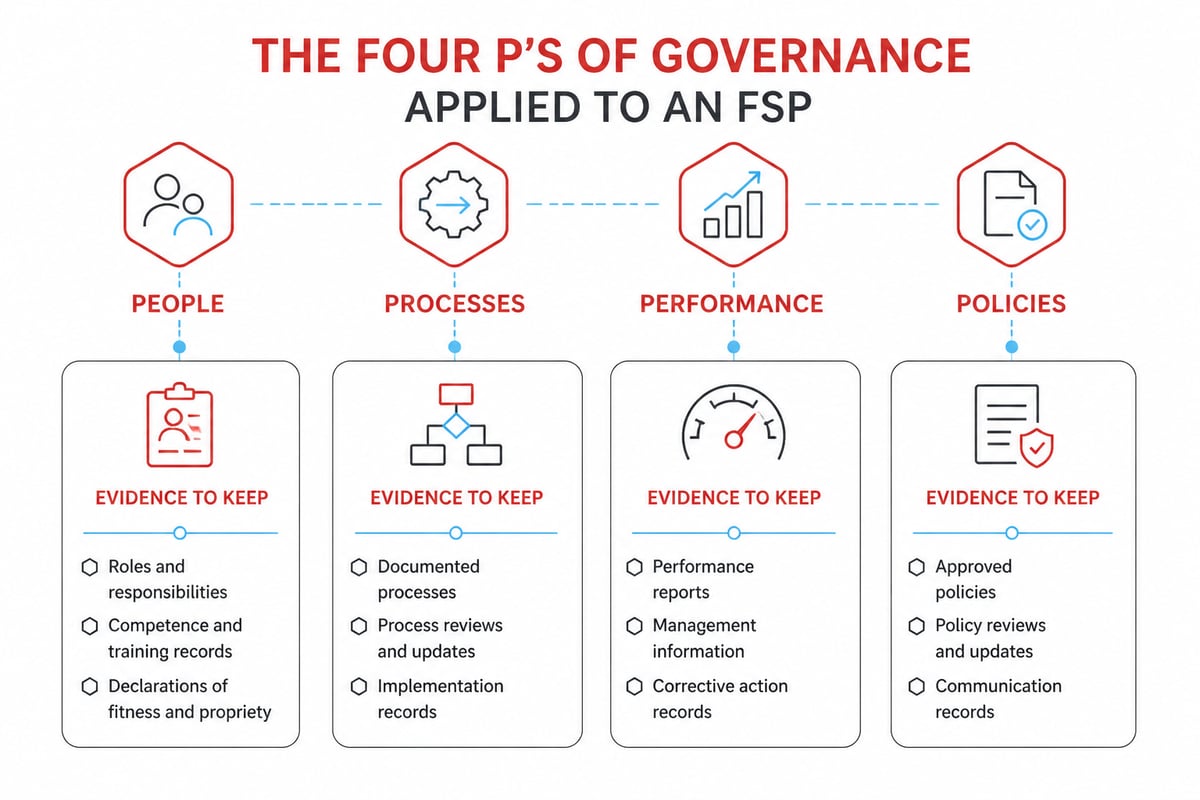
The four P's of governance are sometimes cited as people, processes, performance and policies, though the label is not a regulatory standard and different organisations define it differently. In practice they translate into four checks for a broker practice:
| Principle | Question for an FSP | Evidence to keep |
|---|---|---|
| People | Are roles, fit-and-proper status and supervision defined? | Appointment letters, representative register, CPD records |
| Processes | Are advice, onboarding and complaints handled consistently? | Written procedures, checklists, file reviews |
| Performance | Are results measured and reported? | Compliance reports, monitoring findings, KPIs |
| Policies | Are rules documented and reviewed? | RMCP, conflicts policy, POPIA manual, review dates |
A Practical GRC Implementation Checklist for Brokers
A workable GRC system for a small practice can be built in stages, starting with an honest baseline and ending with scheduled monitoring.
- Map your obligations. List what applies to your licence categories under FAIS, your status as an accountable institution under FICA, and your role as a responsible party under POPIA.
- Assign accountability. Name the key individual, compliance officer, information officer and the person responsible for FICA reporting. Record each appointment in writing.
- Build a risk register. Record risks by area (advice quality, money laundering, data security, outsourcing, business continuity), rate likelihood and impact, and name an owner for each.
- Document the controls. Draft or update the RMCP, POPIA manual, conflicts of interest policy, complaints procedure and breach response plan so they describe what actually happens in your practice.
- Train your people. Cover FICA identification and reporting, POPIA handling rules, and FAIS disclosure requirements for every representative and administrator.
- Monitor on a schedule. Review a sample of advice files, client due diligence records and consent forms each quarter, and log findings with owners and deadlines.
- Report and correct. Present findings to the key individual, track corrective actions to closure and retest the control.
- Review annually. Revisit the risk register, policies and monitoring plan whenever legislation, products or business model change.
Broker Workflow Touchpoints
GRC becomes real when it is attached to daily steps. At client onboarding, the FICA identification and risk rating is captured and the POPIA consent is recorded. At advice stage, the needs analysis, product comparison and disclosure are filed. At product placement, the due diligence on the provider is retained. At review, changes in client circumstances trigger an updated risk rating. Embedding the control at each step avoids a year-end scramble to reconstruct records.

Do You Need GRC Software or Outsourced Support?
Small FSPs can run GRC with structured spreadsheets, a document repository and a calendar, provided someone owns the process. Software becomes useful when the number of representatives, clients or obligations makes manual tracking unreliable. Typical features include a central risk register, policy version control, task assignment with reminders, and an audit trail.
Whether tools or people, the quality of the output depends on independence and expertise. Governance, risk and compliance services, as the phrase is generally used, cover advisory work such as RMCP drafting, policy development, regulatory examination training, compliance monitoring and independent assurance. An outsourced compliance partner can provide that capacity, while the FSP retains accountability.
For practices that want help staying ahead of change, Holistic Compliance Management Solutions keeps FSPs up to date with imminent regulatory changes and offers guidance on implementing them, which suits a practice without the time to track every notice.
Common Challenges in Implementing GRC
The most frequent obstacles are practical rather than technical.
- Scope creep: trying to document every conceivable risk at once. Start with the obligations that carry the heaviest penalties and expand.
- Paper compliance: policies exist but do not match behaviour. An inspector will test the practice against the document, so the document must be true.
- Resource limits: small practices lack time. Scheduled quarterly sampling is more sustainable than an annual overhaul.
- Regulatory change: FAIS amendments, FIC directives and the progress of COFI require a person or partner assigned to watch for them.
- Emerging risk blind spots: as noted above, many firms have not yet classified AI-related cyber risk. A practice that uses AI note-taking or document tools should assess the POPIA implications before rollout.
Directors and key individuals should also recognise that risk perception shifts quickly. WTW’s 2024 financial institutions directors and officers survey found that health and safety was identified as a risk concern by a much larger share of financial-services and insurance respondents than the year before. A static risk register will miss shifts of that kind, which is why the annual review in the checklist above is a minimum rather than a target.
Is CGRC Certification Worth It?
The CGRC (Certified in Governance, Risk and Compliance) credential from ISC2 is oriented towards information-system risk and authorisation processes, so its value depends on role. For a compliance officer or IT risk specialist working on security governance in a larger institution, it demonstrates structured knowledge of risk management frameworks. For most independent broker practices, the more directly useful qualifications are FAIS regulatory examinations, recognised compliance officer training and FICA and POPIA courses that map to the daily obligations of the practice.
FAQ
What are governance, risk and compliance services?
They are advisory and operational services that help an organisation direct itself, manage risk and meet regulatory duties. For an FSP, these typically include RMCP drafting, POPIA documentation, regulatory examination training, compliance monitoring and independent assurance reviews.
Who is responsible for GRC in a small FSP?
The FSP's key individual carries overall accountability under FAIS, and the information officer and FICA compliance officer carry delegated duties. Specialists or outsourced providers can assist, but accountability for the practice's compliance cannot be outsourced.
How often should a broker practice review its GRC system?
At least annually, and whenever legislation, products, systems or the business model change. Monitoring of files and controls should run more frequently, commonly each quarter, so that gaps are corrected before an inspection finds them.
Begin this week by listing every FAIS, FICA and POPIA obligation that applies to your practice and marking which ones have a named owner and written evidence. Holistic Compliance Management Solutions (Pty) Ltd, an independent compliance risk management business serving financial services providers from Cape Town since 2018, provides training on FICA, RMCP drafting and regulatory examinations, along with compliance monitoring. Clients also receive a free FICA course with CPD points awarded on completion. To schedule FICA training that covers client identification, RMCP content and reporting duties for your representatives and administrators, Register Now and have your team working from a documented, tested programme.