
Leadership Training Courses: A Guide for Financial Advisers
Who this is for: independent brokers, regulated brokers, FSP applicants and compliance officers.
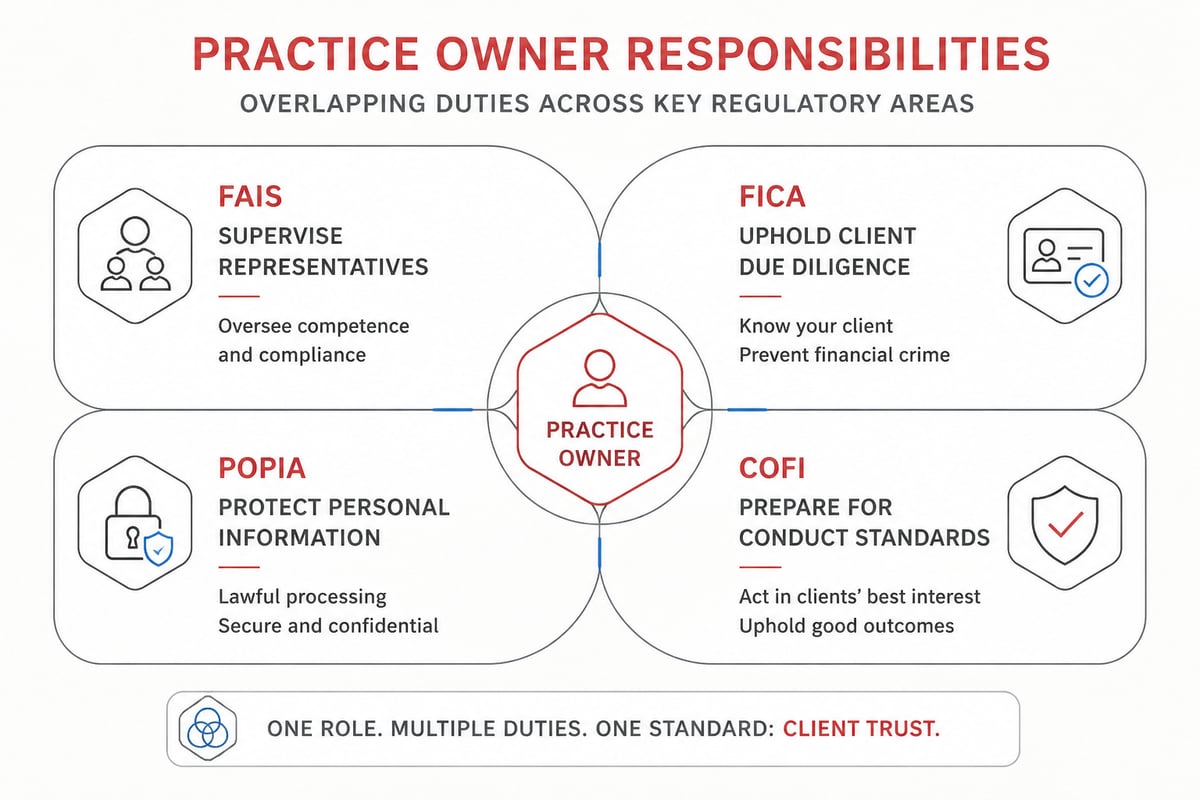
The best leadership training courses for a financial adviser combine people-management skills with regulatory accountability, because a key individual or practice owner answers for both the team and the licence. A good course should teach you to set standards, coach representatives, manage conflict and build a compliance culture that holds up under FSCA inspection. This guide explains what to look for, which skills matter, how to judge a programme, and how leadership connects to your FAIS, FICA, POPIA and COFI duties.
Why Leadership Training Matters for an Independent Broker Practice
Leadership training matters for financial advisers because compliance failures in a practice are usually failures of supervision, not of knowledge. A representative who skips client verification or mishandles personal information is typically working inside a culture the practice owner has set.
In a small FSP, the owner is often adviser, manager, compliance lead and employer at once. That combination is demanding. You are expected to supervise representatives, maintain accurate records, respond to client complaints and keep pace with regulatory change, all while generating revenue.
The wider sector recognises this pressure. Industry research on financial services skills points to leadership development, emotional intelligence, resilience, adaptability and change management as in demand across the sector. Each of those skills applies directly to a practice navigating the shift towards the Conduct of Financial Institutions (COFI) Bill and outcomes-based regulation.
Team friction also carries a cost. The CIPD's 2024 Good Work Index found that many workers reported experiencing some form of workplace conflict in the previous year. In a regulated practice, unresolved conflict between an adviser and an administrator can quickly become a missed FICA report or an unrecorded client complaint.
What Should Leadership Training Courses for Financial Advisers Cover?
Leadership training courses for financial advisers should cover people management, ethical decision-making and regulatory accountability in one programme. A generic management course will teach delegation and motivation, but it will not show you how to apply them to a representative who is on your FSP licence.
Look for these core modules:
- Supervision and delegation. How to oversee representatives, review their files and document that oversight.
- Ethical decision-making. Applying the General Code of Conduct and treating customers fairly in real client scenarios.
- Performance conversations. Addressing poor file quality or missed continuing professional development without damaging the working relationship.
- Change management. Preparing a team for new requirements such as COFI, amended FICA obligations or revised debarment processes.
- Conflict resolution. Handling disagreements between staff, and between staff and clients, before they become formal complaints.
- Succession and continuity. Planning for the day a key individual leaves, a requirement many practices neglect until it is urgent.
If a course does not touch your regulatory context at all, treat it as a supplement rather than a substitute. For a comparison of qualification levels and subjects, see our guide to management courses in South Africa.
Which Leadership Program Is Best for a Financial Adviser?
The best leadership programme is the one that matches your practice size, your regulatory exposure and your available time, not the one with the most famous name. A sole practitioner with two administrators needs something different from a multi-adviser FSP with a dedicated compliance officer.
Use these questions to compare options:
- Is the content relevant to financial services? Case studies drawn from advice, insurance or investment practices will transfer far better than examples from manufacturing or retail.
- Does it carry recognised credit? Courses that award CPD points under the FSCA's continuing professional development framework save you from paying twice for the same hours.
- Is the facilitator credible? Look for trainers with direct experience of FSP operations, inspections and licence conditions.
- Can you apply it immediately? The strongest programmes end with a practical output, such as a supervision schedule or a team compliance calendar.
- Does the format fit your diary? Self-paced online modules suit solo practitioners; facilitated workshops suit teams who want to build shared habits.
Seniority also matters. Newly appointed key individuals benefit most from foundational supervision skills, while established owners often gain more from strategic topics such as succession planning and culture.
Are There Any Free Management Courses?
Yes, free management courses exist, and they are a reasonable starting point for building confidence before you commit to a paid programme. Several public and private providers offer introductory modules on communication, team management and business planning.
Free options have limits. They rarely address FAIS supervision, FICA obligations or POPIA accountability, so they work best as general grounding. Treat them as the first layer and add sector-specific training on top.
For regulatory topics, free training is available from the right providers. Holistic Compliance Management Solutions offers a free FICA course for clients. That makes it a practical way to strengthen the compliance side of your leadership.
What Are the 7 Leadership Skills a Financial Adviser Needs?
There is no single official list of seven leadership skills, but seven capabilities consistently matter in a regulated advisory practice. Developing each one lowers your supervisory risk and improves client outcomes.
- Accountability. Owning the outcome of your team's work, including errors, and correcting them openly.
- Clear communication. Setting expectations in writing so that rules on client onboarding, record keeping and complaints are unambiguous.
- Ethical judgement. Choosing the compliant option when a commercial shortcut is tempting.
- Delegation with oversight. Assigning tasks while keeping a review mechanism in place.
- Emotional intelligence. Reading team stress and client concerns early, before they escalate.
- Adaptability. Responding to regulatory change without disrupting service delivery.
- Coaching. Building the competence of representatives and administrators rather than simply correcting them.
Score yourself honestly against each skill. The two lowest scores indicate where leadership training courses will give you the greatest return.
The 5 C's of Leadership Development in a Compliance Setting
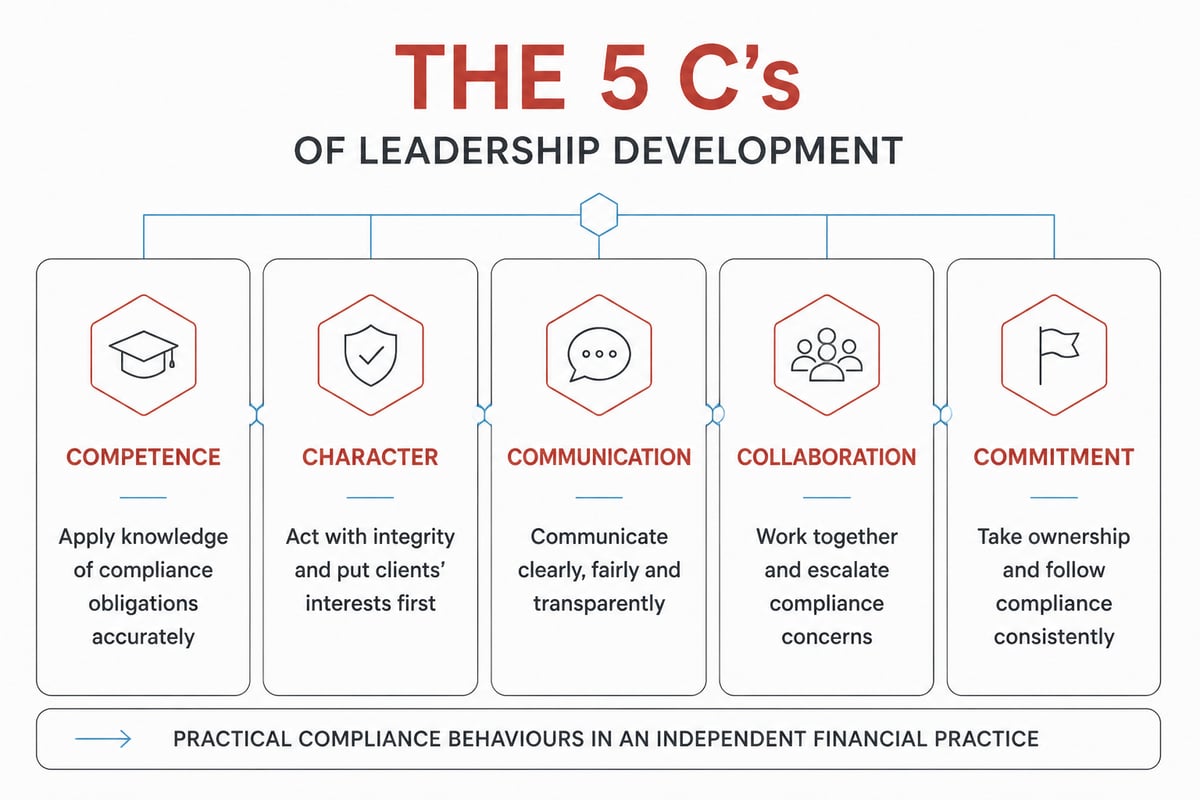
The 5 C's of leadership development are commonly described as competence, character, communication, collaboration and commitment, and each translates directly into compliance behaviour. The framework is not an official standard, but it offers a useful way to structure your own development plan.
- Competence: knowing the FAIS, FICA and POPIA requirements that apply to your licence categories, and keeping your regulatory exam and CPD status current.
- Character: applying rules consistently, even when a long-standing client would prefer you did not.
- Communication: explaining to clients why you need verification documents or consent, in plain language.
- Collaboration: working with your compliance officer, product providers and auditors as partners rather than obstacles.
- Commitment: maintaining records and monitoring routines every month, not only before an inspection.
Linking Leadership to FAIS, FICA, POPIA and COFI
Leadership and compliance are the same discipline viewed from two angles: leaders decide what the practice does, and compliance proves that it did it. Each framework asks something specific of the person in charge.
FAIS and FSP licensing
Under the Financial Advisory and Intermediary Services Act, the FSP is responsible for the conduct of its representatives. Key individuals must be fit and proper, and the practice must maintain supervision, record keeping and complaints handling that can be evidenced. Leadership training that includes supervision methods supports these duties directly.
FICA and the RMCP
The Financial Intelligence Centre Act requires accountable institutions to understand their risks and document how they manage them in a Risk Management and Compliance Programme (RMCP). A leader who understands the RMCP can brief staff on client due diligence, suspicious and unusual transaction reporting and record retention, rather than leaving the document in a drawer.
POPIA
The Protection of Personal Information Act makes the responsible party accountable for how client data is collected, stored and shared. In practice, that means appointing an Information Officer, training staff on consent and securing client files. Your leadership sets the tone: if you handle client documents casually on WhatsApp, your team will too.
COFI
The Conduct of Financial Institutions Bill moves the sector towards outcomes-based conduct regulation. Leaders should begin preparing now by reviewing product governance, fair treatment of customers and how the practice evidences good outcomes. Training in change management helps here, because the practical work involves updating policies and retraining people.
A Practical Compliance Leadership Checklist for Your Practice
A compliance leadership checklist turns good intentions into routines you can show an inspector. Work through the following steps and record the date and outcome of each one.
- Confirm roles. Name your key individuals, compliance officer and Information Officer in writing, and confirm each person understands their responsibilities.
- Review your RMCP. Check that it reflects your actual client base, products and delivery channels, and that every staff member has read it.
- Schedule supervision. Set a fixed monthly time to review a sample of representative files against your checklist.
- Track CPD and exams. Keep a register of each representative's CPD hours, regulatory exam status and licence category.
- Run POPIA housekeeping. Review consent forms, access controls, retention periods and any operator agreements with service providers.
- Log complaints and incidents. Maintain a simple register and review it quarterly for patterns.
- Hold a team compliance meeting. Fifteen minutes each month on one topic, with minutes kept.
- Plan for change. List upcoming regulatory developments, including COFI, and assign an owner and deadline to each action.
Independent compliance monitoring adds an objective check to this routine. An outside reviewer can spot gaps that daily proximity hides, and the findings give your leadership team a clear action list.
How to Choose Between Online, In-Person and Blended Formats
The right format depends on your team size and how you learn best, and each option has distinct strengths for an advisory practice.
| Format | Best suited to | Main advantage | Main limitation |
|---|---|---|---|
| Online self-paced | Sole practitioners, busy owners | Flexible timing, low disruption | Limited peer discussion |
| Live virtual workshop | Practices with remote or regional staff | Interaction without travel | Needs protected diary time |
| In-person workshop | Whole-team culture building | Strong group discussion and role play | Requires closing the office or rotating cover |
| Blended programme | Growing multi-adviser FSPs | Combines knowledge and application | Longer commitment overall |
Whichever you choose, ask whether the provider offers follow-up support. Training delivers its value in the weeks afterwards, when you apply it to real files and real conversations.
Building a Leadership Development Plan Over 12 Months
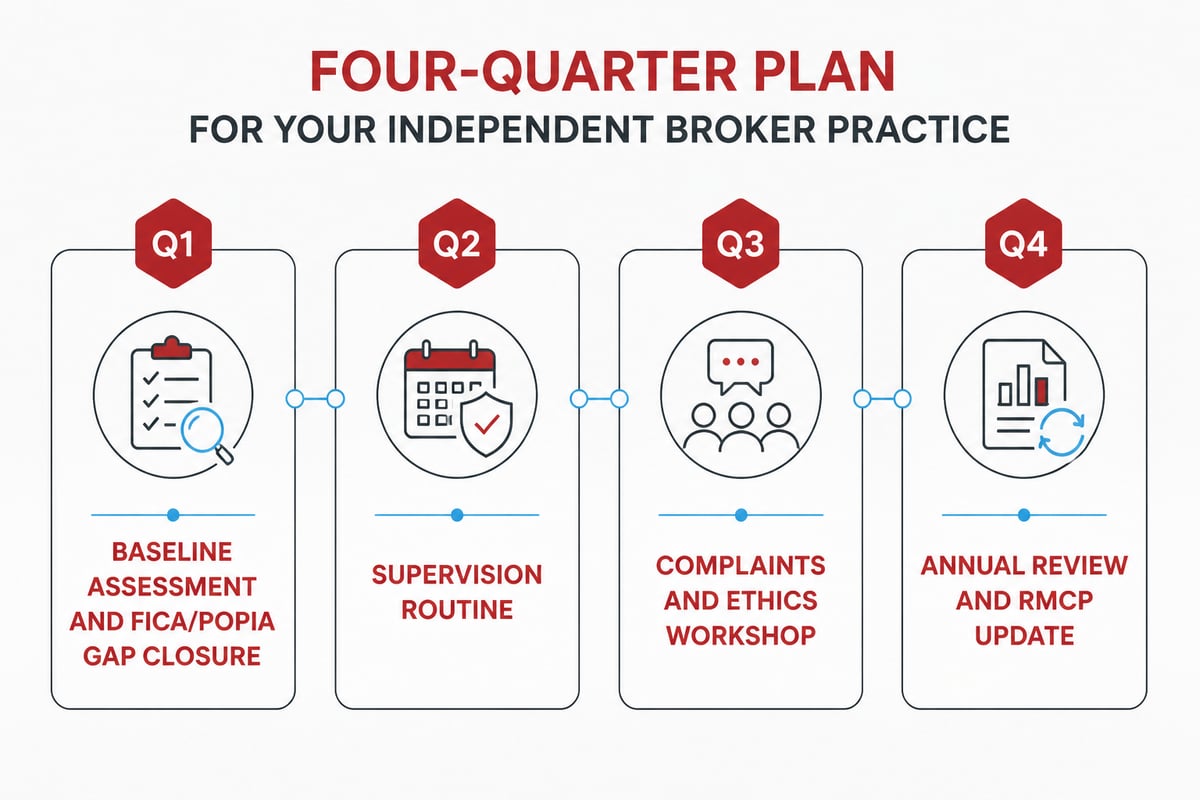
A leadership development plan works best when it is short, specific and tied to measurable outcomes. Aim for one focus per quarter rather than trying to improve everything at once.
- Quarter one: complete a baseline self-assessment against the seven skills above and close any gaps in FICA and POPIA knowledge.
- Quarter two: introduce a formal supervision routine and document it.
- Quarter three: run a team session on complaints handling and ethical decision-making using real, anonymised scenarios.
- Quarter four: review progress, update your RMCP and policies, and set goals for the following year.
Measure results with practical indicators: fewer file exceptions at review, complaints resolved within your internal timeframe, CPD completed ahead of deadline and a clean result from your next compliance monitoring cycle.
Research from the wider sector can inform your priorities. Sector bodies such as the Financial Services Skills Commission publish research on future skills and skills gaps in financial services, which is useful reading when you decide which capabilities to build next.
Schedule FICA Training and Strengthen Your Leadership Foundation
Who this is for: independent brokers, regulated brokers, FSP applicants and compliance officers who want their teams confident in client due diligence and RMCP obligations.
FICA is often the first compliance area where leadership gaps become visible, because it depends on every team member following the same verification steps every time. If you want your practice to meet its obligations consistently, structured training is the most efficient route.
Schedule FICA training with Holistic Compliance Management Solutions, and expect it to cover:
- How the RMCP applies to your client types, products and delivery channels
- Client identification and verification steps, with record-keeping and reporting responsibilities
- Practical guidance on embedding the process into daily broker workflows so your team applies it uniformly
For POPIA concerns, book a compliance consultation to review consent, data handling and Information Officer duties. For licensing questions, request an FSP licensing assessment to confirm your categories, key individual arrangements and supervision structure.
FAQ
Do leadership training courses count towards CPD points?
It depends on the provider and whether the content is accredited for CPD under the FSCA framework. Always confirm the number of CPD hours and the accreditation before you enrol, and keep the completion certificate in your records.
How long do leadership training courses for advisers usually take?
Duration varies, from short workshops to programmes spread over several months. Shorter formats suit a specific skill such as supervision, while longer programmes suit a wider development plan for a growing practice.
Should representatives attend leadership training as well?
Yes, where they are likely to supervise others or progress to key individual roles. Early exposure to supervision, ethics and communication builds a stronger pipeline and supports continuity in your practice.
Start this week by listing every compliance duty in your practice and writing the name of the person responsible beside each one; any blank line is where leadership training should begin. For the FICA and RMCP side of that list, you can Register Now with Holistic Compliance Management Solutions, an independent provider that supports financial service providers in running a sustainable practice under changing regulation. The free FICA course for clients is a practical first step for your team.