
Compliance Training for Financial Service Providers
Who this is for: independent brokers, regulated brokers, FSP applicants and compliance officers.
Training for compliance means giving every person in your practice the knowledge, evidence and routine they need to meet their legal duties, and for a South African FSP that means FAIS, FICA and POPIA today, with COFI on the horizon. Training is only as good as the records behind it. When the FSCA or the Information Regulator asks how you equipped staff, a dated attendance record and a written plan carry far more weight than a verbal assurance.
This guide sets out what an independent broker practice needs to train on, how often, and how to document it without building a bureaucracy around a small team.
What does compliance training cover for a South African FSP?
Compliance training for a South African FSP covers four regulatory pillars: licensing and conduct under FAIS, anti-money laundering under FICA, personal information under POPIA, and the market conduct reforms that COFI will introduce.
Each pillar has a different owner, a different regulator and a different failure mode.
- FAIS: fit and proper requirements, the General Code of Conduct, disclosure, record keeping, complaints handling and continuous professional development. The FSCA supervises this.
- FICA: customer due diligence, ongoing monitoring, suspicious and unusual transaction reporting and the Risk Management and Compliance Programme (RMCP). The Financial Intelligence Centre and the FSCA both have a role.
- POPIA: lawful processing of client information, security safeguards, operator agreements, breach notification and the duties of the Information Officer.
- COFI: the Conduct of Financial Institutions Bill is intended to consolidate market conduct rules and move towards a more outcomes-based approach. Training now should focus on awareness of the direction of travel, rather than fixed rules that are still subject to change.
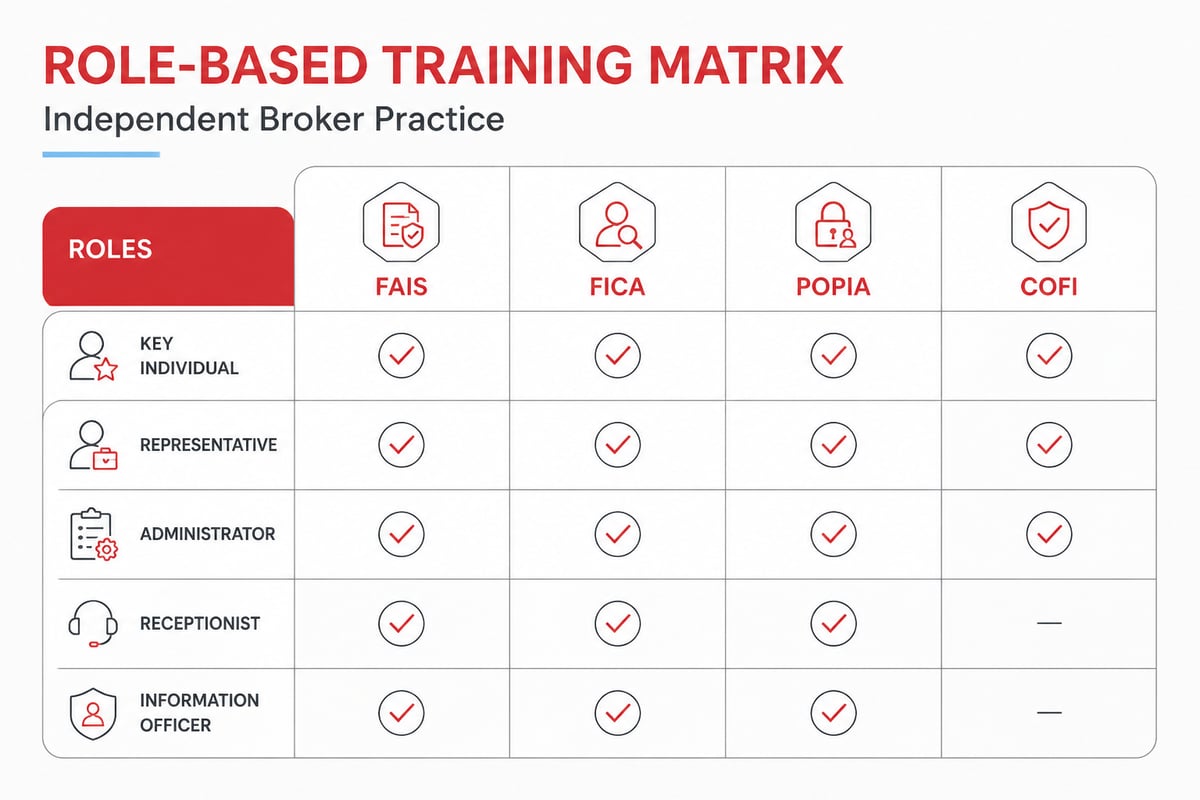
A common weakness in smaller practices is treating these as one annual tick-box session. A better approach is to train by role, because the receptionist who captures client documents, the representative who gives advice and the key individual who signs off the RMCP each carry different risks.
Why is training for compliance a legal duty and not an optional extra?
Training is a legal duty because the legislation makes the FSP, and in particular its key individual, answerable for the competence and conduct of every representative and employee.
Under FAIS, an FSP must ensure that its representatives meet fit and proper standards, which include ongoing product knowledge and regulatory knowledge. Under FICA, accountable institutions must train employees so that they can comply with the Act and with the institution's own RMCP. Under POPIA, the responsible party must take reasonable technical and organisational measures to protect personal information, and untrained staff are one of the most common causes of breaches.
International regulators set a useful benchmark for how seriously supervisors view this. In the United States, FINRA's 2025 Annual Regulatory Oversight Report notes that Rule 3310 requires ongoing anti-money laundering training for appropriate personnel, and FINRA recommends tailoring it to employees' roles and responsibilities and updating it for regulatory developments. The same logic applies under FICA: generic training that ignores job function will struggle to satisfy a supervisor.
The practical consequence is that a South African FSP should be able to show three things on request: who was trained, on what, and when.
How do you get into compliance as a financial services professional?
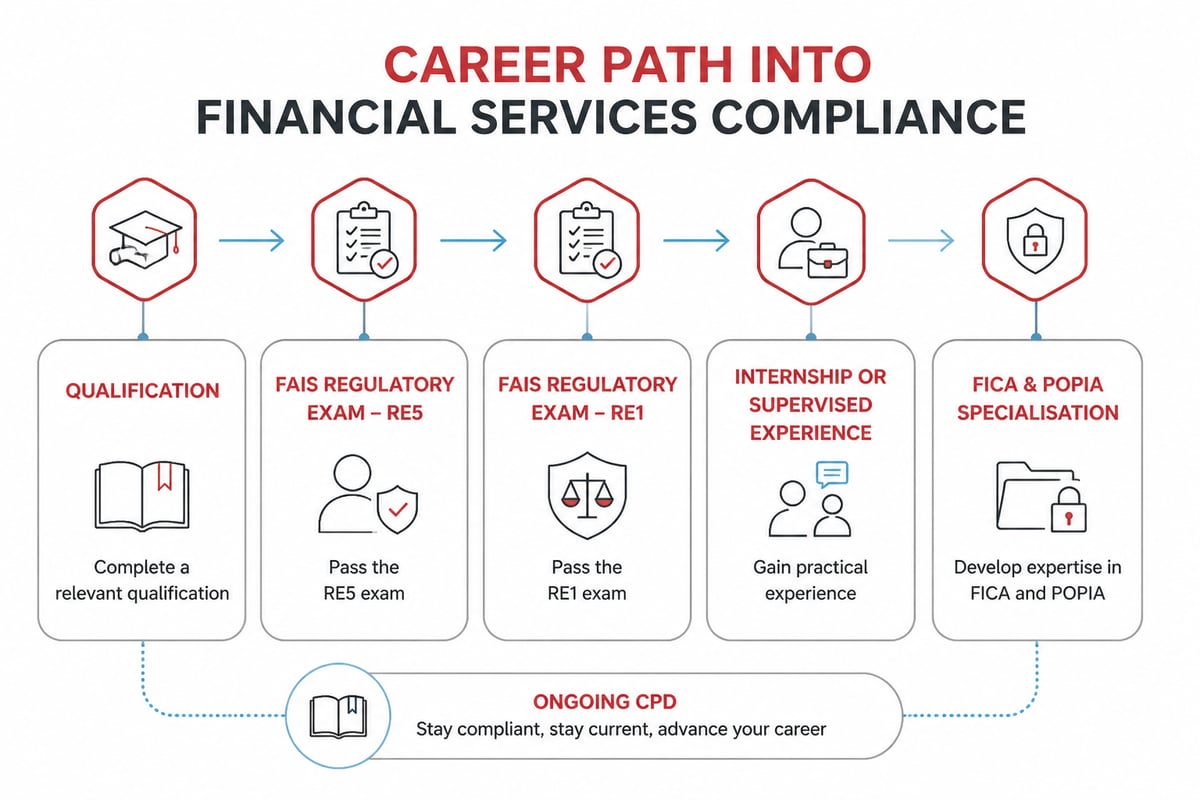
You get into compliance in South Africa by combining a recognised financial services qualification, the regulatory examinations relevant to your category, and supervised practical experience in a compliance function.
A typical path looks like this:
- Build a foundation. A relevant degree, diploma or higher certificate in financial services, law, risk management or commerce is the usual starting point.
- Pass the regulatory exams. FAIS regulatory examinations (RE5 for representatives and RE1 for key individuals) are required for most roles, and they give you working knowledge of the legislation you will later monitor.
- Gain supervised experience. Internships and junior monitoring roles inside an FSP or an external compliance practice are the most direct route into the work. Holistic Compliance Management Solutions facilitates internship placements for exactly this purpose.
- Specialise. Many practitioners add FICA, POPIA and RMCP expertise, because those areas generate steady demand across every FSP category.
- Maintain competence. Ongoing CPD keeps your knowledge current as the regulatory framework shifts.
For an existing advisor, the same steps apply in a lighter form: you are not changing careers, but you are formalising the compliance knowledge your practice depends on.
What are the pillars of a compliance framework?
A compliance framework rests on five pillars that most regulators and risk professionals recognise: governance, risk assessment, policies and controls, training and communication, and monitoring with reporting.
Applied to a broker practice, they translate as follows:
| Pillar | What it means in practice |
|---|---|
| Governance | A named key individual, compliance officer and Information Officer with clear duties |
| Risk assessment | A documented view of FICA, POPIA and conduct risks specific to your client base and products |
| Policies and controls | The RMCP, complaints procedure, conflict of interest policy, POPIA manual and operator agreements |
| Training and communication | Role-based sessions, new-joiner induction, and updates when rules change |
| Monitoring and reporting | Periodic file reviews, breach logs, and reports to management and the regulator |
Training sits in the middle for a reason. The best-written policy fails if the person who handles the client file has never read it, and monitoring cannot improve what staff were never taught to do.
Which training is required under FAIS?
FAIS requires that every representative is fit and proper, which means honesty and integrity, the right qualifications, regulatory examination success, and ongoing product and regulatory competence.
In practice an FSP must manage four recurring items:
- Regulatory examinations for new representatives and key individuals, with the correct level for their category.
- Class of business training for each product category the representative advises on, with evidence of completion.
- Continuous professional development, with the required CPD hours and activities logged each cycle.
- Supervision of new representatives, where a supervised representative must be overseen until they meet all requirements.
Keep a competency file for each representative. It should hold the exam results, qualification certificates, product accreditations, CPD records and the supervision plan where relevant. This file is the first thing a FSCA inspector will ask for, and it takes minutes to maintain if it is updated as events occur, and hours to reconstruct if it is not.
What does FICA training need to include?
FICA training must teach employees how to apply your RMCP, which means identifying and verifying clients, recognising unusual activity, and reporting it correctly and on time.
Content should cover:
- Customer due diligence and verification, including beneficial ownership for legal entities.
- Risk-rating clients and applying enhanced measures to higher-risk relationships, including prominent influential persons.
- Recognising suspicious and unusual transactions and reporting them to the Financial Intelligence Centre through the correct channel.
- Record keeping and retention periods.
- The prohibition on tipping off.
- Targeted financial sanctions screening.
Training must refer to your own RMCP and not simply to the Act. An employee who can recite the legislation but cannot say who the money laundering reporting officer is, or where the verification checklist lives, is not trained for your practice.
Holistic Compliance Management Solutions offers FICA training for clients, which gives a practical base for new joiners and annual refreshers. Drafting the RMCP itself is a separate task, and the firm's Fica RMCP service assists brokers with both FICA and POPI training and RMCP drafting, so the programme and the training reflect each other.
How does POPIA training protect a broker practice?
POPIA training protects a practice by teaching staff to handle personal information lawfully and to recognise a security compromise early enough to report it.
Brokers hold some of the most sensitive data in the economy: identity numbers, bank details, medical information for risk products, and beneficiary details. Training should cover:
- The eight conditions for lawful processing, in plain language.
- Special personal information, including health data, and the stricter rules attached to it.
- Direct marketing consent and the opt-in rules.
- Safe handling of email, cloud storage, WhatsApp and mobile devices, which is where most small-practice incidents originate.
- Operator agreements with product providers, outsourced administrators and software vendors.
- What to do in a breach: who to tell internally, and how notification to the Information Regulator and affected clients works.
Your Information Officer must be registered with the Information Regulator and needs more depth than general staff. Budget extra time for that person to understand the PAIA manual, the compliance framework and the breach response plan.
What should you know about COFI now?
You should treat COFI as a coming change in how conduct is supervised, and prepare by strengthening the habits it is likely to reward: treating customers fairly, documenting outcomes and keeping governance clear.
The Conduct of Financial Institutions Bill has been through several drafts and its final form and commencement are not settled, so avoid training staff on specific clauses that may change. Instead:
- Brief key individuals and compliance officers on the intended direction, including a more principles and outcomes-based approach to conduct.
- Review whether your existing complaints, disclosure and product governance processes can evidence good client outcomes, not merely procedural compliance.
- Watch FSCA communication for consultation periods, because those are the points at which a practice can influence and prepare for the final rules.
A short annual horizon-scanning session for management is enough at this stage. Rolling it into your existing compliance meeting keeps it proportionate.

How often should compliance training be repeated?
Compliance training should be repeated at least annually, with extra sessions when legislation changes, when a monitoring review finds a gap, and when someone joins or changes role.
A workable schedule for a small practice:
- Induction: within the first weeks of employment and before the person handles client files or personal information.
- Annual refresher: FICA, POPIA and the General Code of Conduct, combined into a half-day or a series of short modules.
- Trigger-based updates: after a regulatory change, a breach, an inspection finding or a new product line.
- Management sessions: annually for the key individual, compliance officer and Information Officer on governance duties.
The FINRA approach to a written training plan is a sound model to borrow. Its Information Notice of 14 August 2025 confirms that member firms must evaluate and prioritise Firm Element training needs at least annually and develop a written training plan that considers firm size, structure, business activities and regulatory developments. South African FSPs are not bound by FINRA, but a one-page annual training plan built on the same factors is an easy way to show a supervisor that your approach is deliberate.
What compliance tools and training formats are available?
Compliance tools for a broker practice include monitoring checklists, client onboarding and verification software, a breach and complaints register, a CPD tracker and a document management system with access controls.
Training formats you can mix:
- Instructor-led workshops, best for RMCP walkthroughs and scenario discussions, because staff can ask about your own client types.
- E-learning, efficient for annual refreshers and induction, provided completion is tracked automatically.
- Regulatory exam preparation, for representatives writing RE5 or key individuals writing RE1.
- Compliance monitoring visits, where an independent reviewer tests files against your RMCP and feeds findings back into the next training cycle.
Independence matters in that last format. A reviewer who is not involved in selling or servicing your clients is better placed to report weaknesses candidly, which is why Holistic Compliance Management Solutions offers independent compliance and training services to FSPs.
How do you keep records that prove training took place?
You prove training took place by keeping a dated, signed or system-generated record for every session, linked to the person, the topic and the version of the policy taught.
A defensible training record holds:
- Attendee name, role and date.
- Topic, duration and trainer or provider.
- The version of the RMCP, POPIA manual or code of conduct used.
- Assessment result or confirmation of understanding.
- Certificates, where issued, with CPD points where relevant.
- Follow-up actions for anyone who did not pass or attend.
Store these centrally, restrict access under your POPIA safeguards and retain them for the periods your RMCP and FAIS record keeping rules specify. A certificate alone proves attendance, not competence, so pair it with a short scenario test: ask a representative to risk-rate a sample client or identify a reportable transaction.
What is a practical rollout checklist for a small broker practice?
A practical rollout starts with a gap analysis and ends with a repeatable annual cycle, and it can be completed by a small team without a dedicated learning function.
- Appoint or confirm the key individual, compliance officer, FICA reporting officer and Information Officer.
- List every role in the practice and the regulatory duties each carries.
- Map those duties to FAIS, FICA, POPIA and COFI training needs.
- Check that the RMCP, POPIA manual, complaints policy and conflict of interest policy are current.
- Build a written annual training plan with dates, providers and owners.
- Deliver induction and the first full refresher, and record every attendee.
- Run a monitoring review of a sample of client files to test whether training has changed behaviour.
- Feed findings into the next training cycle and update the plan.
- Set calendar reminders for CPD deadlines, exam windows and Information Regulator obligations.
Done once properly, this cycle becomes routine, and the effort in later years is mostly updating dates and incorporating changes in the rules.
What should a practice do about supervision and management training?
Supervision training equips the people who oversee others to spot and correct compliance failures before a regulator does.
FINRA's guidance is again a useful reference: under the same Information Notice, supervisory training must be included in the firm's plan where the needs analysis identifies a requirement. For an FSP, that need almost always exists, because the key individual carries personal accountability for the representatives under the licence. Cover how to review advice files, how to handle a complaint escalation, how to respond to an FSCA inspection request, and how to document remedial action when a representative falls short.
FAQ
What kind of training is available for financial compliance?
South African FSPs can choose FAIS regulatory exam preparation, class of business and product training, CPD activities, FICA and RMCP training, POPIA awareness, and independent compliance monitoring. Most practices combine formal courses with role-specific, in-house sessions. Holistic Compliance Management Solutions publishes its options on its courses page.
Do all staff need compliance training, or only representatives?
All staff who handle client information or onboarding documents need training, because FICA and POPIA duties apply to the practice as a whole and not only to people who give advice. Administrators and receptionists commonly collect identity documents and process personal information. Their training can be shorter and more task-focused than that of a representative.
Is a training certificate enough evidence for the FSCA?
A certificate shows attendance but not competence, so supplement it with assessment results, the policy version taught and a file review showing the training is applied. Inspectors tend to test whether the practice follows its own programme in daily work. Combining certificates with monitoring findings gives a much stronger picture.
Start by listing every role in your practice and the FAIS, FICA and POPIA duties each one carries, since that single page becomes the foundation of your annual training plan. Holistic Compliance Management Solutions, established in Cape Town in 2018, can help you move from that list to a working programme through the Fica RMCP service and its regulatory exam, FICA and POPIA courses. This article is aimed at FICA and RMCP readers, so the next step is to schedule FICA training, which typically means:
- Walking your team through your own RMCP and verification procedures
- Practising suspicious and unusual transaction recognition and reporting
- Agreeing a record of attendance that supports your CPD and inspection evidence
To put that in place for your practice, you can Register Now for the next available course.