Safety Training Services: A Practical Guide for Teams
Who this is for: independent brokers, regulated brokers, FSP applicants and compliance officers in South Africa.
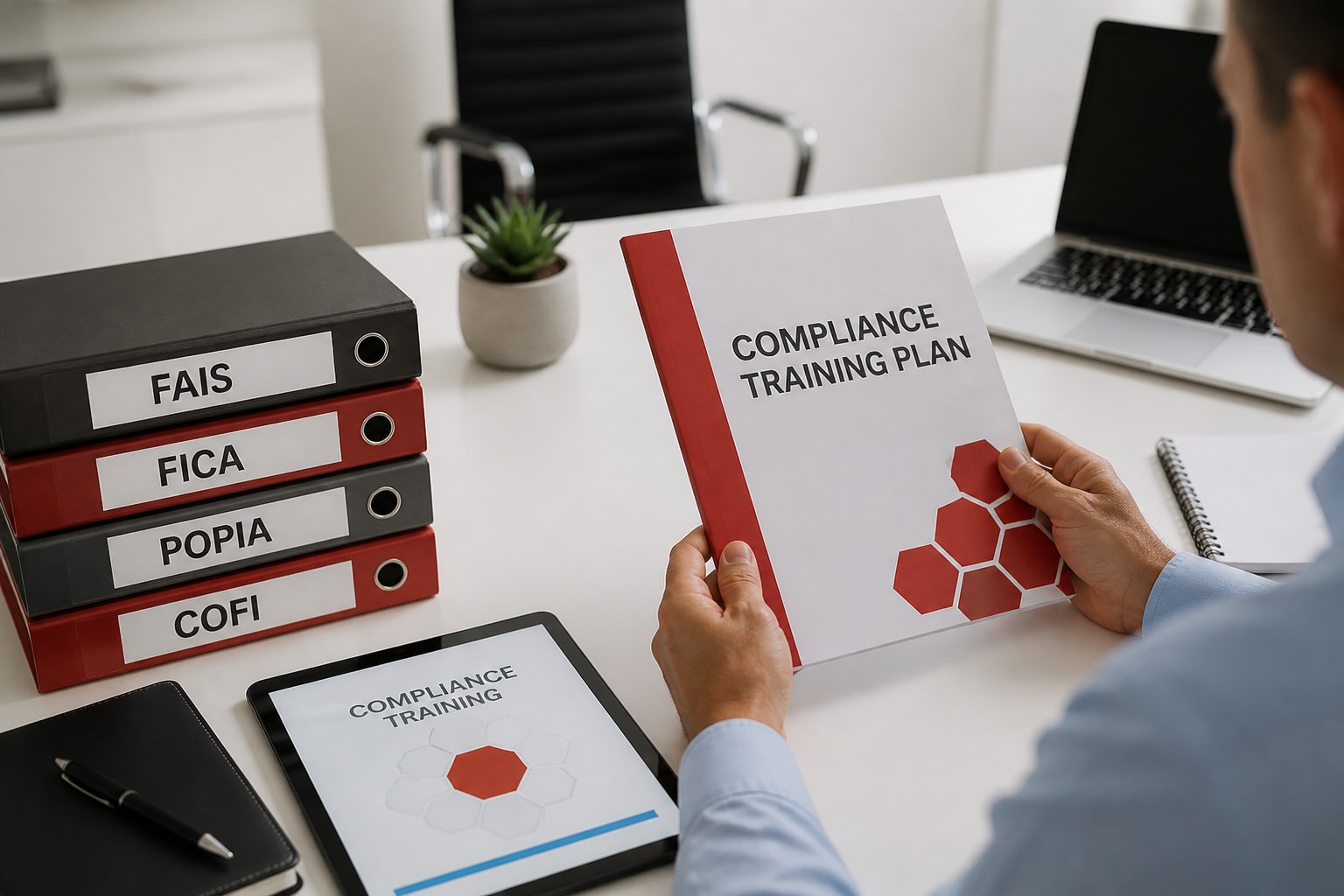
Safety training services give your team structured instruction on the rules and risks that govern their daily work, and for a South African financial services practice that means FAIS, FICA, POPIA and the incoming COFI framework. Choosing a provider well, and running training on a regular schedule, protects your licence, your clients' data and your practice's reputation. This guide sets out what to look for, how to plan training around broker workflows, and which checklists to keep on file.
Workplace safety regulators in other countries offer a useful reference point. Training is best treated as an ongoing duty, not a one-off event, and the same logic applies to regulatory compliance in an advice practice.
What safety training services mean for a financial advice practice
For an independent broker practice, safety training services means structured instruction that keeps your people, clients and data protected, covering regulatory risk as well as physical workplace hazards. In an FSP, the "hazards" are mis-selling, unreported suspicious transactions, data breaches and unlicensed activity.
Physical safety still has its place. Fire marshals, first aid and basic health and safety awareness are obligations for any office, and a practice with several staff members should cover them. The bulk of an FSP's exposure, however, sits in compliance, so most of this guide focuses there.
The principle behind workplace safety training transfers directly. The UK's Health and Safety Executive says employers must provide adequate health and safety training when employees start work, and ongoing training when risks, equipment, responsibilities or other relevant circumstances change. Replace "equipment" with "systems and product ranges" and "risks" with "regulatory requirements", and you have a sound rule for an advice practice.
The training areas a South African broker practice must cover
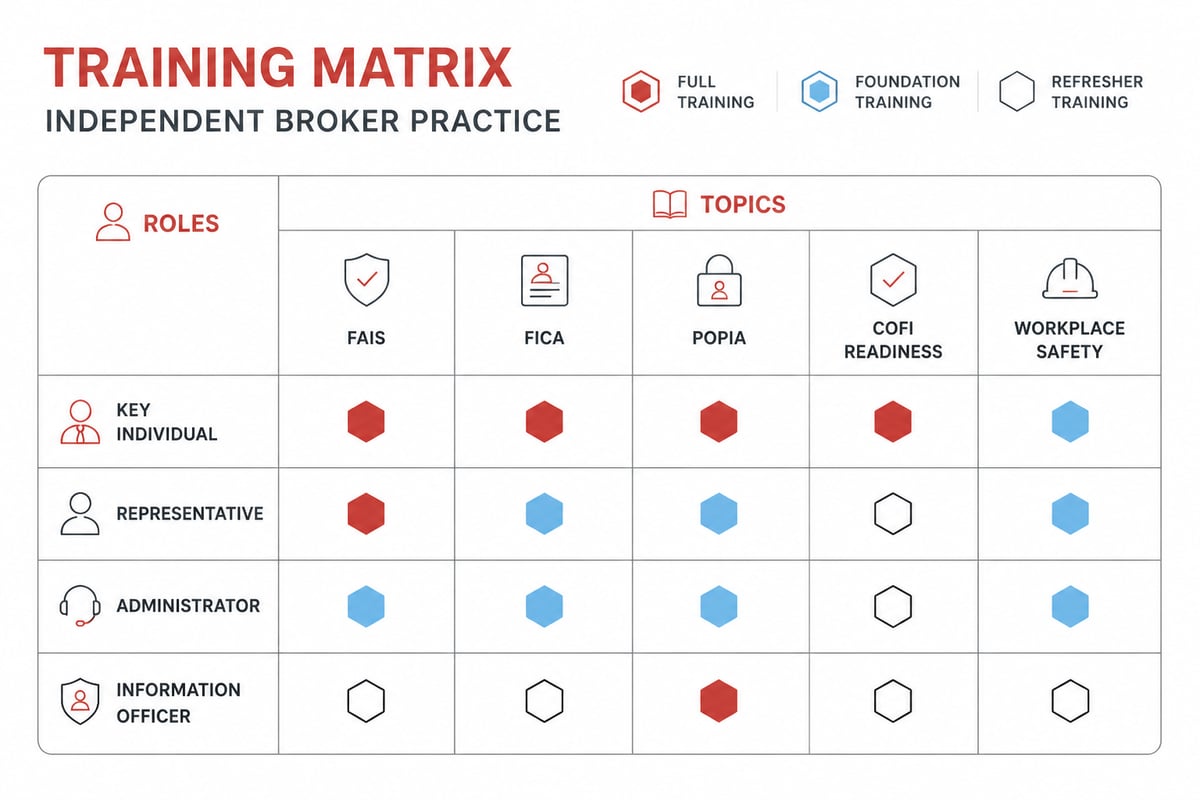
A broker practice needs training in five areas: FAIS fit-and-proper requirements, FICA, POPIA, COFI readiness and general workplace safety. Each has a different audience within the practice and a different refresh cycle.
- FAIS: Representatives must meet fit-and-proper requirements, including regulatory examinations, product-specific competence and continuous professional development. Key individuals carry additional responsibility for supervising representatives.
- FICA: Accountable institutions must identify and verify clients, monitor transactions, report suspicious and unusual activity and keep records. Your Risk Management and Compliance Programme (RMCP) documents how you do this.
- POPIA: Every person who handles client information needs to understand lawful processing, consent, security safeguards and breach notification. Your Information Officer must be registered and trained.
- COFI: The Conduct of Financial Institutions framework is still being developed. Training now means understanding the direction of travel, particularly around treating customers fairly and conduct standards, so your policies do not need rebuilding later.
- Workplace safety: Fire safety, first aid and ergonomics for office staff.
Not everyone needs everything. A receptionist who captures client details needs POPIA and basic FICA awareness. A representative giving advice needs the full set. A compliance officer needs depth in all of them, plus knowledge of how to evidence it.
How to choose safety training services for your team
The best provider for your practice is one that is independent, understands the FSCA's expectations and delivers training tied to your actual workflows. Use the following criteria when comparing options.
- Independence. A provider that also sells products to your practice has a conflict of interest. Independent training means the content serves compliance, not commercial outcomes.
- Relevance to your licence categories. Training for a long-term insurance broker differs from training for a discretionary investment manager. Ask how content is tailored.
- Evidence of completion. You need attendance records, assessments and certificates that you can produce to an FSCA inspector or an auditor.
- CPD recognition. Where training earns continuous professional development points, confirm the accrediting body and the number of points before you book.
- Practical output. Good training leaves you with something usable: a completed checklist, an updated RMCP section or a revised client onboarding form.
- Language and accessibility. OSHA states that required training must be provided in a language employees understand. The principle applies equally to a team whose members are more comfortable in isiXhosa, Afrikaans or English.
Holistic Compliance Management Solutions provides independent compliance and training services to financial service providers, along with practical support that helps advisors manage risk under changing regulation.
When training should happen: onboarding, change and refreshers
Training should happen at three points: when someone joins, when something changes and on a fixed annual cycle. Waiting for an inspection to prompt it is the most expensive approach.
OSHA recommends additional training when changes to facilities, equipment, processes, materials or work organisation could increase hazards, and when workers receive new tasks. In a broker practice, the equivalents are a new CRM or client onboarding platform, a new product provider, an amended Determination of Fit and Proper Requirements, an updated FICA directive or a change of Information Officer.
A simple calendar works well:
- Within the first 30 days: Induction on FICA client identification, POPIA basics, complaints handling and the practice's conflict of interest policy.
- Within 90 days: Role-specific training, including product knowledge and record-keeping standards.
- Annually: Refresher on FICA and POPIA, a review of the RMCP, and CPD planning for every representative.
- On trigger: Training whenever legislation, systems or processes change, or when an incident or near-miss exposes a gap.
Regulators in high-risk industries also build in re-evaluation. For powered industrial truck operators, OSHA requires formal instruction, practical training, a workplace performance evaluation before operation, and operator evaluation at least once every three years, with refresher training when a deficiency is shown. The lesson for FSPs is that competence should be assessed, not assumed from attendance alone.
A POPIA training checklist for broker workflows
POPIA training should follow the path client information takes through your practice, from first contact to archive. The checklist below maps to that path.
Collection
- Staff can explain why each piece of client information is collected and obtain consent where required.
- Fact-find and needs analysis forms contain a clear purpose statement.
- Staff know not to collect information that is not needed for the service.
Storage and security
- Client files, whether physical or digital, are access-controlled.
- Laptops and phones carry encryption and passcodes.
- Email attachments containing ID documents are handled according to policy.
Sharing
- Staff know which third parties (product providers, administrators, auditors) may receive client data and under what agreements.
- Operator agreements are in place with cloud and software providers.
Incidents
- Every team member knows how to report a suspected breach internally, immediately.
- The Information Officer knows when and how to notify the Information Regulator and affected clients.
Retention and destruction
- A retention schedule exists and is applied, balancing FAIS and FICA record-keeping periods against POPIA's limits on holding data.
Keep a signed attendance register and a short assessment for each session. If a complaint reaches the Information Regulator, these records show that the practice took reasonable steps.
FICA and RMCP training: from policy to daily practice
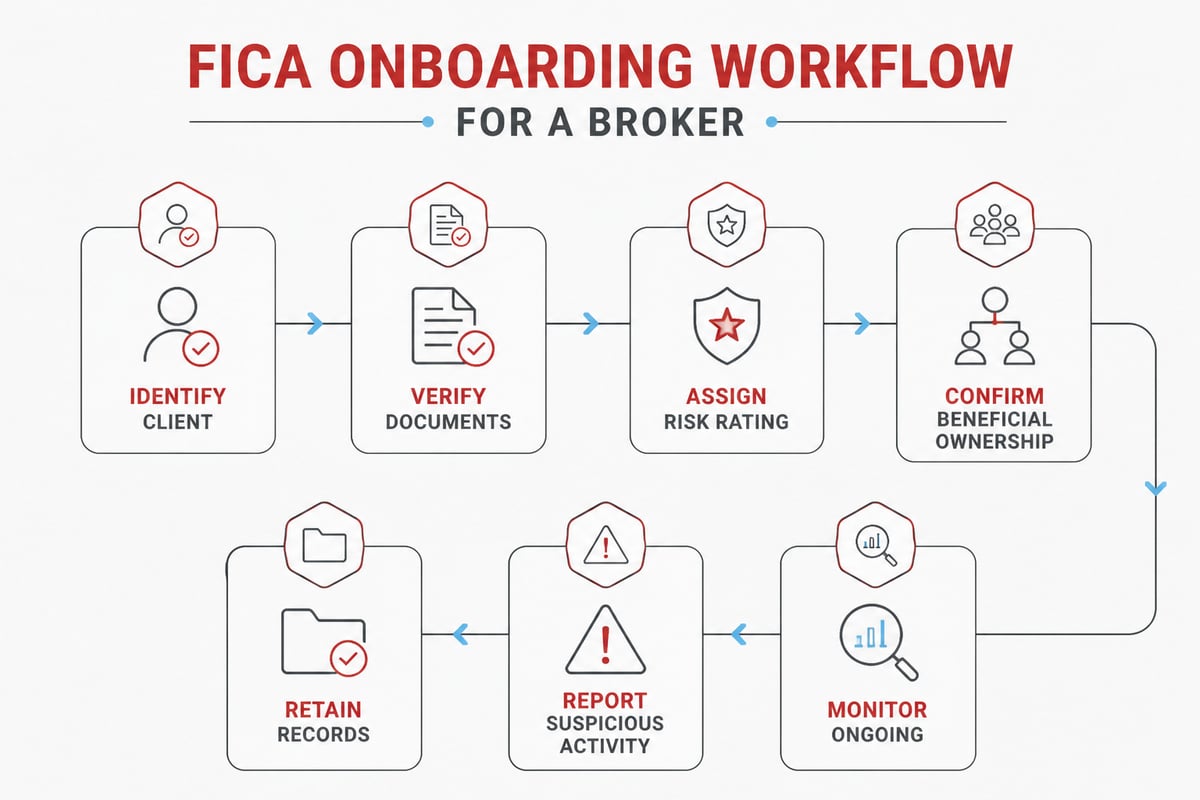
FICA training works when staff can apply the RMCP to a real client file, not merely recite it. The RMCP sets out how your practice identifies, assesses, monitors, mitigates and manages money laundering and terrorist financing risk, and every employee who deals with clients must understand their part in it.
Training should walk through these steps using your own client scenarios:
- Client identification and verification: which documents are acceptable for natural persons, companies, trusts and partnerships, and how to verify them.
- Risk rating: how to classify a client, for example by product, delivery channel, geography and whether the person is a prominent influential person.
- Beneficial ownership: how to identify the individuals behind legal entities.
- Ongoing due diligence: what triggers a review of an existing client.
- Reporting: how to recognise a suspicious or unusual transaction, and how to escalate it to the person responsible for filing with the Financial Intelligence Centre.
- Record-keeping: what to retain, in what form and for how long.
A common weakness is an RMCP that was drafted once and never revisited. Staff then follow habit rather than the written programme, which is exactly the gap an inspector tests. Holistic Compliance Management Solutions assists with FICA and POPI training and offers affordable solutions for drafting your FICA RMCP, which suits practices that need the document and the staff training to match.
FAIS and COFI: keeping representatives competent
Representatives stay competent through exams, continuous professional development and supervised practice, and your training plan should track all three for each person. Under FAIS, key individuals are accountable for the conduct of representatives, so supervision records matter as much as certificates.
Build a representative register that records:
- Licence categories and product subcategories authorised
- Regulatory exam status and dates passed
- Class of business training completed
- CPD points earned and the cycle end date
- Date of the last supervised file review
For COFI, avoid waiting for final commencement dates. Use current training to reinforce principles that will carry over: treating customers fairly, clear and fair disclosure, suitable advice and robust complaints handling. A practice that already documents why a product was recommended and how the client's needs were assessed will find the transition far easier.
Holistic Compliance Management Solutions also provides training for regulatory exams and facilitates internship placements, which can help practices bring new entrants towards full authorisation under supervision.

Workplace safety basics for your office
Even a small advice practice has a duty to keep its premises safe, and the training involved is short but must be documented. Typical elements include fire evacuation drills, first aid nominations, safe electrical practices and ergonomic set-up for screen-based work.
The HSE notes that equipment training should reflect the job, workers' existing competence, the circumstances of work and the equipment itself, and that it may range from in-house instruction to formal external training with competence assessment. A seven-person practice does not need an elaborate programme, but it does need a named fire marshal, a first aider and a record that each has been instructed.
OSHA also publishes training resources for employers that can serve as reference material for building simple induction content, although South African workplaces fall under their own Occupational Health and Safety Act.
Who pays and when: scheduling training sensibly
Training should be scheduled within working hours and funded by the practice, because compliance is a business obligation. The HSE says work-equipment training should normally take place during working hours and at no cost to employees, a sensible benchmark for any practice that wants staff to take sessions seriously.
For smaller practices, practical scheduling options include:
- Block sessions held quarterly, covering one regulatory theme each time
- Short monthly briefings of 30 to 45 minutes on a single topic, such as a new FSCA notice
- Annual compliance day combining the FICA and POPIA refreshers with RMCP review
Whichever format you choose, assign one person to maintain the training file: dates, topics, attendees, assessment results and certificates.
Measuring whether training is working
Measure training by outcomes in the files and processes, not by attendance alone. Useful indicators include:
- The proportion of client files that pass an internal FICA audit on first review
- The number of POPIA incidents reported internally, and the time taken to escalate them
- Assessment scores before and after each session
- Findings in the compliance monitoring report, tracked quarter on quarter
- Complaints received and the time taken to resolve them
An independent compliance monitoring review is valuable here. It tests whether what staff were taught is what they actually do, and it feeds the findings back into the next round of training.
Schedule FICA training for your practice
If you want your team trained on FICA and the RMCP in a way that suits your licence categories and client base, this is the next step. Holistic Compliance Management Solutions delivers FICA training with an independent perspective, and it is suited to independent brokers, regulated brokers, FSP applicants and compliance officers.
A typical FICA training engagement can include:
- Walking your team through client identification, verification and risk rating using realistic broker scenarios
- Reviewing your current RMCP against what your staff actually do day to day
- Guidance on record-keeping, suspicious transaction escalation and CPD evidence
Please contact the company directly to confirm session formats, scheduling and costs.
Start this week by listing every person in your practice who touches client information and noting the last date each completed FICA and POPIA training. If the dates are missing or more than a year old, you have your priority list. Holistic Compliance Management Solutions can help you close those gaps, including through Fica RMCP drafting and training support, and you can Register Now for FICA training and schedule your team’s sessions.