
Online Safety Training Guide for South African FSPs
Who this is for: independent brokers, regulated brokers, FSP applicants and compliance officers in South African financial services practices.
Safety training online is a structured way of teaching staff to protect people, data and the business, and for a South African FSP it covers two things: basic workplace safety under the Occupational Health and Safety Act, and the regulatory "safety" duties that keep a practice out of trouble with the FSCA, the Information Regulator and the Financial Intelligence Centre. A broker's office carries low physical risk, so the greater exposure usually lies in FICA, POPIA and FAIS obligations. This guide explains what to train, how to run it online and how to prove it happened.
What safety training online means for a financial services practice
For an FSP, safety training online means digital courses that cover physical workplace safety and the compliance obligations that protect clients, staff and the licence itself.
The two strands deserve separate treatment because they have different regulators and different evidence requirements.
Workplace safety. Under the Occupational Health and Safety Act, employers must provide a safe working environment, regardless of whether the workplace is an open-plan office in Sandton or a home office in Cape Town. Employers should read the General Safety Regulations made under the Act alongside their existing health and safety arrangements. For most advisory practices, the relevant topics are fire safety, first aid readiness, ergonomics, emergency evacuation and safe remote working.
Regulatory safety. This is where the real exposure sits for brokers. Failure to train staff on FICA can lead to administrative sanctions. Poor handling of client information can lead to a POPIA complaint. Weak record-keeping can undermine a FAIS compliance inspection.
A sensible practice treats both strands as one training calendar. The first strand is usually short and annual. The second is continuous, because regulation changes and staff turnover creates fresh gaps.
Why South African FSPs are moving training online
FSPs are moving training online because it is cheaper to schedule, easier to evidence and simpler to repeat for new staff than classroom sessions.
The practical advantages for an independent practice are clear:
- Flexibility. Advisors can complete modules between client meetings rather than closing the office for a day.
- Consistency. Every staff member receives the same content and the same assessment, which matters when an auditor asks how you trained your team.
- Records. Completion dates, scores and certificates are generated automatically, which supports your compliance file.
- Onboarding. New hires can be trained before they handle client data or onboard a client.
- CPD. Where a course carries continuing professional development points, completion can support your FAIS continuing professional development obligations.
The drawback is quality. Many free courses are generic, written for other jurisdictions and silent on South African law. A UK-style health and safety course, for example, will not teach you about the Financial Intelligence Centre Act or a South African Risk Management and Compliance Programme. Generic safety courses can supplement your programme, but they cannot replace training built around local law. Examples of such general offerings include a Level 2 health and safety e-learning course from a UK provider, which illustrates the format but is not tailored to FAIS or FICA.
FAIS training: keeping advisors fit, proper and current
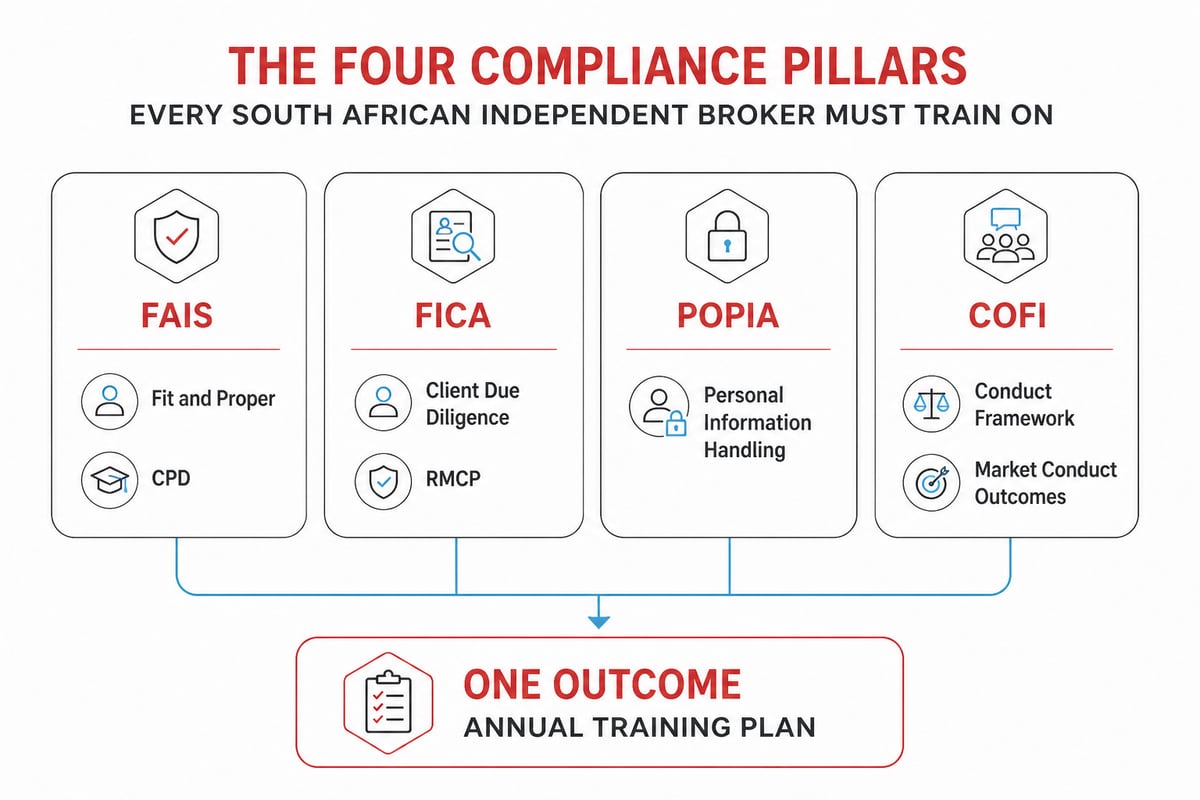
FAIS training online should confirm that every representative meets the fit and proper requirements and keeps up their continuing professional development.
Under the Financial Advisory and Intermediary Services Act, a Key Individual is responsible for oversight of representatives, so training records are part of the KI's evidence. Online modules work well for:
- Regulatory examination preparation, where candidates need structured revision before sitting an FSCA-approved exam
- Product-specific training required for the categories on your licence
- Treating Customers Fairly outcomes and how they appear in advice files
- Complaints handling procedures and record keeping
- Conflict of interest management and disclosure
A FAIS training checklist for brokers
- List every representative and the licence categories they are authorised to advise on.
- Record each person's exam status, product accreditation and CPD cycle dates.
- Schedule refresher training before the cycle closes, not after.
- Keep certificates and attendance records in one folder, labelled by person and year.
- Review the list whenever you add a representative or a new product category.
If you are applying for a licence, the training file is also part of your readiness. Applicants should be able to show that competence, operational ability and compliance arrangements exist before the application is lodged.
FICA training: building client due diligence into daily workflow
FICA training should teach staff how to identify clients, verify information, spot suspicious activity and report to the Financial Intelligence Centre.
Accountable institutions, which include many financial services providers, must have a Risk Management and Compliance Programme, commonly called an RMCP, and must train employees on it. A programme that sits in a drawer is not compliant. Staff must understand it and apply it at onboarding.
What FICA training should cover
- Identifying and verifying clients, including natural persons, companies, trusts and partnerships
- Understanding beneficial ownership
- Risk-rating clients and applying enhanced due diligence to higher-risk relationships
- Screening against targeted financial sanctions lists
- Recognising unusual and suspicious transactions and escalating internally
- Reporting duties, including suspicious and unusual transaction reports
- Record keeping and retention periods
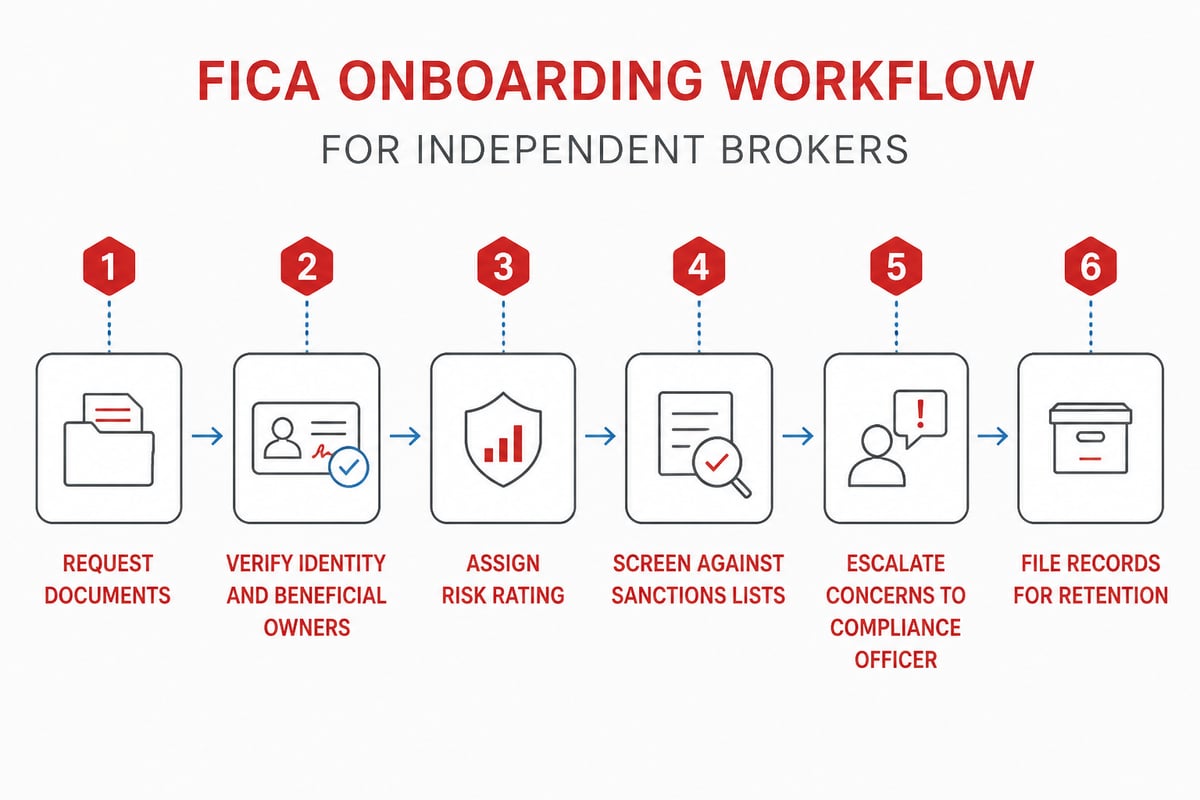
Practical workflow steps for a broker
- Before the first meeting: confirm which documents the client must provide.
- At onboarding: verify identity, address and, where relevant, entity structure and beneficial owners.
- Risk rate: assign a risk rating according to your RMCP and record the reasoning.
- Screen: check the client and related parties against sanctions lists.
- Escalate: pass any concern to your compliance officer the same day.
- File: store everything in a structured, retrievable format.
Holistic Compliance Management Solutions offers FICA training that gives practices a structured starting point for this strand. For practices that need a documented programme as well as trained staff, Fica RMCP support covers FICA and POPIA training and the drafting of your RMCP, so the programme staff are trained on is the one the practice actually uses.
POPIA training: protecting personal information in a broker's practice
POPIA training should ensure every person who touches client data understands the eight conditions for lawful processing and what to do when something goes wrong.
Brokers process large volumes of sensitive information: identity numbers, bank details, health data for life and medical products, and financial histories. The Protection of Personal Information Act requires responsible parties to secure that information, and a data incident can lead to complaints to the Information Regulator and reputational damage with clients.
Topics to include
- The eight conditions for lawful processing, in plain language
- Your role as responsible party and the role of operators, such as software providers and outsourced administrators
- The designated Information Officer and their registration with the Information Regulator
- Consent and the lawful basis for processing, including direct marketing rules
- Security safeguards: passwords, device encryption, secure email and document sharing
- Retention and destruction of records, balanced against FICA and FAIS retention duties
- Responding to a data subject request
- Breach notification: who to tell, how fast and what to record
A POPIA readiness checklist
- Appoint and register an Information Officer
- Maintain a personal information inventory showing what you hold, where and why
- Keep a current privacy notice and consent wording in client onboarding forms
- Put written agreements in place with operators who process data for you
- Document your breach response procedure and test it once a year
- Train every staff member on joining and at least annually afterwards
Remote work deserves specific attention. An advisor working from home on a personal laptop with a shared family printer is a POPIA risk that no office policy will fix without training and clear rules.
COFI and market conduct: preparing your practice for what is coming
COFI training online should help brokers understand the Conduct of Financial Institutions Bill's direction of travel so that today's processes do not need rebuilding later.
The COFI Bill is intended to consolidate and replace parts of the existing conduct framework, including elements of FAIS, with a more outcomes-focused approach to how financial institutions treat customers. Final commencement and the detail of subordinate rules are matters to confirm with the FSCA and your compliance adviser, so avoid hard-coding assumptions into training material.
What a practice can do now:
- Build training around customer outcomes rather than box-ticking: Is the product suitable? Was the disclosure clear? Was the complaint resolved fairly?
- Strengthen advice file documentation, because outcomes-based supervision depends on evidence of reasoning
- Review fee disclosures, conflicts and remuneration practices
- Record the training you provide on conduct topics, so you can show a consistent culture over time
Treat COFI as a prompt to improve the quality of conduct training, not as a separate programme that begins only when legislation is finalised.
How to choose safety training online for your practice
Choose safety training online by testing it against a short set of criteria: local law, assessment, evidence and relevance to your licence.
| Criterion | What to look for |
|---|---|
| South African content | References FAIS, FICA, POPIA and FSCA expectations, not foreign law |
| Role relevance | Separate or adaptable content for advisors, administrators and compliance officers |
| Assessment | A graded test with a pass mark, not just a "mark as complete" button |
| Evidence | Downloadable certificates with names, dates and course titles |
| CPD value | Clear statement of CPD points where applicable |
| Currency | Evidence that content is updated when regulation or guidance changes |
| Support | Access to a person who can answer practice-specific questions |
Be cautious about volume. Many general online health and safety courses exist, but they seldom address the licence conditions that matter for an FSP. Use them for workplace basics and use specialist providers for compliance.
It is also sensible to keep statistics in proportion. National injury and fatality figures for heavy industry should not be read as a picture of risk in a financial advisory office. The case for training in your practice rests on regulatory obligations and data protection, not on industrial injury rates.
Building a training programme that survives an inspection
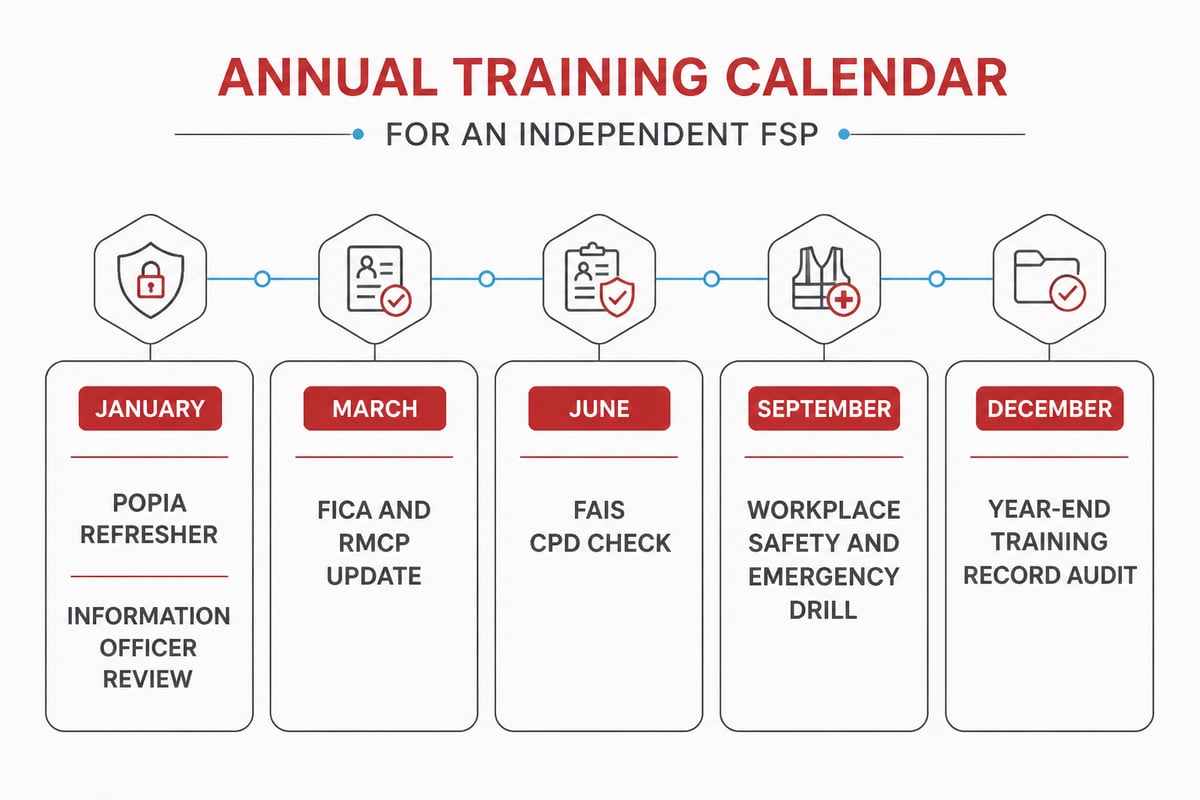
A defensible programme has a plan, a record and a review cycle, and each of the three is simple to maintain.
Step-by-step implementation guidance
- Map obligations. List what applies to your licence categories: FAIS, FICA, POPIA and any workplace safety duties.
- Map people. Assign each person the modules that match their role, from new administrator to Key Individual.
- Set the calendar. Fix annual refreshers and trigger-based training for new hires, new products and incidents.
- Assess. Require a pass mark and keep the result.
- Record. Maintain a training register with name, course, date, score and certificate reference.
- Review. Once a year, compare the register against staff changes and regulatory updates, then close the gaps.
- Act on findings. Where a compliance monitoring visit or internal review reveals weak practice, add targeted training on that topic within a stated period.
What an inspector may ask to see
- Your RMCP and evidence that staff were trained on it
- Your POPIA documentation and Information Officer registration
- Fit and proper and CPD records for each representative
- Advice files showing the application of the training in real client work
- Evidence that issues found previously were corrected
Independent compliance monitoring helps here. An outside reviewer can test whether the training translated into behaviour, which an internal review sometimes misses because the people checking the files are the people who wrote the process.
Common mistakes in online compliance training
Most weaknesses in online training come from a few repeatable errors that are easy to correct.
- Training once and filing it. A single induction course does not satisfy continuing obligations. Schedule refreshers.
- No link to workflow. Staff who pass a quiz but use an outdated onboarding form have not been trained in any useful sense.
- Weak records. If you cannot show who trained, when and with what result, an inspector may treat the training as not having happened.
- Ignoring part-time and outsourced staff. Anyone who handles client data or onboarding needs the same baseline.
- Over-reliance on generic content. General health and safety, cyber awareness or customer service courses do not replace FICA, POPIA and FAIS content.
- No ownership. Appoint one person, usually the compliance officer or Key Individual, to own the training calendar.
A short quarterly check helps. Ask whether any new staff joined, any new products were added, any regulation changed and any incident occurred. If the answer to any is yes, training probably needs to follow.
Frequently asked questions
Is online training accepted for FICA and POPIA compliance?
Yes, provided the content is accurate, staff understand it and you keep evidence of completion. The law requires that training takes place and that you can demonstrate it, rather than prescribing a classroom format.
How often should brokers repeat compliance training?
At least annually for core topics, and sooner when legislation, internal procedures or staff roles change. New staff should be trained before they handle client information or onboarding.
Do solo advisors need a formal training programme?
Yes. A sole practitioner is still the responsible party under POPIA, an accountable institution under FICA where applicable, and a representative under FAIS. A smaller practice may need less material, but it still needs a plan and a record.
Can general health and safety e-learning count towards FAIS CPD?
Only if the provider states that it carries CPD value recognised for your category of activity. Check this before relying on any course for CPD purposes.
What should an FSP applicant train on before applying for a licence?
Applicants should be able to show competence in the activities they intend to perform, along with workable compliance arrangements covering FAIS, FICA and POPIA. Training records help support the application.
Your next step is to open a spreadsheet today and list every person in your practice against the FAIS, FICA and POPIA training each one has completed in the past twelve months, because the gaps will tell you exactly where to start. If FICA is the largest gap, schedule FICA training and take the structured route: Holistic Compliance Management Solutions provides independent, practical support so advisors can run a sustainable business under changing regulation, including help with your Fica RMCP. Register Now to secure your place and put a documented, evidence-ready training programme in place.