
Compliance Safety Training Guide for Financial Teams
Who this is for: independent brokers, regulated brokers, FSP applicants and compliance officers.
Compliance safety training is structured instruction that teaches financial services staff the laws, controls and behaviours that keep clients, data and the practice itself protected. For South African independent brokers and Financial Service Providers (FSPs), that means practical, role-specific training on FAIS, FICA, POPIA and the incoming COFI framework, repeated regularly and proven by records. Training that is recorded, role-based and tested is what a regulator, an auditor or a product provider will look for when they review your practice.
What compliance safety training means for a financial practice
In a financial practice, compliance safety training covers the instruction that prevents regulatory breaches, client harm and data loss, rather than physical workplace hazards alone. The "safety" element is the protection of clients' money, personal information and trust.
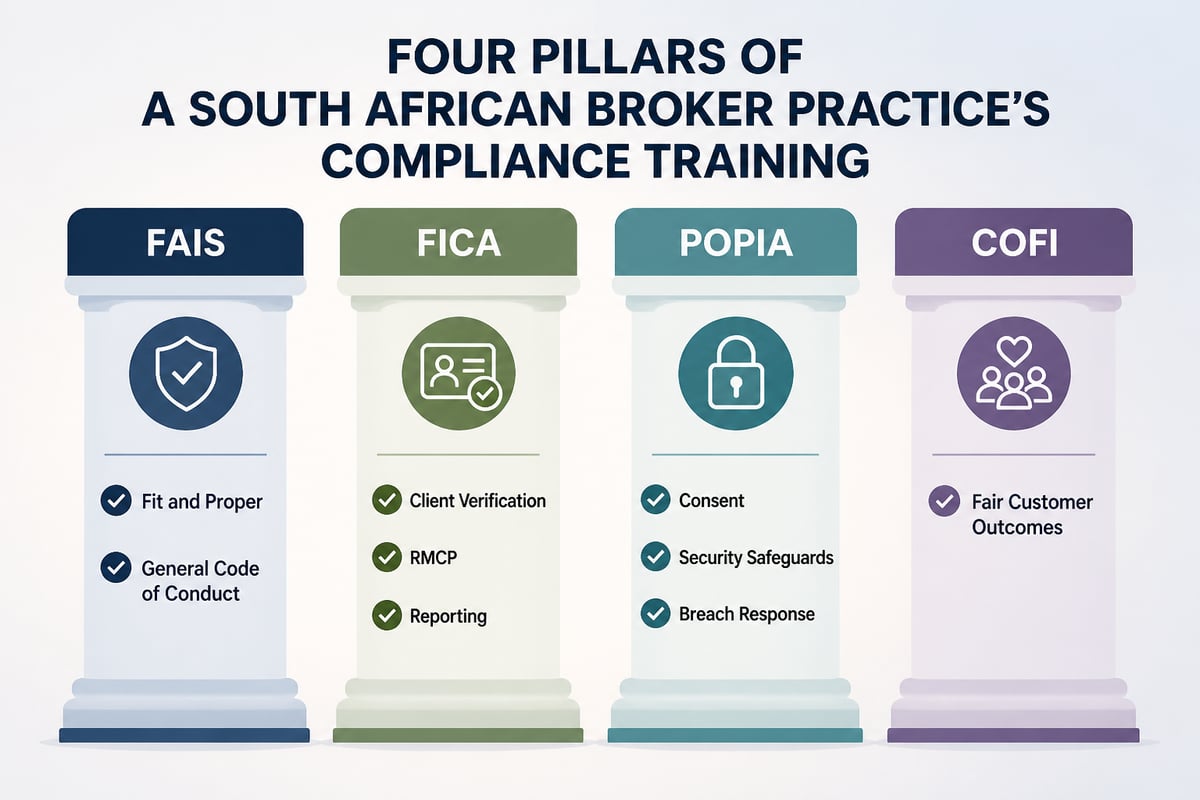
For an independent broker practice, four legal frameworks shape the content:
- FAIS (Financial Advisory and Intermediary Services Act): fit and proper requirements, the General Code of Conduct, advice records, disclosure and complaints handling.
- FICA (Financial Intelligence Centre Act): client identification and verification, risk-based due diligence, suspicious and unusual transaction reporting, and the Risk Management and Compliance Programme (RMCP).
- POPIA (Protection of Personal Information Act): lawful processing of client data, consent, security safeguards, breach notification and the role of the Information Officer.
- COFI (Conduct of Financial Institutions Bill): the planned market conduct framework intended to consolidate and replace parts of existing conduct requirements, built around the fair treatment of customers.
Because COFI is still progressing through the legislative process, the sensible approach is to build training that already reflects Treating Customers Fairly outcomes. Your team will then be prepared whichever way the final provisions land.
Why regulators expect evidence of training, not attendance alone
Regulators judge training on whether it changes behaviour and whether the practice can prove it. Attendance registers are a starting point, not the finish line.
Although it is a UK regulator, the Financial Conduct Authority sets out principles that are useful benchmarks for any conduct regime. The FCA says firms should provide Conduct Rules training relevant to employees’ roles, use interactive and realistic scenarios, reinforce the training regularly, include it in onboarding and assess its effectiveness. It also states that firms must review employee competence and training needs regularly and monitor training effectiveness against its objectives.
For a South African FSP, the same logic maps neatly onto your obligations:
- The Financial Sector Conduct Authority (FSCA) expects key individuals and representatives to remain competent, which includes ongoing continuous professional development (CPD).
- The Financial Intelligence Centre expects accountable institutions to train staff on the RMCP and to be able to show that they did.
- The Information Regulator expects responsible parties to take reasonable steps to secure personal information, which includes staff awareness.
A practice that can produce dated attendance records, assessment results and a training plan tied to identified risks is in a far stronger position during an inspection than one holding only certificates.
A role-based training matrix for broker practices
A role-based matrix assigns each staff member only the training their duties require, which keeps sessions relevant and records defensible. A small practice often has a key individual, a few representatives and one or two administrators, and each group faces different risks.
| Role | Core topics | Suggested frequency |
|---|---|---|
| Key individual / principal | FAIS governance, supervision of representatives, RMCP oversight, POPIA accountability | Annually, plus on regulatory change |
| Representatives / advisors | General Code of Conduct, needs analysis and advice records, disclosures, FICA verification, complaints | Onboarding, then at least annually, with CPD tracking |
| Administrators / support staff | FICA document collection, POPIA data handling, phishing awareness, secure record storage | Onboarding, then every six months |
| Information Officer | POPIA registration, PAIA manual, breach notification, operator agreements | Annually |
| Compliance officer | Regulatory updates, monitoring methodology, reporting to the FSCA and FIC | Continuous, with at least annual formal refresh |
Keep the matrix as a living document. Review it each time you hire, change a process or take on a new product provider.
FAIS training: the foundation of an advice practice
FAIS training should ensure every representative can explain, and evidence, how they meet fit and proper requirements and the General Code of Conduct in daily advice.
Focus the sessions on the moments where brokers most often slip:
- Needs analysis and record of advice: the client's circumstances, the reasons for the recommendation and the alternatives considered must be on file, not remembered.
- Disclosure: representatives should know exactly which disclosures are required before and during a transaction, including remuneration and conflicts of interest.
- Product suitability: the advice must match the client's stated needs and risk profile, particularly with replacement business.
- Complaints handling: staff must recognise a complaint, even when it is raised informally, and escalate it within the practice's procedure.
- Debarment and honesty: representatives need to understand the consequences of misrepresentation and of non-disclosure to the FSP.
If you are an applicant for a licence, training should begin before you submit. Your key individuals need to demonstrate competence and your compliance arrangements must be credible from the first day of operation.
FICA and RMCP training: turning the programme into daily practice
FICA training works when staff can apply the RMCP at the point where a client is onboarded, rather than only recite its sections. The RMCP is your written risk-based approach to client due diligence, and it is only effective if every person who touches a client file understands it.
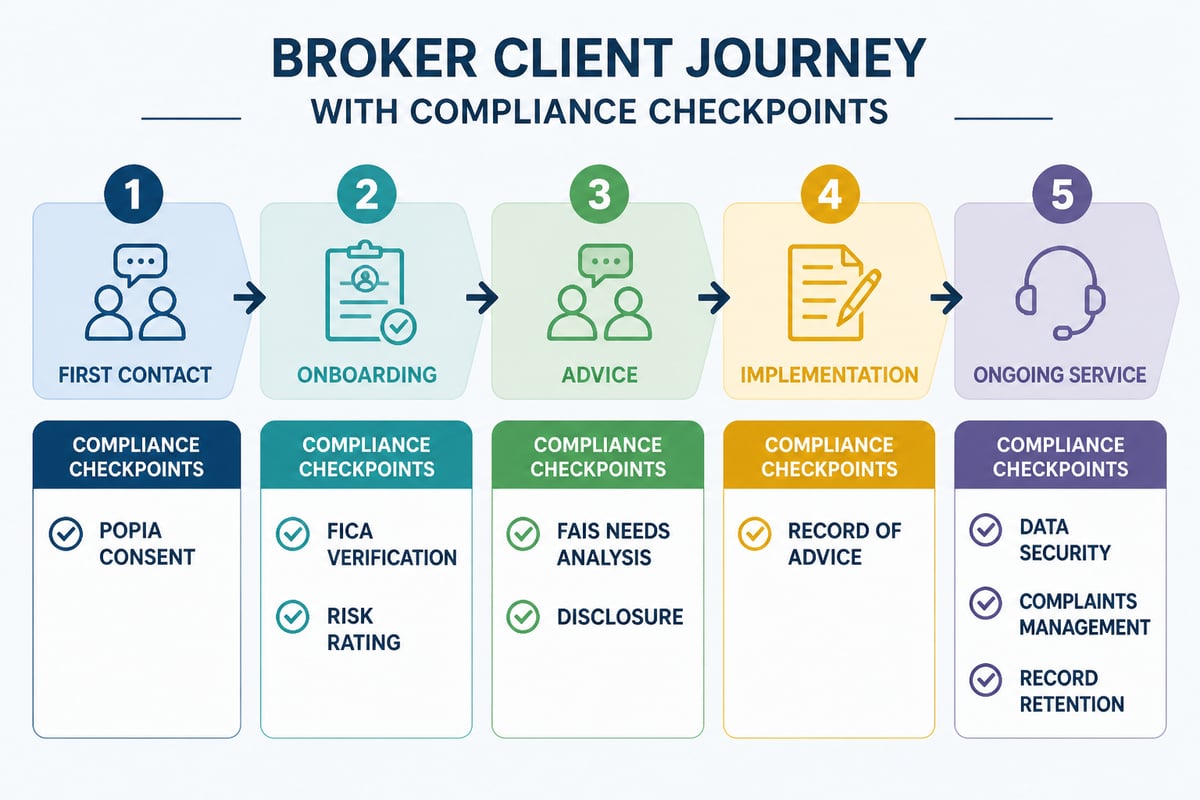
A practical FICA training session should walk staff through the real onboarding workflow:
- Identify the client type: natural person, company, trust or partnership, because each requires different documents.
- Verify identity and address: collect and check the required documents against originals or reliable sources.
- Establish the beneficial owner: for legal entities, understand who ultimately owns or controls the client.
- Risk-rate the client: apply the criteria in your RMCP and document the outcome.
- Screen against sanctions and prominent-person lists: and record the result.
- Recognise and report: know what constitutes a suspicious or unusual transaction and how to escalate to the money laundering reporting officer without tipping off the client.
- Retain records: keep the information for the legally required period and be able to retrieve it.
Many practices find that an RMCP downloaded as a template does not match how they actually work, which creates a gap between the document and behaviour. Holistic Compliance Management Solutions offers FICA RMCP drafting together with FICA and POPIA staff training. Its FICA RMCP service assists insurance brokers stay compliant and mitigates risk.
POPIA training: protecting client information in everyday workflows
POPIA training should teach staff how to handle client information lawfully at each stage of a broker's workflow, from first quote to archived file. Brokers collect identity documents, bank details, medical information and financial statements, which makes them attractive targets and heavily regulated custodians.
Cover these practical points with all staff:
- Purpose and consent: collect only what is needed for the stated purpose and record the client's consent or the lawful basis for processing.
- Special personal information: health data collected for life and medical products requires heightened care.
- Sharing with product providers and operators: use written operator agreements and share only what the provider needs.
- Security safeguards: screen locks, encrypted devices, secure document portals and no client files on personal messaging apps.
- Breach response: staff must know to report a suspected breach internally at once, so the Information Officer can assess notification duties to the Information Regulator and affected clients.
- Data subject requests: clients may ask to access or correct their information, and staff should know who handles those requests.
Cyber awareness belongs here too. FINRA identifies periodic staff training to recognise and thwart phishing and social-engineering tactics as an effective cybersecurity practice. Although FINRA regulates US broker-dealers, the principle of periodic phishing awareness applies to any practice that handles client payments and correspondence by email. FINRA's wider cybersecurity overview is a helpful reference for tabletop exercises and incident response planning.
Preparing for COFI without waiting for the final text
Preparing for COFI means embedding fair customer outcomes into training now, because the framework's direction of travel is already clear. The Bill is designed around how customers are treated across the product life cycle, from design and marketing to servicing and complaints.
Practical preparation steps include:
- Map your current conduct obligations against the draft principles and identify where your processes rely on informal habits.
- Introduce outcome-focused scenarios into FAIS sessions, such as a client who does not understand a policy exclusion or a vulnerable client facing a replacement recommendation.
- Review your product provider agreements and your own distribution practices for fairness and clarity of communication.
- Track management information on conduct, such as complaint volumes, lapse rates and replacement business, so you can show the practice monitors customer outcomes.
Treat this as an extension of your existing FAIS training, not a separate programme. Practices that already document how they treat customers fairly will find COFI far less disruptive.
How often to train and when to retrain
Train at onboarding, refresh at least annually, and retrain whenever something changes that could create new risk. A single yearly session is rarely enough to keep behaviour consistent.
Triggers that should prompt additional training include:
- A change in legislation, regulator guidance or a Financial Intelligence Centre directive.
- A new product provider, product type or distribution channel.
- A new system, CRM or document platform that alters how client data is handled.
- A compliance incident, a near miss or a finding from monitoring.
- A staff member moving into a new role with different duties.
OSHA, writing about workplace safety, makes the same point: it recommends additional training when changes to facilities, equipment, processes, materials or work organisation could increase hazards, and when a worker receives a new task. The setting differs, but the principle transfers well. A new onboarding platform is a process change, and a new administrator is a new task, so both warrant fresh training.
A simple annual calendar for a small practice might look like this:
- Quarter one: FICA and RMCP refresher, including sanctions screening and reporting.
- Quarter two: POPIA and cyber awareness, including a phishing simulation.
- Quarter three: FAIS General Code of Conduct, record of advice and complaints.
- Quarter four: regulatory update, COFI readiness and review of the training matrix.
A practical checklist for building your training programme
A workable programme can be built in a few weeks if you follow a clear sequence and keep records from the start. Use this checklist as a starting point for your practice.
Planning
- Identify every role and list the laws and procedures each one touches.
- Complete or update your risk assessment so training targets real exposures.
- Appoint someone accountable for the training plan, usually the compliance officer or key individual.
Delivery
- Use your own forms, client files and systems in examples, with identifying details removed.
- Include short scenarios that require a decision, such as an unusual cash deposit or a client requesting data deletion.
- Allow time for questions, because the questions reveal where the real confusion sits.
Assessment and records
- Test understanding with a short quiz or case discussion and record the results.
- Keep dated attendance registers, materials used, assessment scores and trainer details.
- Record CPD hours for representatives against their individual requirements.
Review and improvement
- Compare incidents and monitoring findings against the training delivered.
- Update content after every regulatory change or internal failure.
- Report training completion and effectiveness to the principal or board at least annually.
The FCA's guidance on credit brokers sets out similar expectations on staff training and standards of behaviour, and illustrates how a regulator reads a firm's training records as evidence of its conduct culture.
Using compliance monitoring to test whether training works
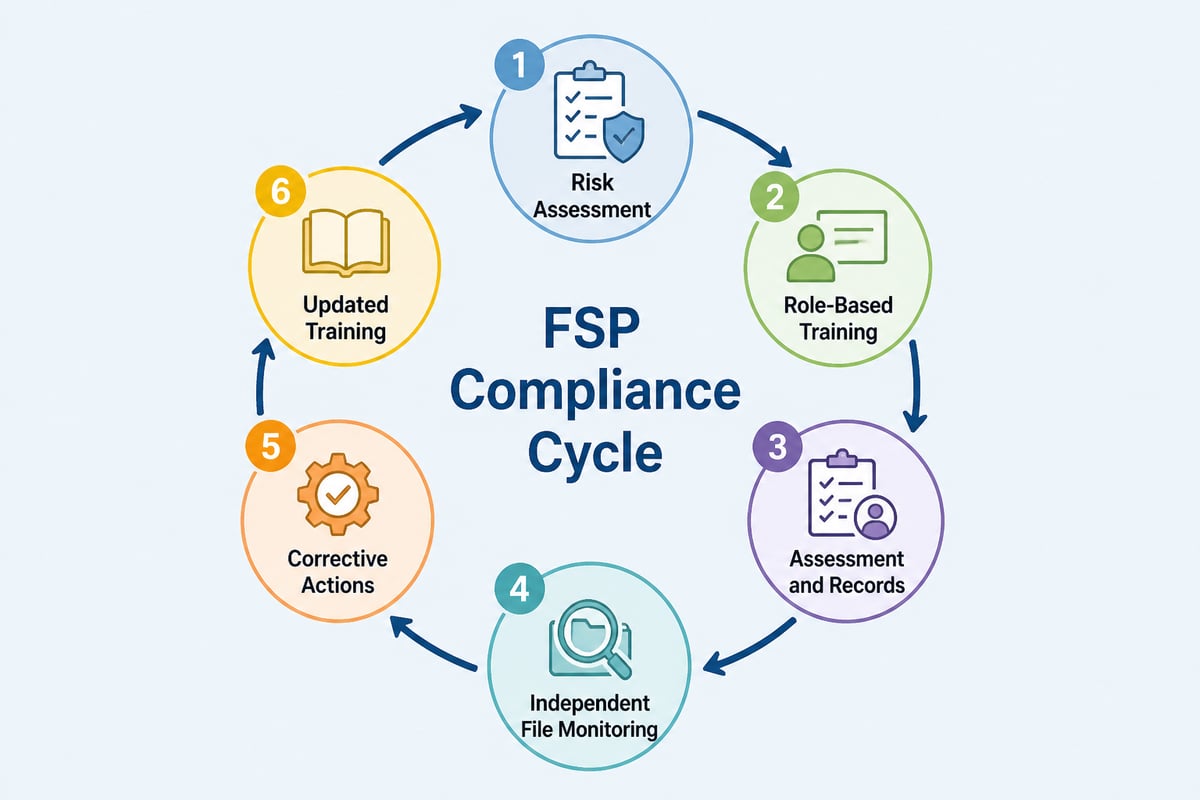
Independent compliance monitoring shows whether training has changed behaviour by sampling real files and processes against the standard you taught. If staff pass a quiz but client files still lack proof of address, the training has not landed.
A monitoring cycle for a broker practice typically includes:
- File reviews: a sample of client files checked for FICA documents, risk ratings, records of advice and POPIA consent.
- Process walk-throughs: observing how a new client is onboarded from first call to policy issue.
- Complaints and incident log review: looking for patterns that point to a training gap.
- Findings and corrective actions: each exception is recorded, assigned an owner and a deadline, and followed up.
Feed the results straight back into the next training session. If three files in a sample missed the beneficial owner step for company clients, the next FICA session should centre on exactly that step. This loop between monitoring and training is what turns a compliance calendar into a functioning control environment.
Common mistakes in compliance safety training for brokers
The most frequent failures are generic content, one-off delivery and missing records, all of which are avoidable. Recognising them early saves cost and reduces regulatory exposure.
- Generic content: off-the-shelf courses that never mention your products, systems or client types are quickly forgotten.
- Training only the advisors: administrators handle the most client documents and often cause the most POPIA and FICA errors.
- No link to the RMCP: staff trained on general anti-money laundering concepts but not on your own programme will apply it inconsistently.
- Ignoring part-time and new staff: interns and temporary staff need onboarding training before they touch client files.
- No evidence: a session that happened but left no register, material or assessment cannot be proven later.
- Treating training as a cost: a single penalty, debarment or breach notification typically costs far more than a year of structured training.
Internship placements deserve a mention here. Practices that take on new entrants should build compliance instruction into the first weeks, because a new graduate learning on the job without structure is both a risk and a missed opportunity to build a strong compliance culture from the start.
Quick-start steps for the next 30 days
You can establish a defensible baseline within a month by acting on a short list of priorities.
- List all staff and their roles, then assign each to the training matrix above.
- Confirm your RMCP is current and matches how clients are actually onboarded.
- Verify your Information Officer registration and breach response procedure.
- Schedule the first FICA and POPIA sessions and set a date for a phishing awareness exercise.
- Create a training register template and begin recording from the first session.
- Book an independent file review for the following quarter to test results.
Consistent, documented effort is what separates a compliant practice from one that is merely hopeful. Start small, record everything and improve each cycle.
Start by listing every person in your practice who handles client information and checking whether each has documented FICA, POPIA and FAIS training from the last twelve months. If gaps appear, the quickest fix is structured, workflow-based instruction tied to your own RMCP. Holistic Compliance Management Solutions, established in Cape Town in 2018, provides independent compliance monitoring, regulatory exam training and practical staff instruction to financial service providers. To schedule FICA training for your team, contact us through Holistic Compliance Management Solutions, and expect:
- A walk-through of your RMCP applied to real onboarding and reporting scenarios
- Role-based sessions for brokers, administrators and key individuals, with attendance and assessment records
- A short list of corrective actions drawn from your own client file practices