
Safety Solutions Guide for Financial Service Providers
Who this is for: independent brokers, regulated brokers, FSP applicants and compliance officers.
Safety solutions for a financial service provider are the controls, records and routines that protect clients, client data and your licence while keeping you inside FAIS, FICA, POPIA and, increasingly, COFI requirements. For an independent practice, that means documented processes, trained staff and regular monitoring, not a folder of policies that nobody opens. This guide sets out what to put in place, in what order, and how to build it into the way a broker actually works day to day.
What Safety Solutions Mean for a South African FSP
In a financial services setting, safety solutions are the protective measures that stop regulatory breaches, data leaks, financial crime and advice failures before they harm a client or your practice.
The word "safety" is broader than most advisors first assume. It covers four distinct risk areas, each with its own regulator and its own consequences:
- Conduct and licensing risk under the Financial Advisory and Intermediary Services Act (FAIS), overseen by the Financial Sector Conduct Authority (FSCA).
- Financial crime risk under the Financial Intelligence Centre Act (FICA), supervised by the Financial Intelligence Centre (FIC).
- Personal information risk under the Protection of Personal Information Act (POPIA), enforced by the Information Regulator.
- Market conduct risk under the incoming Conduct of Financial Institutions (COFI) Bill, which is intended to consolidate and strengthen conduct rules.
A small practice rarely fails because it ignored the law entirely. It fails because a single gap, such as an out-of-date client file, an unsigned mandate or a shared inbox with no access controls, sits unnoticed until an inspection or an incident exposes it.
Treat these four areas as one connected system. A client onboarding step, for example, touches all four at once: you collect identity documents (FICA), record the needs analysis (FAIS), store the data (POPIA) and deliver fair outcomes (COFI principles).
Mapping Your Risks Before You Choose Controls
Start with a risk map, because controls that are not tied to a specific risk waste time and leave real gaps.
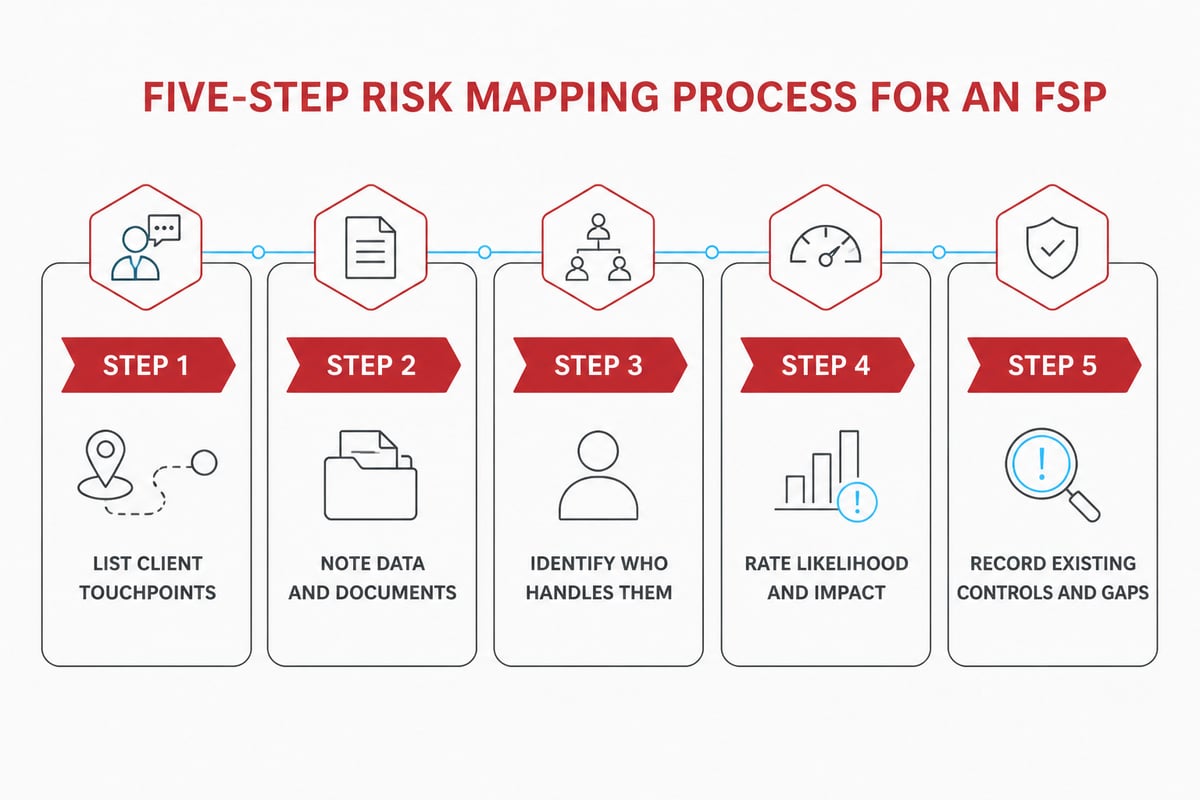
A practical map for an independent practice takes an afternoon and follows five steps:
- List every client touchpoint: lead capture, first meeting, needs analysis, product recommendation, application, onboarding, ongoing servicing, claims and offboarding.
- Note what data and documents move at each point: ID copies, proof of address, bank statements, health information for risk products, signed mandates.
- Identify who handles them: principal, representatives, administrators, outsourced bookkeepers, product providers and any IT supplier.
- Rate each touchpoint for likelihood and impact of failure, using a simple high, medium and low scale.
- Record the control that currently exists and mark where there is none.
The output is a short register. High-impact items with no control become your first priorities. This register also becomes evidence of a risk-based approach, which both the FSCA and the FIC expect to see.
FAIS and Licensing Safeguards for Independent Practices
The core FAIS safeguard is a licence that matches what you actually do, supported by a compliant representative structure and a fit-and-proper file that stays current.
Many practices drift out of alignment over time. A broker starts advising on a new product category without extending the licence authorisation, or a new representative begins work before debut and regulatory exam requirements are met. Both are conduct failures with licence consequences.
Licence and representative checks
Run these checks at least quarterly:
- Confirm every category and sub-category you advise on appears on your FSP licence.
- Verify each representative's approval, key individual status and regulatory exam results are on file.
- Check that continuous professional development (CPD) hours are on track for every advisor.
- Confirm that supervision arrangements for new or provisional representatives are documented.
- Review any outsourced or third-party arrangements for conflicts of interest.
Advice record safeguards
Your advice file is your strongest defence if a client complaint reaches the Ombud. A defensible file contains the signed mandate, the needs analysis, the record of advice explaining why a product suits the client, disclosures and evidence that the client understood them. Build the file template once and make it non-negotiable for every client.
Preparing for an FSCA inspection
Inspections reward preparation. Keep your key documents in one indexed location: licence, compliance reports, complaints register, conflict of interest policy, fit-and-proper evidence and training records. A practice that can produce these within the hour signals control; one that scrambles signals the opposite.
FICA and RMCP Controls That Hold Up Under Review
FICA safeguards rest on a Risk Management and Compliance Programme (RMCP) that you have written for your own practice, applied to every client and kept alive through training and review.
An RMCP copied from a template and never adapted is one of the most common weaknesses in small practices. The FIC expects the document to describe how your business identifies and rates risk, so it must reflect your client mix, products, delivery channels and geography.
Elements an RMCP must address
A sound programme covers, in your own words and for your own workflow:
- Client due diligence: identification and verification procedures for natural persons, companies, trusts and other entities.
- Beneficial ownership and the identification of the people behind legal entities.
- Risk rating of clients and the enhanced due diligence applied to higher-risk clients, including prominent persons.
- Screening against targeted financial sanctions lists.
- Record-keeping periods and storage methods.
- Detection and reporting of suspicious and unusual transactions, and cash threshold reporting where applicable.
- Roles, including the person responsible for compliance, and staff training.
- Periodic review of the programme itself.
A workable onboarding checklist
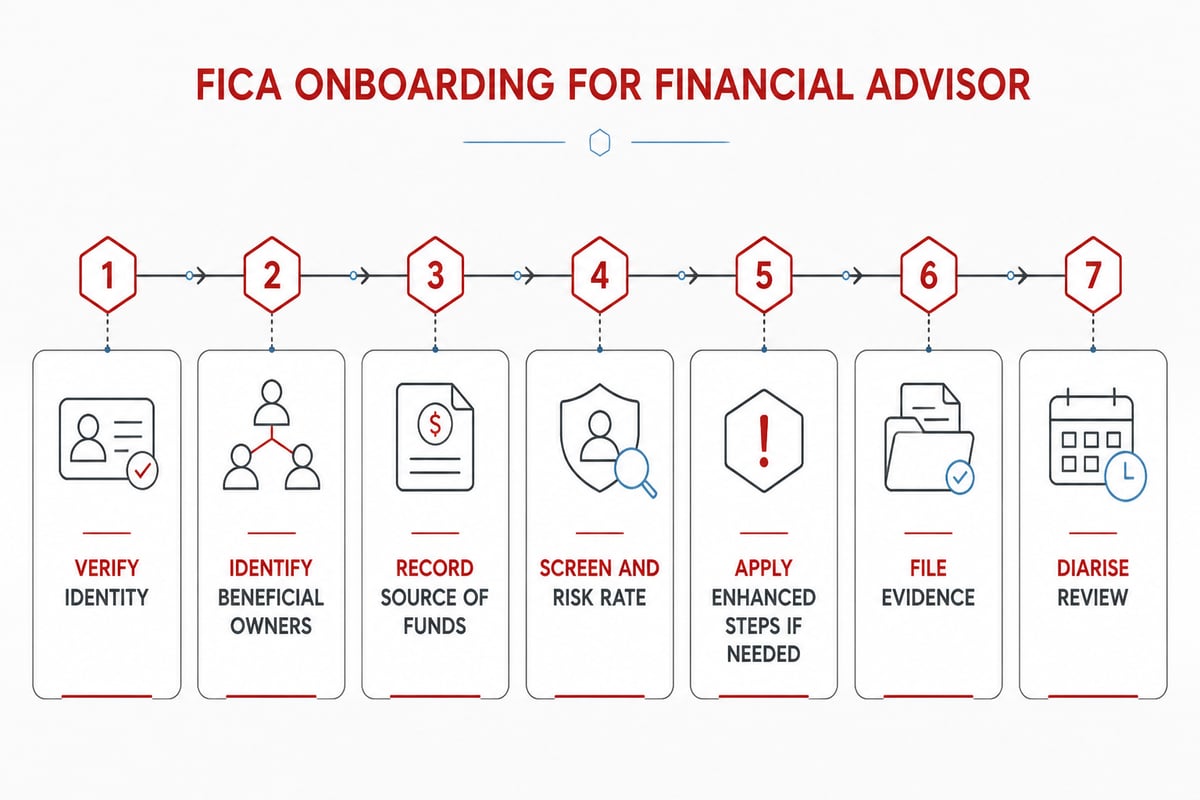
Use this at the moment a client is onboarded, not weeks later:
- Collect and verify identity and address documents.
- For entities, obtain founding documents and identify beneficial owners.
- Record the source of funds and the purpose of the relationship.
- Screen the client and assign a risk rating.
- Apply enhanced steps if the rating is high.
- File the evidence in a retrievable client record.
- Diarise the next review according to the risk rating.
Training is the control that makes the rest function. Everyone who touches client onboarding, including administrators, needs to understand why each step exists and what to do when something looks wrong. Holistic Compliance Management Solutions (Pty) Ltd offers FICA training, which gives your team a structured starting point.
POPIA Safety Solutions for Client Data
POPIA requires you to protect personal information with reasonable technical and organisational measures, and for a broker that means controlling where client data lives, who sees it and how quickly you can respond if it is exposed.
Financial advisors hold some of the most sensitive data of any profession: identity numbers, bank details, income, health and family information. A breach does not require a sophisticated attacker. A laptop left in a car, a spreadsheet emailed to the wrong address or a WhatsApp group used to share client documents is enough.
The POPIA essentials for a practice
- Appoint an Information Officer and register them with the Information Regulator.
- Maintain a personal information inventory: what you collect, why, where it is stored and for how long.
- Obtain and record consent or another lawful basis for processing, and issue a clear privacy notice.
- Control access: unique logins, multi-factor authentication, role-based permissions and prompt removal of leavers.
- Secure devices and communication: encrypted laptops, secure document sharing instead of personal messaging apps, and tested backups.
- Vet operators: where a software provider, outsourced administrator or bookkeeper processes client data for you, have a written agreement covering security and breach notification.
- Maintain a breach response plan that names who decides, who notifies the Information Regulator and affected clients, and how quickly.
Reconciling POPIA with retention rules
Brokers often feel pulled between deleting data and keeping it. FAIS and FICA require specific record retention, so POPIA's storage limitation principle works alongside them rather than against them. Set a retention schedule per record type, keep each record for the longest applicable legal period and then destroy it securely. Document the schedule so the logic is visible.
A simple data hygiene routine
Once a month, review who has access to your client system, clear downloads folders of loose client documents, check that backups completed and confirm laptops and phones are encrypted. Thirty minutes monthly prevents the slow accumulation of risk that leads to incidents.
Preparing for COFI Without Waiting for the Final Rules
The COFI Bill is designed to consolidate market conduct requirements and shift the emphasis toward demonstrable fair outcomes for customers, so the sensible preparation is to strengthen the habits it will reward now.
Because the final shape of the legislation and its subordinate rules may still change, avoid building rigid processes around draft details. Focus instead on the principles that run through the Treating Customers Fairly approach and that regulators have signalled consistently:
- Products and advice that match genuine client needs, evidenced in the file.
- Clear, plain-language disclosure and communication.
- Fair handling of complaints, with a register and root-cause review.
- Management of conflicts of interest and remuneration structures.
- Governance that shows who is accountable for conduct outcomes.
A useful exercise is to take five recent client files and ask whether a stranger reading them could see why the advice was appropriate and fair. If the answer is no, you have found the gap that COFI is likely to expose.
Holistic Compliance Management Solutions (Pty) Ltd provides a compliance management service that keeps practices informed of imminent regulatory changes and offers guidance on implementing them.
Treating Third-Party and Supplier Risk as a Safety Control
A point many small practices overlook in their planning is that your safety is only as strong as the weakest supplier who touches your clients or their data.
Financial advisors rely on product providers, platforms, CRM and quoting software, cloud storage, outsourced administrators, IT support and sometimes call centres. Each is a route through which a compliance failure or data breach can reach your client, and your licence remains accountable for it.
A simple supplier safety review needs only a one-page form per supplier:
| Question | Why it matters |
|---|---|
| What client data does the supplier access or hold? | Determines POPIA operator obligations |
| Is there a written agreement covering security and breach notification? | Evidence of reasonable safeguards |
| Where is data stored and who can access it? | Identifies cross-border and access risks |
| What happens to the data if the contract ends? | Supports retention and destruction duties |
| Does the supplier perform any regulated activity on your behalf? | Raises FAIS outsourcing and oversight duties |
Review high-risk suppliers annually and record the outcome. This single habit closes a gap that inspectors and the Information Regulator both pay attention to.

Compliance Monitoring: The Routine That Keeps Controls Alive
Compliance monitoring is the scheduled testing of your own controls, and it converts a set of policies into a safety system that actually works.
Independent monitoring adds objectivity. A principal reviewing their own files tends to see what they expect to see, whereas an independent reviewer tests whether the evidence is truly there. Holistic Compliance Management Solutions (Pty) Ltd offers independent compliance and training services to financial service providers, helping them manage risks and improve practice management.
A monitoring calendar for an independent practice
| Frequency | Activity |
|---|---|
| Monthly | Access review, backup check, complaints register update |
| Quarterly | Licence and representative check, sample of client files, FICA screening review |
| Six-monthly | Test of breach response plan, supplier review for high-risk providers |
| Annually | RMCP review, privacy notice and consent review, CPD and training audit, compliance report |
What to do with findings
Every finding needs an owner, a deadline and a closing note. Keep a simple findings log showing the issue, the risk rating, the corrective action and the date closed. Repeated findings in the same area signal a process problem rather than a people problem, and should trigger a redesign of the workflow itself.
Building a 90-Day Implementation Plan
A 90-day plan turns this guide into action by sequencing the highest-risk fixes first and spreading the effort so that daily client work is not disrupted.
Days 1 to 30: foundation
- Complete the risk map and register.
- Confirm licence scope, representative approvals and CPD status.
- Appoint and register the Information Officer.
- Build the personal information inventory.
Days 31 to 60: controls
- Rewrite or tailor the RMCP to your practice and train all staff.
- Standardise the onboarding checklist and advice file template.
- Implement access controls, multi-factor authentication and secure document sharing.
- Put written agreements in place with key suppliers.
Days 61 to 90: assurance
- Run the first file sample and FICA review.
- Test the breach response plan with a realistic scenario.
- Review complaints handling and conflict of interest records against COFI principles.
- Set the annual monitoring calendar and diarise every review date.
By day 90 you will hold a documented, tested set of safety solutions that you can show to a regulator, a product provider or a prospective client with confidence.
Frequently Asked Questions
How often should an RMCP be reviewed?
Review it at least annually and whenever your business changes materially, such as new products, new client types or new delivery channels.
Do small one-person practices need all of this?
Yes. The obligations under FAIS, FICA and POPIA apply regardless of size. A proportionate approach means simpler documents, not fewer obligations.
What is the first thing to fix if resources are tight?
Fix the highest-impact gaps on your risk register, which for most practices are an adapted RMCP, a registered Information Officer and a consistent advice file.
Which safety solutions should an FSP applicant prepare first?
Prepare the compliance framework that the licence application relies on: a clear business model, key individual and representative evidence, an RMCP and a POPIA readiness plan.
Choosing the Right Next Step by Risk Area
The right next step depends on where your largest gap sits, and matching it to the correct support saves time and cost.
- Licensing or representative gaps (FAIS): request an FSP licensing assessment to confirm that your authorised categories, key individuals and representative structure align with your actual activities.
- Personal information gaps (POPIA): book a compliance consultation to review your inventory, consent approach, security measures and breach plan.
- Financial crime gaps (FICA and RMCP): schedule FICA training so that every team member can apply your programme correctly and demonstrate it.
A consultation or training session in any of these areas should leave you with defined deliverables. A useful engagement typically includes:
- A gap analysis against the relevant legislation and your own workflow.
- A prioritised action list with owners and timelines.
- Practical templates or guidance for the records you need to keep.
For exact content, format and availability, check the details on the Holistic Compliance Management Solutions (Pty) Ltd contact and course pages.
Take one concrete step today: open your advice and onboarding files for your five most recent clients and mark every missing document, then bring that list to a professional review. If FICA and your RMCP are your largest gap, you can arrange FICA training or speak with Holistic Compliance Management Solutions (Pty) Ltd about its compliance management service, which keeps practices informed of imminent regulatory changes and offers guidance on implementing them. Visit the courses page to explore the training options available.