
Risk Assessment Training for Financial Services in SA
Effective risk assessment training has become non-negotiable for Financial Service Providers (FSPs), independent brokers, and financial advisors operating in South Africa's increasingly regulated environment. With FAIS, FICA, POPIA, and COFI compliance requirements tightening year on year, the ability to identify, evaluate, and mitigate risks systematically determines not only regulatory standing but business sustainability itself. For independent broker practices and FSPs navigating the Financial Sector Conduct Authority's (FSCA) heightened enforcement activity in 2026, structured risk assessment training equips teams with the practical competencies to embed risk management into daily operations, protect client interests, and demonstrate compliance readiness during inspections.
Understanding Risk Assessment Training in the South African Financial Services Context
Risk assessment training develops the knowledge, skills, and judgement required to conduct systematic evaluations of threats and vulnerabilities within financial services operations. For South African FSPs and brokers, this extends far beyond generic risk management concepts to encompass sector-specific regulatory frameworks, supervisory expectations, and practical implementation within resource-constrained practices.
The training must address multiple risk domains simultaneously:
- Compliance risk: Failure to meet FAIS fit and proper requirements, FICA customer due diligence obligations, or POPIA data protection standards
- Operational risk: Breakdowns in client onboarding processes, policy administration, or complaints handling
- Reputational risk: Mis-selling, poor advice quality, or data breaches that erode client trust
- Financial crime risk: Money laundering, terrorist financing, or sanctions violations through inadequate client screening
Effective risk assessment training translates regulatory obligations into actionable workflows. For an independent broker operating from a single office in Pretoria or Cape Town, this means understanding how to conduct FICA client verification in practice, not just in theory. It means knowing which risk indicators trigger enhanced due diligence, how to document risk decisions, and when to escalate suspicions to the Financial Intelligence Centre.
The Regulatory Imperative for Structured Training
The FSCA's Conduct of Financial Institutions (COFI) Bill, expected to be enacted by late 2026 or early 2027, introduces explicit conduct risk management requirements. FSPs will need to demonstrate that key individuals and representatives understand how to identify conduct risks-such as conflicts of interest, unsuitable advice, or unfair treatment of clients-and have been trained to assess and mitigate these systematically.
Similarly, the Protection of Personal Information Act (POPIA) mandates that responsible parties implement appropriate security safeguards and that staff handling personal information understand their obligations. Risk assessment training must therefore cover how to evaluate data protection risks, conduct privacy impact assessments, and implement proportionate controls.
The Financial Intelligence Centre Act (FICA) goes further, requiring accountable institutions to conduct risk assessments of their entire business and establish risk management and compliance programmes (RMCPs) proportionate to identified risks. This isn't a one-off exercise but an ongoing obligation requiring continuous risk monitoring and periodic reassessment.
Designing Role-Based Risk Assessment Training for FSPs and Brokers
Generic compliance training fails in financial services because risk responsibilities differ dramatically across roles. A Key Individual's risk assessment obligations differ from those of a client-facing representative or an administrative assistant handling client data.
Training Content for Key Individuals and Compliance Officers
Key Individuals and compliance officers require deep, technical risk assessment training covering:
Enterprise-level risk assessment methodologies: How to conduct firm-wide risk assessments identifying material risks across products, client segments, distribution channels, and geographies. The COSO enterprise risk management framework provides authoritative guidance on designing these assessments and integrating risk management into strategic planning.
Regulatory risk mapping: Systematic identification of applicable regulatory obligations (FAIS, FICA, POPIA, COFI, tax advice regulations) and translation into control requirements and testing procedures.
Risk control design and effectiveness testing: How to design preventive and detective controls, establish key risk indicators, and test control effectiveness through sampling and scenario analysis.
For compliance officers specifically, risk assessment training should incorporate risk-based internal audit planning methodologies to prioritise compliance monitoring activities based on assessed risk levels.

Training Content for Representatives and Client-Facing Staff
Representatives require practical, scenario-based training focused on:
- Client risk classification: How to assess client risk profiles during onboarding using FICA risk factors (geographic location, product complexity, transaction patterns, source of funds)
- Product suitability assessment: Systematic evaluation of product features against client needs, circumstances, and risk tolerance
- Red flag identification: Recognition of money laundering typologies, suspicious transaction patterns, and conduct risk indicators in real client interactions
- Escalation protocols: Clear decision trees for when to escalate potential risks to compliance officers or Key Individuals
| Risk Scenario | Assessment Questions | Required Actions |
|---|---|---|
| High-value cash investment from new client | Source of funds verified? Client risk profile completed? PEP screening conducted? | Enhanced due diligence, source of wealth verification, senior approval |
| Client requests complex structured product | Client financial literacy assessed? Product risks explained? Alternative simpler products considered? | Suitability analysis documented, risk disclosure signed, compliance review |
| Elderly client alters beneficiary nominations | Mental capacity concerns? Undue influence suspected? Family dynamics understood? | Additional verification, independent legal advice recommended, supervisor consultation |
Training Content for Administrative and Support Staff
Even staff without direct client contact require targeted risk assessment training:
- Data protection risk assessment: Identifying personal information handling risks, securing client files, recognising phishing attempts, reporting data breaches
- Access control awareness: Understanding why system access restrictions exist and the risks of sharing passwords or leaving systems unlocked
- Document retention risk: Recognising compliance record-keeping requirements and risks of premature document destruction
FICA Risk Assessment and RMCP Implementation Training
FICA risk assessment training warrants particular attention given the Financial Intelligence Centre's increasingly assertive enforcement posture. Independent brokers and smaller FSPs often struggle with FICA compliance not due to bad faith but because they lack practical training on conducting business risk assessments and translating findings into effective RMCPs.
Conducting the Business-Wide Risk Assessment
Effective training must walk participants through the entire FICA business risk assessment process:
Step 1: Information gathering – Collect data on client demographics, product mix, transaction volumes, geographic exposure, distribution channels, and operational processes. For a typical independent broker, this means documenting client profiles (retail investors, high net worth, corporate), product focus (retirement annuities, life policies, unit trusts), and delivery methods (face-to-face, telephonic, digital).
Step 2: Inherent risk identification – Apply the FIC's risk factors to identify inherent money laundering and terrorist financing risks. Key factors include:
- Client risk: Politically exposed persons (PEPs), clients from high-risk jurisdictions, cash-intensive businesses, trusts with complex structures
- Product risk: Products with investment or savings features, products allowing third-party payments, products with early termination or surrender features
- Geographic risk: Clients resident in or conducting business with high-risk jurisdictions identified by the FATF
- Delivery channel risk: Non-face-to-face onboarding, reliance on intermediaries, digital-only interactions
Step 3: Control assessment – Evaluate existing controls mitigating identified risks: client due diligence procedures, ongoing monitoring, staff training, independent compliance testing, suspicious transaction reporting processes.
Step 4: Residual risk determination – Assess residual risk after considering controls, using a simple matrix (low, medium, high) or more sophisticated scoring methodology.
Step 5: RMCP development – Design or update the Risk Management and Compliance Programme to address material residual risks through enhanced controls, additional training, increased monitoring, or risk acceptance with documented rationale.
Practical risk assessment training should include worked examples using anonymised broker scenarios. For instance, a training module might walk through assessing the risks of a Western Cape-based broker with 200 retail clients, predominantly retirement-focused products, face-to-face client interactions, and no international client exposure-versus an online-only broker servicing high-net-worth clients across Southern Africa with offshore investment mandates.
RMCP Drafting and Implementation
Once the business risk assessment is complete, training must cover translating findings into an effective RMCP document and operational reality. Holistic Compliance Management Solutions offers specialised FICA and POPI training with affordable FICA RMCP drafting solutions designed specifically for insurance brokers and independent advisors navigating these requirements.
The RMCP must be a working document, not shelf-ware. Training should emphasise:
- Proportionality: Controls must be appropriate to assessed risk levels. A small broker with low inherent risk shouldn't implement enterprise-level controls designed for major banks.
- Documentation: Risk decisions, control design rationale, and testing results must be documented to demonstrate compliance during FIC inspections.
- Review cycles: The RMCP requires periodic review (typically annually) and updating when material business changes occur.

POPIA Risk Assessment and Data Protection Training
The Information Regulator's enforcement activity has intensified throughout 2025 and 2026, with significant penalties imposed on organisations failing to implement adequate security safeguards or respond properly to data breaches. For FSPs handling sensitive client financial and personal information, POPIA risk assessment training is essential.
Privacy Impact Assessment Methodology
Training should cover conducting Privacy Impact Assessments (PIAs) for new or significantly changed processing activities:
- Describe the processing: What personal information is collected, from whom, for what purpose, how is it used, who has access, how long is it retained?
- Identify necessity and proportionality: Is the processing necessary for the stated purpose? Could the purpose be achieved with less information or less intrusive methods?
- Identify risks to data subjects: What could go wrong? Unauthorised access, inappropriate disclosure, inaccurate information, excessive retention, function creep?
- Identify compliance risks: Does the processing comply with POPIA's conditions (lawfulness, purpose specification, minimality, accuracy, security)?
- Identify solutions: What controls mitigate identified risks? Encryption, access controls, retention policies, staff training, vendor contracts, incident response procedures?
- Document and approve: PIAs should be documented and approved by senior management or the Information Officer before high-risk processing begins.
Data Security Risk Assessment
Representatives and administrative staff require practical training on assessing data security risks in daily operations:
- Email security: Risks of sending unencrypted emails containing client information, phishing identification, secure file transfer alternatives
- Mobile device security: Risks of accessing client information on personal devices, password protection requirements, risks of public Wi-Fi
- Physical security: Risks of leaving client files visible, proper document disposal, visitor access to client information areas
- Third-party risk: Risks of sharing client information with product providers, IT service providers, or outsourced administrators without appropriate contracts and security verification
Training effectiveness improves dramatically when linked to real incidents. The NIST Special Publication 800-50r1 provides detailed guidance on building cybersecurity and privacy learning programmes that connect training to measurable risk management outcomes rather than mere awareness.
FAIS and COFI Conduct Risk Assessment Training
The Conduct of Financial Institutions framework shifts regulatory focus from mere compliance with rules to demonstrable fair treatment of clients and proactive conduct risk management. This requires a cultural shift supported by effective training.
Identifying Conduct Risks in Advice and Product Distribution
Training must help representatives and compliance officers identify conduct risks systematically:
Conflicts of interest: Commission structures incentivising inappropriate product recommendations, tied agency arrangements limiting product choice, personal relationships with clients affecting objectivity.
Product complexity mismatch: Recommending complex structured products to financially unsophisticated clients, inadequate product disclosure, oversimplification of product risks.
Vulnerable client exploitation: Targeting elderly clients with unsuitable products, exploiting behavioural biases, aggressive sales tactics with financially stressed clients.
After-sales service failures: Poor complaints handling, delays in policy administration, inadequate ongoing client contact, failure to review advice suitability.
Conduct Risk Assessment Frameworks
The training should introduce practical conduct risk assessment frameworks applicable to broker practices:
- Pre-advice risk assessment: Before providing advice, assess client vulnerability, financial sophistication, emotional state, and potential conflicts affecting the adviser
- Product governance risk assessment: Regularly assess whether products on the broker's panel remain suitable for target markets, whether product providers deliver expected value, whether complaint patterns indicate product issues
- Distribution channel risk assessment: Evaluate risks in how products are marketed and sold-digital channels, telephonic sales, tied agents, referral arrangements
Conduct risk assessment isn't theoretical. A practical training scenario might explore the conduct risks when a broker receives higher commission for Product A versus Product B, both suitable for a client. The training should prompt participants to identify the conflict, consider how to manage it (disclosure, product panel review, flat fee structures), and document the risk decision.
Building Competency-Based Training Programmes
Effective risk assessment training moves beyond generic e-learning modules to competency-based programmes with clear learning outcomes and measurable proficiency standards.
Mapping Training to Risk Competencies
The NICE Framework Resource Center provides valuable resources for designing role-based training mapped to specific competencies. While focused on cybersecurity, the methodology applies to financial services risk assessment training:
- Identify required competencies: What must a representative know and be able to do to assess client risks effectively? (Knowledge of FICA risk factors, ability to conduct customer due diligence, judgement to escalate unusual patterns)
- Map competencies to roles: Which competencies apply to which roles? (All staff need data protection awareness; only Key Individuals need enterprise risk assessment skills)
- Design learning pathways: What sequence of training activities builds proficiency? (Foundational regulatory knowledge, scenario-based application, practical exercises, assessment, ongoing refresher training)
- Measure competency attainment: How do we know someone is competent? (Written assessments, practical simulations, supervisor observations, compliance testing results)
Training Delivery Methods for Maximum Effectiveness
Different training objectives require different delivery methods:
Knowledge acquisition: E-learning modules, webinars, and guided reading work well for foundational knowledge (what FICA requires, what constitutes personal information under POPIA, what conduct risks exist).
Skill development: Workshops, case studies, and role-playing exercises are essential for building practical skills (conducting a client risk assessment, completing an enhanced due diligence interview, documenting a suitability decision).
Judgement development: Scenario discussions, peer learning, and mentoring develop the professional judgement required for complex risk decisions (when to refuse a client, how to balance commercial and compliance considerations, whether to file a suspicious transaction report).
Research consistently demonstrates that passive training formats produce limited behavioural change. Academic studies like the anti-phishing training effectiveness research reveal that even repeated training often fails to change behaviour unless coupled with contextual reinforcement and consequences. For risk assessment training, this means training must be reinforced through:
- Supervisor coaching on actual client files
- Compliance monitoring providing feedback on risk assessment quality
- Consequences (remedial training, supervision, disciplinary action) when risk assessments are inadequate
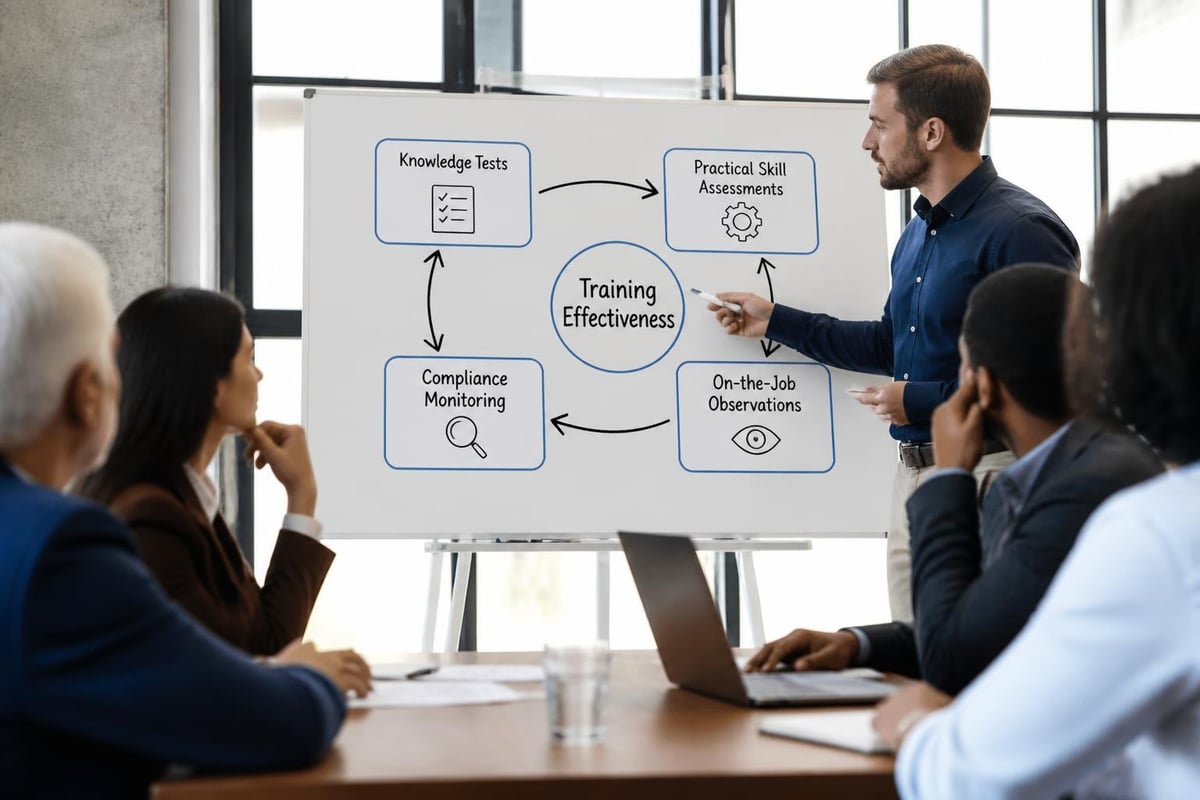
Measuring Training Effectiveness and Continuous Improvement
Training represents a significant investment of time and resources. FSPs need to demonstrate that risk assessment training actually improves risk management outcomes.
Kirkpatrick's Four Levels Applied to Risk Assessment Training
Level 1 – Reaction: Did participants find the training relevant and useful? (Post-training surveys, feedback forms)
Level 2 – Learning: Did participants acquire intended knowledge and skills? (Written assessments, practical exercises, case study performance)
Level 3 – Behaviour: Are participants applying learned skills in their daily work? (Supervisor observations, file reviews, mystery shopping, compliance monitoring results)
Level 4 – Results: Has training improved risk management outcomes? (Reduced compliance breaches, improved FICA risk assessment quality, fewer client complaints, better suspicious transaction reporting)
Most FSPs measure only Level 1 and 2, collecting feedback and running post-training quizzes. The real value emerges at Levels 3 and 4. A compliance monitoring programme should specifically test whether representatives conduct risk assessments as trained:
| Monitoring Test | What to Review | Good Practice Standard |
|---|---|---|
| Client risk assessment completeness | Random sample of client files | 100% of files contain completed risk classification, 95%+ contain documented rationale for risk rating |
| Enhanced due diligence application | High-risk client files | 100% of high-risk clients have enhanced due diligence documentation, source of wealth verified, ongoing monitoring frequency appropriate to risk |
| Product suitability documentation | Random sample of advice files | 95%+ contain documented needs analysis, risk profile assessment, product comparison, suitability rationale |
| Data protection controls | Observation and system testing | No unencrypted client information on unsecured devices, access logs show appropriate access patterns, no unauthorised information sharing |
Adapting Training Based on Monitoring Results
Effective training programmes incorporate continuous improvement loops. If compliance monitoring reveals that representatives consistently misclassify certain client types (for example, rating all pensioners as low risk regardless of transaction patterns), this indicates a training gap requiring remediation.
Quarterly training reviews should analyse:
- Compliance monitoring findings revealing knowledge or skill gaps
- Near-misses and incidents indicating training inadequacies
- Regulatory developments requiring updated training content
- Staff feedback on practical challenges applying risk assessment concepts
The ISACA IT risk resources provide valuable frameworks for linking training to risk management maturity and continuous improvement.
Practical Implementation for Independent Brokers
Independent brokers face unique challenges implementing risk assessment training. Limited budgets, small teams, and time constraints mean training must be targeted and practical.
Developing an Annual Training Plan
Start with a simple annual training calendar addressing core risk domains:
Q1 2026: FICA risk assessment and client due diligence refresher (2-hour workshop covering business risk assessment updates, recent FIC typologies, enhanced due diligence case studies)
Q2 2026: POPIA data protection and security (90-minute session on email security, physical file security, data breach response, third-party data sharing)
Q3 2026: Conduct risk and treating customers fairly (2-hour workshop on conflict of interest identification, vulnerable client handling, product suitability documentation)
Q4 2026: Year-end compliance and risk review (session reviewing the year's compliance monitoring findings, updating business risk assessment, planning next year's control improvements)
Creating Internal Training Resources
Larger brokerages can develop internal training resources:
- Risk assessment checklists: Simple one-page guides for common scenarios (new client risk assessment, high-risk client enhanced due diligence, product suitability evaluation)
- Decision trees: Visual guides for escalation decisions (when to escalate unusual transaction patterns, when to file suspicious transaction reports, when to seek compliance advice)
- Case study library: Anonymised examples of good and poor risk assessments from actual files, used for team training discussions
- Quick reference guides: Summaries of key requirements (FICA risk factors, POPIA security safeguards, FAIS record-keeping periods)
Leveraging External Training Providers
Smaller brokers benefit from external training providers offering specialised content and regulatory expertise. Quality external training provides current regulatory updates, sector-wide perspectives, and professional development credentials.
When selecting external training, evaluate:
- Relevance: Is content specific to South African financial services regulation and practical broker workflows?
- Credentials: Does the provider have recognised expertise and regulatory knowledge?
- Practical application: Does training include case studies, practical exercises, and implementation tools rather than just regulatory theory?
- Ongoing support: Does the provider offer post-training support, updated materials, and ongoing guidance?
Integrating Risk Assessment Training Into Organisational Culture
The most sophisticated training fails if risk assessment remains a compliance exercise separate from daily operations. Embedding risk assessment into organisational culture requires leadership commitment and practical integration.
Management Tone and Accountability
Key Individuals and senior management must visibly prioritise risk assessment. This means:
- Participating in training alongside staff
- Discussing risk assessment quality in performance reviews
- Recognising and rewarding good risk management decisions
- Taking visible action when risk assessments are inadequate
Risk assessment quality should be a specific performance criterion. Representatives should understand that providing excellent advice includes conducting thorough risk assessments, not just maximising sales.
Making Risk Assessment Operationally Embedded
Risk assessment should be integrated into operational workflows, not an additional administrative burden:
- Client onboarding systems should include risk assessment fields as mandatory
- Advice process templates should incorporate suitability and conduct risk documentation
- Regular team meetings should include risk assessment case discussions
- Compliance monitoring should provide constructive feedback on risk assessment quality
Building a Learning Culture
The WHO’s risk assessment training resources demonstrate the value of sector-specific toolkits and continuous learning approaches. Financial services organisations should similarly develop communities of practice where compliance officers and representatives share risk assessment challenges, discuss complex scenarios, and learn from each other's experiences.
Monthly "risk roundtable" sessions where the team discusses recent challenging risk assessments (appropriately anonymised) build collective competency more effectively than isolated training events.
Addressing Common Training Challenges
Challenge: Training Fatigue and Engagement
Representatives often view compliance training as tiresome box-ticking. Combat this by:
- Using real scenarios from your practice
- Keeping sessions short and focused (90 minutes maximum)
- Making training interactive with discussions and problem-solving
- Explaining the "why" – how risk assessment protects clients, the business, and representatives' professional reputation
- Varying formats between e-learning, workshops, and case discussions
Challenge: Measuring Practical Application
Written tests reveal knowledge but not practical competency. Supplement with:
- Supervisor file reviews with feedback conversations
- Peer review processes where experienced representatives review newer colleagues' risk assessments
- Mystery shopping or scenario testing where representatives demonstrate risk assessment skills
- Using actual compliance monitoring results as training effectiveness metrics
Challenge: Keeping Training Current
Regulatory requirements evolve constantly. Maintain currency by:
- Subscribing to FSCA communications and regulatory alert services
- Designating responsibility for monitoring regulatory developments
- Scheduling quarterly training updates addressing recent regulatory changes
- Maintaining relationships with compliance specialists and industry bodies
Challenge: Resource Constraints
Small brokerages struggle to develop comprehensive training programmes. Maximise efficiency by:
- Focusing training on highest-risk areas identified in your business risk assessment
- Using free regulatory guidance materials and toolkits
- Sharing training resources within buying groups or industry associations
- Leveraging specialist external providers for complex topics
Sector-Specific Risk Assessment Training Applications
Risk assessment training must address sector-specific risks and scenarios relevant to your particular financial services practice.
Long-Term Insurance Brokers
Specific training focus areas:
- Underwriting disclosure risk assessment (identifying when clients may be withholding material health or lifestyle information)
- Policy replacement suitability (assessing risks of recommending clients cancel existing policies)
- Beneficiary nomination risks (identifying potential undue influence, fraud, or elder abuse scenarios)
- Claims assistance conflicts (managing conflicts when assisting clients with claims where broker commission could be affected)
Short-Term Insurance Brokers
Specific training focus areas:
- Commercial client risk assessment (evaluating business nature, claims history, risk management practices)
- Underinsurance risk identification and disclosure
- High-value item verification (art, jewellery, vehicles requiring enhanced due diligence)
- Flood/natural disaster exposure in high-risk geographic areas
Investment and Wealth Management Advisors
Specific training focus areas:
- Investment suitability and risk tolerance assessment
- Offshore investment client risk assessment (FICA enhanced due diligence for foreign jurisdictions)
- Complex product appropriateness (hedge funds, structured products, private equity)
- Ongoing portfolio monitoring and suitability review obligations
Healthcare and Benefits Consultants
Specific training focus areas:
- Medical scheme suitability assessment
- Employer group risk product governance
- Employee vulnerability and financial literacy considerations
- Data protection in healthcare context (special personal information under POPIA)
Effective risk assessment training transforms regulatory obligations into practical competencies that protect clients, strengthen business resilience, and demonstrate compliance readiness. For South African FSPs and independent brokers navigating the convergent demands of FAIS, FICA, POPIA, and COFI, structured training programmes tailored to role-specific responsibilities and local regulatory requirements are no longer optional. Holistic Compliance Management Solutions (Pty) Ltd specialises in delivering practical, implementation-focused compliance training and ongoing monitoring support designed specifically for the challenges facing independent financial services practices across South Africa.
Schedule FICA Training
For: Independent brokers, FSP compliance officers, financial advisors requiring practical FICA and RMCP implementation skills
Your FICA training consultation includes:
- Customised business risk assessment workshop for your specific practice
- FICA RMCP drafting support aligned to your assessed risk profile
- Practical client due diligence implementation guidance and templates
- Ongoing compliance monitoring support to maintain FICA effectiveness