
Compliance Resource Group: Essential Framework for FSPs
Financial services providers operating in South Africa face an increasingly complex regulatory environment. Between the Financial Advisory and Intermediary Services Act (FAIS), Financial Intelligence Centre Act (FICA), Protection of Personal Information Act (POPIA), and Conduct of Financial Institutions Act (COFI), independent brokers and advisory practices must navigate multiple compliance obligations simultaneously. Establishing a structured compliance resource group within your practice or accessing external expertise through dedicated compliance partnerships has become essential for managing these interconnected requirements effectively. This comprehensive guide explores how financial service providers can build, implement, and leverage a compliance resource group to maintain regulatory adherence whilst focusing on client service and business growth.
Understanding the Compliance Resource Group Framework
A compliance resource group serves as the centralised hub for all regulatory activities within a financial services practice. Rather than treating compliance as a fragmented series of tick-box exercises, this structured approach consolidates expertise, documentation, training, and monitoring into a cohesive system.
Core Components of an Effective Compliance Resource Group
The foundation of any compliance resource group rests on several interconnected pillars. Regulatory knowledge management ensures your team stays current with legislative changes and industry bulletins from the Financial Sector Conduct Authority (FSCA). Documentation systems maintain records that satisfy audit requirements whilst remaining accessible for daily operations. Training delivery mechanisms keep representatives qualified and informed about evolving obligations.
Beyond these basics, sophisticated compliance resource groups incorporate:
- Risk assessment frameworks tailored to your specific product suite and client base
- Policy templates that align with South African regulatory expectations
- Monitoring protocols that identify compliance gaps before they become violations
- Incident response procedures for addressing regulatory breaches or client complaints
- Stakeholder communication channels connecting compliance officers, representatives, and management

The South African Regulatory Landscape for FSPs
South African financial services providers operate under a distinctive regulatory framework that distinguishes this market from international jurisdictions. The FSCA oversees conduct regulation, whilst the Prudential Authority handles financial soundness. Your compliance resource group must address requirements from multiple acts simultaneously.
FAIS compliance governs how you provide advice, disclose conflicts of interest, and maintain representative competency. The General Code of Conduct sets standards for fair treatment of clients, whilst specific product supplier codes add layers of requirements. Your compliance resource group should maintain current versions of all applicable codes and track amendments as they're promulgated.
FICA obligations require robust client due diligence, ongoing monitoring of business relationships, and reporting of suspicious transactions. The Risk Management and Compliance Programme (RMCP) serves as your operational blueprint, and your compliance resource group becomes the custodian of this critical document. For FSPs seeking assistance with drafting their FICA RMCP, specialised compliance practice services can provide affordable solutions tailored to insurance brokers.
POPIA compliance intersects with virtually every client interaction. Processing personal information requires lawful grounds, security safeguards, and transparent privacy notices. Your compliance resource group ensures information officer responsibilities are fulfilled and data subject rights are respected.
Building Your Compliance Resource Group Structure
Establishing an effective compliance resource group requires deliberate planning and resource allocation. The structure you adopt should reflect your practice size, complexity, and risk profile.
Staffing Models for Different Practice Sizes
Sole practitioners and micro-practices (1-3 representatives) typically cannot justify full-time compliance staff. Your compliance resource group might comprise:
- External compliance officer providing oversight (quarterly visits)
- Designated internal champion handling day-to-day queries
- Access to shared resources through industry associations
- Technology platforms automating routine compliance tasks
Small to medium practices (4-15 representatives) benefit from part-time internal compliance capacity:
| Function | Resource Allocation | Primary Responsibilities |
|---|---|---|
| Compliance oversight | 0.5 FTE internal + external support | Policy development, FSCA liaison |
| Training coordination | 0.25 FTE | CPD tracking, regulatory exam preparation |
| Record keeping | Shared admin role | File audits, documentation management |
| Risk monitoring | Monthly external review | Transaction sampling, complaint analysis |
Larger practices (15+ representatives) should consider dedicated compliance resource groups with specialised roles covering different regulatory domains.
Defining Roles and Responsibilities
Clear accountability prevents compliance gaps. Your compliance resource group structure should document specific responsibilities for each role.
The Compliance Officer serves as your regulatory point person. This individual maintains your FSP licence, submits regulatory returns, and acts as liaison with the FSCA. Whether internal or outsourced, this role requires deep regulatory knowledge and regular professional development.
Key Individual responsibilities often overlap with compliance functions, but focus more on overall practice supervision and representative oversight. Your compliance resource group should clarify where Key Individual duties end and Compliance Officer functions begin.
Representatives carry compliance obligations in their daily client interactions. Your compliance resource group must ensure they understand their personal responsibilities for record keeping, disclosure, and ethical conduct.
Support staff handling client data or processing transactions need clear guidance on FICA and POPIA requirements relevant to their functions.
Technology Infrastructure for Compliance Management
Modern compliance resource groups leverage technology to enhance efficiency and reduce human error. The right systems create audit trails, automate workflows, and generate compliance reports.
Customer Relationship Management (CRM) systems with built-in compliance features track client interactions, store required disclosures, and flag review dates. Integration with product supplier systems reduces duplicate data entry whilst maintaining necessary records.
Document management platforms organise policies, procedures, and training materials in searchable repositories. Version control ensures representatives always access current guidance, whilst archived versions provide historical evidence during audits.
Learning management systems (LMS) deliver training modules, track completion, and generate CPD records. When integrated with your compliance resource group's training calendar, these platforms ensure representatives complete mandatory updates before deadlines.
Cloud-based solutions offer particular advantages for compliance resource groups serving distributed teams. The Microsoft Azure governance framework provides practical guidance for organising cloud resources whilst applying policy controls at scale, offering lessons applicable beyond pure IT contexts.
Implementing Core Compliance Programmes
A compliance resource group exists to deliver tangible programmes that reduce regulatory risk. Implementation requires systematic approaches across multiple domains.
FAIS Compliance Programme Components
Your FAIS compliance programme forms the backbone of regulatory adherence. The compliance resource group coordinates several interconnected elements.
Fit and Proper assessments verify that all representatives and key individuals meet integrity, competency, and operational ability requirements. Your compliance resource group maintains evidence files documenting qualifications, experience, criminal record checks, and financial soundness.
- Initial assessments for new representatives
- Annual re-assessments for continuing suitability
- Triggered reviews following complaints or regulatory changes
- Documentation standards that satisfy FSCA expectations
Representative supervision ensures advice quality and regulatory compliance. Effective supervision programmes include file reviews, client feedback analysis, and periodic observations of client interactions. Your compliance resource group should establish sampling methodologies that cover different representatives, product types, and transaction sizes throughout the year.
Conflict of interest management requires ongoing vigilance. The compliance resource group maintains your conflict register, reviews remuneration structures for potential bias, and ensures disclosures accurately reflect your commercial arrangements.
FICA Risk Management and Compliance Programme
The RMCP represents your documented approach to anti-money laundering and counter-terrorism financing. Your compliance resource group transforms this document from a compliance formality into an operational tool.
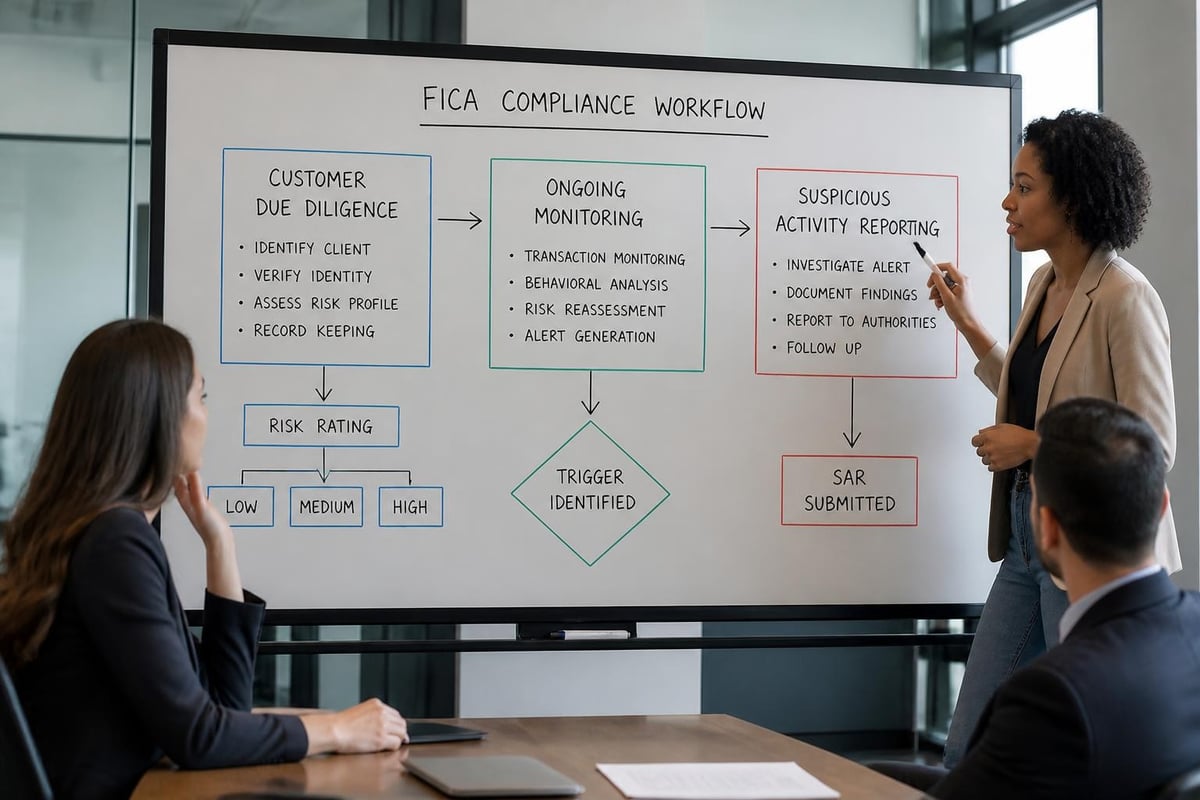
Customer due diligence (CDD) procedures must align with your assessed risk profile. The compliance resource group develops tiered verification requirements:
- Simplified CDD for low-risk clients (standard retail customers)
- Standard CDD for typical business relationships (documentation of identity, address, income source)
- Enhanced CDD for high-risk categories (politically exposed persons, complex structures, high-value transactions)
Your compliance resource group creates practical tools that representatives use daily: CDD checklists, acceptable document lists, verification procedures for remote onboarding, and exception approval processes.
Ongoing monitoring identifies unusual patterns requiring further investigation. The compliance resource group establishes triggers based on your risk assessment:
- Transaction values exceeding defined thresholds
- Patterns inconsistent with client profiles
- Sudden changes in transaction frequency or type
- Clients avoiding documentation requirements
- Geographic risk factors (payments to high-risk jurisdictions)
Suspicious transaction reporting demands prompt action when red flags emerge. Your compliance resource group creates reporting templates, trains staff on recognition indicators, and maintains relationships with the Financial Intelligence Centre.
The DOJ’s evaluation framework for corporate compliance programs offers valuable guidance on demonstrating the effectiveness of your FICA controls, even though it originates from U.S. federal prosecutors.
POPIA Compliance Framework
Personal information processing pervades financial services operations. Your compliance resource group ensures POPIA compliance across the client lifecycle.
Information processing mapping documents what personal information you collect, why you collect it, how you use it, and who can access it. This exercise often reveals processing activities representatives perform without realising the POPIA implications.
| Processing Activity | Legal Basis | Security Measures | Retention Period |
|---|---|---|---|
| Client onboarding | Consent + compliance with law | Encrypted storage, access controls | Duration of relationship + 5 years |
| Marketing communications | Consent (opt-in) | Subscription management system | Until consent withdrawn |
| Claims submission | Contract performance | Secure transmission protocols | Per insurer requirements |
| Complaints handling | Legitimate interest | Confidential file storage | 5 years from resolution |
Privacy notice development requires clear communication about your information practices. Your compliance resource group drafts notices in plain language, ensures they cover all required elements, and implements delivery mechanisms that create evidence of provision.
Data subject rights procedures enable clients to access their information, request corrections, or object to processing. The compliance resource group establishes response workflows and trains staff on handling these requests within POPIA's timeframes.
Information security measures protect personal information throughout its lifecycle. Your compliance resource group conducts regular security assessments, implements appropriate technical controls, and ensures third-party service providers maintain adequate safeguards. The NIST Cybersecurity Framework provides risk-based functions that compliance teams can map to their specific security controls.
Operationalising Compliance Monitoring
Monitoring transforms compliance from policy to practice. Your compliance resource group develops systematic review processes that identify issues before they escalate.
File Review Programmes
Regular file audits reveal whether representatives follow established procedures. Effective file review programmes balance thoroughness with efficiency.
Sampling methodologies ensure representative coverage without drowning the compliance resource group in paperwork. Risk-based sampling focuses attention on higher-risk transactions:
- All transactions exceeding defined monetary thresholds
- Random samples from each representative's portfolio
- Targeted reviews of specific products or transaction types
- Complaint-triggered file examinations
- New representative oversight during probationary periods
Review checklists standardise assessments across the compliance resource group. Detailed checklists covering needs analysis documentation, product comparisons, disclosure provision, and record completeness ensure consistent evaluation standards.
Feedback mechanisms close the loop between monitoring and improvement. The compliance resource group should provide individual feedback to representatives, identify common deficiencies requiring broader training, and escalate serious issues through appropriate channels.
Compliance Testing and Quality Assurance
Beyond file reviews, comprehensive compliance resource groups implement various testing activities.
Mystery shopping programmes assess client-facing compliance in real-world scenarios. Whether conducted internally or through external providers, these exercises reveal gaps between written policies and actual practice.
System testing verifies that technology controls function as intended. The compliance resource group periodically tests automated processes: Do CDD triggers fire correctly? Are retention periods enforced? Do access controls prevent unauthorised viewing of client data?
Policy effectiveness reviews assess whether your compliance framework remains fit for purpose. The compliance resource group examines incident data, monitoring findings, and regulatory developments to identify policy gaps or areas requiring enhancement.
The NIST assessment and auditing resources offer practical tools for evaluating technical and programmatic controls, useful when establishing evidence collection programmes.
Incident Management and Remediation
Even robust compliance resource groups encounter breaches and deficiencies. Effective incident response minimises harm and demonstrates regulatory commitment.
Incident classification enables appropriate response. Your compliance resource group should establish severity criteria:
- Critical incidents: Regulatory breaches requiring immediate FSCA notification
- Significant incidents: Material compliance failures needing prompt remediation
- Minor incidents: Isolated deficiencies addressed through standard processes
Root cause analysis identifies underlying issues rather than treating symptoms. The compliance resource group investigates whether incidents reflect individual errors, process failures, inadequate training, or systemic weaknesses.
Corrective action plans document remediation steps, assign responsibilities, and set completion deadlines. The compliance resource group tracks implementation and verifies effectiveness through follow-up monitoring.
Training and Competency Management
A compliance resource group succeeds only when representatives understand and apply regulatory requirements. Comprehensive training programmes build sustainable compliance cultures.
Regulatory Examination Preparation
Representatives must pass the appropriate regulatory examinations before providing financial services. Your compliance resource group coordinates exam preparation to maximise first-time pass rates whilst ensuring genuine competency.
Study materials should cover syllabus content comprehensively whilst remaining accessible. The compliance resource group curates resources from various sources, supplements them with practice-specific guidance, and creates study schedules for candidates.
Mock examinations identify knowledge gaps before candidates sit official assessments. The compliance resource group can facilitate practice tests, review common mistakes, and provide targeted coaching on challenging topics.
Ongoing professional development extends beyond initial qualification. The compliance resource group tracks CPD requirements, identifies relevant training opportunities, and ensures representatives maintain currency in their product knowledge and regulatory understanding.

Compliance Updates and Policy Training
Regulations evolve continuously. Your compliance resource group ensures the team stays informed about changes affecting daily operations.
Regulatory bulletins translate FSCA communications and legislative amendments into practical guidance. Rather than forwarding dense regulatory documents, the compliance resource group distils key points, explains implementation requirements, and highlights deadlines.
Policy rollout training accompanies new or revised procedures. When your compliance resource group updates the RMCP, introduces new disclosure templates, or revises approval workflows, structured training ensures smooth implementation.
Scenario-based learning develops practical judgement. The compliance resource group presents realistic situations representatives might encounter, facilitates discussion of appropriate responses, and reinforces key principles through application rather than rote learning.
Specialist Topic Workshops
Certain compliance areas warrant focused attention. Your compliance resource group should deliver periodic deep-dive sessions on high-risk or complex topics.
FICA workshop content might cover:
- Identifying suspicious transaction indicators in your specific product context
- Conducting enhanced due diligence for complex client structures
- Updating client information during periodic reviews
- Documenting source of wealth for high-value transactions
- Navigating verification challenges with remote clients
POPIA training addresses practical scenarios representatives face daily: obtaining valid consent, responding to access requests, managing marketing opt-outs, and reporting security incidents.
Product-specific compliance ensures representatives understand the particular regulatory requirements attached to different financial products, from disclosure obligations to cooling-off periods.
Measuring Compliance Resource Group Effectiveness
Effective compliance resource groups demonstrate their value through measurable outcomes. Establishing appropriate metrics enables continuous improvement.
Key Performance Indicators for Compliance
Leading indicators measure compliance activities before problems emerge:
- Percentage of files meeting review standards
- Training completion rates within prescribed timeframes
- Policy acknowledgement tracking
- Proactive risk assessments completed
- Internal audit findings closure rates
Lagging indicators track outcomes and actual regulatory performance:
| Metric | Target | Measurement Frequency |
|---|---|---|
| FSCA complaints received | Zero or declining trend | Quarterly |
| Ombud determinations against practice | Zero | Quarterly |
| Regulatory enforcement actions | Zero | Annual |
| Client complaints (compliance-related) | <1% of client base | Monthly |
| Audit deficiencies (repeat findings) | Zero repeat issues | Per audit cycle |
Efficiency metrics assess compliance resource group productivity:
- Average time to complete file reviews
- Cost per representative for compliance support
- Training hours delivered versus representatives trained
- Incident response times by severity category
Continuous Improvement Processes
Data without action provides little value. Your compliance resource group should establish improvement cycles that translate metrics into meaningful changes.
Regular performance reviews examine compliance metrics against targets. The compliance resource group identifies trends, investigates variances, and proposes corrective measures. Quarterly reviews maintain focus without creating excessive administrative burden.
Stakeholder feedback mechanisms gather input from representatives, management, and clients. The compliance resource group seeks to understand friction points, unnecessary complexity, and opportunities to streamline compliance processes without compromising regulatory standards.
Benchmarking activities compare your compliance resource group's performance against industry peers. Industry associations, compliance networks, and regulatory statistics provide reference points for assessing relative maturity.
External validation through periodic independent reviews provides objective assessment. Third-party compliance audits, regulatory examinations, and professional peer reviews identify blind spots internal teams might miss.
Leveraging External Compliance Resources
Few practices possess comprehensive internal compliance expertise. Strategic partnerships extend your compliance resource group's capabilities.
When to Engage External Compliance Support
Resource constraints make external support attractive for practices unable to justify full-time compliance staff. Outsourced compliance officers provide expertise at a fraction of permanent employment costs.
Specialist knowledge requirements emerge during licence applications, regulatory investigations, or implementation of new regulatory requirements. Engaging external expertise for these discrete projects supplements your core compliance resource group.
Independent oversight strengthens governance. Even practices with internal compliance teams benefit from external reviews that provide objective assessment and challenge existing practices.
Capacity management during peak periods (annual compliance reporting, audit preparation, new representative onboarding surges) allows your compliance resource group to scale support flexibly.
Selecting Compliance Partners
Evaluating potential compliance partners requires careful assessment. Your compliance resource group integration depends on selecting providers with appropriate expertise and compatible approaches.
Regulatory experience in the South African financial services context is non-negotiable. Verify that prospective partners demonstrate current knowledge of FAIS, FICA, POPIA, and COFI requirements. Request examples of similar engagements and consider whether their client base reflects comparable complexity to your practice.
Service scope alignment ensures the partner addresses your actual needs. Some providers excel at policy development but lack monitoring capabilities. Others offer comprehensive programmes but minimum engagement sizes that exceed your requirements.
Communication style and availability affect day-to-day effectiveness. The compliance resource group should establish expected response times, preferred communication channels, and escalation procedures. Consider whether the partner's availability aligns with your operational needs.
Technology compatibility enables seamless integration. Partners should work with your existing systems or provide platforms that enhance rather than complicate your compliance infrastructure.
Managing the Internal-External Compliance Interface
Successful external partnerships require clear boundaries and strong coordination.
Responsibility matrices document which compliance functions remain internal versus those delegated to external partners. Ambiguity creates gaps where critical tasks fall between the cracks.
Regular communication protocols maintain alignment. Whether weekly check-ins, monthly reports, or quarterly strategic reviews, structured interaction prevents the compliance resource group from becoming disconnected from external support.
Knowledge transfer mechanisms ensure external expertise enhances internal capability rather than creating dependency. Your compliance resource group should document external advice, participate in delivery rather than passive receipt, and gradually build internal competency.
Emerging Compliance Challenges for FSPs
The regulatory environment continues evolving. Forward-looking compliance resource groups anticipate rather than merely react to emerging requirements.
Conduct of Financial Institutions Act Implementation
COFI represents fundamental changes to conduct regulation in South Africa. Though implementation timelines extend across several years, your compliance resource group should begin preparation now.
Product governance requirements demand enhanced oversight of product design, distribution, and outcomes monitoring. The compliance resource group must develop frameworks for assessing product value, identifying target markets, and measuring customer outcomes.
Vulnerable client protections require tailored approaches for clients with diminished capacity or circumstances that increase susceptibility to harm. Your compliance resource group should establish identification procedures, appropriate service adjustments, and staff training on fair treatment principles.
Culture and governance expectations extend compliance beyond technical rule-following to organisational values and leadership accountability. The compliance resource group becomes instrumental in embedding conduct risk awareness throughout the practice.
Technology-Driven Compliance Risks
Digital transformation in financial services creates novel compliance challenges that compliance resource groups must address.
Remote advice delivery accelerates, requiring FAIS-compliant approaches to virtual client interactions, electronic record keeping, and digital disclosure provision. Your compliance resource group should establish standards for video meetings, electronic signatures, and secure information transmission.
Data analytics capabilities offer powerful monitoring tools but create privacy considerations. The compliance resource group balances POPIA compliance with leveraging data insights for risk management and client service enhancement.
Cybersecurity obligations increasingly feature in regulatory expectations. The compliance resource group coordinates with IT functions to ensure information security measures satisfy both technical requirements and compliance documentation needs.
Regulatory Supervision Intensity
The FSCA's supervisory approach continues maturing, with implications for compliance resource groups.
Thematic reviews target specific risks or market conduct issues across multiple FSPs. When your practice falls within scope, the compliance resource group coordinates response, gathers required information, and implements any remediation identified.
Proactive compliance culture earns regulatory credibility. Compliance resource groups that demonstrate genuine commitment to fair client outcomes, rather than minimal technical compliance, position their practices favourably during regulatory interactions.
Regulatory technology adoption by the FSCA enables data-driven supervision. Your compliance resource group should anticipate requests for electronic data submissions and ensure your systems can produce required information in usable formats.
Building a Sustainable Compliance Culture
Ultimate compliance success depends on embedding regulatory consciousness throughout your practice. The compliance resource group catalyses cultural transformation.
Leadership Commitment and Tone from the Top
Compliance culture flows from leadership. Practice principals and key individuals must demonstrate genuine commitment that extends beyond delegation to the compliance resource group.
Resource allocation decisions signal priorities. Providing adequate budget, time, and staffing for compliance activities communicates leadership's seriousness about regulatory obligations.
Response to compliance findings reveals true commitment. When monitoring identifies deficiencies, leadership that supports necessary remediation regardless of short-term commercial impact builds credible compliance culture.
Personal compliance adherence by leaders sets standards for the entire team. Practice principals who follow the same procedures they expect of representatives reinforce that compliance applies universally.
Representative Engagement and Ownership
Compliance cannot remain solely the compliance resource group's responsibility. Representatives must understand their personal obligations and embrace compliance as integral to professional practice.
Making compliance accessible reduces barriers to adherence. The compliance resource group should provide user-friendly tools, clear guidance, and readily available support that makes doing the right thing the easy thing.
Recognising compliance excellence reinforces desired behaviours. Acknowledging representatives who consistently demonstrate strong compliance practices, whether through formal recognition or informal praise, builds positive associations.
Psychological safety enables representatives to raise compliance concerns without fear of blame. The compliance resource group should cultivate environments where questions are welcomed and mistakes become learning opportunities rather than occasions for punishment.
Client-Centric Compliance Messaging
Positioning compliance as client protection rather than regulatory burden transforms perceptions.
Explaining compliance value helps clients appreciate why you collect information, provide disclosures, and follow certain procedures. Rather than treating compliance as administrative inconvenience, frame it as demonstrating professionalism and protecting client interests.
Competitive differentiation emerges from superior compliance. Practices with robust compliance resource groups deliver higher service standards, reduce client harm risk, and build sustainable trust that competitors lacking similar infrastructure cannot match.
Establishing and maintaining an effective compliance resource group has become essential for South African financial services providers navigating the complexities of FAIS, FICA, POPIA, and emerging COFI requirements. Whether building internal capacity, engaging external expertise, or combining both approaches, systematic compliance management protects your practice whilst enabling focus on client service and business growth.
Who this is for: Independent insurance brokers, financial advisors, FSP licence holders, compliance officers, and practice principals responsible for regulatory adherence.
For FSPs seeking to strengthen their compliance frameworks, Holistic Compliance Management Solutions (Pty) Ltd offers specialised support tailored to the South African financial services context. Schedule FICA training to build your team's competency in critical regulatory areas:
- Practical FICA and POPIA training aligned to broker workflows
- RMCP drafting and implementation guidance
- Affordable compliance solutions scaled to independent practice needs
Our Cape Town-based team has supported financial service providers since 2018, combining deep regulatory knowledge with practical understanding of broker operations to deliver compliance support that works in the real world.