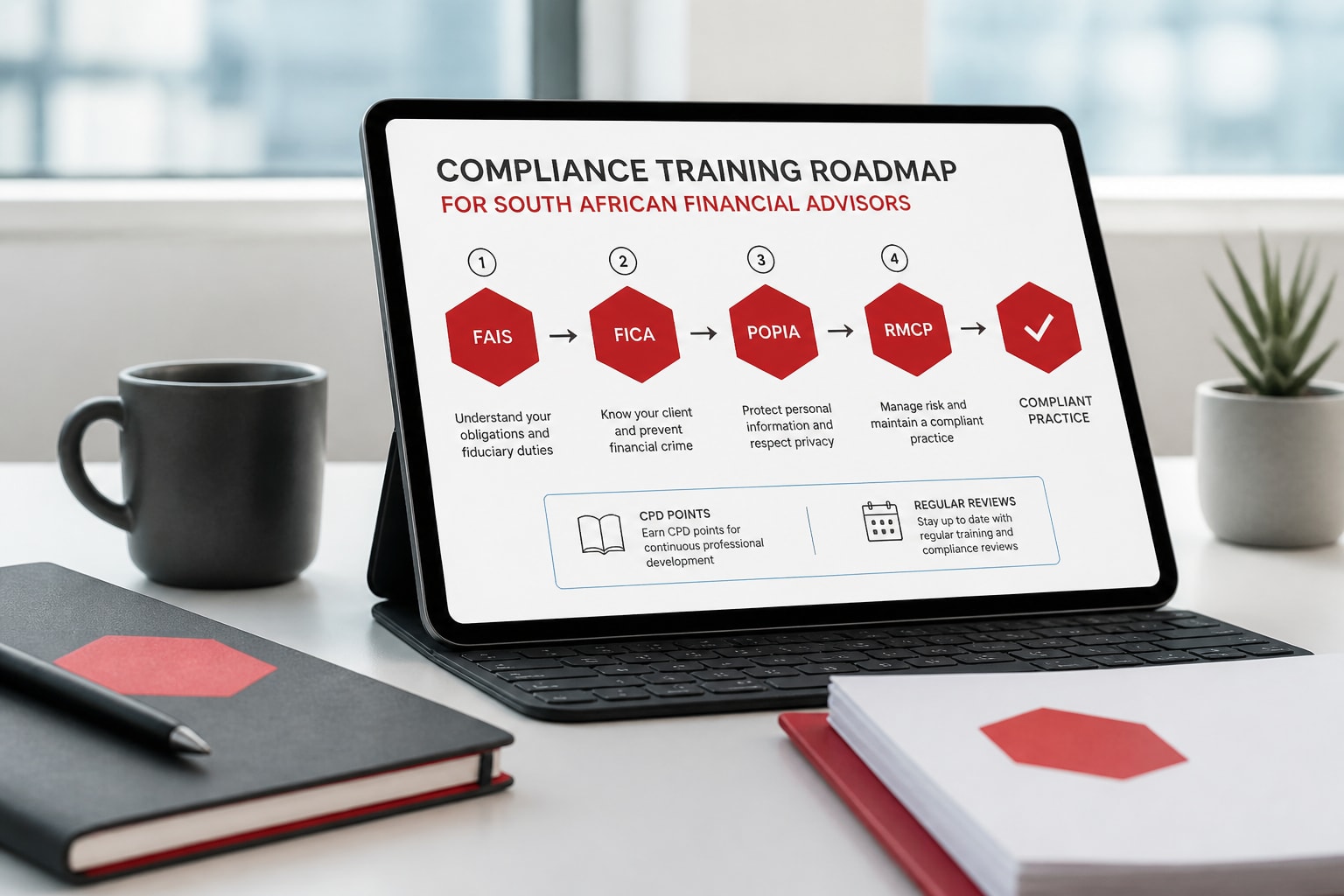
Training Courses Guide for Compliance Professionals
Who this is for: independent brokers, regulated brokers, FSP applicants and compliance officers who need to meet FSCA, FICA and POPIA obligations.
Training courses for compliance professionals are structured programmes that teach regulatory requirements, test your understanding and, in many cases, award continuing professional development (CPD) points. For South African financial service providers (FSPs), the most relevant courses cover FAIS regulatory examinations, FICA, POPIA and the drafting of a Risk Management and Compliance Programme (RMCP). Choosing well means matching each course to a specific obligation in your practice, rather than collecting certificates for their own sake.
This guide explains what the main course types are, which formats suit a broker practice, how to select a provider and how to confirm that training has changed behaviour in your business.
What are training courses in compliance, and what do they cover?
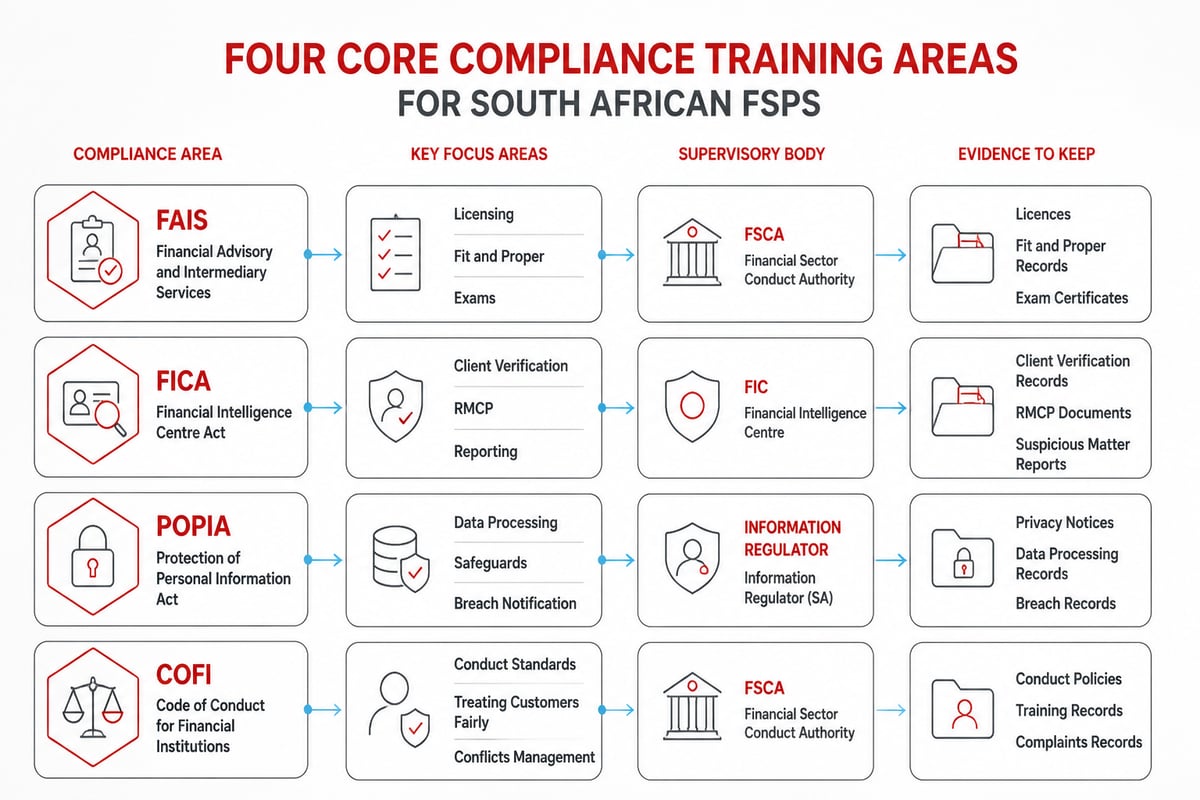
Compliance training courses teach the rules a regulated business must follow and the procedures that evidence those rules in daily work. In South Africa, that normally means a defined set of legislative areas, each with its own supervisory body and its own expectations of your practice.
The core subjects for an independent broker or FSP are:
- FAIS: the Financial Advisory and Intermediary Services Act, including fit and proper requirements, representative supervision and the regulatory examinations that key individuals and representatives must pass.
- FICA: the Financial Intelligence Centre Act, covering client identification and verification, record keeping, reporting of suspicious and unusual transactions and the RMCP.
- POPIA: the Protection of Personal Information Act, covering lawful processing of client data, security safeguards, operator agreements and breach notification.
- COFI: the Conduct of Financial Institutions Bill, which signals a move towards a single, principles-based conduct framework and is worth tracking so your practice is not caught unprepared.
Each of these areas generates paperwork that a regulator can ask to see. Training is the point at which staff learn to produce that paperwork correctly, rather than assembling it at the last minute before an inspection.
What is an example of a training course for financial advisors?
A typical example is a FICA course that takes a broker through client due diligence, risk-rating of clients, record retention periods and the structure of an RMCP, ending with an assessment. A practical course of this kind uses broker scenarios, such as onboarding a new short-term insurance client or verifying a trust, so that learners apply the rules to workflows they recognise.
Other common examples include:
- Regulatory exam preparation: structured revision and practice assessments for the FAIS regulatory examinations.
- POPIA awareness for staff: short sessions on handling client documents, emailing personal information and responding to a suspected breach.
- RMCP drafting workshops: guided sessions in which a practice builds a programme tailored to its own client base and product mix.
- Ongoing CPD courses: shorter modules that keep representatives current on regulatory change.
The common thread is relevance. A course on international anti-money-laundering typologies has value, but a broker running a small practice will usually gain more from training that mirrors the files, forms and client conversations of their own business.
Which training format suits a broker practice?
The best format is usually a blend: self-paced online modules for baseline knowledge, supported by live sessions for discussion and practical queries. A Compliance Week survey report found that most respondents supplement e-learning with live training, and that most make training accessible on mobile devices. Live sessions are useful for resolving the questions that arise from real client files, and online content is efficient for baseline knowledge.
| Format | Strengths | Limitations |
|---|---|---|
| Self-paced online | Flexible, easy to record completion, suits staff with client commitments | Limited interaction, easy to click through without engaging |
| Live virtual | Allows questions, reaches representatives in different locations | Requires fixed time, depends on connectivity |
| In-person workshop | Strong for RMCP drafting and team discussion | Time out of the office, travel costs |
| Mentored or internship-based | Builds applied skill alongside experienced practitioners | Slower, needs a supervising person |
For a practice with only a handful of representatives, a sensible pattern is online FICA and POPIA modules for all staff each year, plus a live workshop whenever the RMCP or the practice's data-handling procedures change.
Can you get free online courses with certificates?
Yes, free online training courses with certificates exist, but you should check what the certificate is worth before relying on it. A free certificate of completion shows that you attended, which can support your training records. It does not by itself prove competence, and it may not carry recognised CPD points.
Holistic Compliance Management Solutions (Pty) Ltd offers a free FICA course for clients, with CPD points awarded on completion. That is a practical example of the useful kind: free to the learner, tied to a live regulatory obligation and capable of contributing to your CPD record.
When evaluating any free offer, ask four questions:
- Does it address a South African requirement, or is it generic international content?
- Is the material current with the latest amendments?
- Does it assess understanding, or only record attendance?
- Will the certificate be accepted for the CPD points you need?
What are the best learning and development courses for compliance staff?
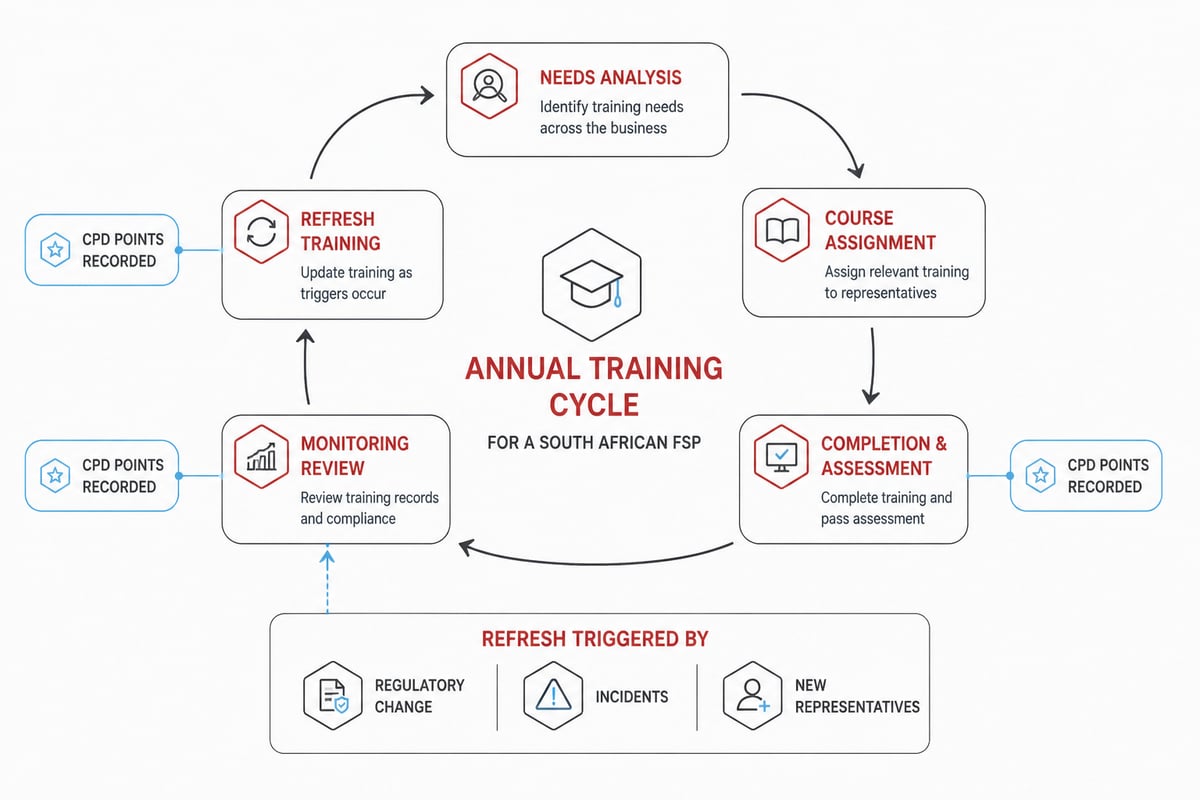
The best courses are those that map directly to a documented training need in your practice, and no single programme is best for everyone. A sound approach to learning and development is to identify the need, design the intervention, then measure the impact. Applied to an FSP, that means starting from your risk assessment and your inspection findings, not from a catalogue.
A practical needs analysis for a broker practice looks like this:
- List every representative and support staff member, with their role and the regulations they touch daily.
- Record each person's existing qualifications, exam status and CPD balance.
- Identify gaps against current obligations, such as a new representative who has not completed FICA training or a staff member who handles client data without POPIA instruction.
- Prioritise by risk: unverified clients and unprotected personal information usually come before advanced topics.
- Assign a course or activity to each gap, with a completion date and an owner.
Internationally recognised credentials can add value for compliance officers who work across borders. Internationally recognised financial crime certificates, for example, may suit a compliance officer at a larger FSP with cross-border exposure, though they are not a substitute for local FICA and FAIS knowledge.
How do you choose a compliance training provider?
Choose a provider whose content reflects South African law, whose facilitators have practical compliance experience and whose independence is clear. Independence matters because a provider that also sells you products or advice may have an interest in the conclusions it teaches.
Use this checklist when comparing providers:
- Regulatory fit: content references FAIS, FICA, POPIA and current FSCA and Financial Intelligence Centre guidance.
- Practical orientation: exercises use broker workflows, such as client onboarding, mandate handling and record keeping.
- Evidence of completion: attendance registers, assessment results and certificates you can file for an inspection.
- CPD recognition: clarity on how many points are awarded and under which framework.
- Update frequency: a stated process for revising material when legislation or guidance changes.
- Support after training: access to someone who can answer follow-up questions as you implement what you learned.
Holistic Compliance Management Solutions (Pty) Ltd, established in Cape Town in 2018, positions its services around independent and uncompromised compliance support for FSPs. For practices that want training and RMCP drafting from the same source, the Fica RMCP service pairs FICA and POPI training with affordable support in drafting your RMCP, so the programme your staff are trained on is the one your practice actually uses.

How often should training be refreshed?
Training should be refreshed at least annually, and sooner whenever legislation, guidance or your own business changes materially. Regulators in other jurisdictions state this expectation plainly. The FCA’s training and competence guidance says firms must regularly review employees' competence and training needs, consider changes in regulation and legislation and regularly assess training effectiveness. It is a United Kingdom source, but the principle is sound and mirrors the supervisory logic behind FSCA expectations of fit and proper conduct.
The Compliance Week survey also reported that many respondents update code-of-conduct training annually, and that most include lessons from prior compliance incidents in their training. The second figure deserves attention from small practices. A near miss, such as a client file found without a verified address, makes an excellent teaching case because staff recognise it as their own.
Triggers for an off-cycle refresh include:
- A new or amended RMCP.
- A change in the FSP's product range or client profile.
- A POPIA incident or regulator query.
- A new representative joining the practice.
- An inspection finding or internal monitoring exception.
How do you know training has worked?
Training has worked when behaviour and file quality improve, not when the attendance register is full. The OCEG 2025 survey found that organisations more often measure training activity than training impact. For a broker practice, that distinction is practical: completion rates tell you who sat the course, while file reviews tell you whether it made a difference.
Useful measures for an FSP include:
- Assessment scores taken before and after a module, to show knowledge gain.
- Client file audits sampled monthly, checking verification documents, risk ratings and signed mandates.
- Exception rates from compliance monitoring, such as missing documents per hundred files.
- Incident trends, including the number of POPIA queries or suspicious transaction escalations and how quickly they were handled.
- Staff confidence checks, a short question set asking representatives where they would look for the answer in a given scenario.
Compare results across quarters. If exceptions in a particular area stay flat after training, the course may have missed the real cause, which could be a poorly designed form or an unclear internal procedure rather than a knowledge gap.
What are training courses in health and social care compared with compliance training?
Training courses in health and social care focus on safeguarding, clinical practice and care standards, while compliance training in financial services focuses on conduct, client due diligence and data protection. The delivery methods overlap, including e-learning, live sessions and competency assessment, but the regulators, content and evidence differ. For a South African FSP, only the financial services content is relevant, so a general health and social care qualification will not satisfy FAIS, FICA or POPIA requirements.
Which career and CPD considerations apply to compliance professionals?
Compliance roles typically reward a mix of formal qualification, supervised experience and ongoing CPD. Compliance roles generally combine formal study with on-the-job training. Practical experience under supervision is as important as the classroom in South Africa too.
For advisors and compliance officers, a sustainable CPD approach includes:
- Track points continuously, keeping certificates and descriptions of activities in a single folder.
- Balance topics, so that your CPD record includes FICA, POPIA and conduct content, not only product knowledge.
- Use internships deliberately. Placing a graduate in the practice under supervision builds capacity and gives the intern applied exposure to monitoring and file reviews.
- Review annually against your personal development plan and the practice's compliance calendar.
FAQ
How long do compliance training courses usually take?
Duration varies by subject and format. Short awareness modules may take an hour or two, while regulatory exam preparation and RMCP drafting workshops take considerably longer. Check the provider's stated hours and whether assessment time is included.
Do all staff in a broker practice need FICA and POPIA training?
Anyone who handles client information or participates in client onboarding should be trained, including support staff and administrators. The obligations sit with the accountable institution and the responsible party, so the practice should be able to show that training reached everyone who acts on its behalf.
Should training records be kept for inspections?
Yes. Keep attendance registers, assessment results, certificates and the training plan so you can show a regulator what was taught, to whom and when. Records are the evidence that your training programme exists beyond intention.
Start this week by listing every person in your practice against the FICA, POPIA and FAIS topics they handle, and mark the gaps. If your RMCP needs drafting or revising, the Fica RMCP service offers a practical starting point for brokers who want training and documentation aligned. To schedule FICA training for your team, with a free FICA course and CPD points available to clients, Register Now with Holistic Compliance Management Solutions (Pty) Ltd and move your practice from intention to evidenced compliance.