
Occupational Safety Courses: A Guide for South African FSPs
Who this is for: independent brokers, regulated brokers, FSP applicants and compliance officers.
Occupational safety courses teach staff and managers how to identify workplace hazards, meet legal duties under the Occupational Health and Safety Act and keep people from harm, and for a South African FSP the most relevant options are short awareness courses, first aid, fire marshal and health and safety representative training. The course you choose depends on your headcount, your premises and the duties you carry as an employer. This guide takes you from the basics through to a practical plan you can put in place alongside your FSCA, FICA and POPIA obligations.
What are occupational safety courses?
Occupational safety courses are structured training programmes that build practical knowledge of workplace hazards, legal duties and incident prevention. They range from a half-day awareness session to multi-month professional qualifications.
For most readers of this guide, the relevant content falls into four broad groups:
- Awareness training: a short introduction to employer and employee duties, hazard spotting and incident reporting.
- Emergency response training: first aid, fire marshal and evacuation procedures.
- Representative training: preparing staff appointed as health and safety representatives.
- Professional qualifications: diplomas and certificates for people who will manage a safety function full time.
Most financial practices only need the first three. A full professional qualification makes sense for an FSP with large premises, multiple branches or a dedicated operations manager.
Why do financial service providers need safety training?
An FSP is an employer first and a regulated entity second, so it carries workplace safety duties regardless of how low-risk an office environment appears. Ergonomic strain, slips, electrical faults, fire risk and workplace stress are all present in a typical advisory practice.
The wider evidence on training gaps is sobering. A 2024 global report from the Lloyd's Register Foundation found that most workers had never received occupational safety and health training. A 2025 summary of the same research says most workers in Africa had never received formal training.
The same report found that trained workers were more than three times as likely to report workplace harm if it occurred. For an FSP, that matters beyond safety. A culture where staff report problems early is the same culture that reports suspicious transactions under FICA and flags data incidents under POPIA.
There is also a fairness point. The report found that part-time workers were considerably less likely than full-time workers to have had recent safety training. Practices that rely on part-time administrators, receptionists or interns should check that those people are not left out of induction and refresher sessions.
Which occupational safety courses suit an FSP?
The right courses for an FSP are the ones that match the risks of an office-based, client-facing practice. The table below sets out the common options and who in the practice they suit.
| Course type | Typical purpose | Who in the practice should attend |
|---|---|---|
| Health and safety awareness | Understand employer and employee duties | All staff, including part-time and interns |
| First aid (levels recognised by the Department of Employment and Labour) | Respond to injuries and medical emergencies | Designated first aiders |
| Fire marshal and fire fighting | Evacuation and initial fire response | Floor or branch marshals |
| Health and safety representative | Inspect, report and liaise with management | Appointed representatives |
| Ergonomics and office wellbeing | Reduce strain and long-term injury | Staff working at desks for long periods |
| Professional safety qualification | Manage a safety function | Operations or practice managers in larger FSPs |
Start with awareness training for everyone, then add the specialist courses your premises and headcount require. A sole practitioner working from a home office needs a very different set from a ten-person practice in a shared building.
What does South African law require of employers?
South African employers must provide a working environment that is safe and without risk to health, as far as is reasonably practicable. The Occupational Health and Safety Act sets this duty, and its regulations spell out the supporting requirements around representatives, first aid and incident reporting.
In practice, the obligations most relevant to an FSP include:
- Appointing health and safety representatives where the headcount threshold in the Act is met.
- Making sure a trained first aider is available where the regulations require one.
- Maintaining fire equipment and a workable evacuation plan.
- Reporting and recording workplace incidents.
- Providing information and training so staff understand the hazards they face.
Confirm the exact thresholds and certificate requirements against the current Act and its regulations, or ask a qualified safety practitioner, because they depend on the size and nature of your workplace. Treat the table above as a starting point, not legal advice.
For context on how national performance is measured, the ILOSTAT occupational safety and health database lets you compare injury and inspection data across countries. South Africa's mining sector shows what sustained attention can achieve: the industry recorded its lowest fatality count in history in 2024, according to the government's January 2025 release. Your risks are far lower, but the principle of training, reporting and follow-up applies to any workplace.
How do you choose a safety course provider?
Choose a provider on accreditation, relevance to office environments and the quality of the records they give you afterwards. A course that produces a certificate but no usable evidence of attendance and assessment leaves you exposed in an inspection.
Use this checklist when comparing providers:
- Accreditation: confirm the provider is accredited for the specific course, particularly for first aid and fire training.
- Content fit: ask for the outline and check it covers office, ergonomic and emergency topics, not only construction or industrial scenarios.
- Delivery method: on-site, classroom and online options all exist. On-site sessions suit small teams who want training tied to their own premises.
- Assessment: look for a genuine assessment rather than attendance alone.
- Records: confirm you receive certificates, attendance registers and dates you can file.
- Refresher cycle: ask when certificates expire and what the refresher involves.
Cost matters, but a cheap course that does not satisfy the regulations is poor value. Request a written quotation that states exactly what is included.
How do safety training records fit with FSCA, FICA and POPIA duties?
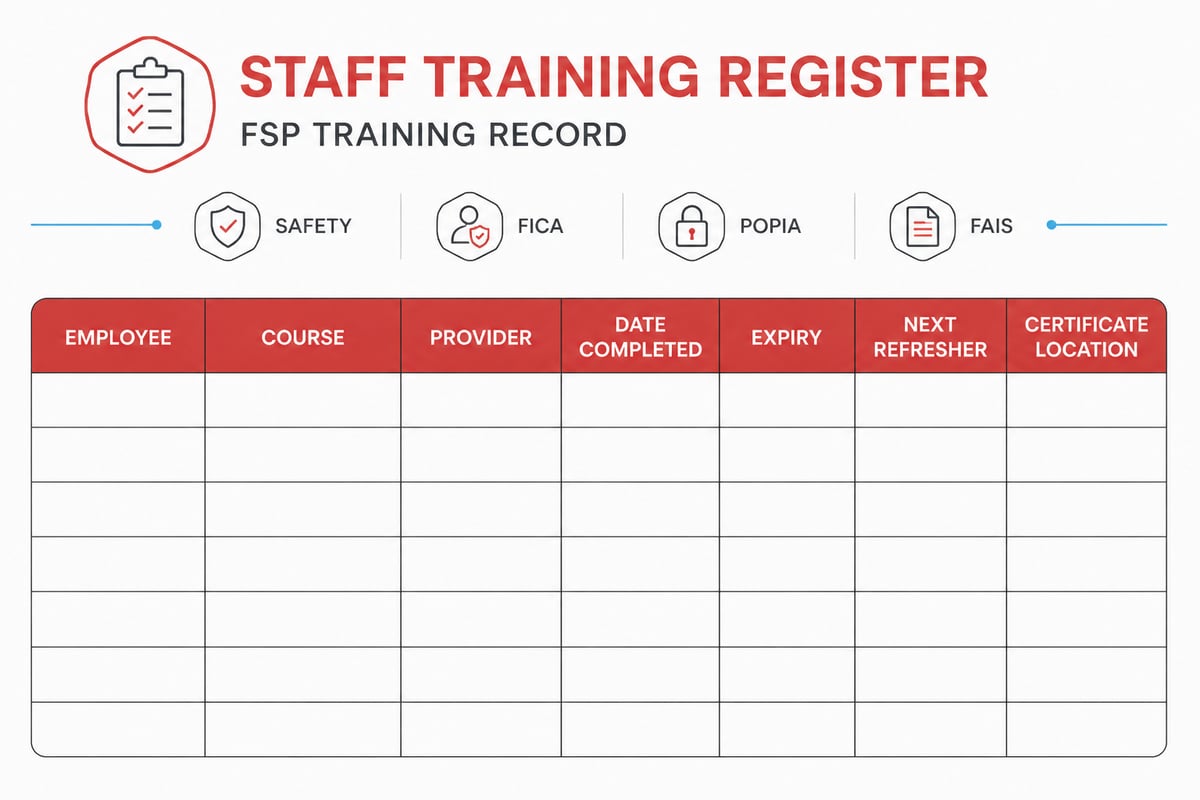
Safety training records belong in the same evidence system as your other compliance records, because an inspector or auditor expects to see documented, dated proof of training in every area. FSPs already keep registers for FAIS continuous professional development, FICA training and POPIA awareness. Adding safety training to that structure costs little and reduces the chance that anything lapses.
A practical staff training register should capture:
- Employee name and role, including part-time staff and interns
- Course title, provider and accreditation reference
- Date completed and certificate expiry date
- Next refresher due date
- Where the certificate is stored
Personal information in these records, such as identity numbers on certificates or medical details in incident reports, falls under POPIA. Store it securely, limit access to those who need it and apply your retention rules. The same discipline you use for client files should apply here.
Where safety training overlaps with other obligations, combine the sessions. A single induction day can cover safety awareness, FICA reporting duties and POPIA handling rules, with separate sign-off for each topic.

What should FSPs know about FICA and POPIA training alongside safety?
Safety training does not replace regulatory training. FICA, POPIA and FAIS each carry their own training expectations, and an FSP needs evidence for all of them.
- FICA: accountable institutions must train staff to recognise and report suspicious and unusual transactions and to apply the practice's Risk Management and Compliance Programme (RMCP). Without a current, practice-specific RMCP, training has nothing to anchor to.
- POPIA: staff who process personal information need to understand lawful processing, security safeguards and what to do when a data incident occurs. Your appointed Information Officer should be registered and trained.
- FAIS: key individuals and representatives must meet fit and proper requirements, including regulatory examinations, and keep up with continuous professional development.
Holistic Compliance Management Solutions (Pty) Ltd, a Cape Town compliance risk management business established in 2018, provides independent compliance and training services to FSPs, including training for regulatory exams, FICA and POPIA and RMCP drafting. It also offers clients a free FICA course with CPD points awarded on completion. Its stated aim is practical support that helps advisors run a sustainable business under changing regulation.
How do you build a training plan for your practice?
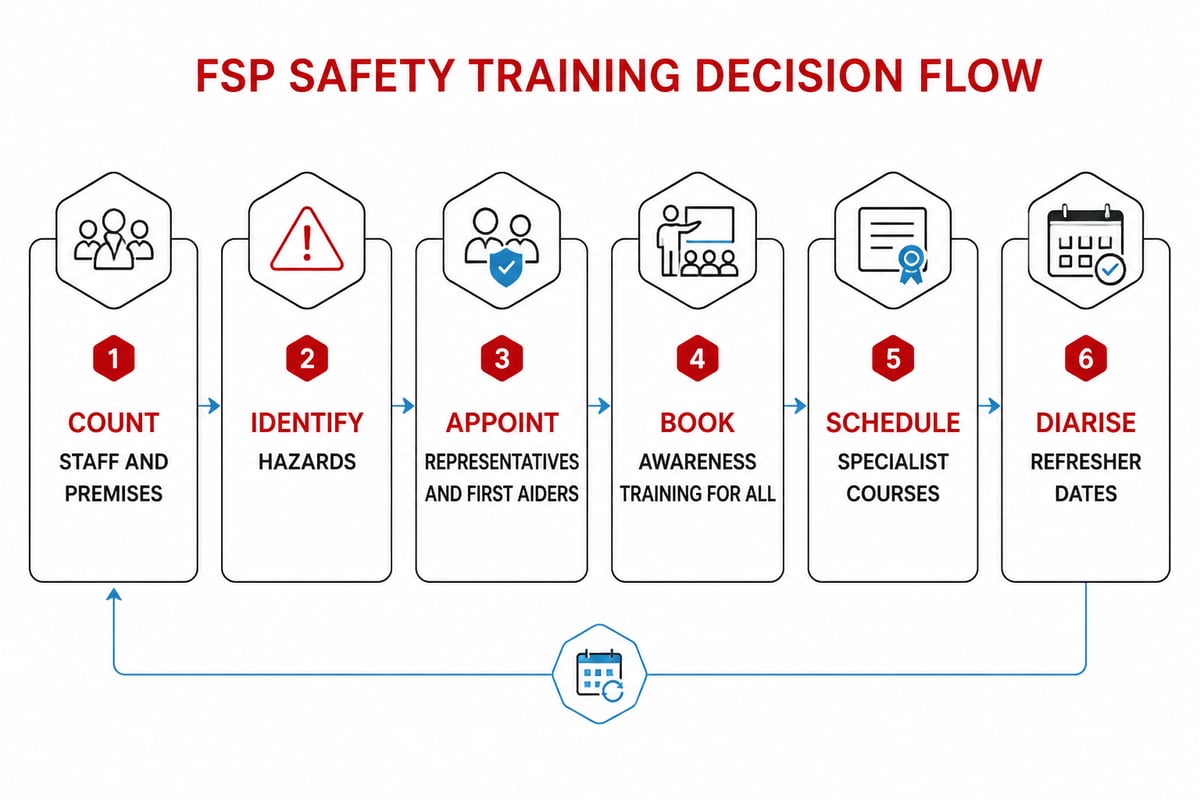
Build the plan in five steps, starting with an honest picture of who works in your premises and what could go wrong.
- Map your people and premises. List every employee, part-timer, intern and regular contractor, and note whether you control the building or share it with a landlord.
- Identify the risks. Walk the office. Check electrical loads, trailing cables, desk set-ups, fire exits, extinguisher dates and first aid supplies.
- Match courses to roles. Give everyone awareness training, then assign first aid, fire marshal and representative roles to specific people, with deputies to cover absence.
- Schedule and budget. Book dates in the year, place refresher deadlines in a shared diary and allow for time away from client appointments.
- Review annually. Revisit the plan when you move premises, hire new staff or change how the practice operates.
Hypothetical example: a practice with several staff, including part-time administrators, might choose awareness training for everyone, first aid for two people on different days of the week, fire marshal training for one person per floor and a combined annual refresher. The point is coverage across working patterns, not the exact numbers.
What mistakes should you avoid?
The most common errors are practical and easy to correct once named.
- Training only full-time staff. Part-time workers carry the same exposure and the same legal protection.
- Letting certificates lapse. First aid and fire qualifications expire. Diarise renewal at least two months ahead.
- Appointing roles without training. A named health and safety representative with no instruction offers little protection.
- Keeping paper records in an unlocked cupboard. Certificates and incident reports contain personal information.
- Treating induction as a one-off. New hires, role changes and office moves each warrant fresh briefings.
- Separating safety from compliance. A single register and a single annual calendar keep everything visible.
How do you measure whether the training worked?
Measure the training by what changes in behaviour and reporting, not by the number of certificates issued. Useful indicators for a small practice include the number of hazards or near misses reported by staff, the time taken to close each action, the completion rate for refreshers and the result of your annual fire drill.
Read a rise in near-miss reports as a good sign. It usually means staff feel able to speak up, which is exactly what the Lloyd's Register Foundation data on reporting suggests training encourages. For a broader view of safety frameworks and resources, the International Labour Organization’s occupational safety and health overview is a reliable reference.
Record each review and what you decided. A brief annual note, signed by the principal or compliance officer, shows that safety training is managed rather than assumed.
Which questions come up most often?
Do small FSPs with fewer than ten staff need occupational safety courses?
Yes. Employer duties apply regardless of size, although some formal requirements, such as appointing representatives, depend on headcount. Awareness training and a trained first aider are sensible even for the smallest practice.
Can online courses replace classroom training?
Online courses suit awareness topics well. First aid and fire fighting rely on hands-on assessment, so check that the format and accreditation meet the regulatory requirement before booking.
Do interns and part-time staff need the same training?
They should receive the same induction and the same awareness training. If an intern joins through a placement programme, agree in writing who is responsible for their induction and safety briefing.
How long should we keep safety training records?
Retention periods depend on the regulations and on your own record-keeping policy. Confirm the applicable period with your compliance officer or a qualified practitioner, then apply it consistently alongside your POPIA retention rules.
Start by listing every person in your practice, including part-timers and interns, and check each against the safety, FICA, POPIA and FAIS training they have completed this year. If the list reveals gaps in your FICA or RMCP training, you can Register Now for training with Holistic Compliance Management Solutions (Pty) Ltd and take advantage of its free FICA course, which awards CPD points on completion. Its independent, practical support helps FSPs keep regulatory training current while the rest of the practice stays safe and well run.