
Safety Training Courses to Consider in South Africa
Who this is for: independent brokers, regulated brokers, FSP applicants and compliance officers who need to decide which training is worth the money.
Safety training in South Africa covers two distinct needs: occupational health and safety (OHS) qualifications that protect people in the workplace, and regulatory training that protects a financial services practice from FSCA, FICA and POPIA exposure. Most financial advisors need the second kind first, but a practice with premises, staff and visiting clients also carries OHS duties under the Occupational Health and Safety Act, so the courses below are worth knowing about. The list covers four recognised OHS and safety professional courses, followed by six compliance training options built for FSPs, each with its format, approximate price and the practice it suits.
What safety training means for a financial services practice
Safety training for an FSP combines workplace safety awareness with regulatory competence. The first part covers hazards, emergency procedures, ergonomics and incident reporting under the OHS Act. The second covers the obligations that carry penalties for a broker practice: FAIS licensing conditions, FICA reporting duties, POPIA handling of client data, and, as the regulatory framework develops, COFI.
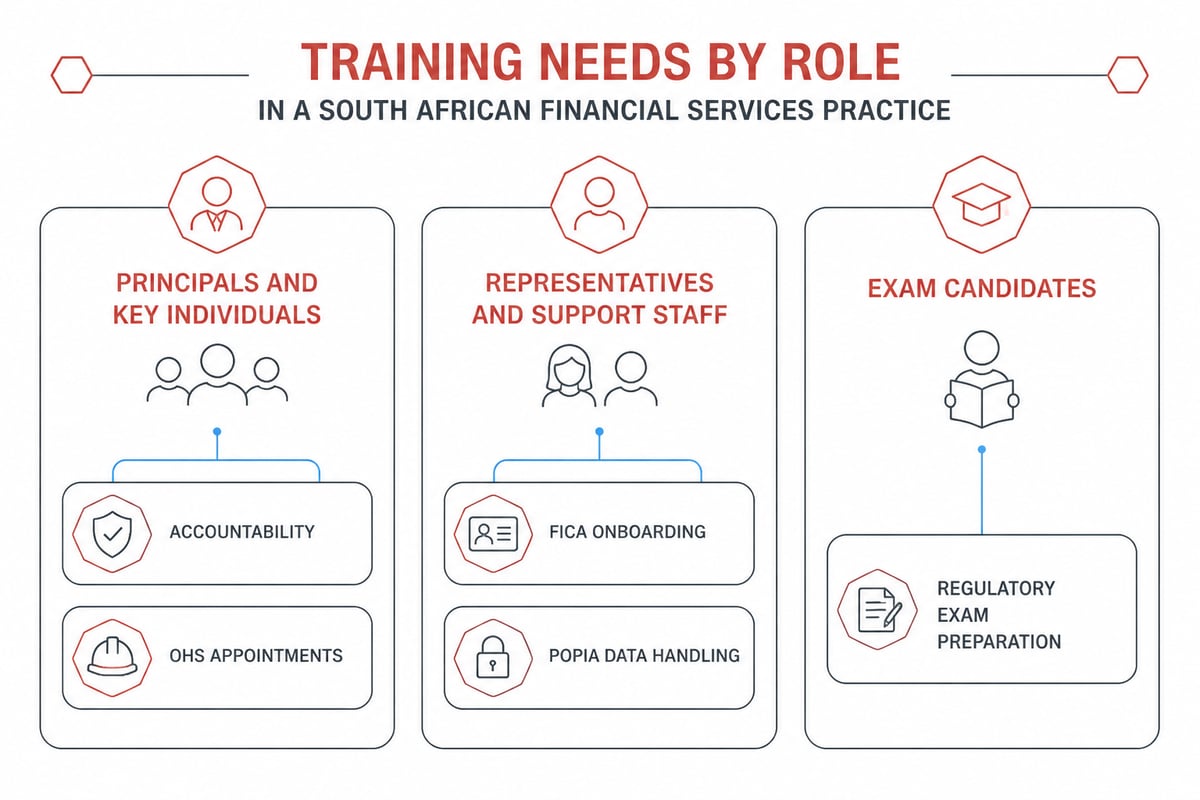
A practical way to scope your needs is to separate three groups of people in the practice:
- Principals and key individuals, who carry personal accountability for compliance and for appointing a health and safety representative where the OHS Act requires one.
- Representatives and support staff, who need working knowledge of client onboarding, record keeping and data protection.
- Candidates preparing for the regulatory examinations, who need exam-focused instruction rather than general awareness.
Matching the course to the group avoids paying professional-level fees for awareness-level needs.
1. Occupational Health and Safety online short course (University of Cape Town)
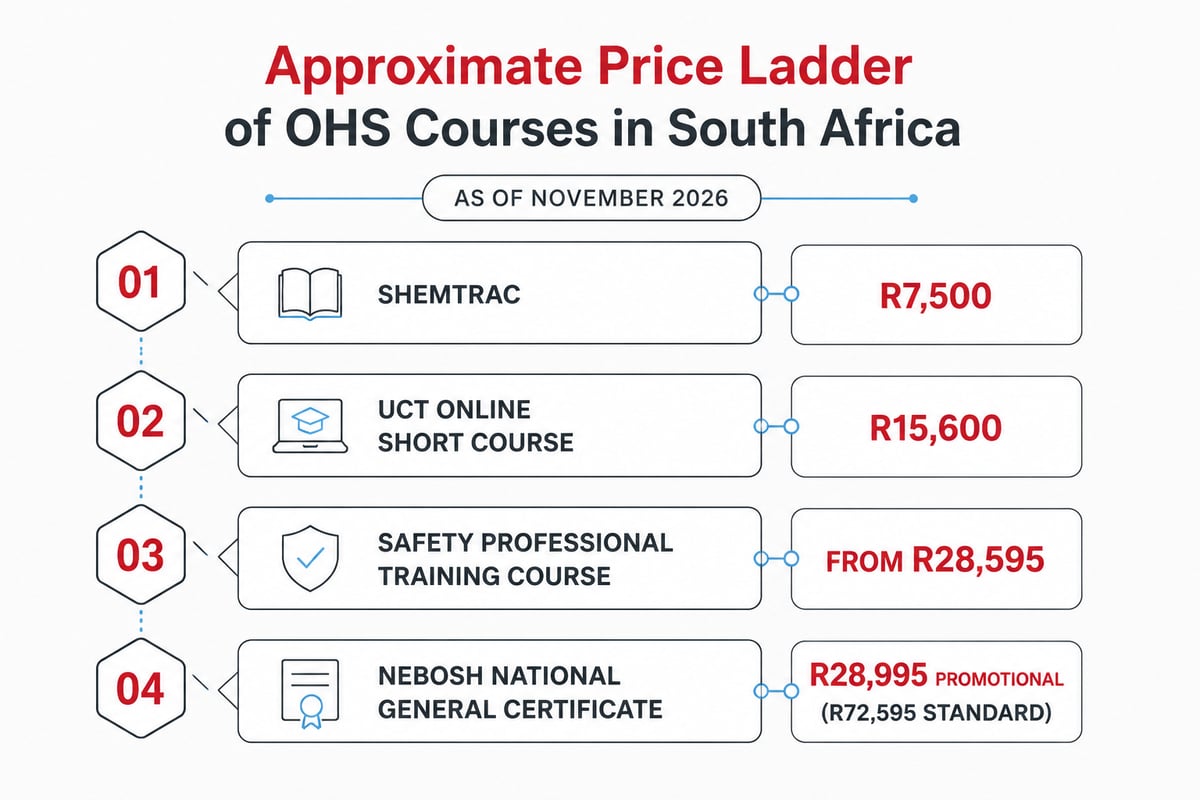
The online short course in occupational health and safety runs over 10 weeks and is listed at approximately R15,600.
- Format: online short course, 10 weeks
- Provider: Not confirmed in the researched information
- Approximate price: R15,600
Suits: a practice principal or office manager who wants a structured online course and can commit to a ten-week schedule alongside client work. The online delivery means no travel, which matters for a small practice with limited cover.
Verdict: a structured online option for principals who want a formal course with a fixed schedule.
2. SHEMTRAC: Occupational Health, Safety and Environment (Funda Institute)
SHEMTRAC is a flagship safety officer course covering workplace health, safety and environmental management. It is listed at approximately R7,500, which makes it the most affordable of the four OHS options here.
- Scope: workplace health, safety and environmental management
- Provider: Not confirmed in the researched information
- Approximate price: R7,500
Suits: a smaller practice that needs one staff member to take on a safety officer function and wants broad preparation at a modest budget. The scope is wide, so it works as a foundation rather than a specialist qualification.
Verdict: the budget-friendly route to a designated safety officer in a small office.
3. Safety Professional Training Course (The Knowledge Academy)
A safety professional training course is offered in South Africa, listed from approximately R28,595. It is aimed at professional-level safety training rather than introductory awareness.
- Level: professional
- Provider: Not confirmed in the researched information
- Approximate price: from R28,595
Suits: a larger or multi-branch practice, or a group that employs several people across sites, where a staff member will hold ongoing responsibility for safety management. The fee is only justified where that responsibility is a real part of the role.
Verdict: a professional-tier option that suits bigger operations more than a sole practitioner.
4. NEBOSH National General Certificate in Occupational Health and Safety (The Knowledge Academy)
This is a virtual NEBOSH National General Certificate, aimed at learners building a career in occupational health and safety. A promotional price of approximately R28,995 is listed, against a listed standard price of approximately R72,595.
- Format: virtual training
- Qualification: NEBOSH National General Certificate
- Approximate price: R28,995 promotional; R72,595 standard
Suits: an individual who intends to specialise in OHS, such as a compliance officer extending into workplace safety, and who values an internationally recognised certificate. Check which price applies when you book, as the gap between promotional and standard pricing is large.
Verdict: the strongest credential on this list, but only worth it for someone making OHS a career focus.
5. FICA and RMCP training (Holistic Compliance Management Solutions)
FICA RMCP is a compliance service that helps insurance brokers stay compliant and mitigate risk, with FICA and POPIA training and affordable support for drafting your Risk Management and Compliance Programme (RMCP). Holistic Compliance Management Solutions (Pty) Ltd also provides a free FICA course for clients, with CPD points awarded on completion.
- Scope: FICA and POPIA training, RMCP drafting
- Provider: Holistic Compliance Management Solutions (Pty) Ltd, independent compliance services for FSPs
- Included for clients: free FICA course with CPD points on completion
Suits: a broker practice that must document how it identifies and verifies clients, reports suspicious transactions and protects personal information. This training addresses FICA and POPIA obligations directly rather than general awareness. For pricing and course dates, use the provider's course pages or contact page.
Verdict: the most directly relevant training here for an FSP facing FICA and POPIA inspection.
6. Regulatory exam training (Holistic Compliance Management Solutions)
RE Exam Training prepares candidates for regulatory examinations. It is offered by a provider that supports advisors in running a sustainable practice under changing regulation.
- Scope: regulatory exam preparation
- Provider: Holistic Compliance Management Solutions (Pty) Ltd
Suits: new representatives and FSP applicants who need to prepare for regulatory exams, as well as practices that facilitate internship placements. Contact the provider for formats, schedules and fees.
Verdict: a relevant starting point for candidates preparing for regulatory examinations.
Comparison of the six options
The table sets the four OHS courses beside the two compliance offerings so that cost, format and fit can be read across a single row. Two features of the table matter when you use it. First, the OHS courses and the compliance offerings answer different legal duties: the first four address workplace safety under the Occupational Health and Safety Act, while the last two address FICA, POPIA and FAIS exposure. They are not substitutes for one another, so a practice may reasonably buy one from each group. Second, several cells say "Not listed" or "Contact provider" because the researched information does not state a format or fee, and you should confirm those details with the provider before budgeting. Where a price shows both promotional and standard figures, as with NEBOSH, ask which applies on your booking date, since the difference is R43,600.
| Option | Focus | Format | Approximate price (as of November 2026) | Suits |
|---|---|---|---|---|
| Occupational Health and Safety online short course | OHS fundamentals | Online, 10 weeks | R15,600 | Principals wanting a structured online course |
| SHEMTRAC | Safety officer preparation | Not listed | R7,500 | Small practice needing a safety officer |
| Safety Professional Training Course | Professional safety management | Not listed | From R28,595 | Larger or multi-site practices |
| NEBOSH National General Certificate | OHS career qualification | Virtual | R28,995 promotional; R72,595 standard | Individuals specialising in OHS |
| FICA RMCP (Holistic Compliance Management Solutions) | FICA, POPIA, RMCP drafting | Contact provider | Contact provider | Brokers facing FICA and POPIA obligations |
| RE Exam Training (Holistic Compliance Management Solutions) | FSCA regulatory exam preparation | Contact provider | Contact provider | Representatives and FSP applicants |
How to choose the right safety training for your practice
Choose by obligation first and credential second. Start with the legal duty your practice cannot defer, then add broader training as budget allows.
- Identify the regulatory gaps. Review whether your RMCP is current, whether staff have documented FICA and POPIA training, and whether any representative still needs to pass the regulatory exam.
- Check OHS Act duties. If your office has employees, confirm who is responsible for safety, first aid, fire equipment and incident records.
- Set a budget per role. The approximate range runs from R7,500 for SHEMTRAC to R28,995 or more for professional certificates, so reserve the higher tier for roles that need it.
- Confirm the format. Online and virtual delivery suits practices that cannot release staff for days at a time.
- Keep evidence. Retain certificates, attendance records and CPD points for FSCA and Information Regulator inspections.
Industry bodies also publish structured programmes, but local legal context still determines what applies to a South African FSP.

A practical safety training checklist for broker workflows
A workable plan fits the way an independent practice operates day to day. Use this checklist as a starting point.
- Onboarding: staff can complete client identification and verification correctly, and know when to escalate.
- Record keeping: client files are stored securely, retained for the required period and accessible for inspection.
- Data protection: personal information is collected for a defined purpose, access is limited, and an incident response step is documented under POPIA.
- Reporting: the practice knows how and when to file suspicious and unusual transaction reports.
- Licensing conditions: key individuals and representatives hold current authorisations, and CPD is tracked.
- Workplace safety: emergency exits, first aid supplies and incident logs are in place and reviewed.
- Review cycle: the RMCP and training register are reviewed at least annually and after any regulatory change.
A small practice with one principal and two representatives could assign the OHS function to one staff member, enrol a new representative in exam training, and complete FICA and POPIA training for the whole team in one session. The point is to match each course to a named person and a named obligation.
Why regulatory safety training deserves a budget line
Regulatory safety training deserves a fixed budget line because the cost of a failed inspection or a data breach is far higher than the cost of preparation. FICA non-compliance can attract administrative sanctions, and POPIA breaches can lead to reporting duties and reputational damage with clients who trust you with sensitive financial information. Treating training as a recurring, documented activity, rather than a one-off event, also demonstrates the culture of compliance that regulators look for. Independent oversight helps here: an outside compliance monitor can test whether training is translating into practice, which is difficult to judge from inside the business.
A budget line also forces useful decisions. Costing training per role shows where money is going: an exam candidate needs exam preparation, a front-office employee who handles client documents needs FICA onboarding and POPIA instruction, and a principal needs enough RMCP knowledge to sign off the programme with confidence. Because the OHS options here range from R7,500 for SHEMTRAC to R28,995 or more for professional certificates, a planned allocation prevents an expensive qualification being bought for a role that only needs awareness. Recurring items should be scheduled rather than left to chance: an annual refresher on FICA and POPIA, training for every new hire during the first weeks of employment, and a re-run after any material regulatory change. Each session should produce a certificate, attendance register or CPD record, because that evidence is what you will hand to an inspector from the FSCA or the Information Regulator.
Your next step is to list every employee and representative, mark which of FICA, POPIA, FAIS exams and OHS duties each one has evidence for, and book training for the gaps. Holistic Compliance Management Solutions (Pty) Ltd supports this with independent compliance services, FICA RMCP drafting and training, and a free FICA course for clients that awards CPD points on completion. If you want to schedule FICA training for your practice, review the available programmes and Register Now to secure a place.