
Business Courses: What to Study and Where to Start
Who this is for: independent brokers, regulated brokers, FSP applicants and compliance officers.
The best business courses for a South African financial advisor are those that cover your regulatory obligations first (FAIS, FICA and POPIA), followed by practice management, client communication and data skills. Start with the course that closes your biggest compliance gap, then build outward. A general management qualification can come later, once your licence conditions, record-keeping and monitoring are secure.
This article sets out what to study, how to compare formats, and how to turn a course into practical changes in your practice.
What business courses should a financial advisor study first?
A financial advisor should study the regulatory courses that underpin their licence before anything else: FAIS knowledge and regulatory exam preparation, FICA, POPIA and risk management. These carry legal consequences if neglected, so they come ahead of general management or marketing training.
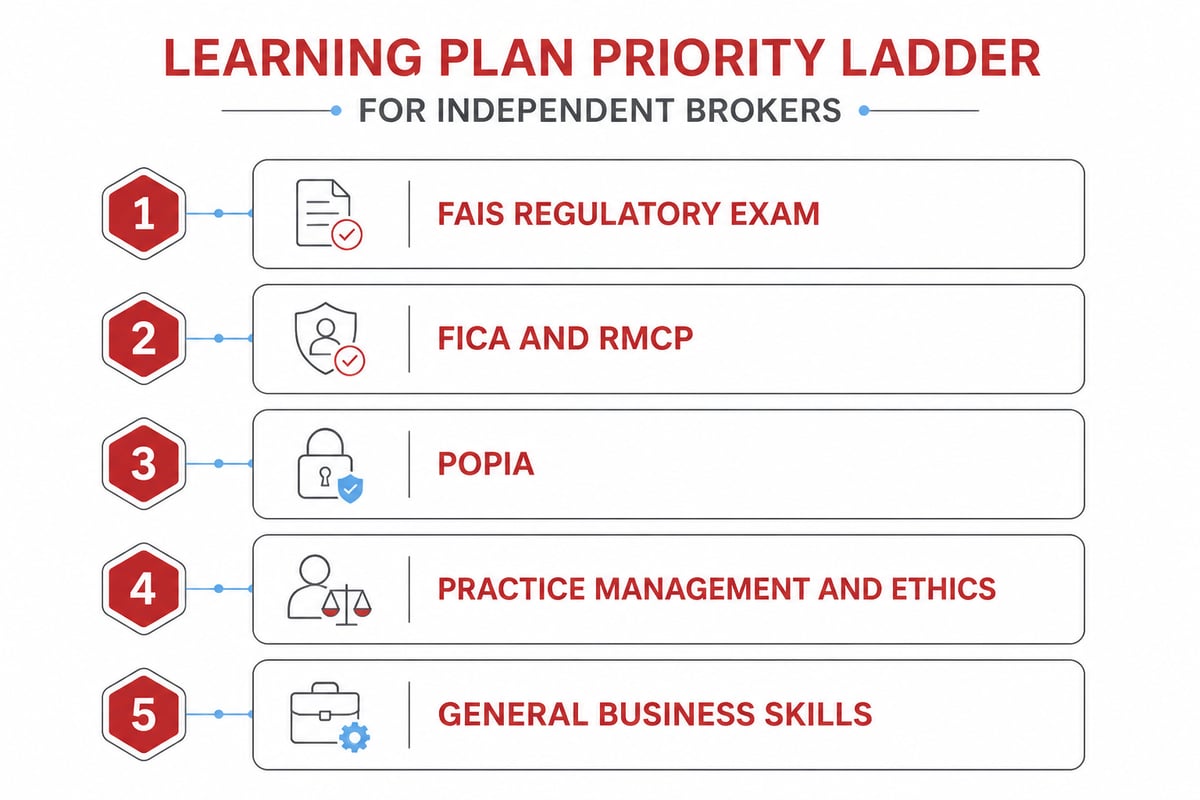
A sensible order of priority looks like this:
- Regulatory exam preparation. Under the Financial Advisory and Intermediary Services (FAIS) Act, representatives must meet fit-and-proper requirements, including the regulatory exams. Passing them is a condition of working with clients.
- FICA and RMCP. The Financial Intelligence Centre Act requires accountable institutions to understand their money laundering and terrorist financing risks and to document them in a Risk Management and Compliance Programme.
- POPIA. The Protection of Personal Information Act governs how you collect, store, share and destroy client information.
- Practice management and ethics. Complaints handling, conflicts of interest, disclosure and record-keeping.
- Business skills. Financial management, marketing and leadership, which matter once the practice grows.
Each item feeds the next. A well-drafted RMCP depends on understanding your client onboarding workflow, and POPIA compliance depends on knowing where client data actually sits.
Which business course can I study to meet FAIS requirements?
To meet FAIS requirements, you can study an accredited regulatory exam preparation course, a product-specific class of business training, and ongoing continuous professional development (CPD) that keeps you within your licence conditions. The right choice depends on whether you are a new representative, a key individual or an FSP applicant.
For new representatives
New entrants need to prepare for the regulatory exams and complete the required product training. Structured exam preparation, with practice questions on the FAIS General Code of Conduct, saves repeated attempts and keeps a supervised representative's start date on schedule.
For key individuals and FSP applicants
If you are applying for an FSP licence, the key individual carries personal accountability for compliance. The application requires documented competence, a compliance arrangement and appropriate operational structures. Applicants benefit from a licensing readiness assessment before submitting to the Financial Sector Conduct Authority (FSCA), because incomplete applications cause delay.
For established brokers
Established advisors should focus on CPD that reflects regulatory change. The Conduct of Financial Institutions (COFI) Bill is intended to consolidate market conduct rules across the sector, so keeping a course record that shows you have followed the direction of travel is sensible preparation.
What is the best business course to take for FICA and RMCP compliance?
The best FICA course is one that teaches you to apply the Act to your own client onboarding, not simply to recite its provisions. It should leave you able to identify and verify clients, assess risk, report suspicious transactions and maintain a living RMCP.
Look for these elements before enrolling:
- Customer due diligence steps, including identification, verification and beneficial ownership
- Risk-based approach, with client, product, geography and delivery channel factors
- Reporting duties to the Financial Intelligence Centre
- Record-keeping periods and how to store them
- How to draft, approve and update an RMCP so it reflects what your practice does in reality
Holistic Compliance Management Solutions offers FICA training and compliance courses. For a practice that has never documented its FICA process, that is a practical starting point. It also provides RMCP drafting support for practices that need the document written or refreshed.
A common weakness in broker RMCPs is that the document describes an ideal process while staff follow a different one. After any course, walk through a real client file from first contact to onboarding and compare it line by line with your RMCP.
How do POPIA courses help an independent broker practice?
POPIA courses help an independent broker by turning a broad statute into a defined set of practice routines: who holds client data, where it is stored, who may access it, and how long it is kept. A good course ends with a working set of documents, not just awareness.
An independent practice handles some of the most sensitive personal information there is, including identity numbers, bank details, health information for risk products, and income data. That makes POPIA compliance a daily workflow issue.
A practical POPIA checklist for a broker
- Appoint an Information Officer and register with the Information Regulator
- Map the personal information you hold, where it came from and who receives it
- Confirm the lawful basis for processing each category of data
- Review client consent and disclosure wording on application and advice forms
- Check that operators, such as product providers, administrators and cloud storage vendors, are bound by written agreements
- Set access controls on laptops, phones and shared drives
- Prepare a breach response procedure, including notification steps
- Define retention and destruction periods, aligned with FAIS and FICA record-keeping rules
Where your practice also needs assurance over how systems and service providers handle data, an independent assurance report can help. Holistic Compliance offers SOC 3 compliance services for that purpose.
Do general business courses still matter for advisors?
Yes. General business courses matter because a compliant practice must also be financially sustainable, and regulatory training does not teach cash flow, pricing or hiring. Once the licence-critical courses are complete, general skills decide whether the practice grows or stalls.
The World Economic Forum's Future of Jobs Report 2025 draws on responses from more than 1,000 employers representing over 14 million workers across 22 industry clusters and 55 economies. Its skills outlook finds that employers expect a large share of workers' core skills to change by 2030, and that most surveyed companies consider analytical thinking essential. The report also estimates that most workers will need training by 2030.
For a financial advisor, those findings translate into three areas worth studying: For a broader comparison of qualification levels, subjects and fit for FSPs, see our guide to management courses in South Africa.
- Analytical thinking. Reading portfolio data, cost structures and client segmentation.
- Technology literacy. AI and big data, networks and cybersecurity are among the fastest-growing skills employers expect through 2030, and each bears on how an advisory practice stores and protects client records.
- Leadership and communication. Supervising representatives, managing administrators and explaining advice in plain language.
These courses can be short. A practice owner does not need a full degree to benefit from a focused module on financial management or team supervision.

Which business courses are in demand in South Africa?
Demand for business skills in South Africa is strongest in compliance, risk management, data protection, financial management and digital capability. These areas share a common feature: regulation or technology has made them non-optional for financial services businesses.
The following table compares the main course categories on what they cover and who benefits most.
| Course category | Main topics | Best suited to |
|---|---|---|
| Regulatory exam preparation | FAIS Act, General Code of Conduct, product knowledge | New representatives, supervised staff |
| FICA and RMCP | Due diligence, reporting, risk assessment, programme drafting | Accountable institutions, compliance officers |
| POPIA | Lawful processing, security safeguards, Information Officer duties | Every practice holding client data |
| Compliance monitoring | Sampling files, testing controls, reporting findings | Key individuals, compliance officers |
| Practice management | Complaints, conflicts, disclosures, record-keeping | Established brokers |
| Financial and business skills | Budgeting, pricing, marketing, leadership | Practice owners planning growth |
For international context, the US Bureau of Labor Statistics publishes projections of job openings for occupations that typically require a bachelor’s degree. The figures are American, so treat them as a general signal rather than a South African forecast.
How should you compare business courses before enrolling?
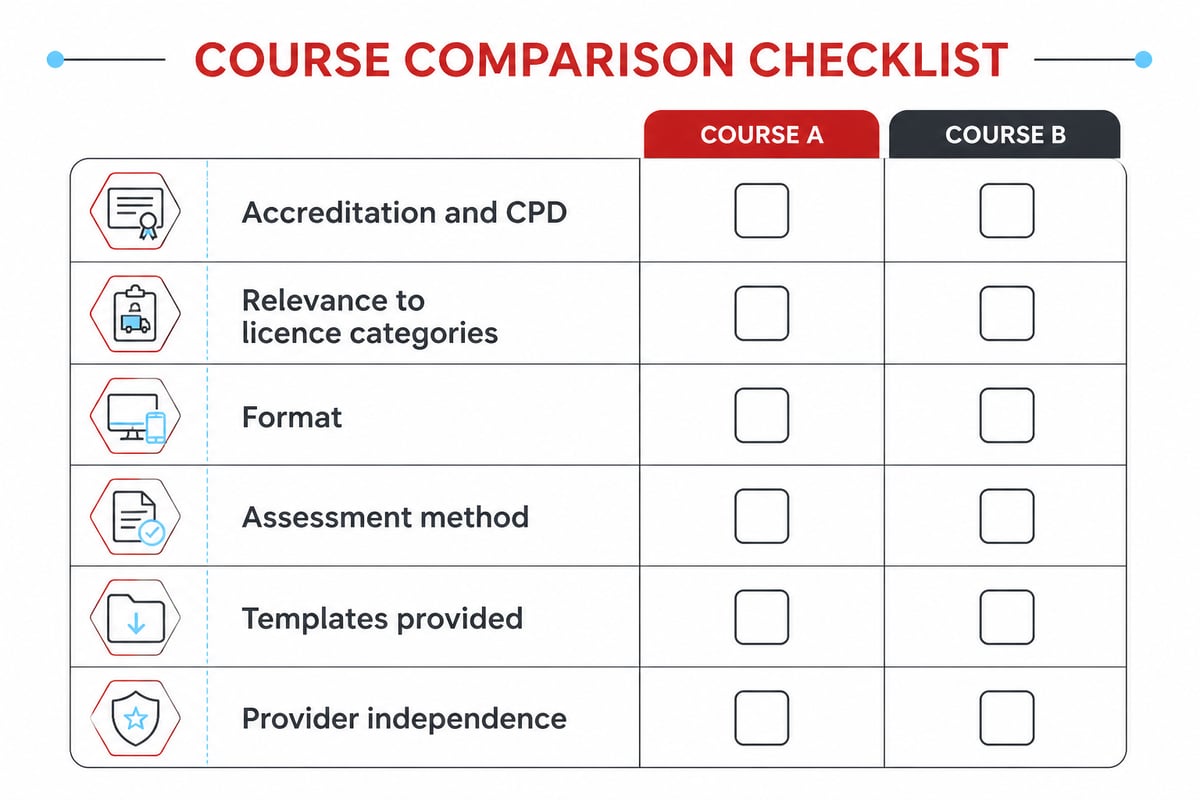
Compare business courses on accreditation, relevance to your licence category, delivery format, assessment method and what you can use afterwards. A course that earns CPD points but changes nothing in your practice has limited value.
Use this checklist:
- Accreditation and CPD. Confirm the provider is recognised and that the hours count towards your CPD requirement.
- Relevance. Does the content match your FSP licence categories and client types?
- Format. Online self-paced courses suit busy practices. Live sessions suit teams who want to discuss real cases together.
- Assessment. A course that tests you on application will teach more than one that only issues a certificate.
- Tools provided. Templates, checklists and sample policies turn learning into action.
- Independence. For compliance training, a provider that is independent of product houses is less likely to be influenced by commercial interests.
Public programmes elsewhere show how structured learning can be offered at no cost. The US Small Business Administration, for example, provides online courses and videos to help people start, pivot or grow a small business. Those resources are American, but they illustrate a useful principle: free introductory material is a sensible first step before paying for specialist training.
How do you turn a course into compliance in your practice?
You turn a course into compliance by assigning an owner, setting deadlines, updating documents and testing the result within 90 days of finishing. Without those steps, training remains theoretical.
A simple implementation sequence
- Capture actions during the course. Keep a running list of gaps in your RMCP, privacy notices, disclosure forms and file notes.
- Assign owners. Name the person responsible for each fix, whether that is the key individual, the Information Officer or an administrator.
- Update the documents. Revise policies, consent wording and onboarding checklists first, because they are cheapest to change.
- Train the team. A short internal briefing makes sure the written process matches what staff do.
- Test with a file review. Select a sample of recent client files and check them against the updated procedures.
- Schedule monitoring. Compliance is ongoing, so set quarterly checks rather than relying on one annual review.
Independent compliance monitoring is particularly useful at step five, because a reviewer outside the practice sees what staff have stopped noticing. Holistic Compliance Management Solutions provides compliance monitoring for financial service providers, alongside practical support that helps advisors run a sustainable business under changing regulation. Its shop lists the available training and compliance products.
What about internships and entry-level business training?
Internships give new entrants supervised workplace experience alongside theory, which is often what employers and FSPs want to see. They suit graduates who hold a business or finance qualification but have no practical exposure to regulated advice.
For an FSP, hosting an intern carries obligations: supervision, clear duties, protection of client data and accurate record-keeping. Holistic Compliance Management Solutions facilitates internship placements, which can help practices that want to bring in new talent without managing the entire process alone.
Interns should also complete basic FICA and POPIA training in their first weeks. Even a junior administrator handles client identity documents, so the training protects the practice from the start.
FAQ
What course is best for business if I already hold an FSP licence?
If you already hold a licence, choose training that tightens your existing obligations: an RMCP review, POPIA implementation and compliance monitoring. These reduce regulatory risk and often reveal weaknesses before an inspection does.
How long do business courses take to complete?
Duration varies by provider and subject. Short compliance courses can be completed in hours or days, while diplomas and degrees take considerably longer. Check the course page or contact the provider for exact timings.
Can the whole team take the same course?
Yes, and it is often the most effective approach. When the key individual, representatives and administrators all complete the same FICA or POPIA training, the written procedures and daily behaviour are more likely to match.
Your next step is to list the three compliance gaps in your practice that worry you most, then match each to a course before the end of this month. If one of those gaps is FICA or your RMCP, Holistic Compliance Management Solutions offers courses that can help you close it. The session is aimed at independent brokers, regulated brokers, FSP applicants and compliance officers who want their client onboarding process to match their documented programme.