
Management Training Guide for Financial Services Teams
Who this is for: independent brokers, regulated brokers, FSP applicants and compliance officers.
Training in management is the structured development of the skills a person needs to lead people, run processes and answer for outcomes, and in financial services it must also cover the regulatory duties that come with supervising advisors. For a South African FSP, that means pairing core people-management skills with working knowledge of FAIS, FICA, POPIA and the incoming COFI framework. Without that pairing, a capable team leader can still expose the practice to regulatory risk.
Two clarifications on scope. The regulatory examples in this guide refer to South African law and to the FSCA as the market conduct regulator. Where we cite fitness and propriety practice from the United Kingdom, we do so only as a useful comparison for how a mature regime treats manager accountability, not as a South African requirement.
What Training Do Managers in Financial Services Need?
Managers in financial services need training in three areas: people leadership, operational control and regulatory accountability. The first two apply to any business. The third is what separates a practice principal or key individual from a general manager. Practices weighing leadership training courses for their managers should start with these three areas.
A workable curriculum for an independent broker practice covers the following:
- People leadership: delegation, performance conversations, coaching and handling conflict within a small team.
- Operational control: workflow design, quality checks on client files, record keeping and complaints handling.
- Regulatory accountability: the duties of the key individual and representatives under FAIS, client due diligence under FICA, personal information handling under POPIA, and conduct expectations that COFI is set to consolidate.
- Financial and commercial literacy: reading practice financials, understanding commission and fee structures, and managing business risk.
- Ethics and conduct: treating customers fairly, managing conflicts of interest and escalating concerns.
Small practices often promote their best advisor into a management seat with no formal preparation. That advisor then inherits supervision duties for which no one has trained them. Closing that gap is the purpose of structured development.
The 3 C's of Management and How They Apply to an FSP
The three C's of management are commonly described as communication, coordination and control, and each has a direct compliance equivalent in a financial services practice.
| The C | General meaning | FSP application |
|---|---|---|
| Communication | Sharing clear instructions and feedback | Briefing representatives on FAIS conduct rules, explaining FICA steps to junior staff, informing clients how their data is used |
| Coordination | Aligning people and tasks | Scheduling onboarding checks, product reviews and CPD so nothing is left to the last month of the cycle |
| Control | Monitoring against standards | Compliance monitoring, file reviews, exception reporting and corrective action |
Other frameworks use different C's, such as competence, commitment and credibility, so it is worth agreeing on one model within your practice and applying it consistently. What matters is that each manager can point to the system behind each C.
The Five Basic Managerial Skills Worth Developing First
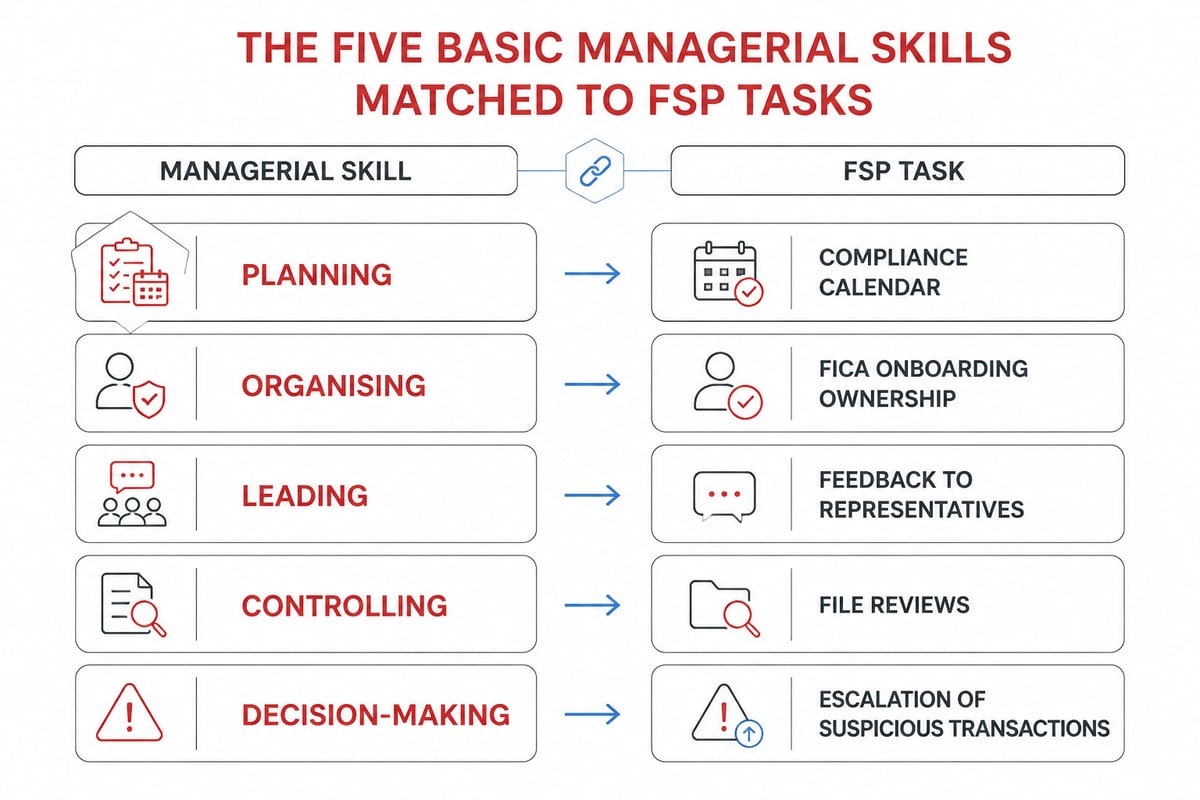
The five basic managerial skills are planning, organising, leading, controlling and decision-making, and each can be turned into a measurable competence within a practice.
- Planning: setting annual compliance and business calendars, including licence renewals, FSCA levy and reporting dates, and representative CPD cycles.
- Organising: assigning clear responsibility for FICA onboarding, record retention, complaints registers and POPIA requests.
- Leading: setting standards by example and giving feedback that changes behaviour.
- Controlling: testing whether the process is followed, not merely documented.
- Decision-making: judging when a client situation needs escalation, a suspicious and unusual transaction report, or a refusal to proceed.
Assess each manager against these five once a year and record the result. That record becomes evidence of competence if the regulator or a client ever questions your oversight.
Regulatory Obligations That Shape Management Training in Financial Services
Management training in financial services must reflect that managers are accountable for the conduct of the people they supervise. The sections below set out the four frameworks South African managers most often need to master.
FAIS and the key individual
Under the Financial Advisory and Intermediary Services Act, the key individual is responsible for the FSP's compliance and for the oversight of its representatives. Training should cover fit and proper requirements, the General Code of Conduct, the regulatory examinations, continuing professional development and the supervision of representatives. A manager who cannot explain the practice's conflict of interest management policy is not ready to supervise.
FICA and the RMCP
The Financial Intelligence Centre Act requires accountable institutions to understand and manage their money laundering and terrorist financing risk through a Risk Management and Compliance Programme. Managers should be able to explain how client risk is rated, when enhanced due diligence applies, and how reports reach the Financial Intelligence Centre. Compliance training for FICA should be repeated for new staff and refreshed whenever the RMCP changes.
POPIA
The Protection of Personal Information Act makes the practice a responsible party for client data. Managers need to know their duties on lawful processing, security safeguards, operator agreements with software providers, breach notification to the Information Regulator, and responding to data subject requests. Appoint and train an information officer, and register that person with the Regulator.
COFI
The Conduct of Financial Institutions Bill is intended to consolidate market conduct requirements across the financial sector. Because the framework is still working its way through the legislative process, manager training should focus on the direction of travel: outcomes-based customer treatment, governance and accountability. Build a short briefing into your annual training so that the practice is not learning the detail for the first time at implementation.
A Comparison Point: How a Mature Regime Treats Manager Fitness
The UK's approach to manager accountability offers a useful benchmark for South African practices building their own standards. Under the FCA's Senior Managers Regime, Senior Managers performing Senior Management Functions need FCA or PRA approval before starting their roles, and firms must assess their ongoing fitness and propriety at least annually.
The same framework reaches below senior level. Certification staff are not approved by the FCA; firms must assess and certify their fitness and propriety on appointment and at least once a year. The FCA Handbook adds that, in assessing whether a certification employee is fit and proper, firms must consider relevant qualifications, training, competence and personal characteristics.
None of this is binding in South Africa. It does give a defensible model for your own practice: assess managers on appointment, reassess annually, and record qualifications, training, competence and conduct in each review.
What Are the Four Types of Training?
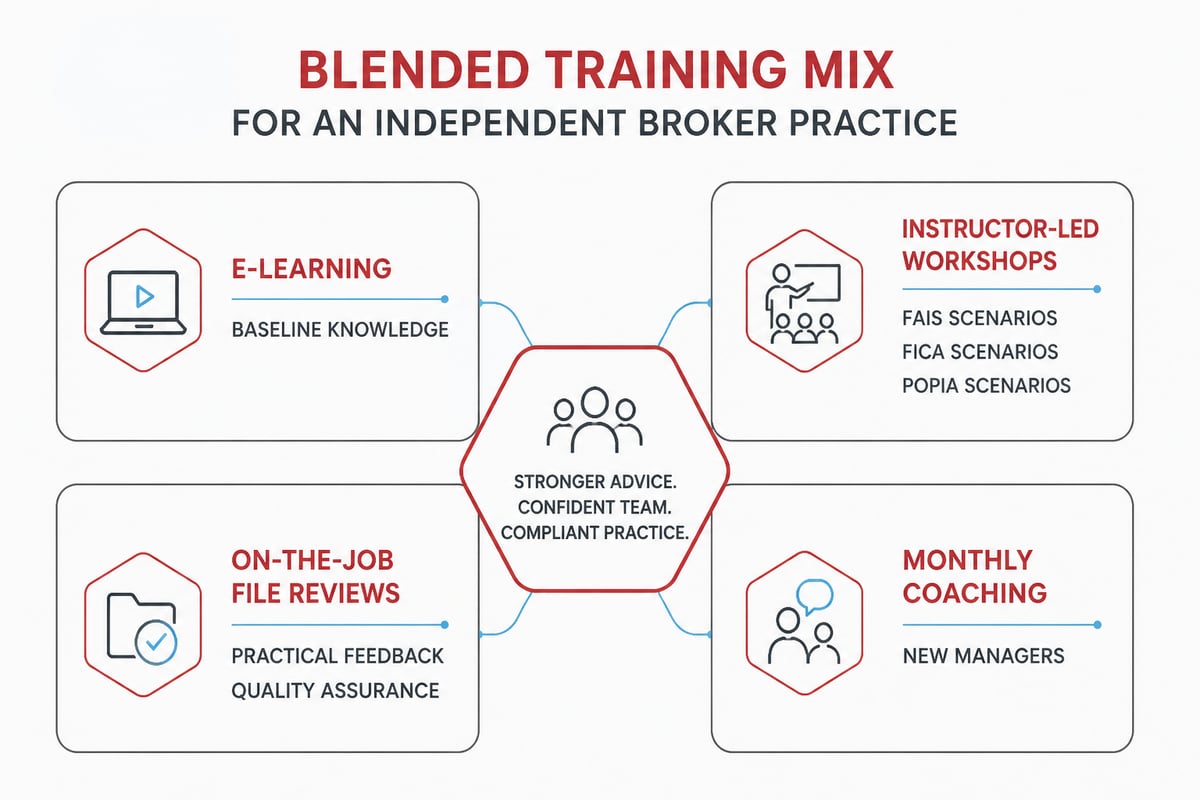
The four types of training most often used in organisations are on-the-job, classroom or instructor-led, e-learning and coaching or mentoring, and a strong management programme blends them rather than relying on one.
- On-the-job training: shadowing, supervised file reviews and gradual delegation. Effective for practice-specific workflows.
- Instructor-led training: workshops or classes delivered in person or virtually. Suited to regulatory content where questions arise.
- E-learning: self-paced modules with assessments. Useful for refreshers and for evidencing CPD.
- Coaching and mentoring: regular one-to-one development with a more experienced manager or an external adviser.
For an independent broker practice with limited time, a sensible mix is e-learning for the baseline, instructor-led sessions for FAIS, FICA and POPIA scenarios, and monthly coaching for new managers.
Choosing a Training Format and Provider
Choose a format by asking what the manager must be able to do afterwards, then match the delivery method to that outcome. Start with the gap, not the brochure.
Use this checklist when comparing options:
- Is the content specific to South African law and FSCA expectations?
- Does completion count toward CPD for representatives and key individuals?
- Are practical templates included, such as an RMCP outline, a POPIA register or a file review form?
- Can the training be run for your whole team, not just one person?
- Is the provider independent, with no product to sell into your practice?
- Is there a way to measure what changed afterwards?
Qualification-based routes suit managers who want a recognised credential, while short targeted courses suit a single gap, such as a new FICA obligation. Both can sit within a single development plan.
A 90-Day Plan for Building Management Capability
A 90-day plan gives a new or developing manager a clear sequence of tasks and evidence of progress. Adapt the steps below to the size of your practice.
- Days 1 to 15, assess: list every manager and supervisor, record their current duties, and rate them against the five basic managerial skills and the four regulatory frameworks.
- Days 16 to 30, prioritise: pick the three largest gaps. For most practices these are FICA risk rating, POPIA breach response and supervision of representatives.
- Days 31 to 60, train: run instructor-led sessions on the priority gaps and assign e-learning for the baseline. Pair each new manager with a mentor.
- Days 61 to 75, apply: have managers complete a live task, such as a file review of ten client records against the RMCP, and document the findings.
- Days 76 to 90, verify: review results, correct weaknesses, and set the next annual cycle. Store the evidence in your compliance file.
Training that ends in a certificate but changes no daily behaviour has not done its job. The live task in step four is what proves the learning has transferred.
Building Compliance Monitoring Into Management Routines
Compliance monitoring turns management training into daily practice by giving managers a repeatable way to test what their teams are doing. It is the control element of the three C's made concrete.
A monthly routine for an independent broker practice might include:
- A sample of new client files checked for FICA documents, risk rating and signed disclosures.
- A review of the complaints register and the time taken to resolve each item.
- A check that representatives' CPD hours and regulatory exam status are current.
- A POPIA check covering access rights, retention periods and any incidents.
- A short written note to the key individual recording findings and actions.
Independent monitoring adds objectivity because the person reviewing the files has no stake in the outcome. Holistic Compliance Management Solutions (Pty) Ltd provides independent compliance and training services for financial service providers, with practical support that helps advisors manage risk and improve practice management.
Where an RMCP Fits in Management Development
A Risk Management and Compliance Programme is both a legal document and a training tool, because every manager should be able to explain it in plain language. If your managers cannot describe how the practice rates client risk, the programme is not working.
Use the RMCP as a teaching text. Walk each manager through the client onboarding flow, ask them to identify where a high-risk client would be flagged, and have them practise an escalation. Compliance practices that support insurance brokers with FICA and POPI training can also help with drafting your RMCP, which keeps the document and the training aligned. Holistic Compliance Management Solutions offers this through its Fica RMCP service, which helps brokers stay compliant and mitigate risk.
Measuring Whether Training in Management Is Working
Training in management is working when you can show a change in behaviour and outcomes, not simply attendance. Choose a small set of indicators and track them each quarter.
- File quality: percentage of sampled client files that pass the FICA and FAIS checklist first time.
- Timeliness: days taken to resolve complaints and respond to data subject requests.
- Currency: share of representatives with up-to-date CPD and examination status.
- Incidents: number of near-misses, breaches or regulator queries, and the speed of corrective action.
- People measures: feedback from team members on clarity of instructions and fairness of supervision.
Review the figures with the key individual and record the decisions taken. A practice that can show a rising pass rate on file reviews is far better placed in an FSCA inspection than one that can show only a stack of certificates.
Common Mistakes in Management Development
Most failures in management development trace back to a handful of avoidable errors. Check your own approach against this list.
- Promoting technical staff into supervision without any development plan.
- Treating compliance training as a once-a-year event rather than a cycle.
- Relying on generic content that ignores South African law.
- Delegating FICA and POPIA entirely to one person with no deputy.
- Failing to keep training records that would satisfy an inspector.
- Using the same course for a first-time supervisor and a seasoned key individual.
FAQ
Do independent brokers need formal management training?
Independent brokers who supervise representatives or administrative staff benefit from formal training because they carry accountability for those people's conduct. FAIS does not prescribe a single management qualification, but the key individual must be able to demonstrate competent oversight, and structured training provides the evidence.
How often should managers in an FSP be retrained?
Review each manager's competence at least annually and refresh regulatory content whenever the law or your RMCP changes. New appointees should complete a baseline programme within their first three months.
Can one course cover FAIS, FICA, POPIA and COFI together?
A single programme can introduce all four, but depth usually requires separate modules, especially for FICA and POPIA where practical templates matter. Treat COFI as a briefing topic until the framework is finalised.
Start this week by listing every person in your practice who supervises others and rating each against the five basic managerial skills, then use the gaps to plan your next training cycle. If your priority is FICA and RMCP content, schedule FICA training with a provider that includes the following: a walk-through of your risk rating process, practical drafting support for your RMCP, and guidance on record keeping and reporting. Holistic Compliance Management Solutions (Pty) Ltd can support that work through its Fica RMCP service and its wider compliance and training offering, so Register Now to schedule FICA training for your managers and representatives.