Safety Courses Guide: What Compliance Staff Need
Who this is for: independent brokers, regulated brokers, FSP applicants and compliance officers in South African financial services.
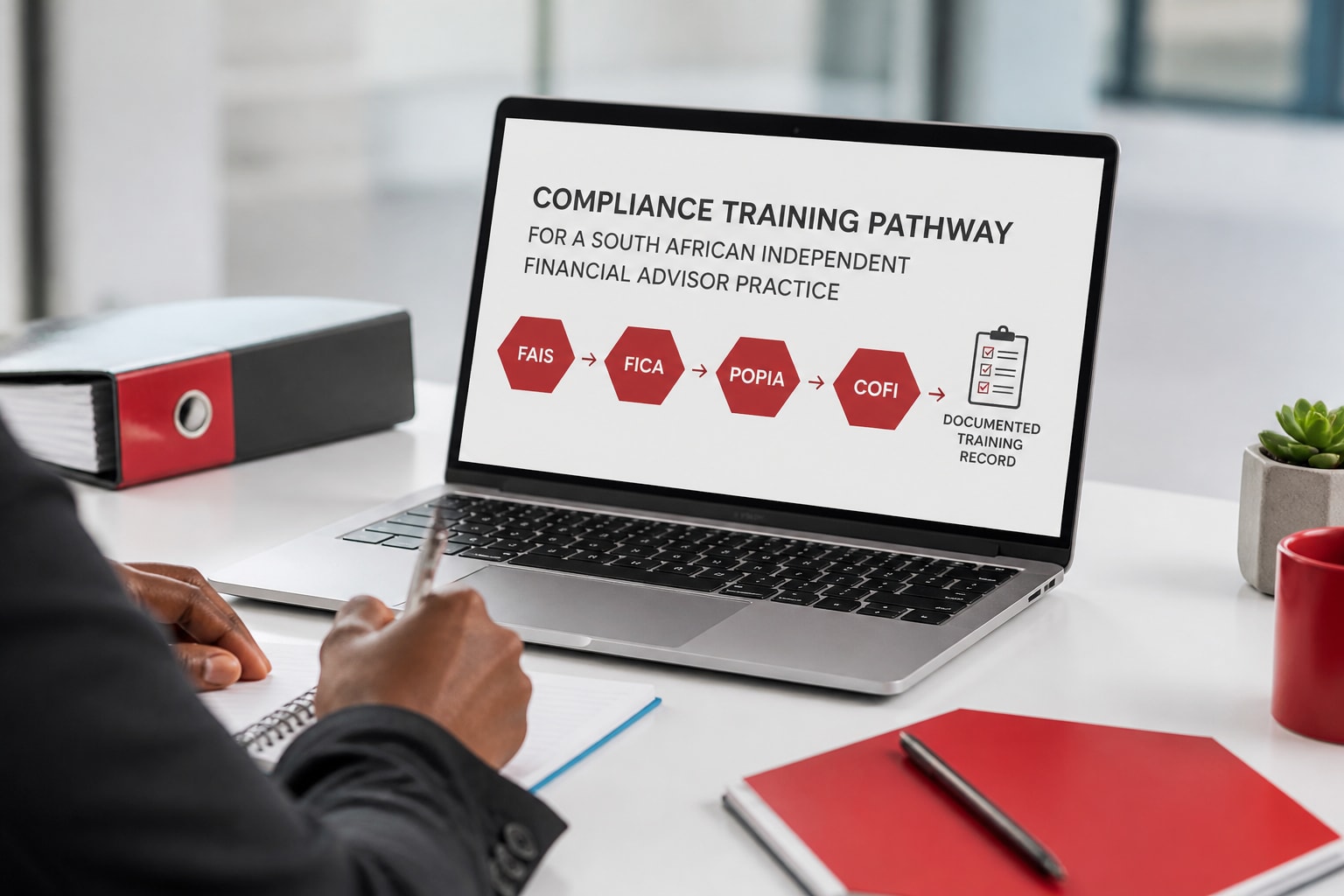
The safety courses that matter most to a South African financial services provider are the compliance courses that keep a practice lawful and its clients protected: FAIS, FICA, POPIA and, increasingly, COFI. Workplace safety training in the traditional sense, such as first aid and fire warden instruction, is still a legal duty for any employer, but the larger exposure for an FSP sits in regulatory risk, data protection and anti-money-laundering controls. This guide explains which courses to prioritise, how to choose a provider, what to record, and how to build a training plan that stands up to an FSCA inspection.
What do safety courses mean for a financial services practice?
For a financial services practice, safety courses cover two distinct areas: physical workplace safety and regulatory safety. Both are obligations, and both need evidence.
Physical safety is governed by the Occupational Health and Safety Act. Even a small broker office with a handful of staff needs a designated health and safety representative once it reaches 20 employees, a first aider where the numbers justify it, and a workable evacuation plan. Typical courses here include basic first aid, fire warden training, ergonomics for display screen use and manual handling.
Regulatory safety is where most FSPs carry their real risk. A missed FICA reporting duty, a POPIA breach or an advisor operating outside the scope of their licence category can result in administrative penalties, debarment or reputational damage that a fire drill will never prevent.
International data illustrates why employers take structured training seriously. The U.S. Bureau of Labor Statistics reported private-industry employers recorded 2.5 million nonfatal workplace injuries and illnesses in 2024. The figures are American, but they show why workplace injury prevention matters. The same discipline applies to compliance failures, which are also preventable.
Which regulatory safety courses should FSPs prioritise?
FSPs should prioritise FAIS regulatory examination preparation, FICA, POPIA and COFI awareness, in that order of urgency for most independent practices. The order shifts if your practice is applying for a licence or has just had a monitoring finding.
| Course area | Primary focus | Typical audience |
|---|---|---|
| FAIS and regulatory exams | Fit and proper requirements, RE1 and RE5 preparation, ongoing CPD | Representatives, key individuals, new entrants |
| FICA | Client due diligence, record keeping, reporting, RMCP | All client-facing staff, compliance officers |
| POPIA | Lawful processing, consent, operator agreements, breach response | Everyone who handles client data |
| COFI | Conduct standards, treating customers fairly, governance expectations | Key individuals, compliance officers, FSP applicants |
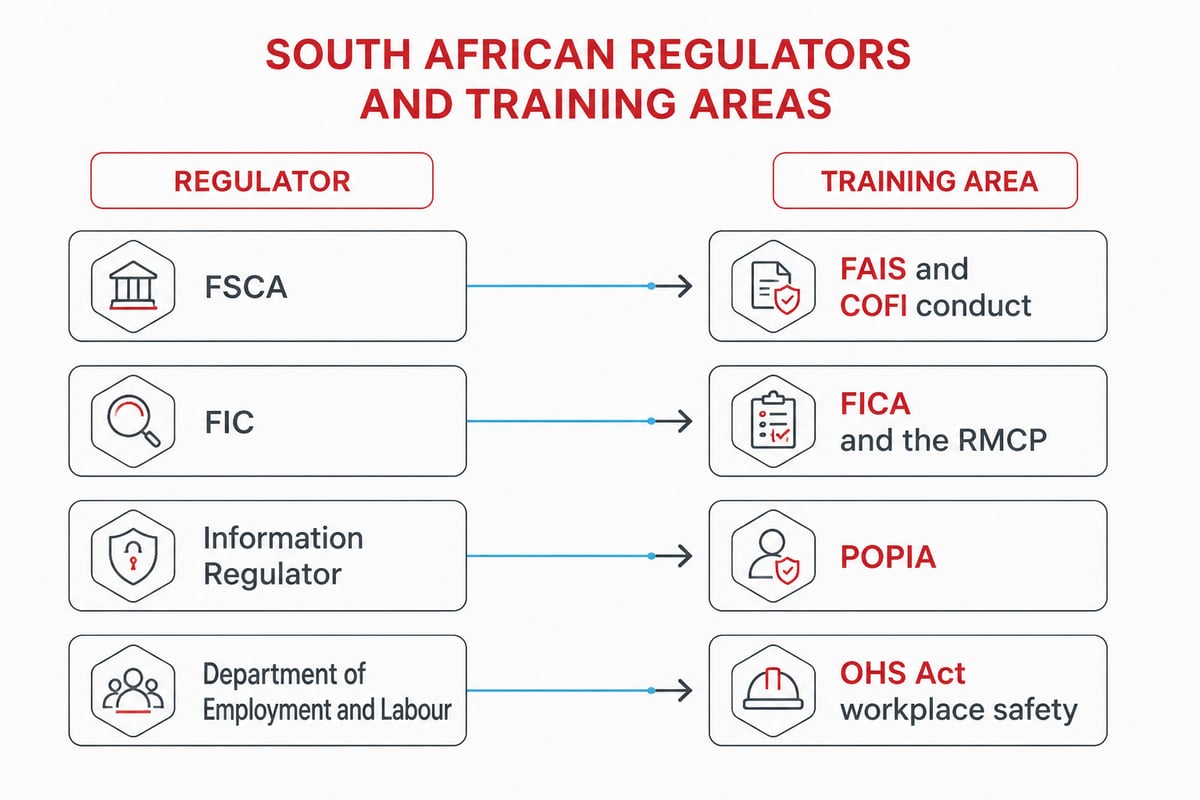
Each area answers a different regulator. The FSCA oversees FAIS conduct, the Financial Intelligence Centre (FIC) supervises FICA obligations and the Information Regulator enforces POPIA. A practice that trains for only one of the three leaves two supervisors unanswered.
FAIS and regulatory exam preparation
FAIS training covers the fit and proper requirements that determine who may render financial services. For representatives, this means class of business competency, the regulatory examinations and annual continuous professional development (CPD). Preparation courses help advisors who are sitting the RE exams for the first time, as well as key individuals who must demonstrate their understanding of the Act, the General Code of Conduct and the supervisory duties attached to their role.
FICA and the RMCP
FICA training must cover customer due diligence, the identification and verification of beneficial owners, politically exposed persons, sanctions screening, record keeping for five years and the reporting of suspicious and unusual transactions. Every accountable institution must also maintain a Risk Management and Compliance Programme (RMCP). Training and the RMCP belong together: an RMCP that staff cannot apply is a document, not a control.
POPIA
POPIA training should be practical. Staff need to know what personal information they hold, the lawful basis for processing it, how to handle a data subject request and what to do within the first hours of a suspected breach. Advisors who email policy schedules, ID copies and bank statements need clear rules on encryption, device security and operator agreements with product providers and cloud vendors.
COFI
The Conduct of Financial Institutions Bill is intended to consolidate market conduct regulation across the sector. Even before final commencement, forward-looking practices are training key individuals on its direction: stronger conduct standards, fair customer outcomes and clearer accountability. Treat COFI as an extension of existing FAIS conduct training and not a separate subject.
How do you choose a provider for safety courses?
Choose a provider by checking accreditation, subject-matter relevance to your licence category, assessment quality and the evidence the course produces. A polished certificate means little if it cannot be linked to a competency your regulator recognises.
Work through these questions before paying for any course:
- Is the content current? FICA, POPIA and FAIS guidance are amended regularly. Ask when the material was last updated.
- Is it recognised for CPD? Representatives must accumulate CPD hours annually, so check whether the course awards points and under which accredited body.
- Is the instruction specific to financial services? Generic data protection training rarely covers insurer bordereaux, policy administration systems or advisor-client email habits.
- Does it include an assessment? A recorded pass mark proves understanding, not attendance.
- Can the provider support implementation? Training that ends at the certificate leaves your practice to work out the procedures alone.
- Is the provider independent? A trainer who also sells you products has a conflict that an inspector may question.
What do safety courses cost, and are free options available?
Costs vary widely by subject, format and accreditation, so request a written quotation from each provider and compare like with like. Short awareness modules generally cost far less than regulatory exam preparation or multi-day management programmes, and group bookings for staff usually reduce the per-head cost.
Free options exist, and they are worth using for the right purpose. The Financial Intelligence Centre publishes guidance notes and public information on FICA obligations, and the Information Regulator publishes POPIA guidance material. Some providers offer a free introductory course as an entry point. Holistic Compliance Management Solutions offers training for FICA, POPI and regulatory exams, and a practice can ask the company directly about introductory options before investing in deeper training.
Free material has limits. It rarely tests competence, it seldom covers your specific processes and it does not produce the signed, dated record an inspector will ask for. Use it for awareness and pair it with assessed training for staff who carry direct regulatory responsibility.
For international benchmarking, the BLS injuries, illnesses and fatalities portal offers free datasets that show how different industries rank for incident rates. It is useful reading if you want to see how risk is measured, even though South African regulators apply their own frameworks.
Which safety diploma or management course is best?
The best diploma is the one that matches your role and is recognised by your regulator or professional body. There is no single winner, so decide by role instead of by brand.
A safety management course teaches you to run a programme and not merely follow one: risk assessment, incident investigation, audit, legislative duties and continuous improvement. In a South African FSP, the equivalent for regulatory risk is a compliance management qualification or structured compliance officer training, which covers monitoring plans, reporting lines to the FSCA and FIC, and how to run an internal review cycle.
Match the qualification to the role:
- Representatives and new entrants: regulatory exam preparation and a FAIS fit and proper pathway.
- Key individuals: supervisory and governance training, plus conduct and COFI awareness.
- Compliance officers: compliance monitoring, FICA and RMCP management, and POPIA information officer duties.
- FSP applicants: licensing requirements, key individual approval and the documentation the FSCA expects to see.
For the physical safety side, a recognised occupational health and safety qualification is appropriate for whoever is designated as the health and safety representative. For most independent broker offices, that is a short, practical course and not a full diploma.

How should a broker practice build a training plan?
A broker practice should build its training plan by mapping each role to its regulatory duties, setting an annual calendar and recording every completion. The aim is a plan that a monitoring visit can verify in minutes.
Step one: map roles to obligations
List every person in the practice and note what they touch. The receptionist who collects ID documents needs FICA and POPIA training. The advisor who recommends products needs FAIS conduct and product knowledge. The key individual needs supervisory and COFI awareness. Where one person holds several roles, they carry several training duties.
Step two: set the annual calendar
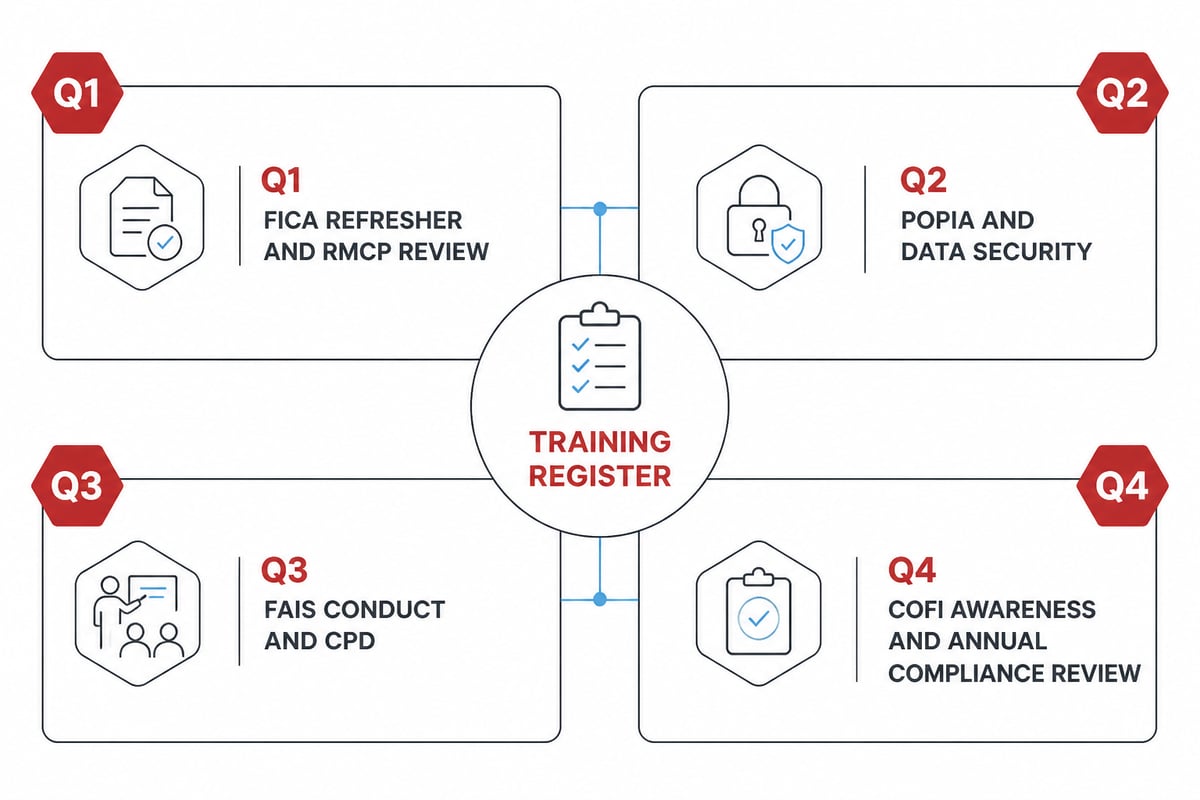
Spread training across the year so that it does not collapse into a single rushed afternoon. A workable pattern is a FICA refresher after your RMCP review, POPIA training after any systems change and conduct training ahead of the annual compliance review. New staff should complete core modules before they handle client data or give advice.
Step three: record everything
Keep a training register with the name, course, date, provider, assessment result and CPD points. Store certificates alongside it. If the FSCA, FIC or Information Regulator asks how you ensure staff competence, the register is your answer.
Step four: test the training in practice
A quarterly spot check shows whether the training has changed behaviour. Pull five client files and confirm that identification, risk rating and consent records are complete. Gaps reveal where the next course should focus.
What does a broker workflow checklist look like?
A broker workflow checklist ties each stage of the client journey to the course content that supports it, so training becomes part of daily practice. Use it to audit your own processes.
At onboarding
- Collect and verify identification and proof of address.
- Establish beneficial ownership for juristic clients.
- Screen against sanctions lists and identify politically exposed persons.
- Obtain POPIA-compliant consent and explain the purpose of processing.
- Record the risk rating assigned under your RMCP.
At advice and product placement
- Complete a needs analysis and record the basis for the recommendation.
- Disclose fees, commissions and conflicts of interest.
- Confirm that the advisor is licensed for the product category.
- Issue the record of advice within the required period.
During the relationship
- Review client risk ratings periodically.
- Keep records for the statutory retention period.
- Report suspicious or unusual transactions without delay.
- Handle data subject access requests within the POPIA timeframe.
At exit or breach
- Archive or securely destroy records as the law permits.
- Follow the written breach response plan and notify the Information Regulator and affected clients where required.
If your staff cannot explain why each item exists, the related training is due.
What does workplace physical safety still require?
Workplace physical safety still requires basic first aid, fire readiness and ergonomic awareness, even in a desk-based practice. The Occupational Health and Safety Act places these duties on every employer, however small.
Injury figures from other jurisdictions show that office environments are not risk-free. The BLS reported that private industry recorded 888,100 cases involving days away from work in 2024, with a median of 8 days away from work per case. The 2024 total recordable case rate was 2.3 cases per 100 full-time-equivalent workers, down from 2.4 in 2023. These are US statistics, but they demonstrate that even modest rates add up to substantial lost time.
For a broker office, the practical minimum is:
- A trained first aider and a stocked first aid kit.
- A fire plan with extinguishers serviced and staff who know the exit route.
- Workstation assessments to reduce display screen strain.
- Safe handling guidance for archive boxes and office equipment.
- A lone-working procedure for staff who visit clients.
Record these activities in the same register as your regulatory training so that one document tells the whole story.
How can Holistic Compliance support your training?
Holistic Compliance Management Solutions offers independent compliance and training services for FSPs, with practical support that helps advisors manage risk and improve practice management. Its focus areas include training for regulatory exams, FICA and POPIA, RMCP drafting and compliance monitoring.
For practices that have trained staff but lack a documented programme, the company's Fica RMCP service assists with drafting the RMCP and offers affordable FICA and POPI training, helping to mitigate risk. For product specifics, course content and scheduling, refer to the company's course pages or contact team directly.
FAQ
Where can I find free health and safety courses online?
The Financial Intelligence Centre and the Information Regulator publish free guidance on FICA and POPIA, and some providers offer introductory courses at no charge. Holistic Compliance Management Solutions offers FICA and POPI training, and free introductory material suits awareness, but assessed training is still needed for staff with direct regulatory duties.
What is a safety management course?
A safety management course teaches how to design and run a programme for identifying hazards, assessing risk, investigating incidents and auditing controls. In financial services, the equivalent is compliance management training, which covers monitoring plans, regulatory reporting and internal review cycles. It suits compliance officers and key individuals who are accountable for the programme.
How often should FSP staff repeat compliance training?
Most practices schedule a refresher at least annually, with additional sessions after regulatory amendments, system changes or a monitoring finding. New staff should complete core FICA, POPIA and FAIS modules before handling client data or giving advice. Representatives must also meet their annual CPD requirements.
Schedule FICA training for your practice today: begin by listing which of your staff handle client identification, then Register Now with Holistic Compliance Management Solutions so those staff complete assessed training, and consider the Fica RMCP service if your programme needs drafting or updating. A FICA training engagement can cover:
- Client due diligence, beneficial ownership and sanctions screening applied to broker workflows.
- Alignment of staff practice with your RMCP, including record keeping and suspicious transaction reporting.
- A completion record and CPD points that you can file as evidence for your next compliance review.