
GDPR Compliance Consultants: South Africa FSP Guide
As South African financial services providers increasingly engage with international markets, jurisdictions, and data processors, understanding the General Data Protection Regulation becomes essential. Whether your brokerage processes policy information for European clients, uses cloud platforms hosted in the EU, or collaborates with international reinsurers, GDPR compliance consultants offer specialised expertise to navigate these complex cross-border obligations. For independent financial advisors and FSPs operating under FAIS, FICA, and POPIA in South Africa, the intersection of European data protection standards with local regulatory frameworks creates unique compliance challenges that require professional guidance.
Understanding GDPR and Its Impact on South African FSPs
The General Data Protection Regulation, which came into effect in May 2018, fundamentally reshaped how organisations worldwide handle personal data. Even though South Africa lies outside the European Union's territorial boundaries, the regulation's extraterritorial scope means it applies to any organisation offering goods or services to individuals in the EU or monitoring their behaviour.
For financial services providers in South Africa, this becomes relevant in several scenarios. If your brokerage serves expatriate clients residing in Europe, processes claims involving EU residents, or uses third-party software providers with European operations, GDPR obligations may apply. The European Commission’s data protection legal framework clarifies that territorial scope extends beyond physical presence.
GDPR Meets POPIA: Alignment and Differences
South Africa's Protection of Personal Information Act shares significant conceptual ground with GDPR, both establishing principles-based frameworks for lawful processing. However, critical differences exist in enforcement mechanisms, breach notification timelines, and consent requirements.
| Aspect | GDPR | POPIA |
|---|---|---|
| Breach notification | 72 hours to supervisory authority | "As soon as reasonably possible" to Regulator |
| Maximum penalties | €20 million or 4% global turnover | R10 million |
| Data Protection Officer | Mandatory for certain processing | Recommended, not always mandatory |
| Territorial scope | Extraterritorial (EU residents) | South African residents and entities |
| Consent standard | Explicit, freely given, specific | Similar but with local interpretation |
Understanding these nuances becomes crucial when your FSP operates across both regulatory regimes. GDPR compliance consultants help bridge these frameworks, ensuring your practice meets the higher standard where regulations overlap whilst maintaining practical South African implementation.
Why Financial Services Providers Need Specialised GDPR Consultants
Generic data protection advice rarely addresses the sector-specific challenges financial services providers face. Insurance brokers, investment advisors, and FSPs handle particularly sensitive categories of personal information, from health disclosures in underwriting to detailed financial profiles for investment planning.
GDPR compliance consultants with financial services experience understand these nuances:
- Legitimate interests assessments specific to insurance underwriting and risk evaluation
- Data retention schedules balancing GDPR's storage limitation with FAIS recordkeeping requirements
- Third-party processor agreements with reinsurers, platform providers, and compliance technology vendors
- Cross-border transfer mechanisms when using international cloud services or outsourced administration

The complexity intensifies when layering FICA obligations for customer due diligence. Your practice must collect and verify identity information under financial intelligence regulations whilst ensuring GDPR's data minimisation principle isn't violated. Professional consultants navigate these competing requirements, designing processes that satisfy both regimes.
Selecting the Right GDPR Compliance Consultant
Not all gdpr compliance consultants bring equivalent expertise to financial services engagements. When evaluating potential advisors for your FSP practice, consider these essential qualifications and capabilities.
Certifications and credentials matter significantly in this specialised field. Look for consultants holding CIPP/E (Certified Information Privacy Professional/Europe) credentials from the International Association of Privacy Professionals, demonstrating formal training in European data protection law. Equally valuable are professionals with CIPM (Certified Information Privacy Manager) qualifications, indicating practical implementation expertise beyond theoretical knowledge.
Industry-specific experience separates generalist advisors from those who understand financial services. Ask potential consultants about previous engagements with insurance brokers, wealth managers, or FSPs. Request case studies showing how they've addressed common challenges like beneficial ownership verification under FICA whilst respecting GDPR's transparency requirements, or how they've structured data sharing agreements with product providers and platform administrators.
The IAPP’s guidance on questions to ask potential external DPOs provides an excellent framework for vetting consultants, even if you're not formally appointing a Data Protection Officer. Key questions include:
- How do you stay current with evolving GDPR guidance from the European Data Protection Board?
- What methodology do you use for data protection impact assessments in financial services contexts?
- Can you provide examples of processor agreements you've negotiated with technology vendors?
- How would you handle a personal data breach involving client policy information?
- What's your approach to training FSP staff on practical data protection in daily workflows?
Practical implementation focus distinguishes consultants who deliver actionable roadmaps from those offering only high-level policy documents. Your FSP needs specific guidance: How should your new business team collect consent for marketing communications? What retention period satisfies both GDPR and FAIS requirements for advice records? How do you configure your CRM system to honour data subject access requests efficiently?
For practices also navigating POPIA compliance, consultants who understand South African regulatory context offer additional value. Holistic Compliance Management Solutions serves financial services providers with integrated approaches to FICA, POPI, and broader regulatory obligations, including FICA and POPI training that addresses both local and international data protection standards within FSP workflows.
Core Services GDPR Compliance Consultants Provide
Professional gdpr compliance consultants deliver structured programmes that move organisations from initial gap analysis through full implementation and ongoing monitoring. Understanding these service components helps you select the right engagement model for your FSP's specific needs and maturity level.
Data Mapping and Processing Inventories
Every GDPR programme begins with comprehensive data mapping. Consultants systematically document what personal data your practice collects, where it's stored, how it flows through your systems, who accesses it, and how long you retain it.
For an independent insurance broker, this mapping exercise typically reveals:
- Client personal data: Names, ID numbers, contact details, employment information, health disclosures, financial information, beneficiary details
- Processing activities: Quotation generation, underwriting submission, policy administration, claims assistance, annual reviews, marketing communications
- Systems and locations: CRM database, email platform, document management system, cloud storage, physical files, product provider portals
- Third parties: Insurers, reinsurers, platform providers, marketing automation vendors, compliance software, IT support contractors
- International transfers: Cloud hosting locations, international reinsurer data sharing, offshore IT support access
This granular inventory becomes the foundation for all subsequent compliance work. The UK ICO’s guidance for controllers and processors provides practical templates and checklists that many consultants adapt for their clients' data mapping exercises.
Legal Basis Assessment and Documentation
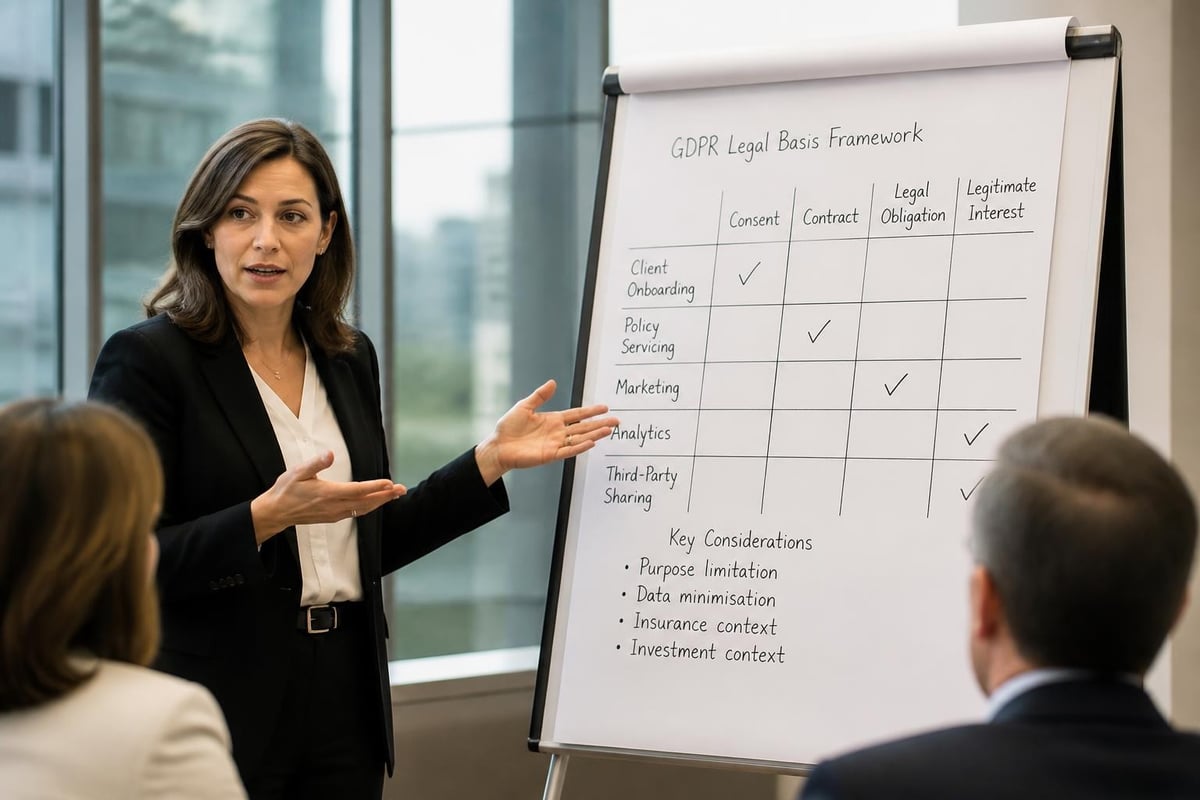
GDPR requires organisations to identify and document a lawful basis for each processing activity. Unlike POPIA's broader "lawful purpose" requirement, GDPR specifies six potential legal bases, and choosing the correct one carries significant implications for data subject rights and compliance obligations.
| Legal Basis | When Applicable | FSP Example | Rights Implications |
|---|---|---|---|
| Consent | Freely given, specific, informed agreement | Marketing communications | Right to withdraw consent easily |
| Contract | Processing necessary for contract performance | Policy administration | Cannot refuse access/portability requests |
| Legal obligation | Required by EU or Member State law | Anti-money laundering checks | Limited objection rights |
| Vital interests | Necessary to protect life | Emergency medical information in claims | Rarely applicable in FSP context |
| Public task | Official authority or public interest | Not applicable for private FSPs | N/A |
| Legitimate interests | Balanced against data subject rights | Fraud prevention, internal administration | Must conduct balancing assessment |
GDPR compliance consultants conduct detailed legal basis assessments, often revealing that FSPs have incorrectly relied on consent when contract or legitimate interests provide more appropriate foundations. This matters enormously: if you process policy information under "consent," clients could theoretically withdraw that consent whilst expecting continued service, creating impossible operational tensions.
Data Protection Impact Assessments
When processing activities present high privacy risks, GDPR mandates formal Data Protection Impact Assessments. For financial services providers, DPIAs typically become necessary when implementing new technology platforms, launching products requiring sensitive health information, or establishing systematic profiling for underwriting or investment recommendations.
Professional consultants guide FSPs through structured DPIA methodologies:
- Describe the processing operation and its purposes in detail
- Assess necessity and proportionality against stated objectives
- Identify risks to data subject rights and freedoms
- Determine mitigation measures to address identified risks
- Document approval from senior management or the DPO
- Review and update as processing activities or risks change
ENISA’s technical implementation guidance on cybersecurity risk management provides practical security controls that consultants often recommend during DPIA mitigation planning, ensuring privacy-by-design principles translate into concrete technical measures.
Processor Agreement Negotiation
Financial services providers rarely process all client data internally. Cloud CRM platforms, document management systems, email marketing tools, compliance monitoring software, and platform administration services all involve third-party processors accessing personal data on your behalf.
GDPR Article 28 establishes mandatory contractual clauses for processor relationships. These requirements exceed typical South African service agreements, demanding specific provisions around:
- Subject matter and duration of processing clearly defined
- Processing purposes limited to documented instructions from the FSP (controller)
- Confidentiality obligations for all personnel accessing data
- Security measures appropriate to processing risks
- Sub-processor authorisation and contractual flow-down requirements
- Data subject rights assistance enabling the FSP to respond to requests
- Breach notification to the FSP without undue delay
- Deletion or return of all personal data at contract termination
- Audit rights allowing the FSP to verify processor compliance
GDPR compliance consultants often negotiate these agreements on behalf of FSP clients, particularly when dealing with large international vendors using standard templates that inadequately address GDPR requirements. Successful negotiation protects your practice from liability when processors fail to meet their obligations.
Implementing GDPR Compliance in FSP Daily Operations
Technical legal compliance means little if front-line staff lack practical guidance for daily workflows. Effective gdpr compliance consultants translate regulatory requirements into operational procedures that advisors, administrators, and support staff can execute consistently.
Privacy Notices and Transparency
GDPR's transparency principle demands clear, accessible information about data processing provided to individuals at the point of collection. For FSPs, this means updating client-facing documents and processes.
Your privacy notice should address:
- Identity and contact details of your FSP and (if applicable) your representative and DPO
- Processing purposes for which you collect and use personal information
- Legal basis for each processing purpose
- Recipients or categories of third parties receiving data (insurers, reinsurers, service providers)
- International transfers if data moves outside South Africa or the EU
- Retention periods or criteria for determining how long you keep information
- Data subject rights including access, rectification, erasure, restriction, portability, and objection
- Withdrawal of consent mechanisms if consent is your legal basis
- Complaint rights to supervisory authorities (Information Regulator in South Africa, relevant DPA in EU)
- Consequences of not providing data when collection is statutory or contractual requirement
Many FSPs bury privacy notices in lengthy policy documents clients never read. Consultants recommend layered approaches: brief, clear summaries at point of collection with links to comprehensive policies for those wanting detail. The EDPB’s collection of guidelines and best practices includes specific guidance on transparency that consultants reference when designing client communications.
Subject Access Request Procedures
GDPR grants individuals extensive rights to access their personal data, and FSPs must respond within one month. For practices handling hundreds or thousands of clients, manual responses quickly become unmanageable.
Efficient SAR procedures require:
- Centralised request intake through designated email or online form
- Identity verification preventing disclosure to unauthorised parties (critical in financial services)
- Data location search across all systems identified in your processing inventory
- Third-party data exclusion removing information about other individuals from responses
- Format selection allowing requesters to receive data electronically when feasible
- Response tracking ensuring deadline compliance and audit trail documentation
Modern FSP practice management systems increasingly include SAR automation features. Consultants help evaluate these capabilities and configure workflows that balance efficiency with accuracy and security.
Breach Response Planning
Despite robust preventive controls, personal data breaches occur through human error, system failures, or malicious attacks. GDPR's 72-hour notification requirement to supervisory authorities means FSPs cannot afford improvised responses.
GDPR compliance consultants develop incident response plans with clear escalation paths:
| Breach Severity | Examples | Response Actions | Notification Required |
|---|---|---|---|
| Low | Single client file misfiled internally | Document incident, implement remedial training | Internal record only |
| Medium | Email sent to wrong recipient (1-10 clients) | Contain breach, assess risk to individuals, document decision | Possibly to individuals if high risk |
| High | Ransomware attack encrypting client database | Immediate containment, forensic investigation, legal advice | Supervisory authority within 72 hours, individuals without undue delay |
| Critical | Large-scale data exfiltration or public exposure | Crisis management activation, external counsel, PR coordination | Supervisory authority and all affected individuals immediately |
Plans should designate specific individuals responsible for breach assessment, notification decisions, communication drafting, and supervisory authority liaison. Regular simulation exercises ensure teams execute effectively under pressure.

GDPR Training for Financial Services Teams
Regulatory compliance ultimately depends on individual behaviour. Advisors collecting client information, administrators processing applications, and support staff handling enquiries all make daily decisions affecting GDPR compliance. Comprehensive training transforms abstract principles into practical guidance.
Role-Based Training Programmes
Effective GDPR training recognises different roles face different privacy challenges. GDPR compliance consultants design differentiated programmes targeting specific functions.
For financial advisors and brokers:
- Collecting consent for marketing communications during client meetings
- Explaining data processing to clients in accessible language
- Recognising when specialist health information requires enhanced care
- Handling client requests to update or delete information
- Secure information handling when working remotely or in public spaces
For administrative and support staff:
- Verifying identity before discussing client information over phone or email
- Processing subject access requests accurately and within deadlines
- Recognising potential data breaches and initiating response procedures
- Managing third-party access to systems and files
- Secure disposal of physical documents containing personal data
For practice principals and compliance officers:
- Conducting privacy impact assessments for new systems or services
- Negotiating processor agreements with technology vendors
- Maintaining processing records and documentation
- Conducting internal audits and identifying improvement areas
- Liaising with supervisory authorities if issues arise
Interactive scenarios based on real FSP situations increase engagement and retention. "A client requests all information you hold about them – what steps do you take?" or "You accidentally email a policy schedule to the wrong address – what happens next?" transform abstract rules into concrete actions.
Integration with POPIA, FICA, and FAIS Training
For South African FSPs, GDPR training shouldn't exist in isolation. Integrated programmes that address POPIA alignment, FICA customer due diligence requirements, and FAIS fit-and-proper standards create comprehensive compliance understanding.
Common training modules address overlapping requirements:
- Lawful collection and processing under both POPIA and GDPR
- Purpose specification satisfying privacy laws whilst meeting FICA risk assessment needs
- Record retention balancing GDPR storage limitation with FAIS advice documentation requirements
- Security safeguards protecting personal information under POPIA and client confidentiality under FAIS
- Cross-border transfers when using international service providers or serving expatriate clients
This holistic approach reflects how compliance operates in practice. When onboarding a new client, advisors simultaneously satisfy FICA identity verification, collect information under FAIS advice obligations, and comply with POPIA and GDPR data protection requirements through a single integrated process.
Technology Solutions GDPR Consultants Recommend
Modern data protection compliance increasingly relies on technology platforms that automate documentation, streamline workflows, and provide audit trails. GDPR compliance consultants help FSPs evaluate and implement appropriate solutions.
Consent and Preference Management
When marketing communications or certain data uses rely on consent, managing permissions at scale requires dedicated systems. Consent management platforms provide:
- Granular permission controls allowing clients to opt in or out of specific channels or purposes
- Easy withdrawal mechanisms enabling clients to revoke consent simply
- Audit trails documenting when consent was given, by whom, and for what purposes
- Preference synchronisation across CRM, email marketing, and other systems
- Compliance dashboards showing consent coverage and identifying gaps
For FSPs with substantial marketing programmes, these platforms demonstrate GDPR's requirement that consent be "as easy to withdraw as to give" whilst maintaining the documentation needed to prove compliant processing.
Data Subject Request Portals
Dedicated SAR management systems help FSPs handle access, rectification, and erasure requests efficiently:
- Self-service portals where clients initiate requests online
- Automated identity verification integrating with existing authentication systems
- System connectors gathering data from multiple sources automatically
- Redaction tools removing third-party information before disclosure
- Response templates ensuring consistent, compliant communications
- Deadline tracking alerting teams before one-month response windows expire
These platforms transform subject access from manual, labour-intensive processes into streamlined workflows that scale with practice growth.
Data Discovery and Classification
Knowing what personal data exists, where it resides, and how sensitive it is forms the foundation of GDPR compliance. Data discovery tools automatically scan file systems, databases, email, and cloud storage to identify and classify personal information.
Advanced solutions apply machine learning to recognise patterns indicating South African ID numbers, health information, financial details, or other sensitive categories. This automation supplements manual data mapping exercises, identifying shadow IT or forgotten data repositories that create compliance risks.
Ongoing GDPR Compliance Monitoring and Improvement
GDPR compliance isn't a one-time project but an ongoing programme requiring regular assessment and refinement. Professional gdpr compliance consultants often provide retained advisory services supporting continuous improvement.
Annual Compliance Audits
Structured annual reviews assess whether implemented controls remain effective and identify emerging risks. Comprehensive audits examine:
Documentation currency: Are processing records, privacy notices, and processor agreements up to date with current activities?
Technical controls: Do access restrictions, encryption, backup procedures, and system security meet evolving threat landscapes?
Training effectiveness: Have all staff completed required training, and does assessment demonstrate understanding?
Incident trends: What patterns emerge from security events or near-misses requiring systemic responses?
Regulatory developments: How do recent supervisory authority guidance, court decisions, or enforcement actions affect your compliance approach?
Audit findings drive prioritised remediation plans with assigned responsibilities and completion deadlines. This structured improvement cycle demonstrates the accountability principle central to GDPR.
Staying Current with Regulatory Guidance
The GDPR framework continues evolving through supervisory authority guidance, European Data Protection Board opinions, and court interpretations. Consultants maintain currency with these developments, translating implications for client organisations.
Recent significant guidance includes:
- International transfer mechanisms following Schrems II invalidation of Privacy Shield
- Cookie consent requirements becoming increasingly stringent across Member States
- Legitimate interests balancing for direct marketing and profiling activities
- Joint controller arrangements when responsibilities blur between parties
- Processor liability clarifications following CJEU case law
CNIL’s practical guide for Data Protection Officers exemplifies national authority publications that consultants monitor, extracting actionable recommendations applicable beyond single jurisdictions. Similarly, analysis from reputable law firms like Gibson Dunn’s Europe data protection updates provides enforcement trend insights that inform risk assessments and advisory priorities.
Cost Considerations and ROI
Engaging gdpr compliance consultants represents significant investment for independent FSPs and smaller brokerages. Understanding cost structures and expected returns helps practices make informed decisions about professional support.
Typical Fee Structures
GDPR consulting engagements generally follow one of several pricing models:
Project-based fees for defined deliverables like gap assessments, policy development, or DPIA completion. Initial compliance projects for small FSPs typically range from R50,000 to R150,000 depending on practice complexity, system count, and documentation maturity.
Hourly rates for ad-hoc advisory support or specific questions. Senior privacy consultants typically charge R1,500 to R3,000 per hour, with matters often requiring 3-10 hours for issues like processor agreement review or breach response guidance.
Retained advisory providing ongoing access for questions, document review, training delivery, and compliance monitoring. Annual retainers for small-to-medium FSPs typically range from R60,000 to R200,000, offering predictable budgeting and relationship continuity.
Virtual DPO services where consultants assume formal Data Protection Officer responsibilities on an outsourced basis. This model suits organisations requiring DPO appointment under GDPR but lacking resources for full-time internal positions. GOV.UK guidance on meeting data privacy requirements helps organisations assess when DPO appointment becomes necessary.
Quantifying Compliance Benefits
Beyond avoiding penalties, GDPR compliance delivers measurable business value:
Reduced breach costs: Data Protection Impact Assessments and security improvements materially reduce breach likelihood and potential damages. Average costs per breached record in financial services exceed R3,000 when factoring notification, remediation, regulatory response, and reputation damage.
Operational efficiency: Systematic processing inventories, documented procedures, and integrated systems often streamline operations whilst ensuring compliance. SAR automation alone can reduce response time from days to hours whilst eliminating administrative burden.
Competitive differentiation: Demonstrating robust data protection builds client trust and provides competitive advantage, particularly when serving sophisticated or privacy-conscious clients. GDPR compliance credentials increasingly feature in FSP marketing and RFP responses.
International market access: Credible GDPR compliance enables FSPs to confidently serve European clients, collaborate with EU-based insurers or reinsurers, and use international technology platforms without regulatory uncertainty limiting business development.
Practical Implementation Roadmap for South African FSPs
Moving from GDPR awareness to full compliance requires structured planning and phased execution. This roadmap provides independent brokers and FSPs with a practical 12-month implementation framework.
Months 1-3: Foundation and Assessment
Week 1-2: Stakeholder alignment
- Secure practice principal commitment and resource allocation
- Designate internal privacy champion or compliance officer lead
- Engage GDPR compliance consultant for initial assessment
Week 3-6: Data mapping exercise
- Document all client information categories collected and processed
- Identify systems, databases, files, and storage locations
- Map information flows to and from third parties
- Catalogue international transfers requiring safeguards
Week 7-12: Gap analysis and prioritisation
- Compare current practices against GDPR requirements
- Assess existing POPIA compliance as foundation
- Identify high-risk gaps requiring immediate attention
- Develop costed remediation plan with timeline
Months 4-6: Core Policy and Documentation
Policy development
- Draft comprehensive data protection policy incorporating GDPR and POPIA
- Create client-facing privacy notices for different touchpoints
- Develop internal processing records documentation
- Establish data retention schedule balancing GDPR and FAIS requirements
Contractual updates
- Review and update processor agreements with technology vendors
- Incorporate GDPR clauses in employment contracts
- Update client terms of business reflecting data protection rights
- Establish data sharing agreements with product providers
Procedures and workflows
- Document subject access request handling procedure
- Create breach response plan with escalation paths
- Establish consent collection and management protocols
- Design privacy impact assessment template and trigger criteria
Months 7-9: Technical Controls and Systems
Security enhancements
- Implement encryption for laptops and portable storage devices
- Deploy multi-factor authentication for system access
- Establish secure remote access protocols
- Configure automated backup and disaster recovery
System configurations
- Enable audit logging in CRM and key systems
- Configure data retention automation where available
- Implement access controls based on role requirements
- Deploy email encryption for sensitive communications
Technology evaluation
- Assess current systems' data protection capabilities
- Identify gaps requiring additional solutions
- Evaluate consent management, SAR automation, or data discovery tools
- Implement priority technologies within budget parameters
Months 10-12: Training, Testing, and Refinement
Comprehensive training delivery
- Conduct role-specific GDPR training for all staff
- Integrate data protection into onboarding for new hires
- Document training completion for accountability demonstration
- Schedule annual refresher training in compliance calendar
Simulation and testing
- Run tabletop breach response exercise
- Test subject access request procedure with mock request
- Conduct internal audit against documented policies
- Identify procedural improvements from testing
Documentation finalisation
- Complete processing records covering all activities
- Finalise all policy documents with version control
- Establish document review calendar ensuring currency
- Create compliance evidence folder for supervisory authority requests
This roadmap adapts based on practice size, complexity, and existing compliance maturity. Smaller independent brokers might compress timelines or phase implementation, whilst larger FSPs may require extended periods for legacy system remediation or complex international transfer mechanisms.
Cross-Border Considerations for FSPs with International Operations
South African FSPs increasingly operate across borders, serving expatriate clients, using international technology platforms, or partnering with global insurers and reinsurers. These cross-border dimensions create additional GDPR compliance complexity requiring specialist consultant guidance.
International Data Transfers Under GDPR
GDPR establishes strict conditions for transferring personal data outside the European Economic Area. When South African FSPs process EU resident data and share it with local service providers, transfer mechanisms become necessary.
Available transfer mechanisms include:
Adequacy decisions: The European Commission has not granted South Africa adequacy status, preventing reliance on this streamlined mechanism.
Standard Contractual Clauses (SCCs): Pre-approved contract templates establishing data protection obligations for importers. FSPs incorporate SCCs into agreements with South African processors handling EU resident data.
Binding Corporate Rules: Internal policies for multinational groups facilitating intra-group transfers. Rarely applicable for independent FSPs or smaller practices.
Derogations for specific situations: Limited exceptions for necessary transfers in contract performance, legal claims, or explicit consent. These derogations support specific transfers but cannot justify systematic ongoing flows.
Following the Schrems II decision invalidating Privacy Shield, consultants increasingly recommend supplementary measures beyond SCCs. These might include encryption with EU-held keys, contractual guarantees limiting government access, or technical controls preventing foreign authority access to data in transit or at rest.
Serving European Clients from South Africa
Independent brokers serving expatriate clients or marketing to European residents trigger GDPR's territorial scope. Compliance obligations vary based on processing scale and nature.
Key considerations include:
- Representative appointment: GDPR Article 27 may require designating an EU-based representative as point of contact for supervisory authorities and data subjects.
- Privacy notice accessibility: Notices must be available in relevant EU languages and reference appropriate supervisory authorities.
- Subject rights infrastructure: Processes must accommodate rights under both GDPR and POPIA, applying the higher standard where they diverge.
- Breach notification protocols: Understand which supervisory authority(ies) to notify based on client location and processing nature.
Consultants help FSPs assess when European client processing triggers full compliance obligations versus lighter-touch requirements, avoiding unnecessary burden whilst maintaining regulatory compliance.
Navigating GDPR compliance whilst managing POPIA, FICA, FAIS, and broader regulatory obligations demands specialist expertise and systematic implementation. Independent financial brokers and FSPs benefit enormously from professional guidance that translates European data protection requirements into practical South African contexts.
Whether you're expanding to serve international clients, implementing new technology platforms, or simply ensuring comprehensive data protection across all regulatory regimes, Holistic Compliance Management Solutions (Pty) Ltd provides integrated compliance support tailored to financial services workflows. Our team helps FSPs build robust, sustainable compliance programmes that protect clients, mitigate regulatory risk, and support business growth through systematic implementation and ongoing advisory services.
Book a compliance consultation to assess your practice's GDPR and POPIA readiness.
What the consultation includes:
- Comprehensive review of your current data processing activities and international exposure
- Gap analysis against GDPR and POPIA requirements with prioritised recommendations
- Practical implementation roadmap tailored to your practice size, systems, and budget
Who this is for: Independent insurance brokers, financial advisors, FSPs with international clients or service providers, compliance officers managing cross-border data protection obligations.