
PCI Compliance Consulting Services for South Africa FSPs
Financial Service Providers (FSPs) in South Africa face a complex regulatory landscape that extends beyond traditional compliance frameworks. Whilst POPIA, FICA, and FAIS dominate the local compliance conversation, organisations processing payment card data must also navigate the Payment Card Industry Data Security Standard (PCI DSS). For independent brokers and financial advisors handling client payments through card transactions, understanding how PCI compliance consulting services integrate with existing South African regulatory obligations has become essential. The convergence of international payment security standards with domestic financial services regulation creates unique challenges that require specialist guidance, particularly for smaller practices operating with limited compliance resources.
Understanding PCI DSS Requirements in the South African Context
The Payment Card Industry Data Security Standard represents a global framework designed to protect cardholder data wherever it is processed, stored, or transmitted. For South African FSPs, this standard applies regardless of transaction volume when card payments are accepted.
Many independent brokers assume PCI compliance only affects large retailers or e-commerce platforms. This misconception creates significant risk exposure. Any organisation that accepts, processes, or stores payment card information falls within scope of PCI DSS requirements. This includes financial advisors collecting premium payments via credit card, insurance brokers processing client transactions, and wealth managers accepting investment contributions through card payments.
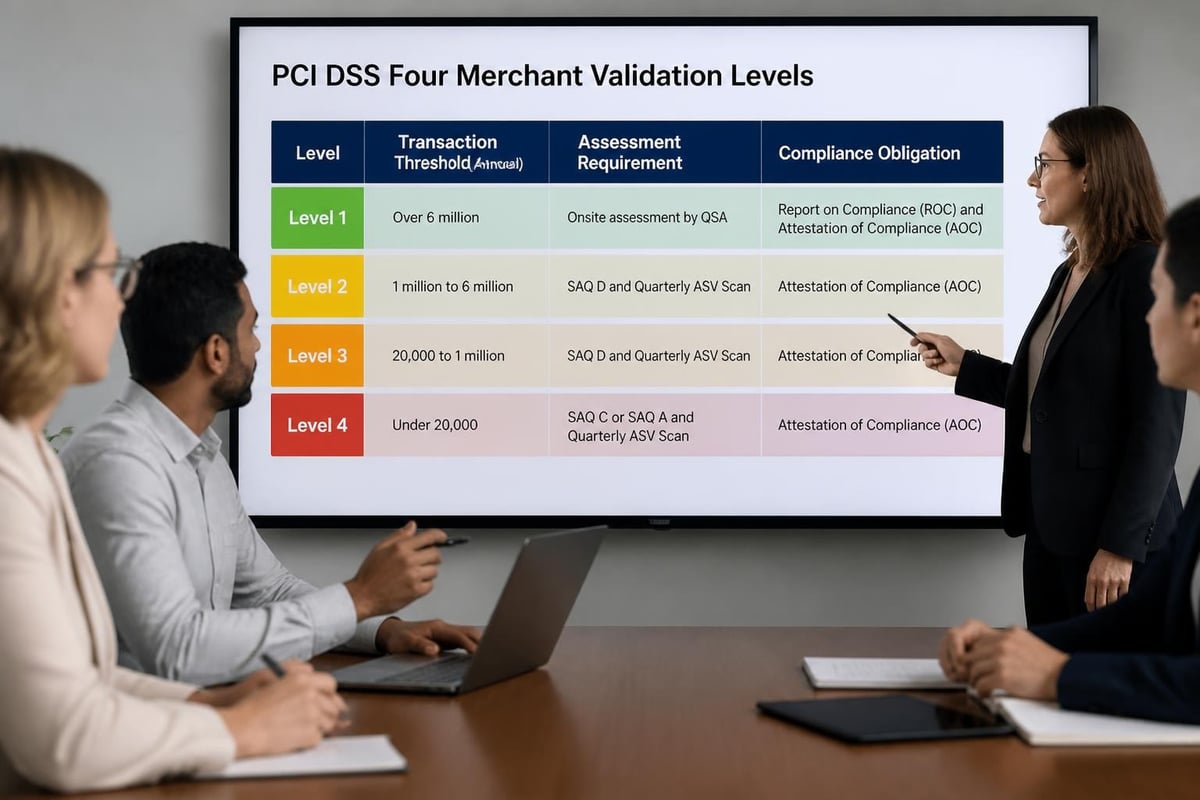
The Four Validation Levels
PCI compliance consulting services help organisations determine their appropriate validation level based on annual transaction volume:
- Level 1: Merchants processing over 6 million transactions annually
- Level 2: Merchants processing 1 to 6 million transactions annually
- Level 3: Merchants processing 20,000 to 1 million e-commerce transactions annually
- Level 4: Merchants processing fewer than 20,000 e-commerce transactions or up to 1 million total transactions annually
Most independent financial advisors and smaller FSPs fall into Level 4, which requires annual Self-Assessment Questionnaires (SAQ) and quarterly network scans by an Approved Scanning Vendor. However, the specific requirements depend on how card data is handled and which payment processing methods are employed.
Integration with POPIA and FICA Requirements
South African FSPs already navigate stringent data protection obligations under the Protection of Personal Information Act (POPIA). Payment card data represents a specific category of personal information requiring heightened protection. PCI compliance consulting services must therefore address the intersection between international payment security standards and domestic privacy legislation.
The Official PCI Security Standards Council provides comprehensive documentation demonstrating how PCI DSS aligns with privacy frameworks worldwide. For South African organisations, this alignment means POPIA's eight conditions for lawful processing of personal information complement rather than conflict with PCI requirements.
Similarly, FICA (Financial Intelligence Centre Act) obligations around client identification and verification create natural touchpoints with PCI compliance. When collecting client payment information, brokers must ensure their Know Your Customer (KYC) processes maintain appropriate segregation between identification documentation and payment card data.
Core Components of PCI Compliance Consulting Services
Professional pci compliance consulting services deliver structured guidance across six fundamental control categories that form the foundation of the PCI DSS framework. Understanding these components helps FSPs evaluate potential consulting partners and align compliance efforts with existing risk management programmes.
Network Security Architecture
Building and maintaining secure networks represents the first major requirement domain. Consulting services assess current network configurations, identify vulnerabilities in firewall implementations, and recommend architecture improvements that create proper segmentation between cardholder data environments and general business systems.
For independent brokers operating from small offices or home-based practices, this often involves evaluating wireless network security, ensuring default passwords on routers and systems have been changed, and implementing proper access controls on systems that process payments.
| Control Area | Independent Broker Implementation | Consulting Service Deliverable |
|---|---|---|
| Firewall configuration | Review router/firewall settings | Network security assessment report |
| Default password management | Inventory all systems with default credentials | Password policy template and remediation plan |
| Wireless security | Implement WPA3 encryption and strong passphrases | Wireless security configuration guide |
| Network segmentation | Separate payment systems from general network | Network architecture diagram and implementation plan |
Cardholder Data Protection
The second domain focuses on protecting stored cardholder data. Many FSPs unknowingly retain payment card information in insecure locations-spreadsheets, email archives, or physical filing systems. Professional pci compliance consulting services conduct data discovery exercises to identify where card data exists within an organisation.
Consultants then develop data retention and disposal policies that comply with both PCI requirements and POPIA's data minimisation principles. This includes implementing encryption for data at rest, tokenisation where appropriate, and secure deletion protocols for information no longer required for legitimate business purposes.
Vulnerability Management Programmes
Maintaining robust vulnerability management processes forms the third critical component. This includes deploying and maintaining anti-virus software, developing secure systems and applications, and conducting regular vulnerability scans.
The Approved Scanning Vendor program defines standards for quarterly vulnerability scanning. Consulting services either perform these scans directly (if the consultant holds ASV certification) or coordinate with certified vendors whilst helping interpret results and prioritise remediation efforts.
For organisations developing custom applications or web portals for client payment processing, consultants reference frameworks like the OWASP Web Security Testing Guide to ensure secure development practices prevent common vulnerabilities such as SQL injection, cross-site scripting, and insecure authentication mechanisms.
Access Control Measures for Financial Services Providers
Implementing strong access control measures represents perhaps the most operationally complex aspect of PCI compliance for independent brokers. These requirements touch every staff member who might access systems containing cardholder data.
Business Need-to-Know Principles
Access to cardholder data must be restricted based on legitimate business need. For a small broker practice, this means defining which staff members require access to payment processing systems and limiting permissions accordingly.
Consulting services help develop role-based access control matrices that map job functions to system permissions. An administrative assistant processing premium payments requires different access levels than a compliance officer reviewing transaction records or a financial advisor who should have no direct access to payment card details.
Unique User Identification and Authentication
Every individual with computer access must have a unique identifier. Shared logins or generic "admin" accounts violate PCI requirements and create audit trail problems that also conflict with POPIA's accountability principle.
Professional pci compliance consulting services assist with:
- Conducting user access reviews to identify shared credentials
- Implementing unique user IDs for all personnel and contractors
- Deploying multi-factor authentication for remote access
- Establishing password policies aligned with current security standards
- Creating processes for promptly removing access when employment terminates

Physical Access Controls
Whilst much attention focuses on digital security, PCI DSS also mandates physical security controls for any locations where cardholder data is processed or stored. Independent brokers working from office premises must implement measures preventing unauthorised physical access to systems and paper records containing card information.
Consulting services evaluate physical security through site visits, assessing visitor management procedures, secure storage for physical card receipts, and proper destruction methods for documents containing payment information. The NIST Technical Guide to Information Security Testing provides methodologies for assessing both physical and technical security controls.
Monitoring, Testing, and Documentation Requirements
Beyond implementing controls, PCI compliance requires ongoing monitoring, regular testing, and comprehensive documentation. These requirements align closely with broader compliance monitoring practices familiar to South African FSPs under FAIS and FICA.
Log Management and Monitoring
Organisations must track and monitor all access to network resources and cardholder data. This involves configuring logging on all systems, implementing log review procedures, and maintaining audit trails that capture who accessed what information and when.
For smaller practices, consultants often recommend centralised logging solutions that aggregate logs from multiple systems into a single platform, making review processes manageable without dedicated IT security staff. These logs serve dual purposes-satisfying PCI requirements whilst also supporting FICA transaction monitoring obligations and POPIA's requirement to maintain evidence of lawful processing activities.
Security Testing Procedures
Regular testing validates that security controls remain effective. PCI compliance consulting services coordinate several testing activities:
- Quarterly vulnerability scans by approved vendors
- Annual penetration testing of network infrastructure and applications
- Daily log reviews to detect suspicious activity
- File integrity monitoring to identify unauthorised changes to critical systems
- Wireless access point inventories to prevent rogue access points
The SANS Institute white paper on managing human risk emphasises that technical controls alone prove insufficient. Human factors-staff training, awareness, and procedural compliance-determine whether security measures function as intended in operational environments.
Documentation and Policy Development
Comprehensive documentation forms the backbone of any compliance programme. PCI requirements specify numerous policies and procedures organisations must maintain and review annually.
| Required Policy | South African Context Consideration | Integration Point |
|---|---|---|
| Information security policy | Align with POPIA processing principles | Overall compliance framework |
| Acceptable use policy | Address FAIS fit and proper requirements | Staff conduct standards |
| Data retention and disposal | Incorporate POPIA storage limitation | Records management |
| Incident response plan | Include POPIA breach notification timelines | Risk management |
| Vendor management policy | Address FSP outsourcing requirements | Third-party oversight |
Professional consultants bring templated policy frameworks that organisations can customise to their specific operations, ensuring both PCI compliance and alignment with South African regulatory expectations. For FSPs already managing FICA Risk Management and Compliance Programmes, integrating PCI requirements into existing documentation creates operational efficiency and demonstrates holistic risk management to regulators.
Selecting Appropriate PCI Compliance Consulting Services
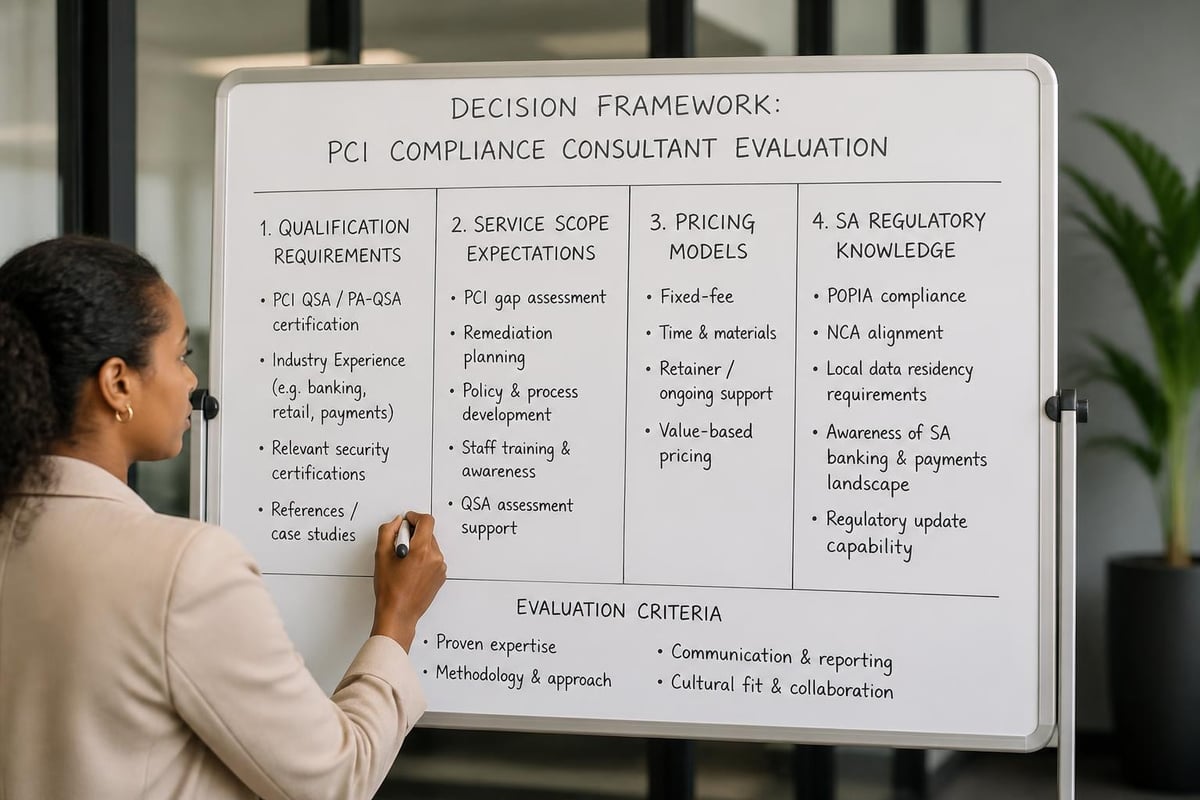
The South African market offers various approaches to PCI compliance support, from international consulting firms to local specialists familiar with the financial services regulatory environment. Independent brokers and smaller FSPs should evaluate potential partners across several dimensions.
Qualification and Certification Requirements
Legitimate pci compliance consulting services employ Qualified Security Assessors (QSAs) certified by the PCI Security Standards Council. These professionals complete rigorous training and maintain ongoing education requirements to stay current with evolving standards.
When evaluating consultants, verify:
- QSA certification status and company listing on official PCI SSC directories
- Experience specifically with financial services organisations
- Understanding of South African regulatory context (POPIA, FICA, FAIS)
- References from similar-sized organisations in comparable industries
- Clear methodology for assessment, remediation, and ongoing support
Service Scope and Deliverables
Comprehensive consulting engagements extend beyond mere gap assessments. Quality providers deliver structured programmes encompassing initial scoping, detailed assessment, remediation planning, implementation support, staff training, and validation activities.
Typical deliverables include:
- Scoping documentation defining which systems, processes, and people fall within PCI compliance scope
- Gap assessment reports identifying current state versus required controls
- Remediation roadmaps prioritising corrective actions based on risk and complexity
- Policy and procedure templates customised to organisational operations
- Staff training programmes covering secure handling of payment card information
- Validation evidence supporting Self-Assessment Questionnaire completion or formal assessments
The FTC guidance on protecting personal information reinforces that effective security programmes require not just consultant-driven assessments but ongoing organisational commitment to maintaining controls and responding to emerging threats.
Cost Structures and Ongoing Support
Pricing models for pci compliance consulting services vary considerably. Independent brokers should understand what specific services are included in quoted fees and which activities incur additional charges.
Common pricing approaches include:
- Project-based fees for initial gap assessment and remediation planning
- Hourly rates for ongoing advisory support and policy updates
- Annual retainer arrangements covering quarterly scans, annual assessments, and unlimited consultation
- Per-location pricing for organisations with multiple office premises
- Technology-inclusive packages bundling consulting services with required scanning tools or security platforms
For smaller FSPs operating with constrained compliance budgets, consultants offering package solutions aligned with Level 4 merchant requirements typically provide better value than hourly arrangements. Ensure contracts clearly specify whether quarterly vulnerability scans, penetration testing, and annual validation activities are included or represent additional fees.
Practical Implementation for Independent Brokers
Understanding requirements represents only the first step. Successful implementation requires translating PCI standards into practical workflows that integrate with daily broker operations without creating excessive administrative burden.
Payment Processing Method Selection
The single most impactful decision affecting PCI compliance scope involves how brokers process card payments. Different approaches create vastly different compliance obligations.
Telephone payments where staff manually key card numbers into payment terminals require extensive controls around call recording, data storage, and staff access. This approach maximises PCI scope and compliance complexity.
Online payment portals integrated with broker websites shift much of the compliance burden to payment gateway providers, provided proper implementation ensures the broker never directly handles card data. Modern payment processors offer hosted payment pages that minimise merchant PCI scope whilst maintaining seamless client experiences.
Point-of-sale terminals for in-person transactions require physical security controls and network segmentation but benefit from clear scoping boundaries when terminals connect directly to payment processors without routing through broader office networks.
For most independent brokers, selecting a payment processor that offers comprehensive data security services and assuming responsibility for PCI compliance on the broker's behalf represents the most cost-effective approach. However, even with outsourced processing, brokers retain certain compliance obligations around access controls, policy maintenance, and staff training.
Staff Training and Awareness Programmes
Human behaviour determines whether technical controls function effectively in operational environments. The SANS guidance on managing human risk demonstrates that security awareness training directly correlates with reduced breach incidents and improved compliance outcomes.
Effective training programmes for financial services staff address:
- Recognising and reporting suspicious payment activities or potential fraud
- Proper handling of card information received via telephone, email, or paper forms
- Secure password practices and multi-factor authentication procedures
- Physical security awareness, including clean desk policies and secure document disposal
- Incident reporting procedures and breach response protocols
- Integration with existing FICA training on client verification and transaction monitoring
Annual refresher training maintains awareness whilst onboarding programmes ensure new staff understand requirements from their first day. Documentation of training completion supports both PCI validation requirements and FAIS fit and proper obligations for FSP key individuals.
Incident Response and Breach Management
Despite best efforts, security incidents occur. Organisations must maintain documented incident response plans addressing both PCI requirements and POPIA breach notification obligations. The overlap between these frameworks creates natural integration points for brokers already managing compliance risk.
An effective incident response plan for payment card environments includes:
- Detection procedures for identifying potential compromises of cardholder data
- Containment steps limiting damage and preventing further unauthorised access
- Evidence preservation supporting forensic investigation and regulatory reporting
- Notification protocols for payment brands, acquiring banks, Information Regulator (under POPIA), and affected cardholders
- Remediation activities addressing root causes and preventing recurrence
- Post-incident reviews capturing lessons learned and updating controls
The UK NCSC guidance on commissioning penetration testing emphasises that incident response capabilities should be tested before real incidents occur. Tabletop exercises walking through breach scenarios help teams identify gaps in plans and improve coordination between compliance, technical, and business stakeholders.
Technology Solutions Supporting PCI Compliance
Whilst consulting services provide strategic guidance and validation support, technology platforms automate many compliance activities and reduce ongoing administrative burden. Understanding available tools helps brokers make informed investment decisions.
Vulnerability Scanning and Management Platforms
Quarterly vulnerability scanning represents a mandatory requirement for all merchants. Whilst external scans must be performed by Approved Scanning Vendors, integrated platforms offer continuous monitoring that identifies vulnerabilities between quarterly assessments, enabling proactive remediation before formal scans.
Modern vulnerability management solutions provide:
- Automated scanning schedules ensuring quarterly requirements are met
- Prioritised remediation guidance ranking vulnerabilities by exploitability and business impact
- Integration with patch management systems to streamline remediation workflows
- Executive dashboards demonstrating compliance status to management and regulators
- Historical trending showing improvement in security posture over time
For smaller brokers, cloud-based scanning services offered by compliance consulting providers typically deliver better value than standalone enterprise vulnerability management platforms requiring dedicated security personnel.
Payment Security Gateways
Payment gateway selection fundamentally determines PCI compliance scope and complexity. Modern gateways employ tokenisation, point-to-point encryption, and hosted payment pages that prevent merchants from ever accessing actual card data.
Key features to evaluate include:
| Feature | Compliance Benefit | Operational Consideration |
|---|---|---|
| Hosted payment pages | Removes card data from merchant environment | Requires internet connectivity for transactions |
| Tokenisation | Replaces card numbers with non-sensitive tokens | Enables recurring payments without storing cards |
| Point-to-point encryption | Encrypts data from capture through processing | Requires compatible payment terminals |
| Fraud detection tools | Identifies suspicious transactions before processing | May increase false positives requiring review |
| Reporting and reconciliation | Supports FICA transaction monitoring requirements | Integration with practice management systems |
The ENISA guidance on mobile payments security provides European perspective on payment security controls that complement PCI requirements, particularly relevant as South African brokers increasingly offer mobile payment options to clients.
Documentation and Evidence Management Systems
Maintaining comprehensive compliance documentation represents an ongoing challenge for independent practices. Dedicated governance, risk, and compliance (GRC) platforms centralise policy management, track control testing, manage evidence collection, and generate compliance reports.
For FSPs already managing FICA Risk Management and Compliance Programmes, platforms supporting multiple regulatory frameworks enable efficient cross-compliance management. Organisations seeking assistance with FICA RMCP drafting and compliance monitoring benefit from integrated approaches addressing payment security alongside broader regulatory obligations.
Continuous Compliance and Annual Validation
PCI compliance is not a one-time project but an ongoing programme requiring sustained attention. Annual validation cycles, quarterly scanning requirements, and continuous monitoring create regular touchpoints ensuring controls remain effective as threats evolve and business operations change.
Self-Assessment Questionnaire Completion
Most independent brokers complete annual Self-Assessment Questionnaires rather than undergoing formal assessments by Qualified Security Assessors. The PCI Security Standards Council publishes multiple SAQ variants, each addressing different payment processing scenarios.
Selecting the appropriate SAQ version requires understanding exactly how card data flows through organisational systems. Professional pci compliance consulting services ensure organisations complete the correct SAQ variant and properly interpret requirements.
The most common SAQ types for brokers include:
- SAQ A for card-not-present merchants outsourcing all payment processing with no electronic storage, processing, or transmission of cardholder data
- SAQ A-EP for e-commerce merchants with website payment processing outsourced via direct post or iframe methods
- SAQ B for merchants using only standalone dial-out terminals with no electronic storage of cardholder data
- SAQ B-IP for merchants using only standalone IP-connected terminals with no electronic storage
- SAQ C for merchants with payment applications connected to the internet with no electronic storage
- SAQ D for all other merchant environments not meeting criteria for SAQ A through C variants
Each SAQ contains specific control requirements organisations must validate annually. Completion generates an Attestation of Compliance demonstrating adherence to applicable PCI DSS requirements.
Maintaining Compliance Between Annual Assessments
Annual validation represents only a snapshot in time. Effective programmes maintain compliance throughout the year through continuous monitoring, regular control testing, and prompt response to changes in systems, processes, or threat landscapes.
Quarterly vulnerability scanning provides regular validation that external-facing systems remain properly hardened. Between formal scans, organisations should conduct internal reviews assessing:
- New systems or applications introduced since the last assessment
- Changes to payment processing methods or vendor relationships
- Staff turnover affecting access control requirements
- Security incidents or near-misses requiring control updates
- Regulatory changes affecting data protection obligations
The CISA Commercial Facilities Sector guidance demonstrates how federal-level cybersecurity frameworks support ongoing compliance programmes through continuous improvement cycles rather than point-in-time assessments.
Responding to Standard Updates and Emerging Threats
PCI DSS undergoes periodic revision, with new versions introducing updated requirements reflecting evolving payment technologies and emerging threats. Version 4.0, introduced in March 2022, includes a transition period extending through March 2025, after which new requirements become fully mandatory.
Professional consulting services monitor standard updates and communicate implications for client organisations. This forward-looking guidance enables brokers to plan technology investments and process changes addressing forthcoming requirements before they become mandatory, avoiding rushed remediation efforts under compliance deadlines.
Similarly, emerging threats such as new malware variants, exploitation techniques, or social engineering approaches require periodic reassessment of existing controls. Consultants tracking threat intelligence provide alerts when new risks require control enhancements, helping organisations maintain effective security postures between formal assessment cycles.
Integration with Broader FSP Compliance Frameworks
For South African financial services providers, PCI compliance exists within a broader regulatory ecosystem encompassing POPIA, FICA, FAIS, and sector-specific requirements. Successful programmes integrate payment security requirements with existing compliance frameworks rather than treating them as isolated obligations.
Unified Risk Management Approaches
Modern compliance programmes employ risk-based approaches assessing likelihood and impact of various compliance failures. Payment card data breaches represent high-impact, moderate-likelihood risks that warrant significant control investment.
Risk Management and Compliance Programmes mandated under FICA provide natural frameworks for incorporating PCI requirements. Risk assessments should evaluate payment processing vulnerabilities alongside traditional financial crime risks such as money laundering, terrorist financing, and sanctions violations.
This integrated approach enables efficient resource allocation, prioritising controls that address multiple compliance objectives simultaneously. For example, access controls protecting cardholder data also support POPIA's security safeguards requirement and FICA's employee screening obligations.
Cross-Functional Compliance Governance
Effective PCI programmes require collaboration between IT, compliance, operations, and business leadership. Governance structures should clearly define roles and responsibilities across these functions whilst providing escalation paths for compliance issues requiring management attention.
For independent brokers operating without dedicated IT departments, external technology service providers often assume technical implementation responsibilities. However, ultimate accountability for compliance remains with the FSP. Governance frameworks must therefore ensure brokers maintain sufficient oversight of outsourced functions and retain evidence demonstrating ongoing vendor management.
Training Programme Integration
Staff training requirements across POPIA, FICA, FAIS, and PCI create opportunities for integrated training programmes covering multiple regulatory obligations in coordinated sessions. This approach reduces training time whilst reinforcing connections between different compliance requirements.
For example, comprehensive data protection training can address:
- POPIA principles for lawful processing of personal information
- FICA client identification and verification requirements
- PCI standards for handling payment card data
- FAIS requirements for protecting client confidential information
- General cybersecurity awareness and phishing prevention
By presenting these topics within a unified framework emphasising protection of sensitive information, training programmes help staff understand underlying principles rather than memorising disconnected rules.
Navigating PCI compliance alongside South African financial services regulations requires specialist expertise and structured implementation approaches. For independent brokers and FSPs processing card payments, professional guidance ensures robust security controls protect client data whilst satisfying multiple regulatory obligations efficiently.
Holistic Compliance Management Solutions (Pty) Ltd brings deep expertise in financial services compliance to help your practice implement effective payment security controls integrated with broader POPIA, FICA, and FAIS requirements. Our team assists brokers and advisors with comprehensive compliance monitoring, FICA RMCP development, and practical implementation guidance tailored to independent practice workflows. Whether you're establishing new payment processing capabilities or validating existing controls, we provide the specialist support South African FSPs need to manage complex regulatory obligations confidently. Book a compliance consultation with Holistic Compliance Management Solutions (Pty) Ltd to assess your payment security requirements and develop an integrated compliance roadmap addressing PCI, POPIA, and FICA obligations.
Book a Compliance Consultation
Your consultation includes:
- Comprehensive assessment of current payment processing methods and PCI scope determination
- Gap analysis identifying specific control enhancements required for your practice
- Integrated compliance roadmap addressing PCI, POPIA, FICA, and FAIS requirements
Designed for: Independent brokers, financial advisors, FSP compliance officers, and practices establishing or reviewing payment card processing capabilities.