
Assessment Solutions for Financial Services Compliance
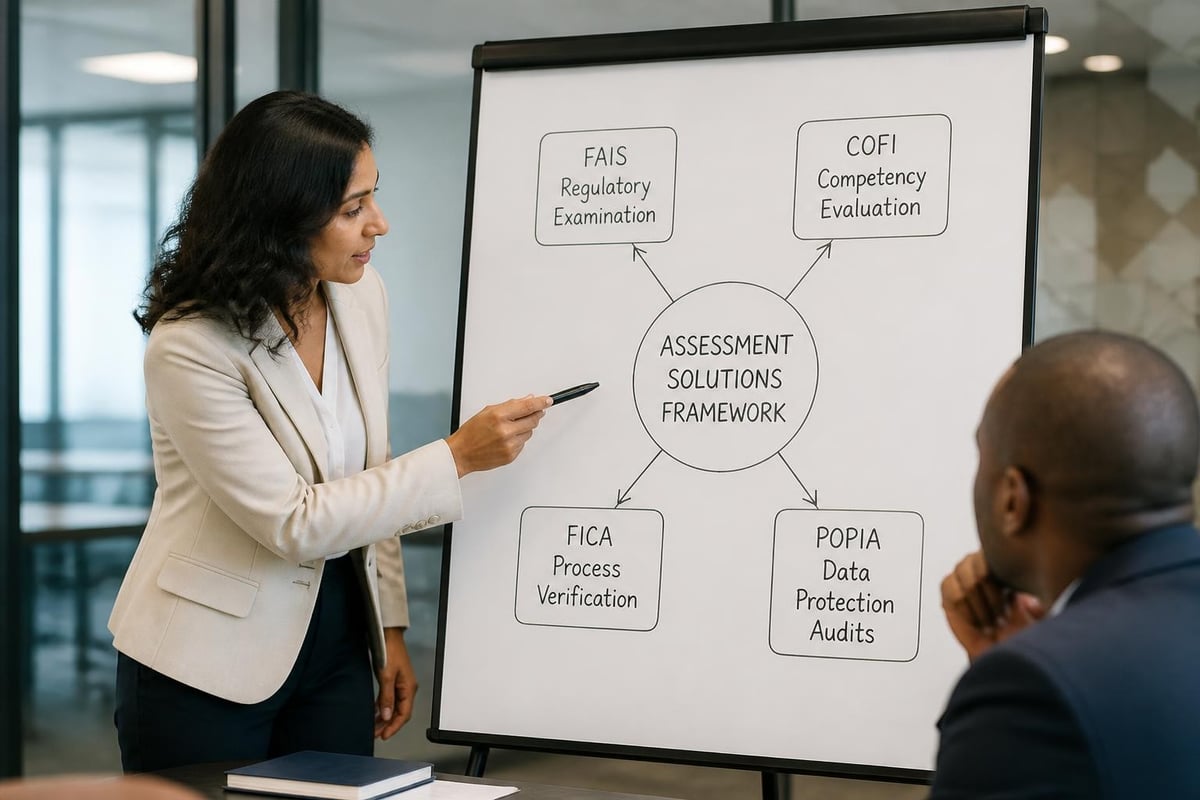
The financial services landscape in South Africa demands rigorous compliance adherence, and effective assessment solutions have become indispensable tools for Financial Service Providers (FSPs) and independent brokers. These systematic evaluation frameworks enable organisations to measure competency, verify regulatory knowledge, ensure ongoing compliance, and maintain professional standards across FAIS, POPIA, FICA, and COFI requirements. For compliance officers and broker principals managing complex regulatory obligations, robust assessment solutions transform abstract compliance requirements into measurable, manageable outcomes that protect both clients and business operations.
Understanding Assessment Solutions in Financial Services Compliance
Assessment solutions encompass structured evaluation methodologies designed to measure knowledge, competency, and compliance adherence within regulated environments. For South African financial services providers, these solutions serve multiple critical functions: verifying that representatives possess required regulatory knowledge, confirming ongoing competency under COFI requirements, validating FICA processes, and measuring POPIA implementation effectiveness.
The regulatory environment in South Africa creates specific assessment needs. The Financial Advisory and Intermediary Services (FAIS) Act requires representatives to demonstrate competency through regulatory examinations before providing financial advice. The Conduct of Financial Institutions (COFI) Act introduces ongoing competency requirements and customer fairness standards. The Financial Intelligence Centre Act (FICA) demands robust client verification procedures, whilst the Protection of Personal Information Act (POPIA) requires systematic evaluation of data handling practices.
Core Components of Effective Assessment Solutions
Modern assessment solutions integrate multiple evaluation dimensions to provide comprehensive compliance oversight:
- Knowledge assessments verify understanding of regulatory frameworks, product knowledge, and procedural requirements
- Competency evaluations measure practical application skills and decision-making capabilities
- Process audits examine systematic compliance implementation across client interactions
- Documentation reviews validate that written procedures, policies, and records meet regulatory standards
- Remediation pathways identify gaps and provide structured improvement plans
The assessment architecture must align with South Africa's regulatory standards, incorporating requirements from the Standards for Educational and Psychological Testing to ensure validity, reliability, and fairness in evaluation methodologies. This becomes particularly critical when assessment outcomes determine licensing eligibility or ongoing authorisation to provide financial services.
Regulatory Examination Requirements Under FAIS
The FAIS regulatory examination system represents the foundational assessment solution for South African financial services. Representatives must pass specific examinations aligned with their advisory categories before obtaining FSP authorisation. These assessments evaluate knowledge across regulatory frameworks, product categories, ethics, and client service obligations.
RE Examination Categories and Requirements
The Regulatory Examinations (RE exams) comprise five distinct assessments, each targeting different advisory categories:
| Examination | Advisory Category | Key Knowledge Areas | Typical Candidates |
|---|---|---|---|
| RE 1 | Short-term Insurance Personal Lines | Policy structures, claims, regulations | Personal lines insurance advisors |
| RE 5 | Long-term Insurance | Life products, investments, regulations | Life insurance representatives |
| RE 7 | Securities and Instruments | Investment products, market regulations | Investment advisors, portfolio managers |
| Class of Business | Multiple categories | Category-specific product knowledge | Multi-category representatives |
| Management | Compliance oversight | Practice management, supervision | Key individuals, compliance officers |
Effective preparation for these assessments requires structured learning programmes that address both theoretical knowledge and practical application scenarios. Independent brokers establishing new practices must ensure all representatives complete appropriate examinations before commencing advisory activities.
The examination process itself follows rigorous protocols including identity verification, secure testing environments, and standardised administration procedures that align with test quality and fairness standards established by professional testing organisations.
Implementation Steps for RE Examination Compliance
Broker principals implementing regulatory examination compliance should follow this systematic approach:
- Conduct a representative audit identifying all individuals requiring FSP authorisation and their advisory categories
- Map examination requirements matching each representative to appropriate RE examinations based on intended product categories
- Schedule preparation training enrolling representatives in structured study programmes covering regulatory content
- Register for examinations completing registration procedures and scheduling assessment dates
- Verify examination completion obtaining proof of successful completion and updating representative records
- Maintain ongoing records documenting examination credentials as part of FSP compliance documentation
For practices seeking RE EXAM Training support, structured preparation programmes significantly improve first-attempt pass rates and reduce time-to-authorisation for new representatives.
COFI Competency Assessment Requirements
The Conduct of Financial Institutions Act introduces continuous competency obligations extending beyond initial qualification. Financial services providers must implement ongoing assessment solutions measuring representative competency throughout their advisory careers, not merely at licensing.
Annual Competency Verification Framework
COFI requirements mandate systematic competency verification encompassing:
- Product knowledge updates covering new product features, regulatory changes, and market developments
- Regulatory framework awareness ensuring representatives understand current compliance obligations
- Customer treatment standards evaluating adherence to treating customers fairly principles
- Practical scenario assessments measuring decision-making quality in client interaction situations
- Ethics and conduct evaluations confirming alignment with professional conduct standards
Implementation requires documented assessment processes conducted annually, with results retained as evidence of compliance monitoring. Independent brokers must establish internal assessment frameworks or engage external compliance providers offering structured competency verification solutions.
Building Your COFI Competency Assessment Programme
A practical COFI assessment programme should include these components:
Monthly knowledge updates delivered through brief assessments covering regulatory changes, product updates, and compliance reminders. These micro-assessments maintain awareness without overwhelming representatives with lengthy annual examinations.
Quarterly scenario-based evaluations presenting realistic client situations requiring representatives to demonstrate appropriate advice processes, disclosure procedures, and documentation practices.
Annual comprehensive reviews combining knowledge testing, practical evaluations, and documented competency attestations signed by both representatives and supervising key individuals.

FICA Compliance Assessment Solutions
The Financial Intelligence Centre Act establishes client verification obligations requiring systematic assessment of implementation effectiveness. FICA assessment solutions evaluate whether broker practices adequately identify clients, verify information, conduct risk assessments, and maintain appropriate records.
FICA Risk Management and Compliance Programme Evaluation
Every FSP must maintain a documented Risk Management and Compliance Programme (RMCP) addressing FICA obligations. Assessment solutions for FICA compliance examine both the documented programme and its operational implementation.
RMCP documentation assessment evaluates:
- Completeness of client identification procedures covering all product categories
- Appropriateness of verification methods and document requirements
- Risk assessment frameworks identifying higher-risk client profiles
- Record-keeping procedures ensuring retention of verification documentation
- Ongoing monitoring processes for existing client relationships
Operational implementation assessment verifies:
- Representative adherence to documented identification procedures
- Quality and completeness of client verification files
- Consistent application of risk assessment methodologies
- Timely completion of verification processes before product conclusion
- Proper escalation of suspicious transactions or activities
Independent brokers should conduct quarterly internal FICA assessments examining sample client files against documented procedures. This proactive approach identifies implementation gaps before regulatory inspections.
FICA Assessment Checklist for Broker Practices
Use this practical checklist when conducting internal FICA compliance assessments:
| Assessment Area | Evaluation Questions | Evidence Required | Compliance Status |
|---|---|---|---|
| Client Identification | Are all clients identified using compliant methods? | Client files, ID copies | Pass/Fail/Partial |
| Verification Procedures | Is verification conducted before product conclusion? | File timestamps, process logs | Pass/Fail/Partial |
| Risk Assessment | Are client risk profiles documented? | Risk assessment forms | Pass/Fail/Partial |
| Record Keeping | Are verification records retained appropriately? | File retention logs | Pass/Fail/Partial |
| Representative Training | Do representatives understand FICA obligations? | Training records, competency tests | Pass/Fail/Partial |
For brokers requiring FICA RMCP drafting assistance or implementation guidance, specialised compliance practice services provide affordable solutions ensuring both documentation quality and operational effectiveness.
POPIA Data Protection Assessment Framework
The Protection of Personal Information Act demands systematic data protection practices throughout the client lifecycle. Assessment solutions for POPIA compliance evaluate information handling from initial collection through storage, processing, sharing, and eventual destruction.
Eight Conditions Assessment Methodology
POPIA establishes eight conditions for lawful processing of personal information. Effective assessment solutions examine compliance against each condition:
- Accountability: Assess whether designated information officers are appointed, privacy policies documented, and oversight mechanisms established
- Processing Limitation: Evaluate consent procedures, purpose specification, and lawfulness of processing activities
- Purpose Specification: Verify that information collection serves documented, legitimate purposes and processing remains within stated boundaries
- Further Processing Limitation: Examine controls preventing information use beyond original collection purposes
- Information Quality: Assess accuracy verification procedures and information update processes
- Openness: Evaluate transparency of privacy practices and accessibility of privacy documentation
- Security Safeguards: Review technical and organisational measures protecting information against loss, damage, or unauthorised access
- Data Subject Participation: Verify procedures enabling clients to access, correct, or request deletion of their information
POPIA Compliance Implementation Assessment
Practical POPIA assessment requires examining both policy documentation and operational reality. Many brokerages possess adequate written policies but struggle with consistent implementation across daily operations.
Documentation assessment examines:
- Privacy policy completeness and accessibility
- Consent form adequacy and deployment
- Information officer appointment documentation
- Data processing agreements with third-party service providers
- Breach notification procedures and incident response plans
Operational assessment verifies:
- Representative adherence to consent collection procedures
- Appropriate information security practices in daily operations
- Vendor compliance with data processing agreements
- Regular privacy training completion by all staff
- Incident response readiness and breach reporting capabilities
Independent broker practices should conduct semi-annual POPIA assessments using structured evaluation frameworks. This frequency balances thoroughness with resource efficiency whilst demonstrating ongoing compliance commitment.

Technology-Enabled Assessment Solutions
Digital transformation enables sophisticated assessment solutions that streamline compliance monitoring whilst reducing administrative burden. Modern platforms integrate automated testing, continuous monitoring, and real-time reporting capabilities previously unavailable through manual assessment processes.
Learning Management Systems for Compliance Training
Learning Management Systems (LMS) provide structured environments for delivering, tracking, and assessing compliance training. For broker practices, LMS platforms offer several advantages:
- Automated knowledge assessments delivering standardised tests after training modules
- Progress tracking monitoring representative completion rates and assessment scores
- Remediation pathways identifying struggling representatives and delivering targeted support
- Compliance documentation generating completion certificates and training records for regulatory purposes
- Version control ensuring all representatives receive current content reflecting latest regulatory requirements
When selecting assessment solutions incorporating digital platforms, brokerages must ensure systems meet accessibility testing and evaluation standards enabling all representatives to participate regardless of disability or technical capability.
Compliance Monitoring Platforms
Dedicated compliance monitoring platforms extend beyond training assessments to evaluate operational compliance across multiple regulatory dimensions simultaneously. These systems typically integrate:
Automated file reviews examining client documentation against FICA, POPIA, and internal policy requirements using AI-assisted analysis identifying missing documents, incomplete verification, or procedural deviations.
Representative activity monitoring tracking client interactions, product recommendations, and disclosure delivery to identify compliance risks before they become regulatory violations.
Policy exception tracking logging instances where representatives deviate from standard procedures, enabling investigation of legitimate exceptions versus compliance breaches.
The emergence of AI-assisted compliance monitoring raises important considerations regarding assessment validity and human oversight. Brokerages implementing AI-enhanced assessment solutions should consult frameworks for evaluating advanced AI systems ensuring technology augments rather than replaces professional judgement.
Digital Identity Verification for Assessment Integrity
As assessment solutions increasingly move online, ensuring participant identity becomes critical. This applies both to regulatory examinations and internal competency assessments where confirmation of representative identity maintains assessment integrity.
Modern identity verification follows protocols outlined in NIST Digital Identity Guidelines establishing authentication assurance levels appropriate for different risk contexts. For high-stakes regulatory examinations determining licensing eligibility, higher assurance levels incorporating biometric verification may be appropriate. For routine internal competency checks, password-protected access with multi-factor authentication typically suffices.
Building a Comprehensive Assessment Solutions Strategy
Independent broker practices require integrated assessment strategies addressing all regulatory obligations through coordinated evaluation frameworks. Fragmented approaches assessing FAIS, COFI, FICA, and POPIA compliance separately create inefficiency and increase compliance burden.
Annual Assessment Calendar
Structure your compliance assessment programme using this annual calendar framework:
January-March: Conduct annual COFI competency reviews combining knowledge assessments, scenario evaluations, and documented attestations. Complete annual POPIA compliance audits examining all eight conditions.
April-June: Perform quarterly FICA file reviews examining client verification quality. Deliver updated product knowledge assessments covering regulatory or product changes implemented during previous quarter.
July-September: Conduct mid-year compliance programme review assessing effectiveness of assessment solutions themselves. Update assessment methodologies based on regulatory changes, industry developments, or identified gaps.
October-December: Complete year-end comprehensive assessments preparing for regulatory returns and planning following year's compliance activities. Identify representatives requiring additional support or remediation.
Assessment Solutions Selection Criteria
When evaluating external assessment solutions or building internal frameworks, apply these selection criteria:
- Regulatory alignment: Solutions must address specific South African regulatory requirements under FAIS, COFI, FICA, and POPIA
- Scalability: Assessment frameworks should accommodate practice growth without proportional compliance cost increases
- Evidence generation: Solutions must produce documentation suitable for regulatory inspection and demonstrating compliance commitment
- Representative experience: Assessment burden should be proportionate, avoiding excessive disruption to client-serving activities
- Continuous improvement: Solutions should identify trends, patterns, and improvement opportunities beyond binary pass/fail outcomes
Resource Allocation for Assessment Activities
Effective assessment implementation requires appropriate resource allocation across time, budget, and personnel:
Time allocation should dedicate approximately 5-8% of representative working hours to assessment activities including preparation, completion, and remediation. Compliance officers typically spend 25-35% of their time on assessment-related activities including development, administration, analysis, and reporting.
Budget allocation varies based on practice size and outsourcing decisions, but typically comprises:
- 15-20% for external assessment platforms or service providers
- 25-30% for training content and preparation materials
- 20-25% for regulatory examination fees
- 15-20% for compliance officer time conducting assessments
- 15-20% for technology infrastructure supporting digital assessments
Personnel requirements generally include designated compliance officers for practices exceeding five representatives, with larger organisations employing dedicated training coordinators focused specifically on assessment programme delivery.
Measuring Assessment Solution Effectiveness
Assessment solutions themselves require periodic evaluation ensuring they effectively measure compliance, identify risks, and drive improvement. Simply conducting assessments without examining their quality and impact creates compliance theatre rather than substantive risk management.
Key Performance Indicators for Assessment Programmes
Monitor these metrics evaluating assessment solution effectiveness:
First-attempt pass rates for regulatory examinations indicate training programme quality. Rates consistently below 70% suggest inadequate preparation support requiring intervention.
Assessment completion rates measure whether representatives complete required evaluations within designated timeframes. Target rates above 95% completion within scheduled periods.
Time-to-remediation tracks how quickly identified gaps are addressed through additional training or process improvements. Effective programmes close identified gaps within 30-45 days.
Repeat finding frequencies indicate whether assessment-identified issues recur in subsequent evaluations. Declining repeat findings demonstrate effective remediation, whilst persistent recurrence suggests systemic problems requiring deeper intervention.
Regulatory inspection outcomes provide external validation of assessment programme effectiveness. Practices with robust internal assessment solutions typically experience fewer regulatory findings and lighter sanctions when violations occur.
Continuous Improvement Methodologies
Apply structured improvement processes to assessment solutions using this approach:
- Quarterly assessment reviews examining metrics, representative feedback, and operational impact
- Annual effectiveness evaluations comparing assessment outcomes against regulatory inspection results and business performance
- Stakeholder feedback collection gathering input from representatives, clients, and regulatory interactions
- Benchmarking exercises comparing assessment approaches against industry peers and best practice standards
- Pilot testing before implementing significant assessment changes affecting multiple representatives
Assessment solutions should evolve as regulatory requirements change, business models develop, and technology capabilities advance. Static assessment programmes quickly become outdated, measuring historical compliance rather than current obligations.
Outsourced Versus Internal Assessment Solutions
Broker practices face strategic decisions regarding assessment solution delivery models: building internal capabilities, outsourcing to specialist providers, or implementing hybrid approaches combining internal oversight with external expertise.
Internal Assessment Programme Advantages
Developing internal assessment capabilities offers several benefits:
- Contextual relevance: Assessments tailored precisely to your practice's products, procedures, and client profiles
- Immediate responsiveness: Ability to adjust assessment content quickly responding to regulatory changes or identified risks
- Representative familiarity: Internal assessors understand practice-specific nuances and representative capabilities
- Cost predictability: Fixed personnel costs versus variable outsourcing fees
- Knowledge retention: Compliance expertise remains within the organisation building institutional capability
However, internal programmes demand significant development investment, require dedicated compliance expertise, and risk insularity without external perspective.
External Assessment Provider Benefits
Outsourcing assessment solutions to specialist compliance providers delivers different advantages:
- Regulatory expertise: Providers maintain current knowledge across evolving regulatory requirements
- Proven methodologies: Established assessment frameworks incorporating industry best practices
- Scalability: Capacity to support practice growth without proportional internal resource increases
- Independent perspective: External evaluation provides credibility and objectivity
- Technology access: Sophisticated assessment platforms without capital investment
Considerations include ongoing service costs, reduced customisation flexibility, and potential dependency on external providers for critical compliance functions.
Hybrid Assessment Models
Many successful broker practices implement hybrid approaches combining internal compliance oversight with external specialist support for specific assessment components. Common hybrid structures include:
- Internal operational assessments examining daily compliance implementation with external annual audits providing independent validation
- Internal training delivery using externally developed assessment content ensuring regulatory currency
- Internal FICA and POPIA monitoring complemented by external regulatory examination preparation leveraging specialist expertise
The optimal model depends on practice size, complexity, compliance officer capabilities, and budget constraints. Practices with fewer than ten representatives typically benefit from external support, whilst larger organisations may justify dedicated internal assessment teams.
Implementation Roadmap for Comprehensive Assessment Solutions
Establishing robust assessment solutions requires systematic implementation following structured roadmaps preventing overwhelm whilst building sustainable compliance capabilities.
Phase 1: Foundation Building (Months 1-3)
Regulatory requirement mapping: Document all assessment obligations under FAIS, COFI, FICA, and POPIA applicable to your practice's specific product categories and operational model.
Current state assessment: Evaluate existing assessment activities identifying gaps between current practices and regulatory requirements.
Resource planning: Determine budget allocation, personnel assignments, and technology requirements supporting comprehensive assessment implementation.
Priority setting: Sequence implementation addressing highest-risk gaps first whilst building towards complete compliance coverage.
Phase 2: Core Implementation (Months 4-9)
Regulatory examination preparation: Establish structured RE exam training for all representatives requiring initial qualification or category additions.
FICA assessment framework: Implement quarterly file review processes examining client verification quality and RMCP adherence.
POPIA evaluation procedures: Develop semi-annual data protection assessments covering all eight conditions with documented findings and remediation plans.
Documentation systems: Create record-keeping frameworks capturing assessment activities, outcomes, and compliance evidence.
Phase 3: Advanced Capabilities (Months 10-12)
COFI competency programmes: Implement ongoing representative assessments combining knowledge testing, scenario evaluations, and documented competency attestations.
Technology integration: Deploy learning management systems, compliance monitoring platforms, or assessment automation tools enhancing efficiency.
Continuous improvement: Establish measurement frameworks evaluating assessment solution effectiveness and driving programme refinement.
Regulatory alignment verification: Conduct comprehensive review confirming all assessment solutions meet current regulatory standards including those outlined in UNESCO guidance on learning assessments for large-scale evaluation programmes.
Common Assessment Implementation Challenges
Broker practices implementing comprehensive assessment solutions encounter predictable challenges requiring proactive management strategies.
Representative Resistance and Assessment Fatigue
Representatives sometimes resist assessment requirements viewing them as administrative burden rather than professional development. This resistance intensifies when assessment frequency increases or evaluation rigor strengthens.
Mitigation strategies include:
- Communicating assessment rationale linking evaluations to regulatory obligations, professional credibility, and practice sustainability
- Designing efficient assessments respecting representative time through focused content and streamlined administration
- Providing immediate feedback connecting assessment results to practical improvement opportunities
- Recognising strong performance publicly whilst supporting struggling representatives privately
- Integrating assessments into normal workflow rather than treating them as separate, disruptive activities
Keeping Assessment Content Current
Regulatory environments evolve continuously through legislative amendments, regulatory guidance updates, and industry practice developments. Assessment solutions using outdated content measure historical rather than current compliance obligations.
Currency maintenance requires:
- Quarterly content reviews comparing assessment materials against latest regulatory publications
- Subscription to regulatory update services providing timely notification of relevant changes
- Participation in industry associations and compliance forums sharing regulatory intelligence
- Documented content versioning tracking when assessment materials were last updated
- Sunset policies automatically retiring assessment content exceeding defined age thresholds
Balancing Rigour with Practicality
Theoretically perfect assessment solutions often prove operationally unsustainable in resource-constrained broker practices. Excessive assessment burden diverts representative time from client service whilst overwhelming compliance officers with administrative requirements.
Balance strategies include:
- Implementing tiered assessment approaches with more frequent, lighter evaluations complemented by less frequent comprehensive assessments
- Leveraging technology automation reducing manual administration whilst maintaining assessment quality
- Focusing assessments on highest-risk areas rather than attempting exhaustive coverage of every compliance dimension
- Integrating assessment activities into existing processes rather than creating parallel compliance workstreams
- Setting realistic completion timelines acknowledging representative workload constraints
Effective assessment solutions transform compliance from abstract regulatory obligation into measurable, manageable business practice for South African financial services providers. By implementing structured evaluation frameworks addressing FAIS, COFI, FICA, and POPIA requirements, independent brokers protect their practices whilst elevating professional standards across the industry. Holistic Compliance Management Solutions (Pty) Ltd provides specialised compliance risk management services helping FSPs and independent brokers implement robust assessment programmes, maintain regulatory currency, and build sustainable compliance capabilities that support long-term business success.
Who this is for: Independent financial advisors, regulated brokerages, FSP applicants, and compliance officers managing multi-regulatory obligations.
Schedule FICA Training to strengthen your assessment capabilities:
- Comprehensive FICA RMCP implementation guidance tailored to broker workflows
- Practical assessment frameworks for client verification quality
- Ongoing compliance monitoring support ensuring sustained adherence