
SOC 2 Audit Cost: South Africa FSP Compliance Guide 2026
The convergence of global data security standards and South African regulatory frameworks has made SOC 2 compliance increasingly relevant for financial services providers. Whether you operate an independent brokerage, manage client portfolios, or provide advisory services under FAIS, understanding the soc 2 audit cost landscape helps you make informed decisions about data protection investments. This guide examines the complete cost structure of SOC 2 audits, how they align with POPIA and FICA requirements, and what South African FSPs should budget for comprehensive compliance.
Understanding SOC 2 in the South African Financial Services Context
SOC 2 (System and Organization Controls 2) represents an international attestation framework developed by the American Institute of Certified Public Accountants (AICPA). For South African financial services providers handling client data, investment portfolios, and sensitive financial information, SOC 2 provides a structured approach to demonstrating security, availability, processing integrity, confidentiality, and privacy controls.
The framework aligns remarkably well with POPIA's eight conditions for lawful processing of personal information. When FSPs implement SOC 2 controls, they simultaneously strengthen their POPIA compliance posture, creating dual-purpose value from a single investment.
Why Financial Services Providers Consider SOC 2
Several market forces drive South African brokers and advisors toward SOC 2 certification:
- International client expectations: Institutional investors and multinational corporations increasingly require SOC 2 reports before engaging financial service providers
- Regulatory convergence: The FSCA's emphasis on operational resilience and data protection creates natural overlap with SOC 2 principles
- Competitive differentiation: Independent brokers can distinguish their practices by demonstrating independently verified security controls
- Insurance requirements: Professional indemnity insurers may offer better terms to practices with formal security attestations
The question of soc 2 audit cost becomes central when FSPs evaluate whether the investment delivers proportionate value relative to their specific client base and growth trajectory.

Complete Cost Structure of SOC 2 Compliance
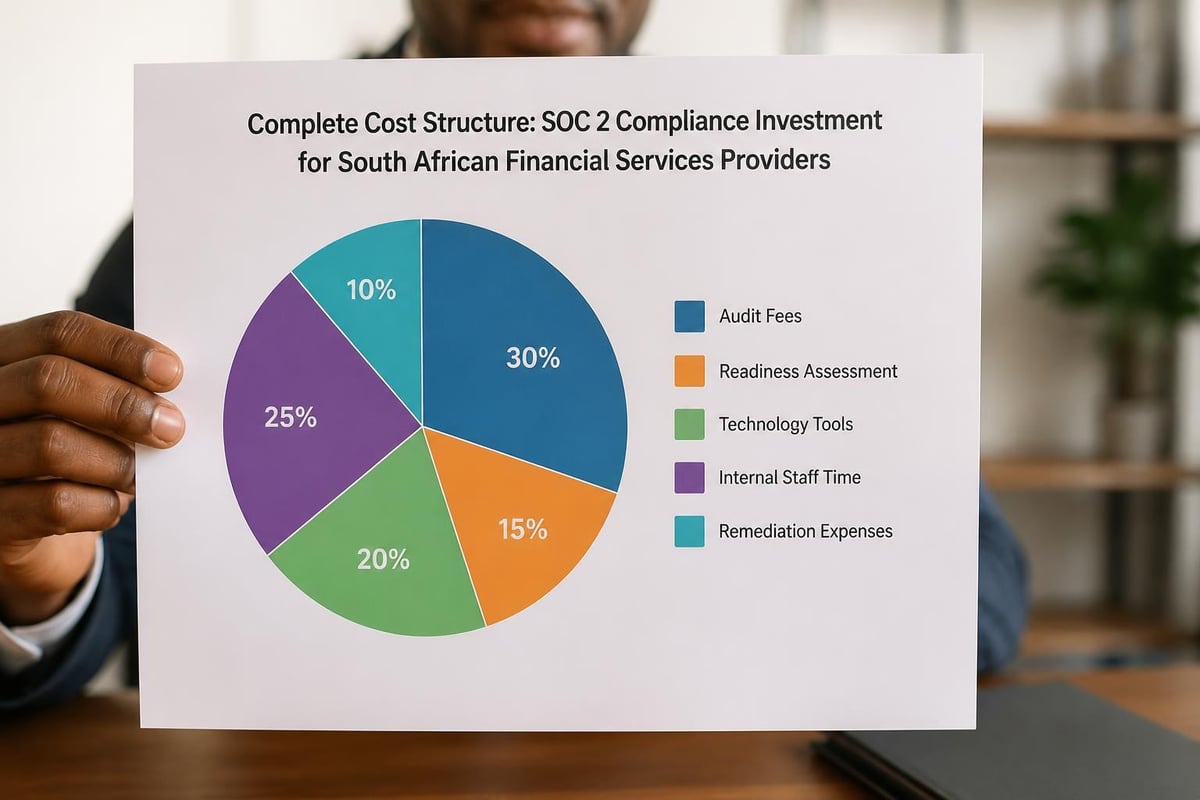
According to comprehensive pricing research aggregating quotes from 165 audit firms, the total cost of achieving SOC 2 compliance extends well beyond the auditor's invoice. South African FSPs should budget across five distinct categories when planning their compliance journey.
Audit Fee Components
The direct auditor fee represents the most visible element of soc 2 audit cost. For 2026, South African financial services providers can expect the following ranges based on organizational complexity:
| Company Size | Employee Range | Typical Audit Fee Range (ZAR)* |
|---|---|---|
| Micro practices | 1-10 | R85,000 – R185,000 |
| Small brokerages | 11-50 | R185,000 – R370,000 |
| Mid-sized FSPs | 51-250 | R370,000 – R925,000 |
| Large organizations | 250+ | R925,000 – R2,775,000+ |
*Converted at R18.50/USD; actual costs vary based on scope, auditor tier, and system complexity
These fees cover the auditor's time conducting the Type I (point-in-time) or Type II (period-of-time) examination. Type II audits, which span three to twelve months of operational evidence, typically cost 40-60% more than Type I assessments but provide greater market credibility.
Readiness Assessment Investment
Before engaging an auditor, most FSPs require a gap analysis to identify control deficiencies. Detailed cost breakdowns show readiness assessments ranging from R55,000 to R185,000 depending on your current maturity level.
For South African practices already maintaining robust POPIA and FICA compliance programmes, readiness costs tend toward the lower end. Your existing Risk Management and Compliance Programme (RMCP) documentation, FICA verification procedures, and POPI Act implementation work all contribute to SOC 2 readiness, reducing the gap assessment scope.
Independent compliance specialists can conduct focused readiness reviews specifically tailored to financial services workflows. Compliance monitoring services that already track your FAIS obligations can efficiently extend coverage to SOC 2 requirements, leveraging existing control documentation and evidence collection processes.
Technology and Tooling Expenses
Continuous compliance monitoring platforms have transformed how organizations maintain SOC 2 readiness. Automation tools and guides now enable FSPs to automatically collect evidence, monitor control effectiveness, and maintain compliance documentation between audit cycles.
Annual tooling costs typically fall within these ranges:
- Basic compliance platforms: R18,500 – R55,000 per year
- Mid-tier solutions with integration: R55,000 – R111,000 per year
- Enterprise platforms with custom workflows: R111,000 – R277,000+ per year
For smaller independent brokerages, the value proposition of compliance automation depends heavily on audit frequency and the number of parallel frameworks you maintain. If you're simultaneously managing POPIA, FICA, COFI, and SOC 2 requirements, integrated platforms deliver significant time savings and reduce your internal labor costs.
Internal Staff Time and Opportunity Cost
The least visible but often most substantial component of soc 2 audit cost involves your team's time. Preparing for and supporting an audit requires significant involvement from multiple roles within your practice.
Typical time investment by role:
- Compliance officer/designated person: 120-200 hours for initial audit; 60-100 hours for renewal
- IT administrator or systems manager: 80-150 hours gathering technical evidence and implementing controls
- Practice principal/key individual: 40-60 hours for interviews, policy approval, and strategic decisions
- Administrative staff: 30-50 hours supporting documentation collection and evidence organization
At South African professional service rates (R500-R1,500 per hour for skilled roles), internal labor can add R120,000 to R450,000 to your total first-year compliance cost. For subsequent years, this typically decreases by 40-50% as processes become routine and evidence collection integrates into daily operations.
Remediation and Control Implementation
The gap assessment inevitably identifies controls requiring strengthening or implementation. Common remediation expenses for financial services providers include:
- Access control systems: R25,000 – R95,000 for identity management and multi-factor authentication
- Encryption upgrades: R15,000 – R65,000 for data-at-rest and data-in-transit protection
- Backup and disaster recovery: R35,000 – R150,000 for automated backup systems meeting availability criteria
- Vendor management processes: R10,000 – R40,000 for third-party risk assessment frameworks
- Incident response planning: R20,000 – R75,000 for documented procedures and tabletop exercises
These investments deliver value beyond SOC 2 compliance. They directly strengthen your POPIA security safeguards (Condition 7), support your FICA record-keeping obligations, and reduce operational risk across your practice.
Factors That Influence Your Specific Audit Cost
Not all SOC 2 audits cost the same. Understanding the variables that drive pricing helps you estimate your practice's specific investment and identify opportunities to optimize costs.
Trust Services Criteria Selection
SOC 2 allows organizations to select which Trust Services Criteria (TSC) to include in the audit scope. The five available criteria are:
- Security (mandatory baseline): Controls protecting against unauthorized access
- Availability: System uptime and operational performance
- Processing Integrity: Complete, valid, accurate, timely processing
- Confidentiality: Protection of confidential information
- Privacy: Collection, use, retention, disclosure, and disposal of personal information
Most financial services providers pursue Security plus Privacy, given their relevance to POPIA obligations and client expectations. Each additional criterion beyond Security increases the soc 2 audit cost by approximately 15-25%, as auditors must examine additional control sets and evidence.
System and Service Complexity
Auditors price engagements based on the complexity of systems within scope. Factors that increase audit effort and cost include:
- Number of applications processing client data (portfolio management, CRM, communication platforms)
- Custom-developed versus off-the-shelf software
- Integration points between systems
- Cloud service providers requiring vendor management evidence
- Geographic distribution of staff and infrastructure
A solo advisor using standard cloud applications (Office 365, a mainstream CRM, and a third-party portfolio platform) represents a straightforward audit scope. A multi-office brokerage with custom proprietary systems, multiple data centers, and complex integration architecture faces significantly higher audit costs.
Auditor Tier and Brand Premium
Market research shows that brand recognition carries pricing power in the attestation market. The audit firm landscape breaks into three tiers:
| Auditor Tier | Characteristics | Premium vs. Mid-Tier |
|---|---|---|
| Big Four & major international firms | Global recognition, largest client logos, extensive resources | +60% to +150% |
| Mid-tier specialized firms | SOC 2 focus, industry expertise, efficient processes | Baseline pricing |
| Regional and boutique firms | Local presence, personalized service, emerging reputation | -20% to -40% |
For South African FSPs, the question becomes whether international client expectations justify the brand premium. If you primarily serve local individual investors and small businesses, a reputable mid-tier or regional firm likely provides sufficient credibility. If you manage institutional capital or pursue multinational corporate clients, the Big Four premium may deliver proportionate value through enhanced market signal.
Type I versus Type II Examination
The examination type significantly impacts cost and credibility:
Type I (point-in-time): Auditor examines whether controls are suitably designed at a specific date. Lower cost (baseline), faster completion (6-8 weeks), but limited market value as it doesn't prove operational effectiveness.
Type II (period-of-time): Auditor tests whether controls operated effectively over a period (typically 3-12 months). Higher cost (+40% to +60% vs. Type I), longer timeline (3-6 months), but provides meaningful assurance to stakeholders.
Most sophisticated buyers and institutional clients require Type II reports. The incremental cost delivers substantially greater credibility, making Type II the recommended choice unless budget constraints or tight timelines dictate otherwise.
Existing Control Maturity
Your current compliance posture directly influences both readiness costs and audit efficiency. Preparation guidance emphasizes that organizations with mature risk management and control environments experience smoother, less expensive audits.
South African FSPs already maintaining comprehensive FAIS compliance, POPIA implementation, and FICA verification programmes possess significant advantages:
- Existing policy frameworks require adaptation rather than creation from scratch
- Documentation processes for regulatory compliance translate to audit evidence collection
- Staff familiarity with control concepts and compliance thinking reduces training requirements
- Established governance structures (compliance committees, risk management functions) satisfy SOC 2 organizational expectations
Practices starting from minimal control maturity should budget an additional 30-50% for first-year implementation efforts compared to organizations with strong existing compliance foundations.
Aligning SOC 2 with South African Regulatory Frameworks
The strategic value of SOC 2 for South African financial services providers emerges from its alignment with mandatory local requirements. Rather than viewing SOC 2 as an additional compliance burden, sophisticated practices leverage it as a framework organizing their existing regulatory obligations.
POPIA Synergies and Shared Controls
The Protection of Personal Information Act creates eight conditions for lawful processing. SOC 2's Privacy criterion maps directly to these requirements, while Security controls support POPI's security safeguards obligation.
Practical overlap examples:
- Your SOC 2 access control policies simultaneously satisfy POPI's security safeguards (Condition 7) and demonstrate appropriate technical measures
- Encryption implementations for SOC 2 confidentiality strengthen POPI's requirement to secure personal information integrity
- Incident response procedures required for SOC 2 support POPI's security breach notification obligations
- Vendor management controls address both SOC 2's system boundary concepts and POPI's operator/third-party accountability
Analysis of framework overlaps demonstrates that organizations implementing multiple standards simultaneously achieve 30-40% efficiency gains compared to sequential, siloed approaches.
FICA and Client Due Diligence Controls
The Financial Intelligence Centre Act requires FSPs to verify client identities, maintain records, and report suspicious transactions. SOC 2's processing integrity and confidentiality criteria naturally encompass these obligations.
When designing your SOC 2 control environment, structure your client onboarding and verification workflows to satisfy both FICA requirements and SOC 2 processing integrity standards. This integrated approach means your SOC 2 audit simultaneously validates your FICA compliance effectiveness, creating audit efficiency and reducing your overall assurance costs.

FAIS and Conduct of Business Standards
The Financial Advisory and Intermediary Services Act establishes conduct standards for FSPs. The General Code of Conduct (FAIS GCC) requires appropriate systems, controls, and procedures to ensure sound risk management and compliance.
Your SOC 2 implementation directly supports FAIS obligations:
- Systems documentation required for SOC 2 demonstrates the operational capability expected under FAIS
- Risk assessment processes form the foundation of both SOC 2 control design and your FAIS-mandated risk management
- Training and competency programmes satisfy both SOC 2's personnel controls and FAIS requirements for representative knowledge
The Conduct of Financial Institutions (COFI) Bill, expected to substantially expand conduct regulation across financial services, will likely increase emphasis on operational resilience, data protection, and customer outcome monitoring. Early adoption of SOC 2 positions practices favorably for these emerging requirements.
Multi-Year Cost Perspective and Ongoing Investment
Understanding the soc 2 audit cost requires looking beyond the initial certification to the ongoing compliance investment. SOC 2 reports expire after their examination period, necessitating annual or biannual renewals to maintain continuous coverage.
Year-One Implementation Costs
The first-year investment includes all cost categories at their highest levels:
Typical Year One Budget (mid-sized independent brokerage, 25 staff):
- Readiness assessment and gap analysis: R95,000
- Control implementation and remediation: R185,000
- Compliance automation platform: R65,000
- Type II audit fee (six-month period): R295,000
- Internal staff time (fully loaded): R220,000
- Total Year One Investment: R860,000
This represents a significant commitment for independent practices. However, the investment establishes control infrastructure, documentation processes, and compliance capabilities that deliver value across your entire regulatory portfolio.
Subsequent Year Maintenance Costs
Renewal audits cost substantially less than initial certifications, typically 30-50% lower than first-year fees. Your team's familiarity with requirements, established evidence collection processes, and operational controls reduce both auditor effort and internal time investment.
Typical Renewal Year Budget (same example brokerage):
- Annual compliance platform subscription: R65,000
- Type II renewal audit fee (twelve-month period): R240,000
- Internal staff time: R110,000
- Incremental control enhancements: R40,000
- Total Renewal Year Investment: R455,000
This 47% reduction from first-year costs reflects the operational efficiency gained through established processes and staff capability development.
Return on Investment Considerations
Quantifying SOC 2's ROI requires examining both revenue opportunities and risk reduction benefits:
Revenue enablement:
- Access to institutional clients requiring SOC 2 attestation
- Competitive advantage in RFP processes where security assurance differentiates proposals
- Premium pricing justification based on demonstrable risk management maturity
Risk mitigation value:
- Reduced likelihood of data breaches and associated regulatory penalties (POPIA fines up to R10 million or 10 years imprisonment)
- Lower cyber insurance premiums (typically 10-15% discount for SOC 2-certified organizations)
- Decreased FSCA examination findings and enforcement actions
- Protection of practice reputation and client trust
For practices pursuing growth through institutional channels or high-net-worth clients with sophisticated security expectations, SOC 2 often proves revenue-positive within 18-24 months.
Optimizing Your Compliance Investment
Strategic approaches to SOC 2 implementation can significantly reduce costs while maintaining assurance quality and market credibility.
Start with Security Foundation
Rather than pursuing all five Trust Services Criteria immediately, begin with the mandatory Security criterion. This focused scope reduces your initial soc 2 audit cost by 30-40% while establishing the control foundation upon which additional criteria can be built.
After completing your first Security-only audit, assess market feedback and client requirements. If stakeholders accept the limited scope, defer additional criteria. If Privacy or Availability becomes a market requirement, add them in subsequent audit cycles when control evidence already exists.
Leverage Existing Compliance Infrastructure
South African FSPs already maintaining POPIA, FICA, and FAIS compliance possess substantial SOC 2 readiness. Your gap assessment should specifically identify existing controls that satisfy SOC 2 requirements with minimal modification.
For example:
- Your POPIA privacy notice likely satisfies SOC 2 privacy commitment requirements with minor updates
- FICA client verification procedures demonstrate processing integrity controls with appropriate documentation
- FAIS systems and controls documentation provides the foundation for SOC 2 system descriptions
By maximizing reuse of existing documentation and controls, you reduce both readiness costs and ongoing maintenance efforts.
Choose the Right Auditor for Your Market
If your primary clients are South African individuals, families, and domestic businesses, regional audit firms familiar with local regulatory context often provide optimal value. They understand POPIA, FICA, and FAIS requirements and can position SOC 2 within your broader compliance obligations.
Reserve Big Four or major international firms for situations where their brand recognition delivers clear market access or client acquisition benefits. The premium should align with demonstrable revenue opportunities.
Implement Continuous Compliance Approaches
Traditional point-in-time compliance assessments create inefficiency through intensive pre-audit preparation periods. Modern continuous monitoring approaches distribute effort throughout the year and reduce audit surprises.
Compliance automation platforms that continuously collect evidence, monitor control effectiveness, and flag exceptions enable "always audit-ready" states. While these tools carry subscription costs (R55,000-R111,000 annually), they typically deliver net savings by reducing pre-audit scrambles and internal staff time.
Bundle Complementary Assessments
If you're considering multiple security or compliance assessments (penetration testing, vulnerability scanning, ISO 27001, etc.), bundle them strategically. Many auditors offer package pricing for multiple services, and evidence collected for one assessment often supports others.
For South African FSPs, the most natural bundle combines SOC 2 with comprehensive POPIA compliance assessments. Guidance on standards alignment shows that integrated assurance approaches reduce combined costs by 20-30% compared to separate, sequential engagements.
Budget Planning and Financial Preparation
Practical budgeting for soc 2 audit cost requires understanding payment timing, potential cost overruns, and financing considerations.
Payment Structure and Timing
Most audit engagements follow a milestone-based payment structure:
- Initial deposit (20-30% of estimated fee): Due upon engagement letter signing
- Interim payment (40-50%): Due at fieldwork commencement or midpoint
- Final payment (20-30%): Due upon draft report delivery
This structure means you'll pay the majority of audit costs over a 2-4 month period during active fieldwork. Plan cash flow accordingly, particularly if the audit timing coincides with other significant practice expenses.
Readiness work and control implementation costs typically occur 2-4 months before the audit engagement begins, creating an extended payment timeline across 6-8 months for the complete first-year journey.
Contingency and Overrun Management
Budget a 15-20% contingency above initial quotes. Common reasons for cost increases include:
- Scope expansion when initial boundary definition proves incomplete
- Additional criteria added based on preliminary client feedback
- Control deficiencies requiring more extensive remediation than anticipated
- Extended timelines due to evidence collection challenges or staff availability constraints
Clear scope definition during engagement negotiation and rigorous project management during implementation minimize overruns. Engage your auditor early in planning to align expectations and avoid scope surprises.
Financing Options and Amortization
For smaller independent practices, the concentrated first-year investment may strain cash flow. Several financing approaches can smooth the investment:
- Client fee increases: Distribute costs across your client base through modest fee adjustments, particularly for institutional clients directly benefiting from SOC 2 assurance
- Multi-year amortization: Structure your internal accounting to amortize initial implementation costs over the expected certification period (typically 3-5 years)
- Business financing: Consider working capital facilities or term loans if SOC 2 enables significant new client relationships or market access
- Phased implementation: Start with Security-only scope and Type I examination to reduce initial investment, then expand in subsequent years as revenue justifies
Cost Transparency and Quote Comparison
Shopping for SOC 2 audit services requires understanding how to evaluate proposals and compare pricing across firms.
What Should Be Included in Quotes
Comprehensive proposals should itemize:
- Base audit fee for specified scope (criteria, system boundaries, examination period)
- Hourly rates for principal, manager, and staff levels
- Estimated hours by role and audit phase
- Travel expenses (if applicable for multi-location organizations)
- Report issuance and distribution costs
- Exclusions and assumptions clearly stated
Beware of quotes lacking detail or using ambiguous "up to" language without firm commitments. Current market pricing data suggests detailed, transparent proposals correlate with more predictable final costs and fewer billing surprises.
Red Flags in Low-Cost Proposals
Unusually low quotes merit scrutiny. Common issues with bottom-tier pricing include:
- Inexperienced audit teams requiring extensive guidance and creating internal staff burden
- Hidden costs for "out of scope" activities that should be standard
- Limited quality review leading to deficient reports that fail to satisfy sophisticated clients
- Hourly rate overruns that ultimately exceed higher but fixed-price proposals
The SOC 2 audit market demonstrates strong price-quality correlation. Extremely low bids often prove expensive through do-overs, extended timelines, or market rejection of the final report.
Evaluating Non-Price Factors
Price represents only one decision criterion. Additional factors significantly impact your implementation success and overall cost of compliance:
Auditor industry expertise: Firms experienced with financial services understand POPIA, FICA, and FAIS context, reducing explanation requirements and enabling strategic guidance on control design.
Communication quality: Clear, jargon-free explanations reduce confusion, accelerate decision-making, and minimize your team's learning curve.
Technology familiarity: Auditors experienced with your specific platforms (CRM, portfolio management, cloud services) complete evidence review more efficiently.
South African presence: Local firms understand Rand-denominated pricing, can conduct in-person meetings without travel premiums, and align scheduling with South African business calendars.
Post-audit support: Clarify what guidance the firm provides between audit cycles, particularly for addressing client questions about your SOC 2 report.
Navigating soc 2 audit cost requires balancing market expectations, regulatory alignment, and practical budget constraints. For South African financial services providers, strategic implementation that leverages existing POPIA and FICA compliance infrastructure delivers optimal value while positioning practices for both domestic regulatory success and international market access. Whether you're an independent broker seeking competitive differentiation or an established FSP expanding into institutional channels, understanding the complete cost structure enables informed decisions about this increasingly important assurance framework. Holistic Compliance Management Solutions (Pty) Ltd helps financial services providers integrate SOC 2 requirements with POPIA, FICA, and FAIS compliance obligations, creating efficient, comprehensive risk management programmes tailored to South African regulatory context.
Book a compliance consultation – For independent brokers and FSPs considering SOC 2
Your consultation includes:
- Gap assessment comparing current POPIA/FICA controls against SOC 2 requirements
- Realistic cost estimation based on your specific practice size and complexity
- Implementation roadmap integrating SOC 2 with existing regulatory obligations
This service is designed for independent financial brokers, regulated FSPs, and compliance officers evaluating international security frameworks alongside South African regulatory requirements.