
Cybersecurity Compliance Services for Financial Brokers
Financial services providers in South Africa face an increasingly complex regulatory environment where traditional compliance obligations intersect with modern cybersecurity threats. For independent financial advisors, brokers, and FSPs operating under the Financial Advisory and Intermediary Services Act (FAIS), the challenge extends beyond meeting basic licensing requirements to implementing robust cybersecurity measures that satisfy multiple regulatory frameworks simultaneously. Cybersecurity compliance services have emerged as essential partners for practices that need to demonstrate adherence to POPIA's data protection mandates, FICA's customer due diligence requirements, and the Treating Customers Fairly (TCF) principles whilst maintaining operational efficiency. This convergence of regulatory obligations requires specialised expertise that many independent practices struggle to maintain in-house.
Understanding Cybersecurity Compliance in the Financial Services Context
Cybersecurity compliance services provide financial services providers with structured frameworks to protect client information whilst meeting statutory obligations. These services extend beyond basic IT security to encompass governance, risk management, training, documentation, and continuous monitoring tailored to the specific regulatory environment facing South African FSPs.
The Financial Sector Conduct Authority (FSCA) has made clear through various communications and enforcement actions that cybersecurity is not merely an IT concern but a fundamental component of a compliant practice. When brokers collect client financial information, investment preferences, and personal data during the advice process, they assume legal responsibilities under multiple acts simultaneously.
The Regulatory Triad: POPIA, FICA, and FAIS
Independent brokers must navigate three primary regulatory frameworks that contain cybersecurity dimensions:
- POPIA (Protection of Personal Information Act): Mandates that responsible parties implement appropriate technical and organisational measures to protect personal information against unauthorised access, loss, or damage
- FICA (Financial Intelligence Centre Act): Requires accountable institutions to maintain secure client identification and verification records, with specific provisions around data integrity and access controls
- FAIS Act: Imposes general fiduciary duties and fitness requirements that increasingly include cybersecurity capability as part of proper practice management
Cybersecurity compliance services help practices understand where these frameworks overlap and where distinct obligations require separate controls. For instance, POPIA's requirement for consent management intersects with FICA's record-keeping obligations, creating documentation requirements that must satisfy both regulators simultaneously.

The NIST Cybersecurity Framework provides a useful structure that compliance services often adapt for South African FSPs, mapping local regulatory requirements to internationally recognised control categories.
Core Components of Cybersecurity Compliance Services for FSPs
Effective cybersecurity compliance services deliver several interconnected capabilities that address both technical security and regulatory documentation requirements. Understanding these components helps independent brokers evaluate service providers and structure their compliance programmes.
Risk Assessment and Gap Analysis
The foundation of any compliance programme begins with understanding current risks and control deficiencies. Professional services conduct comprehensive assessments that examine:
- Data flow mapping: Documenting where client information enters your practice, how it moves between systems, where it's stored, and when it's destroyed
- Access control review: Identifying who has access to what information, whether permissions align with job functions, and whether segregation of duties exists
- Technical vulnerability scanning: Testing systems for known security weaknesses, outdated software, and configuration errors
- Policy and procedure gap analysis: Comparing current documentation against regulatory requirements from POPIA, FICA, and FAIS
These assessments produce prioritised remediation roadmaps that help practices allocate limited resources to the highest-risk areas first. For independent brokers without dedicated IT staff, this prioritisation proves invaluable.
Policy Development and Documentation
Regulatory compliance demands documented policies, procedures, and evidence of implementation. Cybersecurity compliance services develop tailored documentation that satisfies multiple frameworks simultaneously:
| Document Type | POPIA Requirement | FICA Requirement | FAIS Requirement |
|---|---|---|---|
| Information Security Policy | Sec 19: Security measures | Reg 22A: Record security | General Code: Systems and controls |
| Access Control Procedure | Sec 19(2): Access controls | Reg 21: Client verification access | Gen Code 3.2.6: Information safeguarding |
| Incident Response Plan | Sec 22: Security breach notification | N/A (implied) | Gen Code: Risk management |
| Data Retention Schedule | Sec 14: Retention periods | Sec 23: Five-year retention | Gen Code 3.1.5: Record keeping |
Professional services ensure that each policy references the specific regulatory provision it addresses, making audits and supervisory reviews more straightforward. They also customise generic templates to reflect your actual practice workflows rather than providing unusable boilerplate.
Technical Controls Implementation
Documentation alone provides no protection. Cybersecurity compliance services help brokers implement practical technical controls appropriate to practice size and risk profile:
- Email security: Implementing encrypted email for client communications containing personal information, satisfying POPIA's requirement for security appropriate to the sensitivity of the information
- Multi-factor authentication: Adding secondary verification for practice management systems, CRM platforms, and email accounts to prevent credential theft
- Endpoint protection: Installing and managing anti-malware, firewall, and intrusion detection on all devices that access client information
- Secure file sharing: Replacing insecure methods (unencrypted email attachments) with secure portals for document exchange
- Backup and recovery: Ensuring regular backups of client records satisfy FICA's availability requirements whilst protecting against ransomware
The Center for Internet Security’s controls provide a prioritised framework that compliance services often reference when recommending technical implementations for smaller practices.
POPIA Compliance: Data Protection Requirements for Brokers
POPIA fundamentally changed how financial advisors must handle client information. The Act establishes eight conditions for lawful processing that create specific cybersecurity obligations beyond general IT security.
Consent Management and Purpose Specification
Independent brokers must obtain, document, and respect client consent for information processing. From a cybersecurity perspective, this creates requirements for:
- Consent tracking systems: Maintaining records of what consent was obtained, when, and for what purposes
- Access restriction: Ensuring staff can only access client information relevant to the purposes for which consent was given
- System configuration: Configuring CRM and practice management systems to flag or prevent uses beyond consented purposes
Professional cybersecurity compliance services implement consent management workflows that integrate with existing practice systems rather than requiring separate platforms. For example, they might configure your existing CRM to require purpose selection before accessing client records, automatically logging these selections for audit purposes.
Security Safeguards: Appropriate Technical Measures
Section 19 of POPIA requires "appropriate, reasonable technical and organisational measures" to prevent unauthorised access, loss, or damage to personal information. What constitutes "appropriate" depends on the nature and volume of information, available technology, and cost of implementation.
For independent brokers, this typically translates to:
- Device encryption: Full-disk encryption on laptops and mobile devices containing client information
- Network security: Firewalls and secure WiFi configuration, especially important for home-based practices
- Password policies: Minimum complexity requirements, regular changes, and prohibition of password sharing
- Physical security: Locked filing cabinets, screen privacy filters, clean desk policies for paper records
- Disposal procedures: Secure deletion of electronic records and shredding of physical documents
Cybersecurity compliance services help establish these controls proportionately. A sole proprietor advisor requires different controls than a multi-broker practice with administrative staff.

Data Breach Response Obligations
POPIA Section 22 requires notification to both the Information Regulator and affected data subjects when breaches occur that may cause harm. Cybersecurity compliance services prepare practices for this obligation through:
- Incident response plans: Step-by-step procedures for containing breaches, assessing impact, and determining notification requirements
- Notification templates: Pre-drafted communications to the Regulator and clients that can be quickly customised
- Post-breach review procedures: Processes for identifying root causes and implementing corrective measures
The CISA resources provide practical incident response guidance that compliance professionals adapt to South African regulatory requirements.
FICA Compliance: Customer Due Diligence and Record Security
The Financial Intelligence Centre Act creates cybersecurity obligations through its customer identification, verification, and record-keeping requirements. FICA compliance has grown more complex with the 2017 amendments introducing a risk-based approach.
Client Identification Records and Access Controls
FICA requires accountable institutions to maintain identification records for at least five years after the business relationship ends. From a cybersecurity perspective, this creates obligations around:
- Access logging: Recording who accessed which client verification records and when
- Segregation of duties: Ensuring different individuals perform verification and subsequent access to records
- Integrity controls: Preventing unauthorised alteration of verification documents once recorded
For practices that offer FICA RMCP drafting services, implementing these controls in their own operations demonstrates practical understanding and builds client confidence in their compliance expertise.
Risk Management and Compliance Programme (RMCP)
Every accountable institution must maintain a documented RMCP that addresses how they identify, assess, and mitigate money laundering and terrorist financing risks. Cybersecurity features prominently in modern RMCPs because:
- System security determines data integrity: If client verification systems can be compromised, the entire CDD process becomes unreliable
- Access controls prevent insider threats: Unauthorised staff access to client information creates opportunities for fraud
- Monitoring capabilities enable detection: Audit trails and logging support the identification of suspicious activities
Cybersecurity compliance services help brokers align their information security controls with their RMCP risk assessments, ensuring consistency across compliance documentation. The RMCP should reference specific technical controls (encryption, access management, logging) as mitigating measures against identified risks.
Secure Record Transmission
When brokers transmit client verification documents to product providers or the FIC, FICA's security obligations continue to apply. Best practices include:
| Transmission Method | Security Considerations | FICA Compliance Status |
|---|---|---|
| Unencrypted email | No confidentiality protection; easily intercepted | Non-compliant: Insufficient security |
| Password-protected attachments | Weak encryption; password often sent separately via same channel | Marginal: Better than nothing but inadequate |
| Encrypted email (S/MIME or PGP) | Strong confidentiality; authentication of sender | Compliant: Appropriate technical measure |
| Secure file transfer portals | Strong encryption; access logging; automatic deletion | Preferred: Comprehensive security and auditability |
Professional services configure secure transmission methods that integrate seamlessly with broker workflows rather than adding significant administrative burden.
FAIS and TCF: Fiduciary Duties Meet Information Security
The FAIS Act and General Code establish fiduciary duties that increasingly encompass information security as part of proper practice management. The Treating Customers Fairly outcomes provide additional context for cybersecurity obligations.
Fitness and Propriety: Cybersecurity Competence
Key individuals and representatives must demonstrate fitness and propriety. Whilst this has traditionally focused on qualifications, integrity, and financial soundness, the FSCA increasingly views cybersecurity capability as part of fitness requirements.
Practices demonstrate cybersecurity fitness through:
- Board or management oversight: Documented governance of information security risks
- Staff training: Evidence that all representatives understand their information security obligations
- Incident history: Track record of preventing, detecting, and responding to security incidents
- Third-party management: Due diligence on service providers who access client information
Cybersecurity compliance services help establish governance structures appropriate to practice size. A sole proprietor might document quarterly self-assessments; a larger practice might establish a compliance committee with specific information security responsibilities.
TCF Outcome 2: Products and Services Meet Client Needs
TCF Outcome 2 addresses product suitability, but also extends to the quality of service delivery. When client information is compromised through inadequate security, the FSP fails to treat customers fairly even if the underlying advice was sound.
The connection between cybersecurity and TCF includes:
- Confidentiality maintains trust: Clients must trust that personal information shared during needs analysis remains confidential
- Availability supports service: Clients should be able to access their information and receive service without disruption from security incidents
- Integrity ensures accuracy: Client records must be accurate and protected from unauthorised alteration
Professional compliance services help brokers document how their cybersecurity controls support TCF outcomes, strengthening overall compliance narratives during supervisory reviews.
Record-Keeping Requirements
General Code 3.1.5 requires FSPs to maintain records that enable the reconstruction of advice and transactions. Cybersecurity compliance services ensure these records remain available, accurate, and protected through:
- Backup procedures: Regular, tested backups stored securely offsite or in cloud environments
- Version control: Systems that prevent unauthorised alteration whilst maintaining audit trails of legitimate changes
- Long-term accessibility: Ensuring records remain readable as technology changes over the required retention period
- Disaster recovery: Documented procedures for restoring systems and data after major incidents
The Federal Trade Commission’s security guidance offers practical advice on these topics that compliance professionals adapt to South African regulatory contexts.
Implementing a Cybersecurity Compliance Programme: Practical Steps
Independent brokers and small FSP practices benefit from a phased implementation approach that delivers quick wins whilst building toward comprehensive compliance. Cybersecurity compliance services typically structure programmes across six implementation phases.
Phase 1: Discovery and Risk Assessment (Weeks 1-3)
Begin with understanding your current state:
- Information asset inventory: List all systems, databases, and repositories containing client information
- Data flow documentation: Map how information enters, moves through, and exits your practice
- Current control assessment: Identify existing security measures and documentation
- Regulatory obligation mapping: List specific requirements from POPIA, FICA, and FAIS that apply to your practice
- Risk prioritisation: Rank identified gaps by likelihood and potential impact
This phase produces a baseline security posture assessment and prioritised remediation roadmap. Professional services typically deliver this as a written report with specific findings and recommendations.
Phase 2: Quick Wins and Foundation (Weeks 4-6)
Address high-risk, low-effort items that immediately improve security:
- Enable multi-factor authentication on email and cloud services
- Implement password manager for practice credentials
- Configure automatic screen lock on all devices
- Establish encrypted email capability for client communications
- Create basic access control matrix documenting who should access what information
- Conduct initial staff security awareness session
These foundational controls typically require minimal investment but significantly reduce risk. They also demonstrate good faith compliance efforts should an incident occur during later implementation phases.
Phase 3: Policy and Procedure Documentation (Weeks 7-10)
Develop the documented frameworks required by regulators:
- Information Security Policy: Overall framework for protecting client information
- Access Control Procedure: How access rights are granted, reviewed, and revoked
- Incident Response Plan: Step-by-step actions when breaches or security events occur
- Data Retention and Disposal Schedule: What records are kept for how long and how they're destroyed
- Third-Party Security Procedure: How you assess and manage service provider risks
- Acceptable Use Policy: Staff obligations when using practice systems and devices
Cybersecurity compliance services customise these documents to reflect your actual workflows rather than providing generic templates. Documentation should be usable by staff, not merely filed to satisfy auditors.
Phase 4: Technical Controls Implementation (Weeks 11-16)
Deploy the security technologies identified during risk assessment:
| Control Category | Typical Solutions for Independent Brokers | Implementation Complexity |
|---|---|---|
| Endpoint protection | Cloud-managed antivirus and firewall | Low: Managed service |
| Email security | Microsoft 365 E3/E5 or Google Workspace with DLP | Medium: Configuration required |
| File encryption | BitLocker (Windows) or FileVault (Mac) | Low: Built-in features |
| Secure file sharing | ShareFile, Egnyte, or similar platforms | Medium: Workflow changes |
| Backup and recovery | Cloud backup service with ransomware protection | Low: Set and monitor |
| Network security | Business-grade router/firewall | Medium: Professional installation |
Professional services handle procurement, configuration, and initial management of these technologies, then transition ongoing administration to practice staff or IT providers with appropriate training.
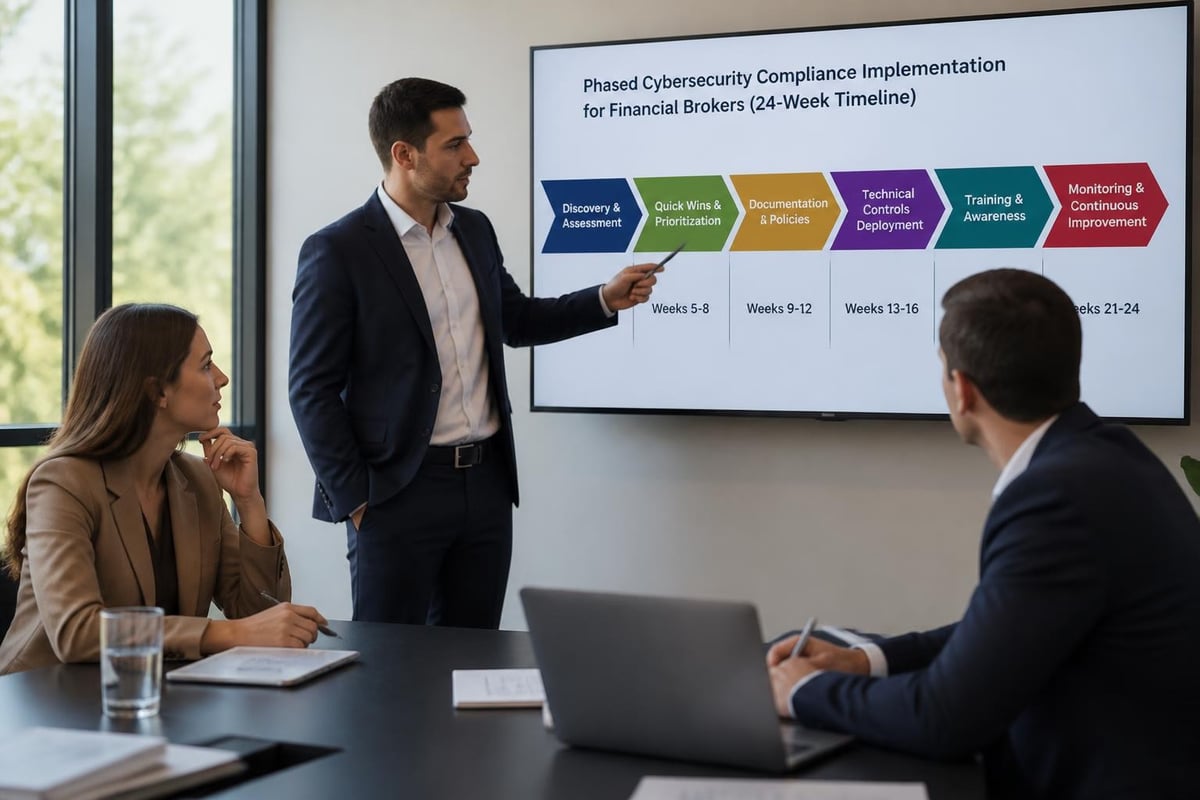
Phase 5: Training and Awareness (Weeks 17-20)
Technology and documentation provide no protection if staff don't understand and follow security procedures:
- Role-based security training: Customised sessions for advisors, administrative staff, and management addressing their specific responsibilities
- Phishing simulation exercises: Controlled tests of staff ability to recognise social engineering attacks
- Policy acknowledgment process: Documented confirmation that all staff have read and understood security policies
- Scenario-based exercises: Tabletop walkthroughs of incident response procedures to identify gaps before real incidents occur
The OWASP resources provide frameworks that compliance services adapt when developing training content around application security and secure development practices relevant to practices using custom or bespoke software.
Phase 6: Monitoring and Continuous Improvement (Week 21 Onward)
Compliance is ongoing, not a one-time project. Establish monitoring and review processes:
- Quarterly access rights reviews: Verify that permissions remain appropriate as roles change
- Monthly security update reviews: Ensure all systems receive security patches promptly
- Annual policy reviews: Update documentation to reflect regulatory changes and practice evolution
- Bi-annual risk reassessments: Re-evaluate threats and control effectiveness as practice and threat landscape change
- Incident metrics tracking: Monitor security events to identify trends requiring additional controls
Cybersecurity compliance services often provide ongoing monitoring packages that alert practices to emerging risks and regulatory changes requiring response.
Vendor Management and Third-Party Risk
Independent brokers rely on numerous service providers who access client information: practice management software vendors, CRM platforms, cloud storage providers, compliance consultancies, and product providers. Each creates cybersecurity compliance obligations.
Due Diligence Requirements
POPIA Section 19 requires operators (service providers) to establish adequate security measures. As the responsible party, you remain liable even when operators cause breaches. Effective vendor management includes:
- Pre-engagement security assessments: Reviewing vendor security certifications, policies, and track records before engagement
- Contractual security obligations: Written agreements specifying security standards, breach notification timeframes, and indemnification
- Ongoing monitoring: Periodic reviews of vendor security posture and incident history
- Exit procedures: Clear processes for data return or destruction when vendor relationships end
Professional compliance services provide vendor assessment templates and contract language that satisfy regulatory obligations whilst remaining commercially realistic for small practices.
Common Vendor Security Questions
When evaluating service providers, independent brokers should ask:
- Where is our client data stored geographically? (Transborder information flow implications under POPIA)
- What encryption standards protect data at rest and in transit? (Technical safeguards under POPIA Section 19)
- Who within your organisation can access our client information? (Access control and need-to-know principles)
- What is your incident response and notification procedure? (Breach notification timing under POPIA Section 22)
- What certifications or independent assessments demonstrate your security? (ISO 27001, SOC 2, etc.)
- How do you handle data disposal when contracts end? (Complete destruction obligations)
Vendors unable or unwilling to answer these questions satisfactorily pose unacceptable compliance risks regardless of their functionality or cost advantages.
Cloud Services and Data Sovereignty
Many practice management systems now operate as cloud services, raising questions about data location and sovereignty. POPIA Chapter 9 regulates transborder information flows, requiring adequate protection in recipient countries.
Cybersecurity compliance services help practices navigate cloud provider complexities:
- Data residency verification: Confirming whether data remains in South Africa or transfers abroad
- Adequacy assessments: Evaluating whether destination countries provide adequate protection under POPIA
- Contractual safeguards: Implementing standard contractual clauses when transfers occur to non-adequate jurisdictions
- Client notification: Informing clients when their information will be processed outside South Africa
The ISACA resources on governance frameworks provide useful context for understanding how cloud governance integrates with overall compliance programmes.
Building Cybersecurity Into Practice Culture
Sustainable compliance requires embedding security consciousness into daily practice operations rather than treating it as an external obligation. Cybersecurity compliance services facilitate this cultural integration through several mechanisms.
Security Champions Programme
Designating specific individuals as security champions creates internal expertise and accountability:
- Compliance officer or manager: Overall responsibility for security programme coordination
- IT point person: Technical implementation and troubleshooting, even if outsourced
- Training coordinator: Ensuring all staff receive and complete security training
- Incident coordinator: First responder when security events occur
In sole proprietor practices, one person fills all roles. Larger practices benefit from distributing responsibilities to create redundancy and specialisation.
Regular Communication and Reinforcement
Security awareness requires ongoing reinforcement, not annual training sessions:
- Monthly security tips: Brief reminders about specific threats (phishing, physical security, password hygiene)
- Incident learning reviews: When security events occur industry-wide, discuss implications for your practice
- Policy update communications: When procedures change, explain why and how it affects daily work
- Recognition programmes: Acknowledge staff who identify and report security concerns
These activities keep security top-of-mind without creating compliance fatigue through excessive formality.
Metrics and Accountability
What gets measured gets managed. Establish simple security metrics that demonstrate programme effectiveness:
| Metric | Target | Frequency | Purpose |
|---|---|---|---|
| Phishing simulation click rate | <10% | Quarterly | Training effectiveness |
| Systems without current patches | 0 | Monthly | Patch management discipline |
| Access rights review completion | 100% | Quarterly | Access control governance |
| Security incidents reported | Trend over time | Monthly | Detection and reporting culture |
| Staff training completion | 100% | Annually | Awareness programme coverage |
Cybersecurity compliance services help establish baseline metrics, set realistic targets, and provide benchmarking against similar practices.
Preparing for Regulatory Examinations and Audits
The FSCA, Information Regulator, and Financial Intelligence Centre all conduct supervisory activities that may examine cybersecurity controls. Proper preparation reduces examination burden and demonstrates compliance competence.
Documentation Readiness
Examiners typically request specific evidence. Maintain organised documentation including:
- Current policies and procedures with version control and approval dates
- Risk assessment reports showing methodology and findings
- Remediation tracking demonstrating how identified gaps were addressed
- Training records listing who completed what training and when
- Incident logs documenting security events, response actions, and lessons learned
- Vendor assessments showing due diligence on third-party service providers
- Access rights matrices current as of examination date
Professional compliance services often maintain this documentation in organised repositories that can be quickly produced during examinations, avoiding the scramble that creates poor impressions.
Common Examination Findings
Learning from industry-wide examination results helps practices avoid common deficiencies:
- Outdated policies: Documentation not updated to reflect current operations or regulatory changes
- Incomplete access reviews: No evidence of periodic verification that permissions remain appropriate
- Inadequate training: Generic cybersecurity awareness with no role-specific or regulatory content
- Vendor gaps: No documented security assessments of critical service providers
- Incident response deficiencies: Plans not tested or staff unfamiliar with procedures
Cybersecurity compliance services conduct pre-examination readiness reviews that identify and remediate these common issues before official supervisory activities commence.
Post-Examination Remediation
When examinations identify deficiencies, rapid and documented response demonstrates good faith compliance efforts:
- Acknowledge findings promptly: Avoid defensiveness; demonstrate understanding of identified issues
- Develop remediation plans: Specific actions, responsible parties, and completion dates for each finding
- Implement corrective measures: Execute the plan with evidence collection for verification
- Follow-up documentation: Provide examiners with evidence that deficiencies have been addressed
- Control enhancement: Implement additional measures to prevent recurrence
Professional services guide practices through remediation processes, ensuring responses satisfy examiner expectations whilst remaining operationally feasible.
Cost Considerations and Return on Investment
Independent brokers often perceive cybersecurity compliance services as expensive overhead. Understanding cost structures and quantifying risk reduction helps justify investment.
Service Pricing Models
Cybersecurity compliance services typically offer several engagement structures:
- Project-based: Fixed fee for specific deliverables (policy development, risk assessment, implementation)
- Retainer: Monthly fee for ongoing monitoring, support, and advisory services
- Hybrid: Initial project for programme establishment, then retainer for maintenance
- Per-incident: Hourly rates for breach response and remediation (expensive and unpredictable)
For independent brokers, hybrid models often provide the best value: concentrated effort for initial implementation, then lower ongoing costs for maintenance and monitoring.
Hidden Costs of Non-Compliance
The true cost comparison includes potential non-compliance consequences:
| Risk Event | Potential Cost | Probability Factor |
|---|---|---|
| POPIA administrative penalty | Up to R10 million | Moderate for material breach |
| FICA administrative penalty | Up to R100 million | Lower, but increasing enforcement |
| FSCA enforcement action | Debarment, fines, reputational damage | Variable by severity |
| Data breach client notification | R50-R200 per affected client | Increasing with threat landscape |
| Breach remediation and investigation | R50,000-R500,000+ | High if inadequate preparation |
| Reputational damage and client loss | Difficult to quantify | Potentially practice-ending |
Even modest cybersecurity compliance investment provides significant risk reduction relative to potential consequences. The question is not whether you can afford compliance services, but whether you can afford the consequences of inadequate security.
Efficiency Gains and Practice Benefits
Beyond risk reduction, proper cybersecurity compliance delivers operational benefits:
- Streamlined workflows: Documented procedures reduce confusion and errors
- Better client service: Secure communication channels enhance professional image
- Competitive advantage: Compliance certification differentiates your practice in RFP processes
- Reduced insurance costs: Some professional indemnity insurers offer discounts for demonstrated cybersecurity controls
- Staff productivity: Clear policies and adequate tools reduce security-related interruptions
These benefits accumulate over time, often offsetting compliance costs within 12-18 months for practices that implement programmes thoughtfully.
Navigating the intersection of POPIA, FICA, and FAIS whilst implementing practical cybersecurity controls requires specialised expertise that most independent financial brokers lack in-house. Professional cybersecurity compliance services provide the frameworks, technologies, and ongoing support necessary to protect client information whilst satisfying regulatory obligations. Whether you're an independent broker establishing your first compliance programme, a growing practice preparing for FSCA examination, or an existing FSP updating controls for evolving threats, Holistic Compliance Management Solutions (Pty) Ltd delivers tailored compliance services specifically designed for South African financial services providers.
For FSP practitioners and compliance officers seeking comprehensive cybersecurity compliance support:
Schedule a FICA and POPIA compliance consultation that includes:
- Complete cybersecurity risk assessment aligned to your RMCP requirements
- Gap analysis against POPIA, FICA, and FAIS technical control obligations
- Prioritised remediation roadmap with implementation timelines and cost estimates
- FICA RMCP review and cybersecurity control integration recommendations
Contact Holistic Compliance Management Solutions today to build cybersecurity compliance capabilities that protect your practice whilst meeting regulatory expectations across all applicable frameworks.