
SOC I Report: Compliance & Assurance for SA FSPs
Financial service providers in South Africa face increasing scrutiny from regulators, clients, and business partners regarding the adequacy of their internal controls. Whether you operate as an independent broker, a compliance officer at an FSP, or manage third-party service relationships, demonstrating robust control environments has become essential. A SOC I report offers a standardised, internationally recognised method for service organisations to provide independent assurance over controls that affect client financial reporting. For South African FSPs navigating FAIS, FICA, POPIA, and COFI obligations, understanding how SOC 1 assurance fits within your broader compliance framework can strengthen your risk management posture and enhance stakeholder confidence.
What Is a SOC I Report and Why It Matters for Financial Service Providers
A SOC I report, formally known as a Service Organization Control Type 1 or Type 2 report, is an independent auditor's examination of controls at a service organisation that are relevant to user entities' internal control over financial reporting. The AICPA official SOC reports framework distinguishes between Type 1 reports (examining control design at a point in time) and Type 2 reports (examining both design and operating effectiveness over a period, typically 6-12 months).
For FSPs in South Africa, a soc i report becomes relevant when you outsource critical functions such as:
- Policy administration and premium processing
- Claims management and settlement
- Investment administration and fund accounting
- Transaction processing for collective investment schemes
- Client record-keeping and data hosting
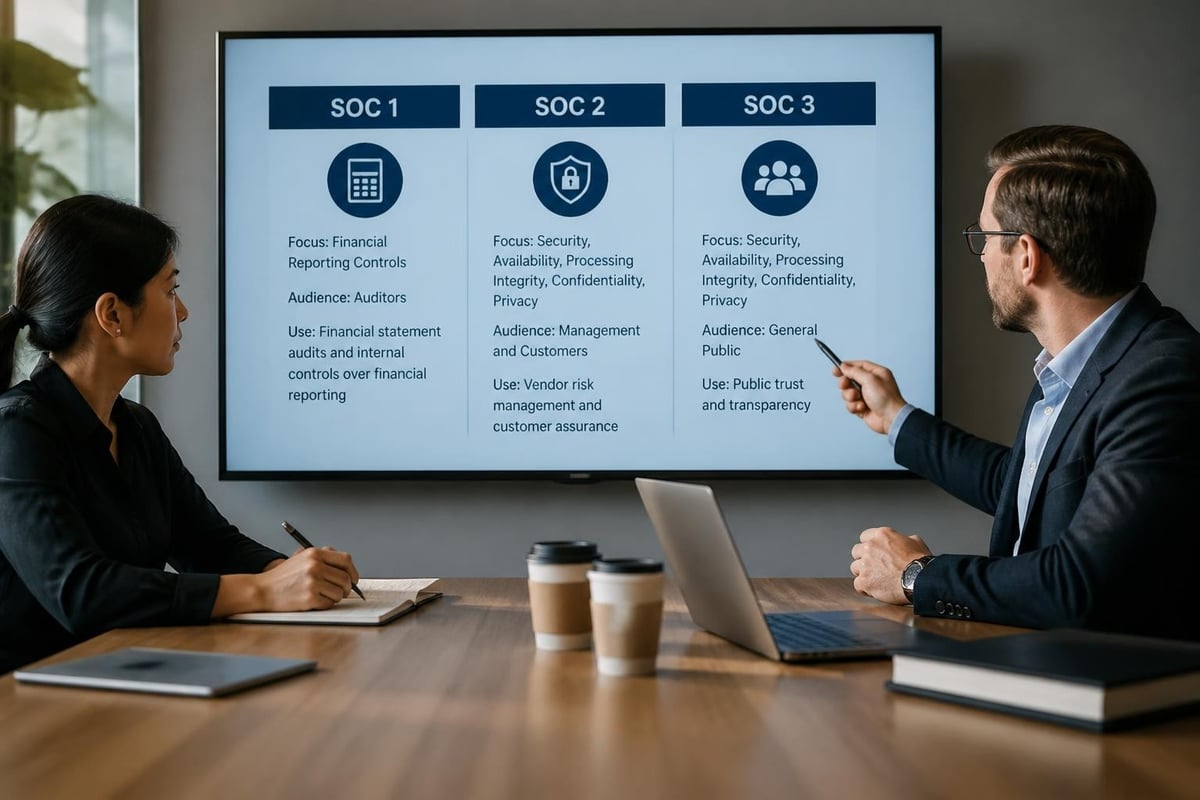
How SOC 1 Differs from SOC 2 and SOC 3
| Report Type | Primary Focus | Intended Users | Typical Use Case for SA FSPs |
|---|---|---|---|
| SOC 1 (Type 1 or 2) | Controls affecting client financial reporting | Auditors, financial controllers | Outsourced transaction processing, fund administration |
| SOC 2 (Type 1 or 2) | Security, availability, confidentiality, privacy | Management, regulators, partners | Cloud platforms, IT service providers, data hosting |
| SOC 3 | Security, availability (general-use summary) | General public, marketing | Public trust signals, vendor websites |
When an FSP relies on a third-party administrator to process client premiums or investment transactions, that administrator's controls directly impact the FSP's ability to produce accurate financial statements. A soc i report from the service provider gives the FSP's auditors confidence that those controls are designed and operating effectively.
The SOC I Engagement Process: From Planning to Report Delivery
Understanding how a soc i report is produced helps FSPs both as service organisations (if you provide outsourced services) and as user entities (if you consume them). AICPA guidance for service organisation management outlines management responsibilities throughout the engagement.
Step 1: Scoping and Planning
The service organisation and auditor define which systems, processes, and controls fall within scope. For an FSP offering outsourced compliance monitoring, scope might include:
- Client onboarding and FICA verification workflows
- Ongoing transaction monitoring systems
- Regulatory reporting data aggregation
- Access controls to client information systems
- Change management for compliance software updates
Management's written assertion describes the system and asserts that controls are suitably designed (Type 1) or designed and operating effectively (Type 2). This assertion forms the basis of the auditor's opinion.
Step 2: Documentation and Evidence Gathering
The service organisation must document control activities, policies, and procedures. Evidence typically includes:
- Policy manuals and standard operating procedures
- System-generated reports (access logs, exception reports)
- Evidence of management review and approval (sign-offs, audit trails)
- Training records and competency assessments
- Incident logs and resolution documentation
For soc i report engagements covering FICA compliance processes, documentation might demonstrate how the organisation verifies identity documents, screens against sanctions lists, and maintains customer due diligence records in accordance with FICA Risk Management and Compliance Programme requirements.
Step 3: Testing and Evaluation
In a Type 2 engagement, auditors perform tests of controls over the reporting period. Testing procedures vary by control type:
| Control Category | Example Test Procedures |
|---|---|
| User access provisioning | Select sample of new users; verify approval, role assignment, and timely provisioning |
| Data validation edits | Test boundary conditions; confirm system rejects invalid entries |
| Management review controls | Inspect evidence of review; re-perform analytical procedures |
| Reconciliation controls | Select sample reconciliations; verify mathematical accuracy and timely resolution of exceptions |
The auditor evaluates whether exceptions represent control deficiencies, significant deficiencies, or material weaknesses, and reports findings accordingly.
Step 4: Report Issuance and Distribution
The final soc i report includes:
- Independent auditor's opinion
- Management's assertion
- Description of the service organisation's system
- Description of controls
- Tests of controls and results (Type 2 only)
- Other information provided by the service organisation (such as complementary user-entity controls)
Distribution is restricted to user entities, their auditors, and regulators with legitimate needs. Unlike SOC 3 reports, SOC 1 reports contain sensitive operational details and should be protected under confidentiality agreements.
Using SOC I Reports as a User Entity: Practical Guidance for South African FSPs
When your FSP relies on third-party service providers-whether for policy administration, IT infrastructure, or compliance monitoring services-you inherit risks from their control environments. KPMG research on third-party risk management demonstrates that SOC reports form a cornerstone of effective vendor risk management programmes.
Integrating SOC 1 Reports into Your Risk Assessment
As a user entity, you must:
- Identify which service organisations affect your financial reporting. Map outsourced processes to financial statement line items and disclosures.
- Obtain and review current SOC 1 reports. Ensure reports cover the period relevant to your financial year-end.
- Evaluate control objectives and test results. Determine whether controls address your specific risks.
- Assess control exceptions and qualifications. Understand the nature, cause, and impact of any deficiencies reported.
- Implement complementary user-entity controls. Most SOC 1 reports specify controls you must perform (e.g., reviewing exception reports, reconciling service provider data).
Practical checklist for reviewing a service provider's soc i report:
- Verify the report type (Type 1 or Type 2) and coverage period align with your needs
- Confirm the auditor is appropriately qualified and independent
- Review management's description for completeness and accuracy
- Map control objectives to your financial reporting risks
- Identify any exceptions, modified opinions, or scope limitations
- Document complementary controls you will implement
- Assess whether subservice organisations (if any) have obtained their own SOC reports
- Plan periodic reassessment (annually or when services change materially)

FAIS, FICA, and POPIA Considerations in Third-Party Relationships
South African FSPs must ensure that outsourcing arrangements comply with:
- FAIS General Code of Conduct (GCC) requirements for outsourcing and oversight
- FICA obligations for customer due diligence, record-keeping, and reporting (even when delegated to third parties)
- POPIA requirements for operator agreements, security safeguards, and cross-border data transfers
While a soc i report focuses on financial reporting controls, FSPs should evaluate whether the service organisation's control environment also addresses regulatory compliance. For instance:
- Does the provider maintain audit trails sufficient for FAIS compliance?
- Are FICA verification records retained for the prescribed five-year period?
- Do access controls and encryption standards meet POPIA's "reasonable measures" test?
If regulatory controls fall outside SOC 1 scope, request a SOC 2 report or independent compliance attestation. PwC’s SOC reporting primer explains how different SOC reports serve different stakeholder needs.
Preparing to Obtain a SOC I Report: Guidance for Service Organisations
FSPs that provide outsourced services-such as policy administration, claims processing, or compliance support-may need to obtain a soc i report to satisfy client and auditor requirements. Preparation typically spans 6-12 months for a first-time engagement.
Building a Control Framework
Start by identifying processes and systems that affect user entities' financial reporting. Common control domains include:
| Control Domain | Key Control Activities | Relevance to Financial Reporting |
|---|---|---|
| Transaction processing | Data input validation, processing accuracy, completeness checks | Ensures transactions are recorded accurately and completely |
| Reconciliation and interface controls | System-to-system reconciliations, suspense account monitoring | Detects and corrects errors between systems |
| Access security | Logical access provisioning, privileged user monitoring, segregation of duties | Prevents unauthorised changes to financial data |
| Change management | Change approval, testing, version control, rollback procedures | Protects system integrity and data accuracy |
| Data backup and recovery | Backup scheduling, restore testing, disaster recovery | Ensures continuity and recoverability of financial records |
Map these controls to the trust services criteria where applicable (particularly processing integrity and confidentiality for financial data).
Designing and Documenting Controls
Each control should have:
- A clear objective (what risk it mitigates)
- A defined frequency (daily, monthly, quarterly)
- Responsible parties (who performs and who reviews)
- Evidence of performance (system logs, sign-offs, reports)
For example, a control objective might state: "To ensure that all client premium receipts are accurately recorded in the policy administration system within one business day of receipt." The corresponding control activity could be: "The finance officer reconciles bank deposits to the policy system daily and investigates variances exceeding R500 within 24 hours, with reconciliations reviewed and approved by the finance manager."
Operating Controls Consistently
For a Type 2 soc i report, controls must operate throughout the reporting period. Inconsistent execution results in exceptions that auditors must report. Best practices include:
- Automated controls where possible. System-enforced validations and workflows reduce reliance on manual procedures.
- Monitoring and supervision. Management should review control performance metrics regularly.
- Training and awareness. Ensure all personnel understand their control responsibilities.
- Incident response. Document and remediate control failures promptly.
FSPs subject to COFI (Conduct of Financial Institutions) requirements will find natural alignment between SOC 1 control design principles and COFI's emphasis on fair customer outcomes, operational resilience, and governance.
International Standards: ISAE 3402 and Cross-Border Assurance
While SOC 1 is the North American standard, ISAE 3402 is the International Auditing and Assurance Standards Board's equivalent for assurance over service organisation controls. Many multinational service providers issue dual-badged reports (both SOC 1 and ISAE 3402) to satisfy stakeholders in multiple jurisdictions.
For South African FSPs operating across borders or serving international clients, ISAE 3402 compliance may be requested. The substance is nearly identical to SOC 1-both examine controls over financial reporting-but ISAE 3402 is recognised globally and required in European, Asian, and other markets.
Practical Differences and Considerations
- Audit standards: ISAE 3402 follows International Standards on Auditing (ISA) methodology; SOC 1 follows U.S. SSAE standards.
- Terminology: ISAE 3402 refers to "service organisations" and "user entities"; SOC 1 uses similar language but within an American GAAP context.
- Report format: Structure and content are aligned, though minor presentation differences exist.
An FSP selecting an auditor for a soc i report should confirm the firm's qualifications, including membership of IRBA (Independent Regulatory Board for Auditors) and experience with financial services clients. Request examples of prior SOC engagements and references from similar organisations.

Emerging Trends: Cybersecurity, AI, and Enhanced Assurance
The control landscape continues to evolve. ISACA’s guidance on NIST Cybersecurity Framework 2.0 and AI highlights emerging assurance considerations. While traditional soc i report engagements focus on financial reporting controls, FSPs increasingly face expectations around:
Cybersecurity and Data Protection
Clients and regulators expect robust cybersecurity controls, particularly for organisations processing sensitive financial and personal information under POPIA. The Cloud Security Alliance explores when penetration testing should supplement SOC assurance. For FSPs, consider whether your service providers:
- Conduct regular vulnerability assessments and penetration testing
- Maintain cybersecurity incident response plans
- Encrypt data in transit and at rest
- Monitor for anomalous access patterns and data exfiltration
While these controls may appear in a SOC 2 report's security category, their failure can indirectly affect financial reporting (through fraud, data corruption, or operational disruption).
Artificial Intelligence and Automated Decision-Making
FSPs increasingly deploy AI for underwriting, fraud detection, and customer service. When AI systems materially affect financial reporting-for instance, automated claims adjudication-auditors must understand and test controls over:
- Model training data quality and bias mitigation
- Model validation and back-testing procedures
- Override and exception handling
- Monitoring of model performance and drift
As AI matures, expect SOC 1 scopes to expand to address algorithmic transparency, explainability, and governance.
Supply Chain and Fourth-Party Risk
Service organisations often rely on subservice organisations (e.g., a cloud infrastructure provider hosting the policy administration platform). PwC’s SOC for Supply Chain offering addresses controls across the supply chain. As a user entity, you should:
- Identify all subservice organisations in the service delivery chain
- Obtain SOC reports from critical fourth parties
- Assess whether the primary service organisation monitors subservice organisation controls
- Understand the "carve-out" or "inclusive" method used in the soc i report (carve-out means subservice organisation controls are excluded and you must obtain separate assurance; inclusive means they are covered in the primary report)
Building a Culture of Control: Governance and Continuous Improvement
Obtaining or reviewing a soc i report should not be a compliance exercise in isolation. Leading FSPs embed control consciousness into daily operations, governance, and strategic planning.
Governance Structure
Establish clear accountability for control design, implementation, and monitoring:
- Board or executive committee provides oversight, approves risk appetite, and reviews control deficiencies.
- Compliance officer or risk manager coordinates control documentation, evidence collection, and remediation.
- Process owners execute controls, provide evidence, and escalate issues.
- Internal audit performs independent testing and reports to the board.
- External auditor conducts SOC engagement and issues opinion.
Regular reporting on control performance-dashboards showing exception rates, remediation status, and emerging risks-keeps governance bodies informed and engaged.
Continuous Monitoring and Improvement
Rather than waiting for the annual audit cycle, implement continuous control monitoring:
- Automated control testing using data analytics tools to detect anomalies or policy violations in real time
- Key control indicators (KCIs) that signal deteriorating control effectiveness before failures occur
- Root cause analysis for control failures, focusing on systemic issues rather than individual errors
- Lessons learned from audit findings, peer benchmarks (such as KPMG’s controls assurance benchmarking), and industry trends
This proactive approach reduces audit surprises, strengthens stakeholder confidence, and aligns control maturity with business growth.
Practical Implementation Checklist for South African FSPs
Whether you are preparing to obtain a soc i report or evaluating a service provider's report, use this checklist to guide your efforts:
For service organisations seeking a SOC 1 report:
- Identify all user entities and understand their financial reporting needs
- Map processes and systems that affect user entity financial statements
- Document control objectives, activities, and evidence requirements
- Assign control ownership and train responsible personnel
- Operate controls consistently for at least six months (Type 2)
- Engage a qualified auditor with financial services experience
- Prepare management's assertion and system description
- Coordinate evidence collection and testing schedules
- Remediate identified deficiencies before report issuance
- Distribute reports securely and maintain confidentiality
For user entities consuming SOC 1 reports:
- Inventory all service providers that handle financial data
- Request current SOC 1 reports (Type 2 preferred)
- Review report scope, period, and auditor qualifications
- Map control objectives to your financial statement assertions
- Identify and implement complementary user-entity controls
- Document exceptions and assess impact on financial reporting
- Communicate findings to your external auditors
- Monitor service provider performance throughout the year
- Re-evaluate reports annually or when services change
- Maintain a central repository of all third-party assurance reports
Aligning SOC I Assurance with South African Regulatory Obligations
While a soc i report is not a direct regulatory requirement under FAIS, FICA, POPIA, or COFI, it supports compliance by demonstrating control maturity and third-party validation. Consider these practical alignments:
FAIS and the General Code of Conduct
The FAIS General Code of Conduct requires FSPs to maintain adequate systems, controls, and risk management. When outsourcing key functions:
- Section 3A of the GCC mandates written outsourcing agreements that specify performance standards and oversight mechanisms.
- FSPs remain accountable for outsourced functions and must monitor third-party performance.
- A soc i report from your service provider demonstrates that appropriate controls exist and are independently verified.
For FSPs offering outsourced services to other licensees, providing a SOC 1 report can be a differentiator, reducing client audit costs and accelerating onboarding. Compliance monitoring services that help FSPs maintain regulatory standards benefit from SOC-level assurance as proof of quality and reliability.
FICA and Record-Keeping Obligations
FICA requires FSPs to establish and verify client identities, maintain records for five years, and report suspicious transactions. When these functions are outsourced:
- The FSP must ensure the service provider's FICA Risk Management and Compliance Programme (RMCP) is adequate.
- Record retention, access controls, and audit trails must comply with FICA Regulations.
- A soc i report covering transaction processing and record-keeping provides assurance that controls exist, though FSPs should verify regulatory-specific requirements separately.
Holistic Compliance Management Solutions (Pty) Ltd assists FSPs with FICA compliance, including RMCP drafting and training, ensuring that internal and outsourced controls meet regulatory standards.
POPIA and Operator Agreements
When an FSP engages a service provider to process personal information (as an "operator" under POPIA), section 21 requires a written agreement mandating appropriate security measures. A soc i report can supplement POPIA compliance by:
- Demonstrating access controls, encryption, and logical security (relevant to POPIA's security safeguards)
- Providing evidence of data backup, disaster recovery, and business continuity (supporting data integrity and availability)
- Showing audit trails and monitoring capabilities (enabling breach detection and investigation)
However, a SOC 1 report alone may not cover all POPIA obligations (such as data subject rights, consent management, or cross-border transfer safeguards). FSPs should request SOC 2 reports or independent POPIA compliance attestations where needed.
COFI and Customer Outcomes
The forthcoming Conduct of Financial Institutions Bill emphasises fair customer outcomes, product governance, and operational resilience. Controls that ensure accurate transaction processing, timely claims settlement, and transparent reporting directly support COFI objectives. A soc i report validates these controls, providing evidence of robust operational governance that can be referenced in compliance submissions and supervisory engagements.
Cost, Timing, and Resource Considerations
Obtaining a soc i report requires investment in auditor fees, internal resources, and control remediation. Typical costs and timelines for South African FSPs include:
| Engagement Aspect | Type 1 Report | Type 2 Report |
|---|---|---|
| Auditor fees | R150,000 – R300,000 | R250,000 – R500,000+ |
| Internal effort (person-days) | 30 – 60 days | 60 – 120 days |
| Timeline (planning to issuance) | 3 – 6 months | 9 – 12 months (including observation period) |
| Frequency | One-time or annual | Annual (most common) |
Cost drivers include:
- Complexity and number of systems in scope
- Maturity of existing control documentation
- Number of control objectives and test samples
- Service organisation size and geographic distribution
- Prior audit findings and remediation needs
Resource requirements:
- Senior management sponsorship and assertion sign-off
- Dedicated project manager or compliance officer
- Process owners to document controls and provide evidence
- IT personnel for system access, logs, and technical documentation
- External auditor coordination and liaison
For smaller FSPs or those new to SOC assurance, consider starting with a readiness assessment or gap analysis to estimate preparation time and cost before committing to a full engagement.
Common Pitfalls and How to Avoid Them
Based on practitioner experience, FSPs encounter several recurring challenges in SOC 1 engagements:
Pitfall 1: Scoping too broadly or narrowly
- Issue: Including irrelevant systems inflates cost; excluding critical controls undermines report value.
- Solution: Conduct a thorough risk assessment with your auditor. Map user entity financial reporting needs to your processes and include only controls that affect those needs.
Pitfall 2: Inadequate control documentation
- Issue: Undocumented or poorly documented controls cannot be tested effectively.
- Solution: Invest in clear, detailed documentation before the engagement. Use templates, process flows, and control matrices to standardise descriptions.
Pitfall 3: Inconsistent control execution
- Issue: Controls performed sporadically or with variations result in exceptions and qualified opinions.
- Solution: Implement control monitoring and supervisory review. Train personnel on the importance of consistency and evidence retention.
Pitfall 4: Ignoring subservice organisations
- Issue: Critical controls outsourced to fourth parties without separate SOC reports create coverage gaps.
- Solution: Identify all subservice organisations early. Obtain their SOC reports or use a "carve-out" method with clear user-entity control responsibilities.
Pitfall 5: Delayed remediation of deficiencies
- Issue: Control deficiencies identified during testing but not remediated before report issuance remain as qualifications.
- Solution: Perform internal control testing several months before the audit. Remediate issues proactively and provide evidence of corrective action.
A soc i report provides independent validation of the control environment underpinning financial reporting accuracy and reliability. For South African FSPs-whether acting as service organisations or user entities-SOC 1 assurance strengthens third-party risk management, regulatory compliance, and stakeholder confidence. By integrating SOC assurance into your broader FAIS, FICA, POPIA, and COFI compliance framework, you build a resilient, transparent control culture that supports sustainable business growth. Holistic Compliance Management Solutions (Pty) Ltd helps FSPs navigate complex regulatory requirements and implement robust risk management practices. Whether you need support with FICA RMCP drafting, compliance monitoring, or regulatory training, our team provides practical, cost-effective solutions tailored to independent brokers and financial service providers. Contact Holistic Compliance Management Solutions (Pty) Ltd today to schedule FICA training and ensure your compliance controls meet the highest standards.