
SOC 1 Compliance Guide for South African FSPs 2026
Service Organization Control (SOC) 1 reporting has become increasingly relevant for South African financial services providers as reliance on third-party service organisations grows. For independent financial brokers, FSPs, and compliance officers navigating FAIS, POPIA, and FICA obligations, understanding SOC 1 compliance is essential when outsourcing critical functions like policy administration, claims processing, or client data management. This framework provides assurance over controls at service organisations that affect user entities' internal control over financial reporting (ICFR), creating a vital bridge between vendor risk management and regulatory compliance in the financial services sector.
Understanding SOC 1 Compliance in the South African Context
SOC 1 compliance refers to adherence to standards for reporting on controls at service organisations relevant to user entities' financial reporting. Developed by the American Institute of Certified Public Accountants (AICPA), the SOC 1 framework provides an internationally recognised methodology for evaluating and reporting on internal controls.
For South African FSPs, SOC 1 compliance intersects with local regulatory requirements:
- FAIS (Financial Advisory and Intermediary Services) Act demands robust operational controls
- POPIA (Protection of Personal Information Act) requires documented third-party data processing agreements
- FICA (Financial Intelligence Centre Act) mandates oversight of outsourced compliance functions
- COFI (Conduct of Financial Institutions) Bill emphasises accountability for customer outcomes, including those delivered through third parties
Why SOC 1 Matters for Financial Services Providers
When your brokerage outsources policy administration to a third-party system provider or uses cloud-based CRM platforms, you remain accountable for the controls those vendors maintain. The Financial Sector Conduct Authority (FSCA) expects FSPs to demonstrate due diligence over service providers, particularly those handling client funds, processing transactions, or maintaining compliance records.
A SOC 1 report provides independent assurance that your service organisation has designed and implemented effective controls. This becomes particularly critical during:
- FSCA on-site inspections and compliance reviews
- Annual financial statement audits
- Risk and Compliance Management Programme (RMCP) updates
- Board reporting on operational and third-party risks
- New FSP licence applications requiring demonstrated control environments
Types of SOC 1 Reports and Their Applications
Understanding the distinction between SOC 1 report types helps FSPs select appropriate vendors and assess the evidence provided.
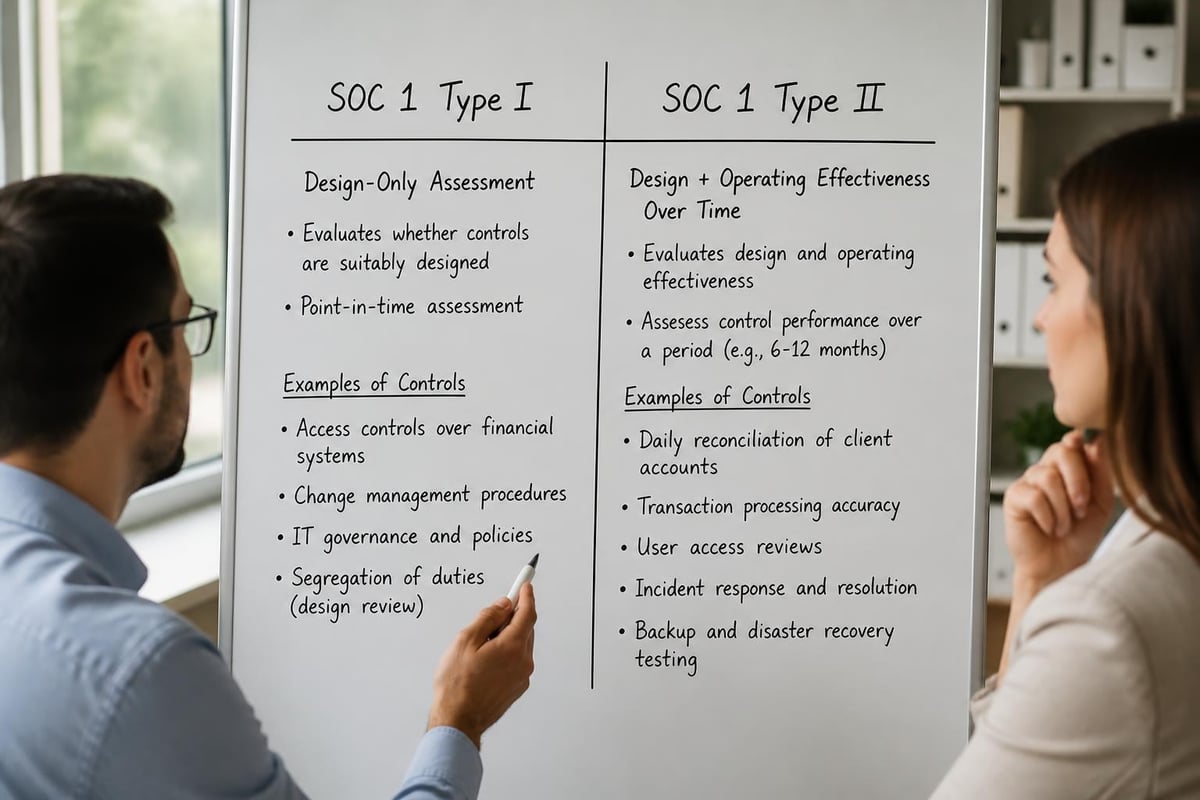
SOC 1 Type I Reports
Type I reports evaluate the design of controls at a specific point in time. An independent auditor examines whether controls are suitably designed to achieve specified control objectives but does not test whether they operated effectively over a period.
Use cases for Type I reports:
- Initial vendor assessments during procurement
- New service relationships where operations haven't commenced
- Quick snapshots for board or risk committee review
- Preliminary due diligence before contract finalisation
Limitations to consider:
Type I reports provide limited assurance since they don't confirm ongoing operational effectiveness. For ongoing vendor relationships or critical outsourced functions, Type II reports offer substantially more value.
SOC 1 Type II Reports
Type II reports examine both design and operating effectiveness over a defined period (typically 6-12 months). Auditors perform tests of controls throughout the review period, providing evidence that controls operated consistently and effectively.
Critical for South African FSPs because:
- Demonstrates sustained control performance aligned with FAIS "fit and proper" standards
- Provides audit evidence your financial statement auditors can rely upon
- Satisfies FSCA expectations for ongoing third-party monitoring
- Supports POPIA accountability requirements for processors handling personal information
- Strengthens your RMCP documentation with independent validation
SOC 1 Control Objectives Relevant to FSPs
The AICPA’s framework allows service organisations to define control objectives based on the services provided. For FSPs evaluating service providers, key control objectives typically include:
| Control Category | Examples for Financial Services | FAIS/POPIA Connection |
|---|---|---|
| Transaction Processing | Accurate premium calculations, timely claims processing, correct commission allocations | FAIS General Code conduct standards, client interest protection |
| Data Security | Access controls, encryption, backup procedures, disaster recovery | POPIA security safeguards (Chapter 8), FICA record retention |
| Logical Access | User authentication, privileged access management, activity logging | POPIA operator accountability, audit trail requirements |
| Change Management | System update protocols, testing procedures, rollback capabilities | Operational risk management, business continuity |
| Financial Reporting | Reconciliation controls, period-end closing, account accuracy | Supporting FSP financial statement preparation |
Mapping SOC 1 Controls to Your RMCP
Your Risk and Compliance Management Programme must address third-party risks. When reviewing a service organisation's SOC 1 report, map their control objectives to your RMCP risk categories:
Operational Risk: Controls over transaction processing, system availability, business continuity planning, and change management directly mitigate operational failures that could harm clients or disrupt your business.
Compliance Risk: Access controls, data retention, and audit trail controls support your POPIA, FICA, and FAIS obligations when functions are outsourced.
Financial Risk: Reconciliation controls, segregation of duties, and financial reporting controls protect against errors or misstatements affecting your financial position.
Evaluating SOC 1 Reports: Practical Steps for Brokers
Receiving a vendor's SOC 1 report is only the first step. Effective evaluation requires systematic review and integration into your compliance monitoring processes. Deloitte’s guidance on reviewing third-party SOC reports provides a structured approach that compliance officers can adapt.
Initial Report Review Checklist
Before diving into detailed controls, verify:
- Report period covers your current service period
- Service auditor is registered and recognised
- Scope of services matches what you're actually using
- Report type (I or II) meets your assurance needs
- Opinion is unqualified (no significant exceptions)
- Management's assertion is included and reasonable
Detailed Control Assessment
Once you've validated the report's fundamentals, systematically evaluate each control:
- Read the service organisation's description of its system and control environment thoroughly
- Identify control objectives relevant to your specific use of their services
- Review control activities mapped to each objective
- Examine test results (Type II only) for exceptions, deviations, or qualifications
- Assess complementary user entity controls you must maintain
- Document gaps between report scope and your actual service usage

Understanding Complementary User Entity Controls (CUECs)
No SOC 1 report provides complete assurance in isolation. Service organisations rely on user entities (your FSP) to implement specific controls that work alongside the service organisation's controls.
Common CUECs in financial services outsourcing:
- User access management: You must properly authorise which staff can access the service platform
- Data input validation: You remain responsible for accuracy of data submitted to the service organisation
- Output review: You must review reports, statements, and outputs for reasonableness
- Reconciliation: You need to reconcile service organisation data with your own records
- Contract management: You must monitor service levels, incidents, and contractual compliance
For FAIS compliance, CUECs are particularly important. The FSCA holds FSPs accountable for outsourced functions, meaning you cannot delegate responsibility even when delegating tasks. Document each CUEC in your RMCP and assign clear ownership.
Integrating SOC 1 Compliance into FAIS Monitoring
The General Code of Conduct for FSPs requires ongoing monitoring of operational arrangements, including outsourcing relationships. SOC 1 reports should form part of your documented third-party oversight programme.
Annual Compliance Monitoring Cycle
Q1 (January-March):
- Request updated SOC 1 reports from all critical service providers
- Review report periods to ensure current coverage
- Identify any service organisations without current SOC 1 reports
Q2 (April-June):
- Conduct detailed SOC 1 report evaluations using the checklist above
- Update third-party risk register with findings
- Escalate any qualified opinions or significant exceptions to Risk Committee
- Document CUEC performance and any control gaps
Q3 (July-September):
- Test complementary user entity controls through sampling
- Review incident logs and service delivery metrics
- Update RMCP documentation with SOC 1 evidence
- Prepare third-party assurance summary for board reporting
Q4 (October-December):
- Conduct annual vendor review meetings
- Discuss SOC 1 findings and remediation plans
- Negotiate next year's service agreements
- Plan compliance monitoring schedule for following year
For brokers seeking guidance on building comprehensive compliance monitoring frameworks, compliance monitoring services can help integrate SOC 1 reviews into your broader oversight programme.
SOC 1 and POPIA: Data Processor Accountability
POPIA Section 21 requires responsible parties to enter written agreements with operators (processors) processing personal information on their behalf. When outsourcing to service organisations, SOC 1 reports complement but don't replace POPIA-specific due diligence.
What SOC 1 Covers for POPIA Compliance
Security safeguards: SOC 1 reports typically include controls over logical access, physical security, encryption, and disaster recovery that align with POPIA's security requirements (Sections 19 and 69).
Audit trails: Change management and activity logging controls documented in SOC 1 reports support POPIA's accountability principle.
Business continuity: Availability controls help demonstrate compliance with POPIA's requirement to maintain appropriate safeguards.
What SOC 1 Doesn't Cover
SOC 1 focuses on controls affecting financial reporting. It may not address:
- Data subject access request procedures
- Cross-border transfer safeguards
- Data retention and destruction protocols specific to POPIA schedules
- Consent management and lawful processing bases
- Direct marketing opt-out mechanisms
Action item: Supplement SOC 1 reviews with POPIA-specific assessments. Request evidence of:
- Information Officer appointment
- POPIA compliance policies and procedures
- Data breach notification protocols
- Sub-processor management (if applicable)
- Processing Records (Section 51 obligations)
SOC 1 Considerations for FICA Compliance Functions
When outsourcing customer due diligence (CDD), ongoing monitoring, or FICA record-keeping to third parties, SOC 1 reports provide valuable but insufficient assurance.
FICA-Specific Control Objectives
Beyond financial reporting controls, evaluate service organisations on:
| FICA Requirement | Relevant Controls | Evidence Beyond SOC 1 |
|---|---|---|
| CDD procedures | Data collection workflows, verification processes, risk assessment methodologies | FICA compliance manual, training records, sample file reviews |
| Record retention | Document management systems, retention schedules, secure storage | Retention policy aligned with FICA Schedules, disposal certificates |
| Ongoing monitoring | Transaction monitoring rules, alert generation, escalation procedures | Alert tuning documentation, false positive rates, investigation records |
| Suspicious activity reporting | STR identification criteria, FIC reporting workflows, audit trails | STR policies, reporting statistics, FIC acknowledgements |
| Sanctions screening | Screening frequency, list sources, hit resolution procedures | Screening reports, vendor list update confirmations, match disposition records |
Practical Example: Outsourced CDD Platform
Suppose your brokerage uses a third-party platform for customer onboarding and FICA verification. The vendor provides a SOC 1 Type II report covering:
- Controls over data input and storage
- User access management
- System availability and backup
- Financial reconciliation for verification fees
What the SOC 1 confirms: The platform accurately captures and secures customer data, maintains proper access controls, and correctly processes verification transactions.
What you still need to verify separately:
- Verification procedures meet FIC Act requirements
- Risk categorisation methodology aligns with your RMCP
- FICA training provided to platform operators is current
- Record retention settings match regulatory schedules
- Customer consent and data processing notices are POPIA-compliant

Guidance for Service Organisations: Obtaining SOC 1 Reports
If your FSP provides outsourcing services to other brokers or licensees (for example, operating a broker support platform or providing back-office administration), you may need to obtain your own SOC 1 report.
Determining if You Need a SOC 1 Report
Consider obtaining a SOC 1 report if:
- You process transactions affecting client entities' financial statements
- Multiple FSPs rely on your services for compliance-critical functions
- Clients' auditors regularly request control documentation
- You want to differentiate your services through independent assurance
- You're expanding into enterprise or institutional markets
Scoping Your SOC 1 Engagement
Work with a registered auditing firm experienced in SOC 1 engagements to:
- Define boundaries: Which systems, processes, and locations will be included
- Identify control objectives: What financial reporting risks do your services address
- Document controls: Prepare detailed control narratives, flowcharts, and evidence
- Select report type: Type I for initial market entry, Type II for established services
- Determine reporting period: Align with client renewal cycles and audit seasons
EY’s guide on working with service organisations offers additional perspectives on scoping considerations.
Costs and Timeline Expectations
Initial SOC 1 Type I engagement (South African context):
- Preparation phase: 2-3 months to document controls and prepare evidence
- Audit fieldwork: 2-4 weeks
- Report delivery: 4-6 weeks post-fieldwork
- Cost range: R150,000-R400,000 depending on scope and complexity
Ongoing SOC 1 Type II engagement:
- Preparation: Continuous throughout reporting period
- Interim testing: Quarterly or semi-annually
- Final fieldwork: 3-4 weeks
- Report delivery: 6-8 weeks post-period-end
- Cost range: R250,000-R600,000 annually
Budget for additional costs if significant control deficiencies are identified requiring remediation before the auditor can issue an unqualified opinion.
How Auditors Use SOC 1 Reports in Financial Statement Audits
Understanding how your external auditors rely on SOC 1 reports helps you provide appropriate evidence and avoid audit delays.
PCAOB Standards and South African Equivalents
The PCAOB’s AS 2601 provides guidance for auditors considering service organisations. South African auditing standards (based on International Standards on Auditing) contain similar requirements, obligating auditors to:
- Understand services provided by service organisations
- Evaluate the service organisation's controls relevant to the audit
- Determine whether sufficient appropriate evidence is available
- Design and perform appropriate audit procedures
What Your Auditor Expects From You
When you use service organisations, your auditor will request:
- List of service organisations used during the financial year
- SOC 1 reports covering the entire audit period
- Documentation of your evaluation of SOC 1 reports
- Evidence of CUECs you've implemented and tested
- Service agreements and SLA performance reports
- Incident reports or exceptions noted during the year
Common audit issues to avoid:
- Providing expired SOC 1 reports with gaps in coverage
- Failing to implement documented CUECs
- Unable to demonstrate CUEC testing or monitoring
- No documentation linking SOC 1 findings to your risk assessment
- Missing service organisations from your inventory
Audit Bridge Letters and Gap Periods
If there's a gap between SOC 1 report periods and your financial year-end, your auditor may request:
- A bridge letter from the service organisation confirming no significant changes to controls
- Additional testing of CUECs during gap periods
- Management representation regarding service organisation performance
Plan ahead by requesting SOC 1 reports with periods aligned to your financial year-end where possible.
Emerging Considerations: COFI and Enhanced Accountability
The Conduct of Financial Institutions Bill (expected to be enacted in 2026-2027) will significantly expand conduct obligations for FSPs, including heightened accountability for customer outcomes delivered through third parties.
COFI's Impact on Third-Party Oversight
COFI introduces a customer outcomes-focused regulatory approach. Key provisions affecting SOC 1 compliance strategies:
Enhanced accountability: FSPs remain fully accountable for fair customer outcomes even when functions are outsourced, requiring more rigorous oversight of service organisations.
Product lifecycle management: Controls over policy administration, claims processing, and customer communications must demonstrably protect customers throughout the product lifecycle.
Value-for-money assessments: Outsourcing arrangements must deliver value to customers, requiring cost-benefit analysis of service provider fees and performance.
Vulnerable customer protections: Service organisations handling customer interactions must have appropriate controls to identify and support vulnerable customers.
Adapting SOC 1 Evaluations for COFI Readiness
Action steps for compliance officers:
- Review SOC 1 control objectives through a customer outcomes lens
- Supplement financial reporting controls with customer treatment controls
- Document how service organisation controls support fair outcomes
- Include COFI considerations in vendor selection criteria
- Enhance monitoring of customer complaints related to outsourced functions
Building a Comprehensive Third-Party Assurance Programme
SOC 1 reports are one component of effective third-party risk management. Best practice programmes integrate multiple assurance sources.
Multi-Layered Assurance Framework
Tier 1 – Contractual foundations:
- Service Level Agreements with clear performance metrics
- POPIA processing agreements (Section 21 requirements)
- Termination rights and data retrieval provisions
- Liability and indemnification clauses
Tier 2 – Independent assurance:
- SOC 1 reports for financial reporting controls
- SOC 2 reports (if available) for security, availability, and confidentiality
- ISO 27001 certification for information security management
- Industry-specific certifications (e.g., PCI-DSS for payment processing)
Tier 3 – Ongoing monitoring:
- Quarterly service review meetings
- SLA performance dashboards
- Incident and change notifications
- Annual on-site assessments or questionnaire reviews
Tier 4 – Testing and validation:
- CUEC testing schedules
- Periodic penetration testing or security assessments
- Business continuity testing participation
- Data accuracy validation through reconciliation
Documentation for FSCA Inspections
Maintain a third-party assurance file for each critical vendor containing:
- Current SOC 1 report and prior year for comparison
- Your documented evaluation and risk assessment
- Board or committee approval of outsourcing arrangement
- Service agreement and amendments
- POPIA processing agreement
- SLA performance reports for the past 12 months
- Incident log and resolution evidence
- CUEC testing results
- Correspondence regarding control deficiencies or improvements
Recent guidance in the CPA Journal on improving SOC 1 report use emphasises the importance of governance and documentation around third-party assurance.
Common Pitfalls and How to Avoid Them
Pitfall 1: Treating SOC 1 as a Tick-Box Exercise
Risk: Filing the report without proper evaluation fails to identify control gaps or complementary controls you need to implement.
Solution: Assign a qualified compliance officer to thoroughly review each report, document findings, and present to risk committee.
Pitfall 2: Ignoring Complementary User Entity Controls
Risk: Assuming the service organisation's controls are sufficient when they actually depend on your controls creates unmitigated risks.
Solution: Create a CUEC register mapping each control to responsible staff, implementation procedures, and testing schedules.
Pitfall 3: Accepting Qualified Opinions Without Investigation
Risk: A modified opinion or control exceptions may indicate significant risks to your operations or financial reporting.
Solution: Escalate qualified opinions immediately, request remediation plans from vendors, and consider alternative providers if risks are unacceptable.
Pitfall 4: Mismatched Report Periods
Risk: SOC 1 reports covering different periods than your financial year create evidence gaps your auditors cannot bridge.
Solution: Negotiate with service providers for report periods aligned to your year-end, or budget for bridge procedures.
Pitfall 5: Overlooking Scope Limitations
Risk: The SOC 1 report may cover only part of the vendor's services, excluding functions critical to your operations.
Solution: Compare report scope to your actual service usage and request supplemental evidence for out-of-scope functions.
Implementation Roadmap for Independent Brokers
Phase 1: Inventory and Classification (Month 1)
Activities:
- List all third-party service providers currently used
- Classify by criticality (high, medium, low) based on FAIS, POPIA, and FICA impact
- Identify which providers should have SOC 1 reports
- Request current SOC 1 reports from critical vendors
Deliverables:
- Third-party service inventory
- Risk classification matrix
- SOC 1 report request log
Phase 2: Policy and Procedure Development (Months 2-3)
Activities:
- Draft third-party risk management policy
- Develop SOC 1 evaluation procedures and checklists
- Define CUEC requirements for each service type
- Establish governance (who reviews, approves, and monitors)
- Update RMCP to incorporate SOC 1 review requirements
Deliverables:
- Third-party oversight policy approved by board
- SOC 1 evaluation toolkit
- CUEC register template
- Updated RMCP sections
Phase 3: Initial Evaluations (Months 4-6)
Activities:
- Conduct detailed SOC 1 report evaluations for all critical vendors
- Identify and document CUECs
- Assess control gaps and exceptions
- Develop remediation plans for significant findings
- Present findings to risk committee
Deliverables:
- SOC 1 evaluation reports for each vendor
- CUEC implementation plans
- Risk register updates
- Board reporting pack
Phase 4: CUEC Implementation and Testing (Months 7-9)
Activities:
- Implement required CUECs across the organisation
- Develop testing procedures for each control
- Conduct initial CUEC testing
- Document results and address deficiencies
Deliverables:
- CUEC procedure manuals
- Testing schedules and results
- Deficiency remediation evidence
Phase 5: Ongoing Monitoring (Month 10+)
Activities:
- Establish quarterly SOC 1 status reviews
- Monitor vendor performance and incidents
- Update evaluations as new reports are received
- Conduct annual CUEC testing
- Report to board and risk committee
Deliverables:
- Quarterly assurance dashboards
- Annual third-party oversight report
- Updated risk assessments
SOC 1 compliance forms a critical component of modern third-party risk management for South African FSPs, providing independent assurance over outsourced controls that affect both financial reporting accuracy and regulatory compliance. By systematically evaluating SOC 1 reports, implementing complementary user entity controls, and integrating vendor oversight into your RMCP, your brokerage strengthens accountability under FAIS, POPIA, and FICA whilst preparing for COFI's enhanced conduct obligations.
For independent brokers and compliance officers seeking expert guidance:
Holistic Compliance Management Solutions (Pty) Ltd helps financial services providers build robust third-party oversight programmes tailored to South African regulatory requirements. Our compliance monitoring services integrate SOC 1 evaluations with FAIS, POPIA, and FICA obligations, ensuring your vendor relationships support rather than undermine your compliance posture. Whether you're preparing for FSCA inspections, updating your RMCP, or navigating new outsourcing arrangements, our experienced team provides practical, actionable guidance. Book a compliance consultation with Holistic Compliance Management Solutions (Pty) Ltd to strengthen your third-party assurance framework and demonstrate accountability to regulators, auditors, and clients.
What our compliance consultation includes:
- Comprehensive third-party service inventory and risk assessment
- SOC 1 report evaluation training and toolkit customisation
- CUEC identification and implementation roadmap
- RMCP updates integrating vendor oversight requirements
Who this is for: Independent brokers, FSP compliance officers, and practice principals managing outsourced policy administration, CRM platforms, FICA verification services, or other critical third-party relationships.