
CPD Training for Financial Services Professionals (2026)
Continuing Professional Development (CPD) training represents a fundamental pillar of professional competence within South Africa's financial services sector. For independent financial advisors, brokers, and Financial Service Providers (FSPs), maintaining current knowledge through structured learning isn't merely a regulatory obligation-it's essential for delivering appropriate client advice, managing emerging risks, and sustaining business viability. The regulatory landscape governing financial services continues to evolve, with amendments to the Financial Advisory and Intermediary Services Act (FAIS), ongoing implementation of the Protection of Personal Information Act (POPIA), and the Financial Sector Conduct Authority's (FSCA) increasing scrutiny of advisor competence making cpd training more critical than ever for practitioners who wish to remain compliant and competitive.
Understanding CPD Training in the South African Financial Services Context
The South African financial services regulatory framework mandates specific CPD requirements for various categories of financial advisors and representatives. The FSCA's Fit and Proper requirements stipulate that representatives must complete a minimum number of CPD hours annually, with prescribed allocations between product-specific knowledge, regulatory updates, and professional skills development.
For independent brokers and advisors, cpd training encompasses far more than accumulating hours. It requires strategic engagement with learning that directly enhances professional competence across technical product knowledge, regulatory compliance, client relationship management, and practice administration. The Engineering Council’s CPD framework offers valuable insights into structured professional development, though financial services practitioners must adapt these principles to their specific regulatory environment.
Regulatory CPD Requirements for FSPs
Different categories of financial services representatives face distinct cpd training obligations:
- Category I Representatives: Retail financial advisors providing basic advice require 15 CPD hours annually
- Category II Representatives: Advisors providing comprehensive financial planning need 30 CPD hours annually
- Key Individuals: Senior management and compliance officers must complete prescribed regulatory training, including updates on FAIS, POPIA, and FICA
- Product Suppliers: Representatives of insurers and other product providers follow industry-specific requirements
The FSCA periodically audits CPD compliance, requesting detailed records of training completed, providers used, and competence assessments undertaken. Non-compliance can result in debarment, fines, or license suspension, making meticulous record-keeping essential.

FAIS Compliance Through Structured CPD Training
The Financial Advisory and Intermediary Services Act establishes the regulatory foundation for advisor conduct, product disclosure, and client protection. Effective cpd training in FAIS compliance equips practitioners to navigate complex scenarios involving conflict of interest management, appropriate advice standards, and record-keeping obligations.
Core FAIS Competency Areas Requiring Ongoing Development
Financial advisors must maintain and enhance competence across several interconnected domains. Product knowledge remains fundamental, covering insurance products, investment instruments, retirement planning vehicles, and healthcare schemes. However, technical product expertise alone proves insufficient without robust understanding of FAIS-specific regulatory obligations.
Representatives require thorough knowledge of:
- General Code of Conduct provisions governing advisor behaviour, disclosure requirements, and conflict management
- Specific Product Advice Standards applicable to short-term insurance, long-term insurance, pension benefits, and securities
- Client Needs Analysis methodologies ensuring advice appropriateness and suitability
- Complaint handling procedures aligned with FAIS Ombud requirements
- Record-keeping obligations for client interactions, advice provided, and ongoing service
Professional practice management forms another critical component. Independent brokers must understand practice compliance requirements, quality assurance processes, and supervisory responsibilities for junior advisors and administrative staff.
Implementing FAIS Compliance Training Within Your Practice
Establishing a systematic approach to FAIS-focused cpd training ensures consistent competence across your advisory team. Begin by conducting a competence gap analysis, identifying areas where current knowledge falls short of regulatory expectations or emerging client needs.
| Implementation Step | Key Activities | Responsible Party | Timeline |
|---|---|---|---|
| Competence Assessment | Skills audit, knowledge testing, regulatory updates review | Compliance Officer | Quarterly |
| Training Needs Analysis | Gap identification, priority ranking, resource allocation | Key Individual | Annually |
| Provider Selection | Accredited provider verification, content relevance assessment | Training Coordinator | Ongoing |
| Training Delivery | Scheduled sessions, attendance tracking, materials distribution | External Provider | Monthly |
| Competence Verification | Post-training assessment, practical application review | Compliance Officer | Per session |
| Record Documentation | CPD register updates, certificate filing, audit trail maintenance | Administration | Immediately |
Regular competence verification separates effective cpd training from mere box-ticking exercises. Implement post-training assessments requiring representatives to demonstrate practical application of learned concepts through case studies, client scenario analysis, or compliance procedure documentation.
POPIA Compliance Training for Financial Services Providers
The Protection of Personal Information Act fundamentally altered how FSPs collect, process, store, and share client data. Since full POPIA enforcement commenced, the Information Regulator has demonstrated willingness to investigate complaints and impose significant penalties for non-compliance. For independent brokers handling substantial volumes of sensitive personal and financial information, comprehensive POPIA cpd training represents essential risk management.
Critical POPIA Competencies for FSP Representatives
Every individual within your practice who interacts with client data requires foundational POPIA knowledge. This includes administrative staff processing applications, advisors conducting needs analyses, compliance officers managing records, and key individuals overseeing practice operations.
Core competencies include:
- Lawful processing conditions: Understanding when and how personal information may be collected and used
- Data subject rights: Managing requests for access, correction, deletion, and objection to processing
- Security safeguards: Implementing appropriate technical and organisational measures protecting client data
- Cross-border transfers: Complying with restrictions on sharing information with international entities
- Breach notification: Recognising reportable breaches and following prescribed notification procedures
- Direct marketing consent: Obtaining and documenting client permission for marketing communications
The UK Government’s continuing professional development guidance emphasises systematic, evidence-based approaches to professional learning-principles equally applicable to POPIA compliance training in financial services.
Practical POPIA Implementation Through CPD Training
Translating POPIA knowledge into operational practice requires structured training addressing specific broker workflows. Consider how client data flows through your practice from initial contact through ongoing service delivery.
Client Onboarding Process: Representatives need clear procedures for collecting only necessary personal information, explaining processing purposes transparently, obtaining appropriate consents, and securely transmitting data to product providers. Training should include practical exercises using your actual onboarding forms and systems.
Ongoing Client Service: Regular policy reviews, portfolio adjustments, and general client communication create continuous data processing activities. Staff must understand retention requirements, secure communication channels, and appropriate record-keeping practices.
Practice Administration: Administrative personnel require specialised training covering document storage protocols, access controls, disposal procedures for outdated records, and responses to data subject requests.

FICA and RMCP Compliance Training Requirements
The Financial Intelligence Centre Act establishes comprehensive obligations for customer due diligence, ongoing monitoring, and suspicious transaction reporting. For FSPs, FICA compliance intersects directly with client onboarding processes, making thorough cpd training in these requirements essential for every representative conducting client business.
FICA Knowledge Requirements for Brokers and Advisors
Representatives must understand both general FICA obligations and specific requirements applicable to financial services providers. This knowledge extends beyond simple identification verification to encompass risk-based client assessment, beneficial ownership determination, and ongoing monitoring responsibilities.
The Risk Management and Compliance Programme (RMCP) represents your practice's documented approach to FICA compliance. Key individuals and compliance officers require advanced cpd training covering RMCP development, implementation, and maintenance. For independent brokers seeking practical guidance on developing robust compliance documentation, FICA training resources provide implementation support tailored to broker practices.
Essential FICA competencies include:
- Customer Identification and Verification (CIV): Collecting prescribed identification documents, verifying authenticity, and maintaining proper records
- Risk Categorisation: Assessing client money laundering and terrorist financing risk based on defined criteria
- Beneficial Ownership: Identifying and verifying individuals who ultimately own or control client entities
- Ongoing Due Diligence: Monitoring client transactions and updating information at prescribed intervals
- Suspicious Transaction Reporting: Recognising reportable activities and submitting STRs to the Financial Intelligence Centre
- Record Retention: Maintaining FICA documentation for prescribed periods (minimum five years after relationship termination)
Building FICA Competence Through Structured Training
Effective FICA cpd training combines regulatory knowledge with practical application skills. Representatives must not only understand obligations but also implement them consistently within daily workflows.
Consider a layered training approach:
Foundation Level: All client-facing staff complete basic FICA awareness covering identification requirements, prescribed documentation, and escalation procedures when risk indicators appear. This ensures consistent minimum competence across your practice.
Practitioner Level: Advisors and brokers undertake comprehensive training addressing risk assessment methodologies, beneficial ownership determination, ongoing monitoring procedures, and suspicious activity recognition. Include practical exercises using actual client scenarios encountered in your practice.
Specialist Level: Compliance officers and key individuals engage with advanced content covering RMCP development, regulatory interpretation, Financial Intelligence Centre guidance notes, inspection preparation, and emerging typologies relevant to financial services.
Cofi Act Compliance and Conduct Standards
The Conduct of Financial Institutions Act (COFI), which commenced implementation in phases from 2024, introduces comprehensive conduct standards applicable across the financial services value chain. For independent brokers and advisors, COFI establishes additional obligations complementing existing FAIS requirements.
COFI Conduct Standards Requiring CPD Focus
The COFI framework emphasises fair treatment of customers throughout the product lifecycle-from design and marketing through advice, sale, and ongoing service. Financial advisors require cpd training addressing specific conduct standards applicable to their advisory activities.
Key COFI competency areas include:
- Product governance obligations: Understanding how product design affects appropriateness for target markets
- Marketing and communication standards: Ensuring promotional materials provide fair, clear, and not misleading information
- Customer understanding and vulnerability: Tailoring communication approaches to individual client circumstances and capabilities
- Conflict management: Enhanced disclosure and management of conflicts beyond existing FAIS requirements
- Value for money considerations: Assessing whether products and services deliver appropriate value relative to costs
- Outcome monitoring: Tracking whether clients achieve intended outcomes from advised products and services
Integrating COFI Training Into Existing CPD Programmes
Rather than treating COFI as entirely separate from FAIS compliance, effective cpd training integrates conduct standards into existing competence frameworks. This approach prevents duplication while ensuring representatives understand how different regulatory requirements interact.
For example, client needs analysis training should address both FAIS appropriateness standards and COFI customer understanding obligations. Product knowledge sessions can incorporate COFI value-for-money considerations alongside technical features and benefits. Complaint handling training addresses both FAIS Ombud procedures and COFI fair treatment principles.
The SHRM research on workplace learning highlights how integrated training approaches improve knowledge retention and practical application compared to siloed learning-insights directly applicable to regulatory compliance training in financial services.
Designing an Effective CPD Training Programme for Your Practice
Independent brokers and small FSPs often struggle to implement structured cpd training programmes amidst competing operational demands. However, systematic professional development delivers tangible benefits beyond regulatory compliance: enhanced advisor confidence, improved client outcomes, reduced errors and complaints, and stronger practice resilience during regulatory changes.
Assessing Training Needs and Setting Objectives
Begin by conducting a comprehensive training needs analysis across your practice. This assessment should consider:
Regulatory Requirements: Current and anticipated CPD hour obligations for different representative categories, mandatory training on specific regulatory updates, and competence areas flagged during previous FSCA inspections or internal audits.
Business Strategy: Training supporting your practice's strategic direction, such as new product offerings, target market expansion, digital service delivery, or enhanced value propositions.
Performance Gaps: Areas where client complaints, processing errors, or quality assurance reviews reveal competence deficiencies requiring remedial training.
Individual Development: Career progression objectives for individual representatives, succession planning requirements, and personal competence enhancement goals.
| Training Need Category | Assessment Method | Priority Level | Frequency |
|---|---|---|---|
| Regulatory Updates | FSCA communications, legislation monitoring | High | Quarterly |
| Product Knowledge | Product provider notifications, market trends | Medium-High | Bi-annually |
| Technical Skills | Performance reviews, error analysis | Medium | Annually |
| Professional Practice | Client feedback, complaint analysis | Medium | Annually |
| Personal Development | Individual discussions, career planning | Variable | Ongoing |
Selecting Appropriate Training Providers and Delivery Methods
The South African market offers numerous cpd training providers, from large industry bodies and professional associations to specialised compliance consultancies and individual subject matter experts. Selecting appropriate providers requires evaluating several factors beyond cost considerations.
Accreditation Status: Verify that training carries appropriate FSCA recognition and qualifies for prescribed CPD categories. Request evidence of provider accreditation and confirmation that specific courses qualify for required CPD hours.
Content Relevance: Assess whether training content addresses your practice's specific compliance obligations, product focus, and operational circumstances. Generic training may satisfy hour requirements without building practical competence.
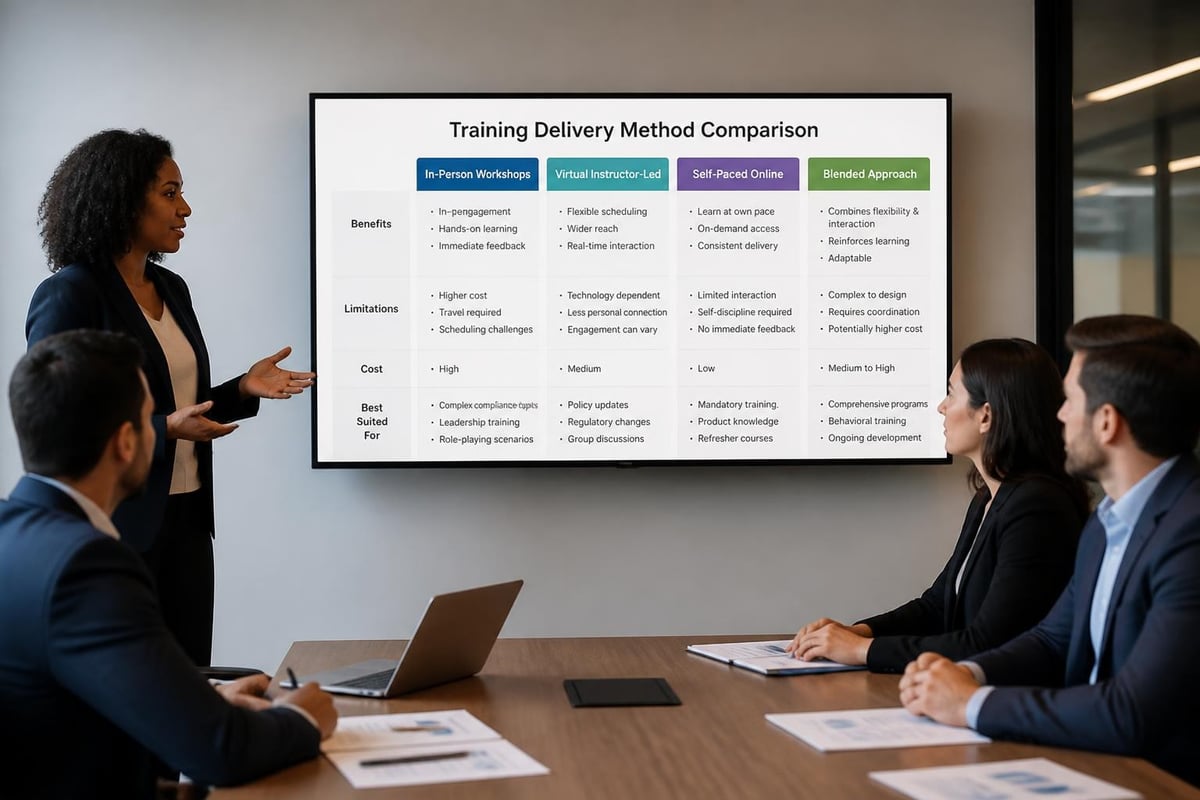
Delivery Flexibility: Consider whether in-person, virtual, or self-paced formats best suit your practice's operational requirements and learning preferences. Each delivery method offers distinct advantages and limitations.
Competence Verification: Determine whether providers include post-training assessments verifying knowledge acquisition and practical application capability, or merely confirm attendance.
Ongoing Support: Evaluate whether providers offer post-training resources, such as reference materials, implementation guides, or follow-up consultations supporting practical application.
Implementing CPD Training: Practical Steps for Independent Brokers
Translating training commitments into consistent competence development requires systematic implementation processes embedded within your practice's operational rhythms. Many brokers struggle not with training availability but with consistent execution amidst client demands and administrative pressures.
Creating a Training Calendar and Commitment Process
Establish an annual training calendar at the beginning of each compliance year, scheduling core regulatory training, product knowledge updates, and professional skills development. This proactive scheduling prevents last-minute compliance scrambles as year-end approaches.
Your calendar should include:
- Mandatory regulatory training dates: FAIS updates, POPIA refreshers, FICA compliance reviews, COFI implementation sessions
- Product provider training: New product launches, significant product changes, underwriting updates
- Internal practice training: Procedure updates, system changes, quality improvement initiatives
- Individual development sessions: Representative-specific training addressing personal competence gaps or career development objectives
- Buffer periods: Reserved time accommodating urgent regulatory updates or addressing emerging training needs
Communicate training commitments clearly to all representatives at the beginning of each year. Obtain formal acknowledgement of scheduled sessions, creating accountability for attendance and participation. For virtual or self-paced training, establish specific completion deadlines preventing procrastination.
Tracking CPD Compliance and Maintaining Records
Meticulous record-keeping represents a non-negotiable component of cpd training management. The FSCA expects FSPs to produce comprehensive training records during inspections, demonstrating not only that required hours were completed but that training addressed appropriate competency areas and resulted in verified knowledge acquisition.
Maintain detailed records including:
- Individual CPD registers: Tracking each representative's accumulated hours by training category, provider, date, and topic
- Training certificates: Original certificates from accredited providers confirming course completion and CPD hours awarded
- Attendance records: Sign-in sheets, virtual session participation logs, or self-paced module completion confirmations
- Assessment results: Post-training test scores, case study evaluations, or practical competence demonstrations
- Training materials: Course content, presentation slides, reference guides, and supplementary resources
- Provider accreditation: Evidence of provider FSCA recognition and specific course approval
Digital record management systems simplify compliance tracking whilst ensuring audit readiness. Consider implementing dedicated compliance software managing CPD tracking alongside other regulatory obligations, or utilise structured spreadsheet templates if budget constraints preclude software investment.
Measuring CPD Training Effectiveness and Impact
Accumulating required CPD hours satisfies regulatory minimums but doesn't guarantee enhanced professional competence or improved client outcomes. Progressive FSPs implement evaluation processes assessing whether training investment translates into practical performance improvements.
Assessment Methods Beyond Attendance Tracking
Effective evaluation examines knowledge acquisition, behaviour change, and business impact across multiple dimensions.
Knowledge Verification: Post-training assessments measuring whether representatives can accurately recall and apply learned concepts. These might include written tests, practical case studies, or scenario-based exercises requiring application of training content to realistic client situations.
Behavioural Observation: Monitoring whether representatives incorporate learned practices into daily workflows. For example, following POPIA training, observe whether advisors consistently explain data processing purposes during client onboarding, obtain documented consent appropriately, and follow prescribed information security procedures.
Performance Metrics: Tracking relevant business indicators potentially influenced by training. Following FICA compliance training, monitor metrics such as customer due diligence completion rates, delayed onboarding due to documentation issues, or internal audit findings related to FICA procedures.
Client Feedback: Gathering client perspectives on service quality dimensions addressed through training. After communication skills training, client satisfaction surveys might reveal improved understanding of advice provided or enhanced confidence in advisor expertise.
Compliance Outcomes: Monitoring regulatory compliance indicators including complaint volumes, FAIS Ombud escalations, internal audit findings, and regulatory inspection results in areas addressed through cpd training.
Continuous Improvement of Your CPD Programme
Treat your practice's CPD framework as a living system requiring regular review and refinement. Conduct formal programme evaluations at least annually, gathering input from representatives, assessing effectiveness measures, and identifying improvement opportunities.
Questions guiding programme review include:
- Which training activities delivered greatest practical value and behaviour change?
- Where do competence gaps persist despite completed training?
- How effectively does current training support business strategy and operational priorities?
- What obstacles prevent consistent training participation or knowledge application?
- How can training delivery methods better accommodate practice operational demands?
- Which providers consistently deliver high-quality, relevant content warranting continued engagement?
Advanced CPD Topics for Experienced Practitioners
Beyond foundational regulatory compliance, experienced financial advisors benefit from cpd training addressing sophisticated technical topics, emerging industry trends, and advanced professional capabilities.
Specialist Product Knowledge and Technical Expertise
As you develop practice specialisation-whether estate planning, retirement optimisation, business insurance, or investment planning-advanced cpd training builds deep technical expertise differentiating your advisory value proposition.
Specialist training areas include:
- Complex estate planning: Advanced trust structures, estate duty optimisation, business succession planning
- Retirement income strategies: Living annuity management, drawdown optimisation, longevity risk management
- Business risk solutions: Key person cover structuring, buy-and-sell agreements, business overhead expense insurance
- Investment portfolio construction: Asset allocation methodologies, multi-manager selection, alternative investments
- Healthcare scheme optimisation: Benefit design comparison, gap cover strategies, chronic condition management
Professional Practice Management and Business Development
Running a compliant, profitable independent advisory practice requires capabilities extending beyond technical product knowledge. Advanced cpd training addressing practice management enhances operational efficiency, profitability, and sustainability.
Relevant practice management training includes:
- Financial management: Practice budgeting, cashflow forecasting, profitability analysis by client segment or product category
- Client relationship management: Systematic review processes, proactive communication strategies, client retention techniques
- Practice valuation and succession: Understanding practice value drivers, preparing for eventual sale or transition, developing junior advisors
- Digital transformation: Implementing client portals, automating administrative processes, leveraging technology for efficiency
- Risk management: Professional indemnity considerations, business continuity planning, cybersecurity protocols
- Team development: Recruiting quality staff, performance management, creating high-performance advisory teams
Emerging Regulatory and Industry Developments
The financial services regulatory environment continues evolving, with new requirements emerging regularly. Proactive engagement with upcoming changes through cpd training positions your practice ahead of compliance curves rather than scrambling to react after implementation deadlines pass.
Monitor emerging developments including:
- Retail Distribution Review outcomes: Potential amendments to commission structures, fee disclosure requirements, or advice standards
- Twin Peaks refinements: Evolving prudential and conduct regulatory expectations as the dual regulatory system matures
- Sustainable finance regulations: Environmental, social, and governance considerations in product recommendations and portfolio construction
- Digital advice frameworks: Regulatory approaches to robo-advice, hybrid advice models, and technology-enabled service delivery
- Consumer protection enhancements: Strengthened disclosure requirements, cooling-off periods, or product intervention measures
Engaging with these topics before regulatory certainty emerges enables strategic positioning rather than reactive compliance.
Building a Culture of Continuous Learning
The most successful advisory practices transcend viewing cpd training as regulatory obligation, instead cultivating cultures where continuous learning forms an intrinsic component of professional identity. This cultural shift transforms compliance burden into competitive advantage.
Leadership Commitment to Professional Development
Cultural change begins with leadership. Key individuals and practice owners must demonstrate personal commitment to ongoing learning, openly discussing their own development activities, sharing insights from training attended, and allocating resources supporting team development.
Visible leadership behaviours reinforcing learning culture include:
- Blocking dedicated time for training in leadership calendars, signalling that development deserves priority despite operational pressures
- Sharing key takeaways from conferences, webinars, or courses attended with the broader team
- Allocating meaningful budget to training beyond minimum compliance requirements
- Recognising and celebrating representatives who pursue additional certifications or advanced qualifications
- Creating opportunities for team members to share expertise through internal presentations or peer training
- Incorporating professional development discussions into regular performance conversations
Creating Knowledge Sharing Mechanisms
Individual learning multiplies impact when shared across teams. Implement structured knowledge transfer processes ensuring insights gained through cpd training benefit your entire practice.
Training Debriefs: Following external training events, require attendees to present key learnings to colleagues. This reinforces learning for the attendee whilst distributing knowledge to team members who didn't attend.
Practice Lunch-and-Learns: Schedule regular informal sessions where team members present on compliance topics, technical product features, or professional practice insights. These sessions build presentation skills whilst creating peer learning opportunities.
Shared Resource Libraries: Maintain centralised repositories of training materials, regulatory updates, technical guides, and implementation resources accessible to all team members. Organise content logically enabling quick reference when specific questions arise.
Case Study Discussions: Regularly review challenging client scenarios as a team, exploring how different approaches might apply learned concepts and discussing optimal solutions considering regulatory obligations and client circumstances.
Supporting Junior Advisors and New Entrants
For practices employing representatives in training or recently qualified advisors, structured cpd training programmes accelerate competence development whilst ensuring consistent quality across your advisory team.
Structured Onboarding and Foundation Training
New representatives require comprehensive foundation training before engaging independently with clients. This onboarding extends beyond product knowledge to encompass regulatory compliance, practice procedures, service standards, and professional conduct expectations.
Foundation training should systematically address:
- Regulatory framework overview: FAIS, POPIA, FICA, and COFI requirements applicable to daily activities
- Product fundamentals: Core features, benefits, and appropriate applications for products your practice advises on
- Advice process: Needs analysis methodologies, product comparison frameworks, recommendation documentation, ongoing service obligations
- Practice systems: CRM usage, document management procedures, compliance checklists, quality assurance processes
- Client communication: Professional interaction standards, disclosure requirements, complaint handling, difficult conversation management
- Professional ethics: Conflicts of interest, confidentiality obligations, professional boundaries, reputation management
Mentorship and Supervised Practice
Technical knowledge alone proves insufficient for developing competent advisors. Practical experience under supervision enables junior representatives to apply learned concepts whilst receiving corrective feedback preventing poor habits from forming.
Implement structured mentorship including:
- Shadowing experienced advisors: New representatives observe client meetings, listening to needs analysis questioning, advice presentation, and objection handling
- Joint client meetings: Junior advisors gradually assume meeting responsibilities whilst senior mentors observe and provide immediate feedback
- File reviews: Compliance officers or senior advisors review documented advice processes, identifying gaps and providing guidance on improvement
- Regular coaching sessions: Scheduled discussions addressing questions, reviewing challenging scenarios, and providing encouragement
- Progressive responsibility: Gradually increasing autonomy as competence develops, from basic administrative tasks through simple advice scenarios to complex planning engagements
Effective cpd training represents far more than regulatory compliance for South African financial services professionals-it forms the foundation of professional competence, client protection, and practice sustainability in an increasingly complex regulatory environment. By implementing structured training programmes addressing FAIS, POPIA, FICA, and COFI obligations whilst fostering genuine learning cultures, independent brokers position their practices for long-term success amidst ongoing industry evolution. Holistic Compliance Management Solutions supports financial services providers throughout their compliance journey, offering specialised training programmes, regulatory examination preparation, and practical implementation guidance tailored to independent broker operations.
Schedule FICA Training
For: Independent brokers, compliance officers, FSP key individuals, and advisory teams requiring practical FICA implementation guidance
Book comprehensive FICA and RMCP training covering:
- Customer identification and verification procedures aligned with broker workflows
- Risk-based client assessment and ongoing monitoring implementation
- RMCP development, documentation, and maintenance for independent practices
- Suspicious transaction recognition and reporting obligations
Contact Holistic Compliance Management Solutions to schedule tailored FICA training supporting your practice's specific compliance requirements and operational circumstances.