
Compliance OSHA Training for South African FSPs
Workplace compliance training has evolved significantly over recent decades, with organisations worldwide recognising that structured, evidence-based training programmes form the foundation of effective risk management. Whilst the Occupational Safety and Health Administration (OSHA) in the United States has established comprehensive training standards for physical workplace safety, the principles underlying compliance osha training translate remarkably well to regulatory compliance in other sectors, including financial services. For South African Financial Service Providers (FSPs), independent brokers, and compliance officers navigating FAIS, FICA, POPIA, and COFI requirements, understanding how robust training frameworks reduce risk, improve outcomes, and create sustainable compliance cultures offers valuable insights for practice management.
Understanding Compliance Training Frameworks
Compliance osha training principles rest on a systematic approach to identifying risks, designing interventions, delivering instruction, and measuring effectiveness. These foundational concepts apply across industries and regulatory environments.
The core philosophy recognises that effective compliance training must be:
- Needs-based: Derived from actual workplace hazards and regulatory requirements
- Performance-oriented: Focused on changing behaviour, not merely conveying information
- Measurable: Evaluated through demonstrable competence, not attendance records
- Documented: Maintained with comprehensive records for audit and verification purposes
- Regularly updated: Refreshed to reflect regulatory changes and emerging risks

Evidence-Based Training Approaches
Research demonstrates that well-designed compliance training programmes significantly improve outcomes. A comprehensive meta-analysis on safety training effectiveness found that structured training interventions substantially enhanced knowledge retention, skills transfer, and safety performance across diverse workplace settings.
For South African FSPs, this evidence-based approach translates directly to regulatory compliance training. When financial advisors complete FAIS training, FICA awareness programmes, or POPIA implementation workshops, the quality and structure of that training determines whether knowledge translates into compliant practice.
OSHA Training Standards and Financial Services Compliance
The ANSI/ASSP Z490.1 standard for occupational safety and health training establishes criteria for developing, delivering, evaluating, and managing training programmes. Whilst designed for workplace safety, these standards offer valuable templates for financial services compliance programmes.
| OSHA Training Standard | Financial Services Application | South African Example |
|---|---|---|
| Hazard identification | Regulatory risk assessment | FAIS non-compliance penalties |
| Competency-based training | Role-specific compliance programmes | FICA training for client onboarding staff |
| Performance evaluation | Practical compliance testing | POPIA data handling assessments |
| Documentation requirements | Audit trail maintenance | FSP compliance file management |
| Refresher training cycles | Regulatory update training | Annual COFI requirements |
Developing Role-Specific Training Programmes
Independent financial brokers require different compliance training from administrative staff or compliance officers. Effective compliance osha training principles demand that programmes address specific job functions and associated risks.
For a typical independent FSP practice, training needs include:
- Principal officers: Comprehensive FAIS Act knowledge, supervisory responsibilities, regulatory liaison
- Financial advisors: Product-specific training, client suitability assessments, record-keeping obligations
- Administrative staff: FICA verification procedures, POPIA data handling, client communication protocols
- Compliance officers: Comprehensive regulatory framework knowledge, monitoring methodologies, reporting requirements
Each role requires tailored training content, appropriate depth, and relevant practical applications.
Implementing Compliance Training in FSP Practices
Independent financial advisors and small FSP practices face unique challenges when implementing structured compliance training programmes. Resource constraints, time pressures, and competing priorities often relegate training to tick-box exercises rather than meaningful risk mitigation.
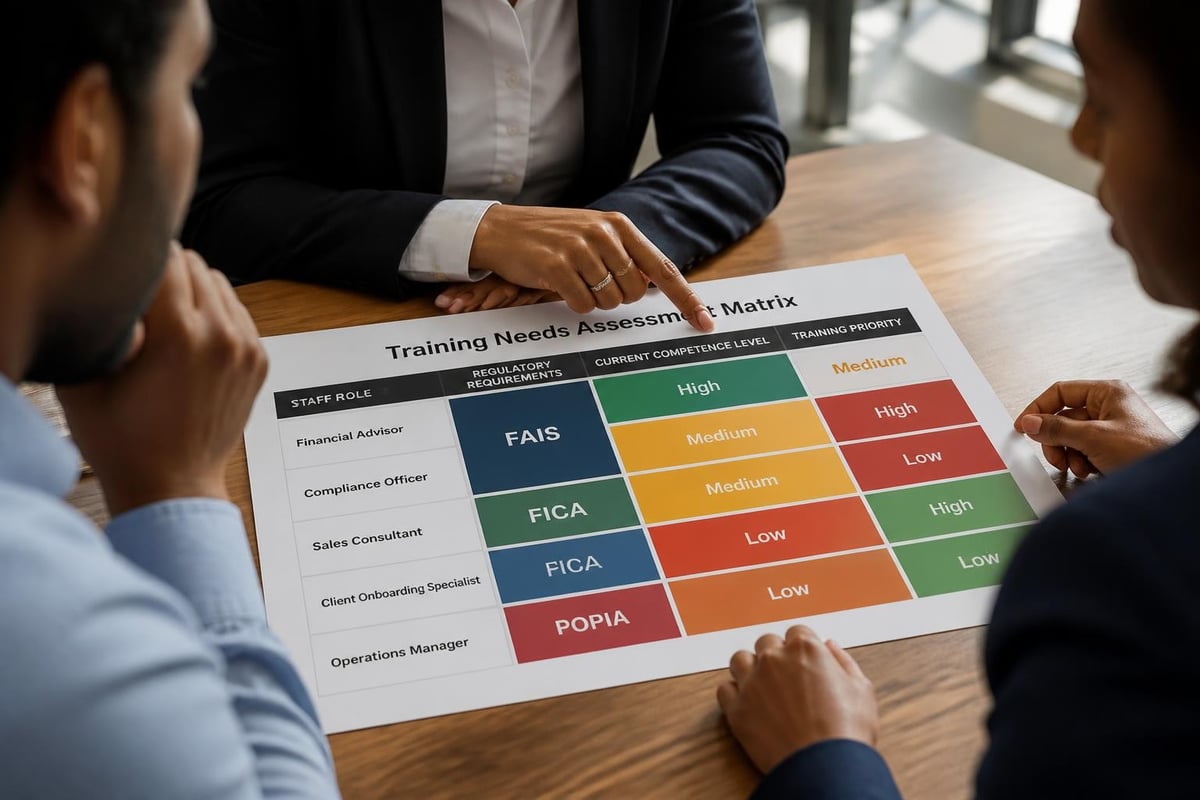
Building a Compliance Training Needs Assessment
Before developing training programmes, conduct a thorough needs assessment:
Step 1: Identify regulatory obligations
- List all applicable legislation (FAIS Act, FICA, POPIA, COFI)
- Document specific compliance requirements for your FSP category
- Note any exemptions or special conditions in your FSP licence
- Review recent regulatory circulars and guidance notices from the FSCA
Step 2: Map roles to requirements
- Create a matrix showing which staff members handle which compliance functions
- Identify gaps where untrained individuals perform compliance-sensitive tasks
- Note any single points of failure where only one person holds critical knowledge
Step 3: Assess current competence
- Review qualification records and CPD certificates
- Conduct practical assessments of compliance knowledge
- Identify recurring compliance failures or near-misses
- Gather feedback from staff about confidence levels
Step 4: Prioritise training needs
- Rank risks by severity and likelihood
- Consider regulatory scrutiny areas (FICA and POPIA currently high priority)
- Account for upcoming regulatory changes
- Balance urgent needs against long-term capability building
Designing Effective Compliance Training Content
Compliance osha training methodologies emphasise that effective training changes behaviour, not merely imparts information. For South African FSPs, this means designing programmes that enable staff to apply compliance requirements in daily practice.
Content structure for FICA training:
- Regulatory context and penalties for non-compliance
- Client identification requirements for different entity types
- Practical document verification procedures
- Risk-based approach to customer due diligence
- Record-keeping and retention obligations
- Red flags for suspicious transactions
- Escalation procedures and reporting lines
The RE EXAM Training programme demonstrates this applied approach, focusing on practical regulatory examination preparation rather than theoretical knowledge alone, ensuring candidates understand how to implement compliance requirements in real-world scenarios.
Content structure for POPIA compliance:
- Eight conditions for lawful processing explained
- Consent mechanisms and record-keeping
- Data subject rights and response procedures
- Security measures for client information
- Cross-border data transfer restrictions
- Breach notification obligations
- Practical document classification exercises
Delivery Methods for Maximum Impact
The format through which compliance training is delivered significantly affects knowledge retention and behaviour change. Independent brokers must balance effectiveness against practical constraints.
Training Delivery Options
| Delivery Method | Advantages | Disadvantages | Best Used For |
|---|---|---|---|
| In-person workshops | Interactive, immediate clarification, networking | Time-intensive, geographic constraints | Complex topics, new legislation |
| Online modules | Flexible timing, consistent content, trackable | Limited interaction, self-discipline required | Refresher training, standardised content |
| Webinars | Real-time interaction, geographic reach | Technology dependencies, scheduling challenges | Regulatory updates, Q&A sessions |
| On-the-job coaching | Contextualised, immediate application | Time-intensive, inconsistent delivery | New staff onboarding, specific skills |
| Reference materials | Ongoing resource, detailed information | Passive learning, limited engagement | Supplementary support, reference guides |
Creating Practical Compliance Exercises
Theory becomes meaningful when applied. Effective compliance osha training incorporates practical exercises that mirror actual workplace scenarios.
FICA verification exercise:
Present trainees with sample identity documents (with identifying details redacted for privacy). Require them to:
- Identify which documents are acceptable for verification purposes
- Note any discrepancies or concerns
- Complete verification checklists correctly
- Determine appropriate customer due diligence level
- Draft file notes documenting the verification process
POPIA data handling scenario:
Describe a situation where a client requests access to personal information held by the FSP. Trainees must:
- Verify the requestor's identity
- Determine what information must be provided
- Identify any exemptions that apply
- Calculate the response timeline
- Draft the appropriate response communication
- Update the request tracking register
FAIS suitability assessment:
Provide a client fact-finding document and product range. Trainees must:
- Analyse the client's financial objectives and risk profile
- Evaluate product suitability against needs
- Document the advice process
- Identify conflicts of interest
- Prepare compliant record of advice
Evaluating Training Effectiveness
Compliance osha training standards emphasise that completion certificates prove attendance, not competence. Effective evaluation measures whether training achieves its objective: improved compliance performance.
Multi-Level Assessment Framework
- Immediate knowledge checks: Post-training assessments verify understanding of core concepts
- Practical competency tests: Observe trainees performing actual compliance tasks under supervision
- Workplace application: Monitor compliance file quality and adherence to procedures in daily work
- Incident tracking: Measure reduction in compliance failures or regulatory findings
- Regulatory outcomes: Track inspection results, client complaints, and enforcement actions
For independent FSPs, practical competency testing offers the most meaningful evaluation. Rather than multiple-choice questions about FICA requirements, observe how staff actually conduct client verification in practice. Provide feedback, correct errors, and verify competence before allowing unsupervised work.
Documentation and Record-Keeping Requirements
Comprehensive documentation serves multiple purposes: demonstrating regulatory compliance, supporting continuous improvement, and protecting the FSP during audits or investigations.
Essential Training Records
Individual training files must contain:
- Training needs assessment results
- Programme curricula and learning objectives
- Attendance registers with dates and duration
- Assessment results and competency verification
- Trainer qualifications and credentials
- Refresher training schedules and completion records
- CPD certificates where applicable
Programme-level documentation includes:
- Annual training plans aligned to regulatory requirements
- Budget allocations and expenditure tracking
- Training evaluation results and improvement actions
- Regulatory updates log and communication records
- Training provider contracts and quality assurance reviews
South African FSPs must maintain these records for the minimum retention period specified under FAIS (five years) or longer if required by other applicable legislation.

Managing Regulatory Change Through Training
The South African financial services regulatory environment evolves continuously. FSCA conducts published standards, issues guidance notices, and updates interpretation of existing legislation. Effective compliance osha training frameworks include mechanisms for rapidly updating programmes when regulations change.
Regulatory Update Protocol
When new regulations or guidance emerge:
-
Immediate assessment (within 5 working days):
- Review the regulatory change and effective date
- Identify which FSP functions and staff are affected
- Determine urgency and compliance risk level
-
Communication cascade (within 10 working days):
- Brief compliance officer and management
- Issue preliminary guidance to affected staff
- Flag high-risk areas requiring immediate attention
-
Training development (timeframe depends on complexity):
- Update existing training materials
- Develop supplementary modules for new requirements
- Create quick-reference guides and checklists
- Schedule delivery before effective date
-
Implementation verification (ongoing):
- Monitor application of new requirements
- Conduct spot checks on compliance files
- Address questions and clarifications
- Document challenges and solutions
Building a Compliance Training Culture
Sustainable compliance extends beyond formal training programmes. Independent FSPs must cultivate organisational cultures where compliance is valued, understood, and integrated into daily operations.
Cultural Elements That Support Compliance
Leadership commitment: Principal officers must demonstrate that compliance is non-negotiable, allocating appropriate resources and modelling compliant behaviour.
Open communication: Staff should feel comfortable raising compliance questions or concerns without fear of criticism.
Continuous learning: Position training as professional development opportunity, not punitive exercise.
Recognition and accountability: Acknowledge excellent compliance practice whilst addressing failures constructively.
Integration with business processes: Embed compliance checks into workflows rather than treating them as separate activities.
Cost-Benefit Analysis of Compliance Training Investment
Independent brokers often question whether comprehensive compliance training justifies the investment. Analysing costs against benefits provides clarity.
Direct Costs
- Training programme fees
- Staff time (opportunity cost)
- Materials and resources
- Assessment and certification
- Ongoing updates and refresher training
Quantifiable Benefits
- Reduced regulatory penalties and fines
- Lower professional indemnity insurance premiums
- Decreased complaint handling costs
- Improved operational efficiency
- Enhanced client retention through professional service
Intangible Benefits
- Reduced regulatory scrutiny and inspection frequency
- Enhanced professional reputation
- Improved staff confidence and job satisfaction
- Competitive advantage in market
- Peace of mind for principal officers
For a typical independent FSP with five advisors, a single FSCA penalty for FICA non-compliance could cost R50,000 to R250,000, far exceeding the annual investment in comprehensive compliance training.
Technology Solutions for Training Management
Modern compliance osha training programmes leverage technology to improve efficiency, consistency, and tracking.
Learning Management Systems (LMS)
Cloud-based LMS platforms offer:
- Centralised training content repository
- Automated enrolment and scheduling
- Progress tracking and completion reporting
- Assessment and certification management
- Mobile accessibility for remote learning
- Integration with compliance monitoring systems
For independent FSPs, even basic LMS functionality significantly improves training administration. Many providers offer affordable solutions tailored to small practices.
Digital Compliance Resources
Supplement formal training with:
- Regulatory update subscription services
- Online compliance libraries and templates
- Industry webinar programmes
- Professional association resources
- Regulatory authority websites and guidance
The FSCA website provides extensive resources, including legislation, standards, circulars, and guidance notices, all freely accessible to FSPs.
Common Compliance Training Pitfalls
Even well-intentioned FSPs make predictable mistakes when implementing compliance training programmes.
Pitfall 1: Generic, off-the-shelf programmes
Solution: Customise training to your specific FSP category, product range, and client base. Generic FICA training that covers all financial sectors wastes time on irrelevant content whilst missing broker-specific nuances.
Pitfall 2: Tick-box mentality
Solution: Focus on competence and behaviour change, not attendance records. Require demonstration of practical skills, not merely course completion.
Pitfall 3: Training and forgetting
Solution: Implement refresher programmes, ongoing reinforcement, and regular competence verification. Compliance knowledge degrades without reinforcement.
Pitfall 4: Inadequate documentation
Solution: Maintain comprehensive records from day one. Recreating training records during an FSCA inspection is impossible and suggests non-compliance.
Pitfall 5: Neglecting administrative staff
Solution: Train everyone who handles client information or compliance-sensitive tasks, regardless of job title. Receptionists processing FICA documents need training as much as advisors.
Integrating Training with Broader Compliance Monitoring
Compliance osha training represents one component of comprehensive risk management. Training must connect to broader compliance monitoring, supervision, and quality assurance processes.
The compliance cycle:
- Risk assessment identifies vulnerabilities
- Training addresses knowledge and skill gaps
- Policies and procedures provide operational guidance
- Supervision verifies correct application
- Monitoring detects failures or drift
- Corrective action addresses issues
- Review and improvement refine the system
Training without monitoring allows non-compliance to persist despite knowledge. Monitoring without training punishes staff for deficiencies they cannot remedy. Both elements must work together.
Preparing for FSCA Inspections
Well-executed compliance training programmes significantly improve FSP performance during regulatory inspections. Inspectors assess whether the FSP understands and implements regulatory requirements, judgements formed partly through staff interactions and file reviews.
Inspection-Ready Training Files
Prepare for inspections by maintaining:
- Current training register showing all staff and training status
- Individual training files for each staff member
- Programme curricula demonstrating regulatory coverage
- Assessment records proving competence verification
- Evidence of refresher training and regulatory updates
- Documentation of training-related corrective actions
During inspections, inspectors may interview staff about compliance requirements. Well-trained staff provide consistent, accurate responses that demonstrate organisational competence. Poorly trained staff create doubt about the FSP's compliance culture.
Specialist Compliance Training Requirements
Beyond general regulatory compliance, certain FSP activities require specialist training.
COFI Requirements for Individual Representatives
The Code of Conduct for Financial Institutions (COFI) mandates minimum training standards for representatives rendering financial services. FSPs must ensure:
- Representatives complete required qualifications before rendering services
- CPD requirements are met annually
- Training records are maintained and submitted to the FSCA
- Competence is verified through appropriate assessment
Non-compliance with COFI training requirements can result in debarment of representatives and FSP penalties.
Product-Specific Training
Representatives must complete product training appropriate to the financial products they recommend. This includes:
- Product provider training programmes
- Regulatory examination preparation where applicable
- Technical product knowledge updates
- Suitability assessment training for complex products
Implementing robust compliance training programmes transforms regulatory obligations from burdensome tick-box exercises into strategic risk management tools that protect both clients and FSP practices. By applying evidence-based training principles adapted from compliance osha training frameworks and tailoring them to South African financial services regulations, independent brokers build sustainable compliance cultures that withstand regulatory scrutiny whilst delivering professional client service. For FSP compliance officers and independent financial advisors: Holistic Compliance Management Solutions (Pty) Ltd offers comprehensive compliance training and monitoring services specifically designed for South African financial service providers, including FICA, POPIA, FAIS, and regulatory examination preparation. Schedule FICA training to ensure your practice maintains audit-ready compliance documentation whilst building genuine competence across your team. Our training includes practical workshop delivery, customised compliance materials for your FSP category, competence assessment and verification, and ongoing regulatory update support tailored to independent broker workflows.