
What Is a Compliance Lab and Why Your Organization Needs One
Organizations today face unprecedented regulatory complexity. Financial services providers, technology companies, healthcare institutions, and manufacturing firms all navigate intricate compliance frameworks that evolve constantly. A compliance lab serves as a dedicated environment where businesses can test, validate, and refine their compliance strategies before full-scale implementation. This controlled testing space allows compliance teams to experiment with new requirements, identify gaps in existing processes, and develop solutions without disrupting daily operations. For companies seeking sustainable business operations within changing regulatory landscapes, establishing a compliance lab represents a strategic investment in long-term compliance effectiveness.
Understanding the Core Functions of a Compliance Lab
A compliance lab operates as a specialized testing environment focused on regulatory adherence. Unlike traditional quality assurance testing, this space specifically addresses legal, regulatory, and industry-standard requirements. The lab provides a controlled setting where compliance professionals can evaluate new regulations, test control mechanisms, and validate reporting processes before organizational rollout.
Primary Testing Capabilities
Modern compliance labs support multiple testing methodologies:
- Regulatory requirement validation – Verifying that business processes meet specific legal obligations
- Control effectiveness assessment – Testing whether implemented controls actually mitigate identified risks
- Process simulation – Running scenarios to identify potential compliance failures
- Documentation review – Evaluating policies, procedures, and records for completeness
- Technology integration testing – Ensuring compliance software functions correctly within existing systems
These capabilities enable organizations to identify issues in a non-production environment. Testing regulatory controls before implementation prevents costly violations and operational disruptions.

The compliance testing process involves verifying that software and business processes align with regulatory standards. Within a compliance lab, teams can conduct this verification systematically, documenting results and refining approaches based on findings.
Building an Effective Compliance Lab Framework
Establishing a compliance lab requires careful planning and resource allocation. Organizations must define clear objectives, secure appropriate tools, and assign qualified personnel to maximize the lab's value.
Essential Components
| Component | Purpose | Implementation Considerations |
|---|---|---|
| Testing environment | Isolated space for compliance validation | Must mirror production systems without affecting live operations |
| Documentation systems | Centralized repository for test results | Version control, audit trails, secure access |
| Simulation tools | Software for scenario testing | Industry-specific requirements, integration capabilities |
| Qualified personnel | Experts who understand both compliance and testing | Ongoing training, cross-functional knowledge |
| Reporting mechanisms | Structured communication of findings | Stakeholder-specific formats, actionable insights |
The physical or virtual space designated as your compliance lab should replicate production environments as closely as possible. This ensures test results accurately predict real-world performance.
Staffing Your Compliance Lab
Personnel requirements vary based on organizational size and industry. Small firms might dedicate a single compliance officer to lab activities part-time, while large enterprises often establish dedicated teams. Key roles include:
- Compliance testers who execute validation procedures
- Subject matter experts who interpret regulatory requirements
- Technical specialists who configure testing environments
- Documentation analysts who maintain records
- Project coordinators who manage testing schedules
Cross-training team members ensures continuity and builds organizational knowledge. The most effective compliance labs foster collaboration between legal, IT, operations, and risk management departments.
Testing Methodologies for Regulatory Compliance
A compliance lab employs various testing approaches depending on the regulatory framework and business context. Selecting appropriate methodologies ensures comprehensive coverage while managing resource constraints.
Conformance Testing Standards
NIST conformance testing provides a foundation for validating whether implementations meet specified standards. This approach verifies that systems, processes, or products conform to documented requirements.
Key testing categories include:
- Functional testing to confirm required capabilities exist
- Performance testing to validate processing speeds and capacities
- Security testing to identify vulnerabilities
- Interface testing to ensure proper data exchange
- Regression testing to verify changes don't break existing compliance
Organizations should document testing procedures thoroughly. Clear test plans, execution logs, and results summaries create an audit trail demonstrating due diligence.
Penetration Testing for Compliance
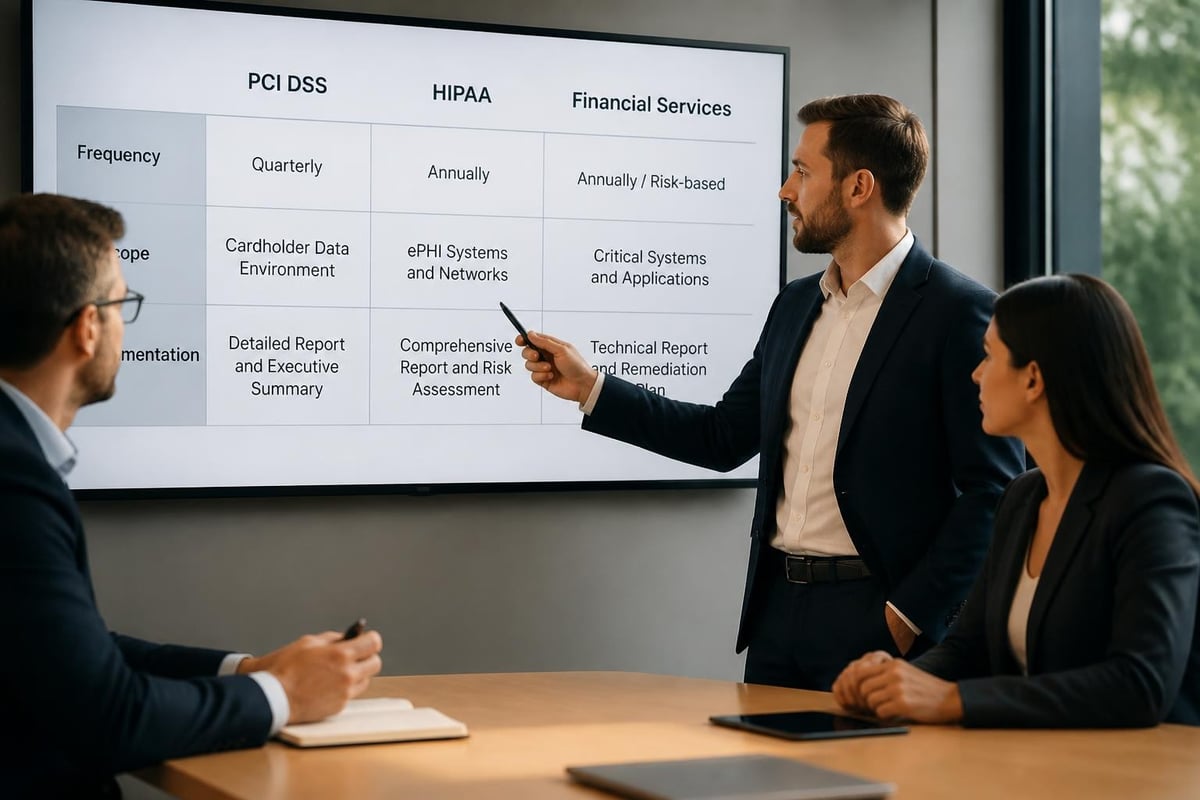
Many regulatory frameworks mandate penetration testing requirements as part of ongoing compliance obligations. PCI DSS, HIPAA, and SEC rules each specify different penetration testing frequencies and scopes.
A compliance lab provides the ideal setting for penetration testing preparation. Teams can:
- Identify systems requiring testing under specific regulations
- Establish testing schedules that meet regulatory timelines
- Review penetration test results and develop remediation plans
- Validate that fixes address identified vulnerabilities
- Prepare documentation for auditors and regulators
This proactive approach prevents last-minute scrambling before compliance deadlines.
Implementing Risk-Based Testing Strategies
Not all compliance requirements carry equal risk. A compliance lab enables organizations to prioritize testing efforts based on potential impact and likelihood of non-compliance.
Risk Assessment Integration
Begin by mapping regulatory requirements to business processes. Identify which requirements present the highest risk exposure based on:
- Severity of potential penalties for non-compliance
- Complexity of the requirement
- Frequency of regulatory examinations
- Historical compliance challenges in your industry
- Technology dependencies and integration points
Risk prioritization matrix:
| Risk Level | Penalty Severity | Testing Frequency | Resource Allocation |
|---|---|---|---|
| Critical | High fines, license revocation | Quarterly or continuous | 40% of lab resources |
| High | Moderate fines, reputational damage | Semi-annually | 30% of lab resources |
| Medium | Low fines, corrective action required | Annually | 20% of lab resources |
| Low | Warnings, documentation requirements | Biennially | 10% of lab resources |
This framework ensures your compliance lab focuses on areas that matter most to organizational sustainability and regulatory standing.
Continuous Monitoring Approaches
Modern compliance labs increasingly adopt continuous monitoring rather than periodic testing. Automated tools can check compliance status in real-time, alerting teams to deviations immediately.
Continuous monitoring supports holistic compliance management solutions by providing ongoing visibility into compliance posture. Organizations can track metrics like policy acknowledgment rates, training completion percentages, and control effectiveness indicators without manual intervention.
Technology Infrastructure for Compliance Labs
The right technology stack transforms a compliance lab from a theoretical concept into an operational asset. Organizations must balance sophistication with usability, ensuring tools enhance rather than complicate compliance efforts.
Software Selection Criteria
When evaluating compliance lab software, consider:
- Regulatory coverage – Does it support your specific frameworks (FSP regulations, FICA, POPI, etc.)?
- Integration capabilities – Can it connect with existing systems for realistic testing?
- Reporting flexibility – Does it generate stakeholder-appropriate documentation?
- Scalability – Will it accommodate organizational growth and regulatory changes?
- Audit trail completeness – Does it maintain comprehensive activity logs?
The compliance testing tools available in 2026 range from specialized regulatory platforms to general-purpose testing frameworks adapted for compliance use.
Data Management in Testing Environments
Compliance labs often work with sensitive information. Establish clear data handling protocols:
For production data replication:
- Anonymize personally identifiable information (PII)
- Apply data masking techniques for financial records
- Implement access controls matching production security
- Schedule regular data refreshes to maintain relevance
For synthetic test data:
- Generate realistic scenarios covering edge cases
- Document data creation methodologies
- Validate that synthetic data adequately represents real conditions
- Maintain separate storage from production backups
Proper data management protects privacy while ensuring test accuracy.
Measuring Compliance Lab Effectiveness
Organizations investing in compliance labs need mechanisms to evaluate return on investment. Establish metrics that demonstrate the lab's contribution to overall compliance success.
Quantitative Performance Indicators
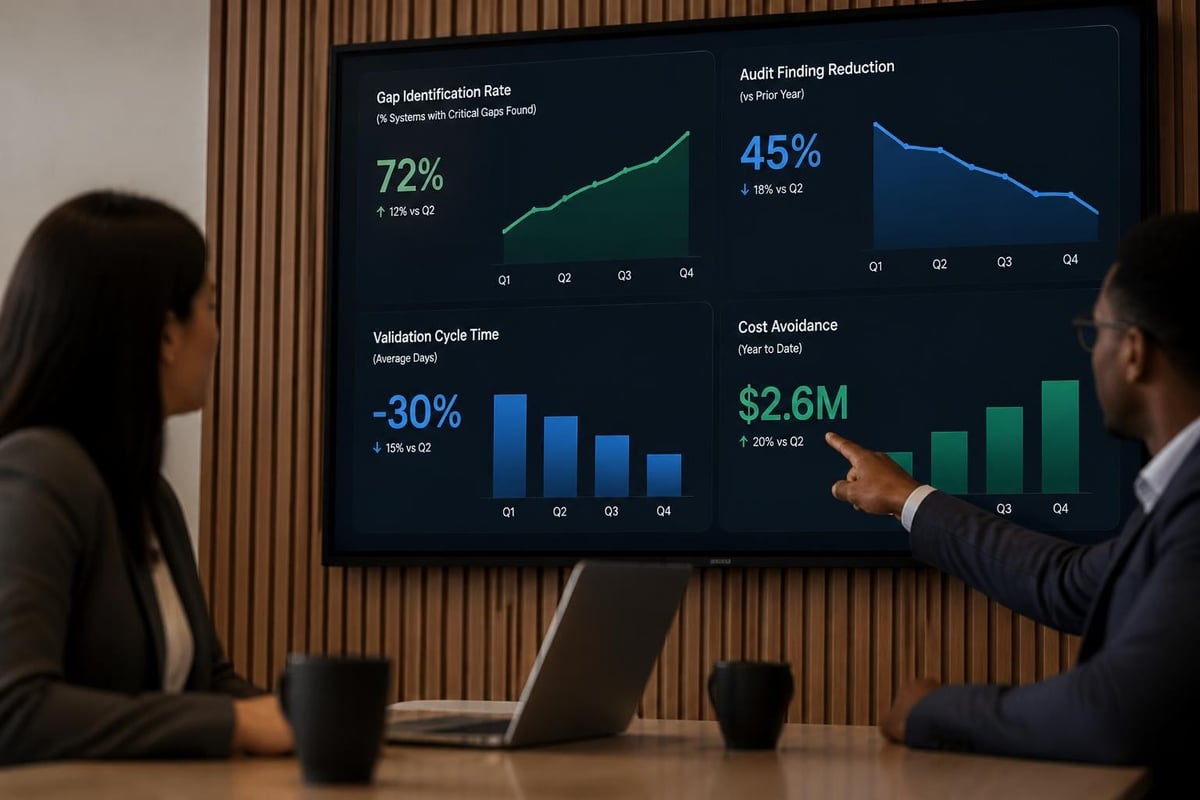
Track these measurable outcomes:
- Number of compliance gaps identified before production deployment
- Percentage reduction in audit findings year-over-year
- Time saved in regulatory examination preparation
- Cost avoidance from prevented violations
- Average time to validate new regulatory requirements
Sample dashboard metrics:
| Metric | Q1 2026 | Q2 2026 | Q3 2026 | Target |
|---|---|---|---|---|
| Pre-production gaps found | 23 | 31 | 28 | 20+ per quarter |
| Audit findings | 7 | 4 | 3 | <5 per audit |
| Validation cycle time (days) | 45 | 38 | 32 | <30 days |
| Compliance incidents | 2 | 1 | 0 | Zero tolerance |
These numbers tell a compelling story about compliance lab value.
Qualitative Benefits Assessment
Beyond numbers, evaluate qualitative improvements:
- Increased confidence among compliance teams
- Enhanced regulatory relationships through proactive engagement
- Improved employee understanding of compliance requirements
- Stronger audit outcomes and examiner feedback
- Greater organizational resilience to regulatory changes
Document specific examples where the compliance lab prevented issues or accelerated compliance achievements.
Adapting Labs for Industry-Specific Requirements
Different industries face unique compliance challenges. A compliance lab for financial services providers differs significantly from one serving healthcare organizations or manufacturers.
Financial Services Provider Considerations
Financial institutions must navigate frameworks like FICA, POPI, FSP licensing requirements, and international standards. A compliance lab supporting this sector should include:
- Customer due diligence process testing
- Anti-money laundering scenario simulation
- Data protection control validation
- Fit and proper requirement verification
- Reporting accuracy assessment
Organizations offering services such as FICA RMCP development benefit from lab environments that allow iterative refinement of risk management and compliance programs before client delivery.
The standardized evidence sampling approaches discussed in recent compliance research highlight the importance of consistent evaluation methodologies, particularly relevant for financial services compliance assessments.
Healthcare and Technology Sectors
Healthcare compliance labs focus heavily on patient data protection, treatment documentation, and clinical safety standards. Technology companies emphasize software security, data privacy, and accessibility compliance.
Sector-specific testing priorities:
- Healthcare: HIPAA validation, patient consent processes, breach notification procedures, medical record retention
- Technology: GDPR/POPIA compliance, accessibility standards (WCAG), software security testing, API compliance
- Manufacturing: Product safety standards, environmental regulations, supply chain compliance, workplace safety
- Education: FERPA requirements, accessibility mandates, data security, accreditation standards
Tailoring your compliance lab to industry requirements maximizes relevance and value.
Establishing Testing Protocols and Documentation
Systematic approaches distinguish effective compliance labs from informal testing efforts. Develop standardized protocols that ensure consistency, repeatability, and defensibility.
Protocol Development Process
Create documented procedures for each testing category:
Standard operating procedure elements:
- Testing objective and scope definition
- Prerequisites and environmental setup requirements
- Step-by-step execution instructions
- Expected results and pass/fail criteria
- Escalation procedures for failed tests
- Documentation requirements and templates
These protocols should align with software verification standards that provide guidelines for developer verification and testing techniques ensuring compliance with security and quality standards.
Documentation Best Practices
Comprehensive documentation serves multiple purposes: demonstrating due diligence, facilitating knowledge transfer, supporting continuous improvement, and satisfying auditor requirements.
Essential documentation types:
- Test plans outlining objectives and methodologies
- Test cases with detailed execution steps
- Test results with timestamps and tester identification
- Gap analysis reports identifying deficiencies
- Remediation tracking logs showing corrective actions
- Version control records for all documentation
Store all compliance lab documentation in centralized, access-controlled repositories with robust backup procedures.
Training and Knowledge Development
A compliance lab functions as both a testing facility and a learning environment. Organizations should leverage lab activities to build compliance competency across teams.
Staff Development Opportunities
Compliance lab work provides hands-on experience with:
- Current and emerging regulatory requirements
- Testing methodologies and quality assurance techniques
- Risk assessment and gap analysis
- Remediation planning and implementation
- Cross-functional collaboration skills
Rotate staff through lab assignments to broaden organizational compliance knowledge. This approach builds bench strength and ensures business continuity.
Stakeholder Education Programs
Use compliance lab findings to educate broader stakeholder groups. Executives, board members, operational managers, and frontline employees all benefit from understanding compliance requirements and organizational approaches to meeting them.
Educational formats:
- Executive briefings on regulatory changes and organizational readiness
- Manager workshops on implementing compliant processes
- Employee training on specific compliance obligations
- Board presentations on compliance program effectiveness
- Client communications about your compliance capabilities
The compliance lab provides concrete examples and data supporting these educational initiatives.
Future Trends in Compliance Laboratory Practices
The compliance landscape continues evolving. Forward-thinking organizations position their compliance labs to address emerging challenges and leverage new opportunities.
Artificial Intelligence and Automation
AI technologies are transforming compliance testing. Machine learning algorithms can identify patterns in compliance data, predict potential violations, and recommend preventive actions. Natural language processing helps analyze regulatory text and compare it against organizational policies.
Compliance labs increasingly incorporate:
- Automated test case generation based on regulatory requirements
- AI-powered gap analysis identifying discrepancies
- Predictive analytics forecasting compliance risks
- Intelligent monitoring systems detecting anomalies
- Chatbots providing real-time compliance guidance
Organizations should evaluate these technologies carefully, balancing efficiency gains against implementation costs and complexity.
Cloud-Based Compliance Testing Environments
Cloud platforms offer flexibility and scalability for compliance labs. Organizations can spin up testing environments on-demand, scale resources based on workload, and access advanced tools without significant capital investment.
Benefits include reduced infrastructure costs, faster environment provisioning, easier collaboration across geographic locations, and automatic updates to testing tools.
Challenges involve data residency requirements, security considerations, and vendor dependency risks.
Integrated Compliance Ecosystems
The future points toward integrated compliance ecosystems where labs connect seamlessly with governance, risk, and compliance (GRC) platforms, operational systems, and external regulatory databases. This integration enables:
- Real-time regulatory requirement updates flowing into test plans
- Automated triggering of compliance tests when systems change
- Direct integration of test results into compliance dashboards
- Bidirectional communication between compliance and operational teams
- Predictive compliance posture assessment
Building toward this integrated future requires strategic technology planning and vendor selection.
Establishing and maintaining a compliance lab represents a proactive approach to regulatory adherence that pays dividends through reduced risk, improved audit outcomes, and enhanced organizational confidence. By creating dedicated environments for testing, validating, and refining compliance approaches, organizations transform compliance from a reactive burden into a strategic capability. Holistic Compliance Management Solutions specializes in helping Financial Service Providers and modern organizations build sustainable compliance programs that thrive within evolving regulatory environments, offering the expertise and tailored solutions needed to establish effective compliance practices that protect your business and support long-term success.