
Social Compliance for Financial Services in South Africa
Social compliance has become a cornerstone of responsible business practice in South Africa's financial services sector. For independent brokers, financial advisors, and Financial Service Providers (FSPs), understanding and implementing social compliance measures is not merely about meeting regulatory requirements. It encompasses the broader responsibility to protect clients, respect data privacy, maintain ethical conduct standards, and contribute to a fair and transparent marketplace. As regulatory frameworks evolve and public expectations rise, financial professionals must navigate an increasingly complex landscape where social compliance intersects with business and human rights obligations, workplace standards, and client protection principles.
Understanding Social Compliance in Financial Services
Social compliance refers to an organisation's adherence to laws, regulations, and ethical standards that govern its impact on people-including employees, clients, suppliers, and broader society. In the financial services context, this extends beyond traditional regulatory compliance to encompass data protection, fair treatment of customers, anti-discrimination measures, and transparent business practices.
For South African FSPs, social compliance creates a framework that protects both the business and its stakeholders. The UN Guiding Principles on Business and Human Rights establish a global benchmark for corporate responsibility, emphasising that businesses must respect human rights and implement due diligence processes to identify and mitigate adverse impacts.
The South African Regulatory Landscape
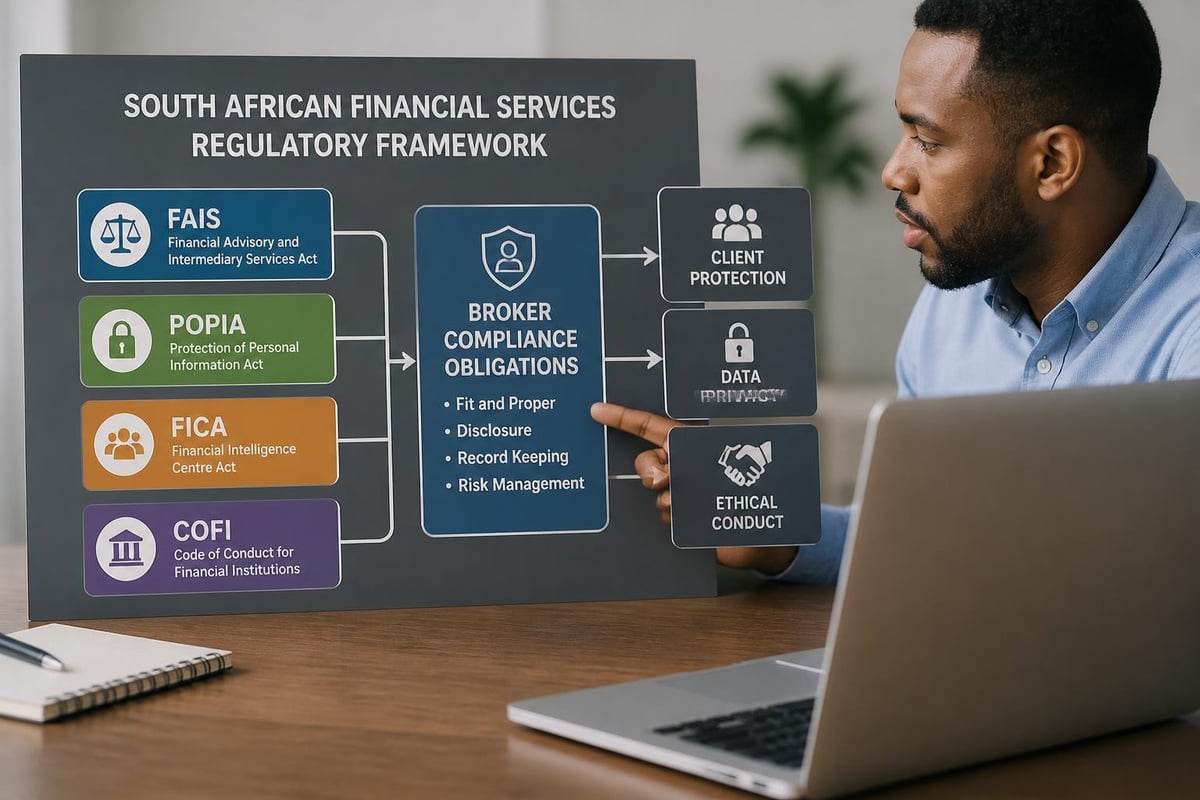
Financial service providers operating in South Africa face a multi-layered regulatory environment. Each piece of legislation addresses different aspects of social compliance:
- Financial Advisory and Intermediary Services (FAIS) Act: Governs the conduct and competence of financial advisors and intermediaries
- Protection of Personal Information Act (POPIA): Mandates data protection and privacy standards
- Financial Intelligence Centre Act (FICA): Requires client verification and anti-money laundering measures
- Conduct of Financial Institutions (COFI) Bill: Introduces enhanced conduct standards and client-centric practices
Understanding how these regulations interconnect forms the foundation of effective social compliance for independent brokers and FSPs.
POPIA Compliance: Data Protection as Social Responsibility
The Protection of Personal Information Act represents South Africa's commitment to protecting individuals' privacy rights. For financial advisors handling sensitive client information daily, POPIA compliance is a critical component of social compliance.
Key POPIA Requirements for FSPs
Financial service providers must process personal information lawfully, with client consent, and for specified purposes only. This means implementing robust data governance systems that track how client information flows through your practice.
Essential POPIA compliance elements include:
- Lawful processing basis: Establish clear legal grounds for collecting and using client data
- Purpose specification: Inform clients exactly why you're collecting their information
- Data minimisation: Collect only information necessary for the specified purpose
- Storage limitation: Retain records only as long as required by law or business necessity
- Security safeguards: Implement technical and organisational measures to protect data
For independent brokers, this often means reviewing existing client onboarding processes, updating privacy notices, and implementing secure storage solutions. Many practices still rely on manual filing systems or basic digital storage without adequate access controls.
Practical POPIA Implementation Steps
| Implementation Phase | Action Required | Timeline |
|---|---|---|
| Assessment | Conduct data inventory and gap analysis | Week 1-2 |
| Policy Development | Draft privacy policy and data processing agreements | Week 3-4 |
| Technical Controls | Implement encryption, access controls, backup systems | Week 5-8 |
| Training | Train staff on POPIA requirements and procedures | Week 6-7 |
| Documentation | Create processing records and consent templates | Week 7-9 |
| Monitoring | Establish ongoing compliance review procedures | Ongoing |
The Information Regulator has emphasised that financial institutions face heightened scrutiny due to the sensitivity of information they handle. Independent brokers must treat POPIA compliance as an ongoing obligation rather than a one-time project.
Consider appointing an Information Officer (required for most FSPs) who takes responsibility for POPIA compliance. This person ensures that data protection practices remain current and that any data breaches are handled according to regulatory requirements.
FICA and Client Verification Obligations
The Financial Intelligence Centre Act establishes the framework for combating money laundering and terrorist financing in South Africa. For FSPs, FICA compliance involves verifying client identities, understanding the nature and purpose of business relationships, and reporting suspicious transactions.
Risk-Based Approach to FICA Compliance
Social compliance under FICA requires more than mechanical box-ticking. The Act mandates a risk-based approach where FSPs assess the money laundering and terrorist financing risks associated with their client base and business model.
Your risk assessment should consider:
- Client risk factors (occupation, source of funds, geographic location)
- Product and service risks (cash-intensive products, complex structures)
- Delivery channel risks (remote onboarding, third-party intermediaries)
- Geographic risks (high-risk jurisdictions, cross-border transactions)
Independent brokers often serve specific market segments. Understanding the risk profile of your typical client allows you to calibrate verification and monitoring procedures appropriately. A broker serving high-net-worth individuals requires more intensive due diligence than one working exclusively with salaried employees seeking basic insurance products.
Risk Management and Compliance Programme (RMCP)
Every accountable institution under FICA must develop and maintain a Risk Management and Compliance Programme. This documented framework outlines your approach to identifying, assessing, and mitigating money laundering and terrorist financing risks.
Your RMCP should include:
- Risk assessment methodology and findings
- Client acceptance and verification procedures
- Ongoing monitoring and review processes
- Suspicious transaction identification and reporting procedures
- Record-keeping protocols
- Training programmes for staff and representatives
- Compliance oversight and governance structures
Many independent brokers struggle with RMCP development, particularly smaller practices with limited compliance resources. Professional assistance with FICA RMCP drafting ensures your programme meets regulatory expectations whilst remaining practical for implementation in your specific business context.

FAIS Act: Conduct and Competence Standards
The Financial Advisory and Intermediary Services Act establishes the licensing and conduct framework for financial advisors and intermediaries. Whilst primarily focused on professional standards, FAIS incorporates significant social compliance dimensions.
Treating Customers Fairly (TCF)
The TCF framework embedded within FAIS requires FSPs to place fair treatment of customers at the heart of their business models. This principle-based approach to social compliance emphasises outcomes rather than mere procedural compliance.
The six TCF outcomes require that:
- Customers can be confident they're dealing with firms where fair treatment is central to corporate culture
- Products and services are designed to meet customer needs and target market requirements
- Customers receive clear information before, during, and after the sale
- Advice is suitable for individual customer circumstances
- Products perform as promised and meet customer expectations
- Customers face no unreasonable barriers when switching, claiming, or complaining
For independent brokers, demonstrating TCF compliance requires evidence. This means maintaining detailed records of needs analysis, advice processes, product explanations, and ongoing service delivery.
Competence and Continuous Professional Development
Social compliance includes ensuring that clients receive advice from competent professionals. FAIS mandates minimum qualification standards and ongoing professional development for all representatives.
Representative competency requirements:
| Product Category | Minimum Qualification | CPD Hours (Annual) |
|---|---|---|
| Category I (Short-term personal lines) | RE 5 | 15 hours |
| Category IIA (Long-term & short-term commercial) | RE 5 | 30 hours |
| Category IIB (Retail pension benefits) | RE 5 | 30 hours |
| Category III (Discretionary FSP) | Higher qualification + experience | 40 hours |
Independent brokers must maintain training records for all representatives and ensure qualifications remain current. The Regulatory Examination (RE5) serves as the baseline competency assessment, but social compliance extends to ongoing learning that keeps pace with regulatory changes, product developments, and market evolution.
COFI: Enhanced Conduct Standards
The Conduct of Financial Institutions Bill represents South Africa's most significant conduct regulation reform in decades. COFI introduces an explicit conduct licensing regime and enhanced standards that strengthen social compliance obligations.
Product Design and Distribution
COFI requires product suppliers to design financial products that deliver fair value and meet identified customer needs. For intermediaries and advisors, this creates an obligation to understand product design processes and target market determinations.
Before recommending any product, advisors must satisfy themselves that:
- The product is designed for customers with characteristics matching their client
- The distribution strategy aligns with appropriate advice channels
- The product delivers fair value considering costs, benefits, and risks
- Product governance includes ongoing reviews and customer outcome monitoring
This represents a shift from caveat emptor (buyer beware) to a principle where financial institutions bear responsibility for ensuring products suit customer needs and deliver promised outcomes.
Conflicts of Interest Management
COFI significantly strengthens conflicts of interest requirements. Financial institutions must identify, avoid where possible, and manage conflicts that could compromise fair customer treatment.
For independent brokers, common conflicts include:
- Commission structures that incentivise recommending higher-commission products
- Ownership or financial interests in product suppliers
- Soft benefits (travel, entertainment, business support) from product providers
- Volume-based incentives and tiered commission arrangements
Social compliance requires transparent disclosure of material conflicts and, in some cases, obtaining informed client consent. The Global Reporting Initiative Standards provide frameworks for disclosing governance practices and conflict management approaches that exceed minimum regulatory requirements.

Building a Social Compliance Culture
Effective social compliance extends beyond policies and procedures to encompass organisational culture. For independent broker practices, this means embedding compliance thinking into daily operations and client interactions.
Leadership and Tone from the Top
The principal officer or practice owner sets the compliance tone. When leadership treats regulatory requirements as bureaucratic obstacles rather than client protection measures, staff and representatives adopt similar attitudes.
Strong compliance culture is characterised by:
- Regular compliance discussions in team meetings and training sessions
- Recognition and reward for compliance excellence, not just sales performance
- Open communication channels where staff can raise compliance concerns
- Prompt investigation and remediation when compliance failures occur
- Resource allocation that reflects compliance priority (technology, training, support)
Compliance Monitoring and Quality Assurance
Regular monitoring ensures that social compliance practices translate from policy to practice. Independent brokers should implement structured monitoring programmes that review representative activities across key risk areas.
Monthly monitoring sample checklist:
- Review 5-10% of new client files for complete FICA documentation
- Check advice records include documented needs analysis and product comparison
- Verify POPIA consent forms are completed and filed correctly
- Confirm commission disclosures match regulatory requirements
- Review complaint handling and response timeframes
- Check CPD completion status for all representatives
- Audit data access logs for unusual patterns
- Test backup and data security systems
Findings from monitoring should feed into training programmes, process improvements, and individual coaching for representatives requiring additional support.
Training and Capacity Building
Social compliance depends on people understanding their obligations and having the skills to meet them. For FSPs, this requires structured training programmes that address both technical compliance requirements and the underlying principles.
Comprehensive Training Programmes
Effective compliance training covers multiple levels:
- Induction training: New representatives learn foundational compliance requirements before client contact
- Product-specific training: Detailed sessions on compliance requirements for specific product categories
- Regulatory update training: Sessions addressing new regulations and amendments
- Scenario-based training: Case studies and role-plays that develop practical compliance judgement
- Remedial training: Targeted sessions addressing identified compliance weaknesses
The International Labour Organization emphasises that training programmes should be accessible, regular, and documented. For social compliance purposes, training records serve as evidence of your commitment to maintaining competent, ethical operations.
Practical Implementation Resources
Many independent brokers benefit from external training support, particularly for specialised compliance areas. Professional training in FICA requirements, POPIA implementation, and regulatory examination preparation ensures that your team maintains current knowledge whilst freeing internal resources for client service.
Supply Chain and Third-Party Risk
Social compliance extends beyond your direct operations to encompass third parties with whom you engage. For FSPs, this includes product suppliers, administration platforms, marketing companies, and outsourced service providers.
Due Diligence on Business Partners
Before engaging any third party who will handle client information or participate in service delivery, conduct due diligence covering:
- Regulatory compliance status and history
- Data security and POPIA compliance capabilities
- Quality assurance and monitoring processes
- Professional indemnity insurance coverage
- Business continuity and disaster recovery plans
- Complaints handling and remediation procedures
The European Commission’s guidance on corporate sustainability due diligence provides frameworks applicable beyond Europe, emphasising that businesses bear responsibility for risks throughout their value chains.
Contractual Protections
Service agreements with third parties should include explicit compliance obligations. Key contractual provisions include:
| Provision | Purpose | Enforcement Mechanism |
|---|---|---|
| POPIA compliance clause | Ensures data protection standards | Audit rights, breach notification |
| Regulatory compliance warranty | Confirms ongoing licence status | Immediate termination if licence revoked |
| Service level agreements | Defines performance expectations | Financial penalties, service credits |
| Confidentiality obligations | Protects client information | Indemnification, liquidated damages |
| Audit and inspection rights | Enables ongoing monitoring | Access to records, premises, systems |
Regular review of third-party performance ensures that outsourcing arrangements don't create compliance gaps or compromise client protection.
Reporting and Disclosure Obligations
Social compliance includes transparency about your business practices, policies, and performance. Various stakeholders-clients, regulators, industry bodies-expect different levels of disclosure.
Client-Facing Disclosures
Clients are entitled to clear information about:
- Your FSP licence details and product categories
- How you're remunerated for advice and services provided
- Material conflicts of interest affecting recommendations
- Complaints procedures and escalation pathways
- How their personal information is processed and protected
- Product features, risks, costs, and exclusions
These disclosures should be provided in plain language, avoiding technical jargon that obscures meaning. The UN Global Compact guidance on business and human rights emphasises that meaningful disclosure enables stakeholders to make informed decisions about their relationships with businesses.
Regulatory Reporting
FSPs must submit various regulatory reports demonstrating ongoing compliance:
- FAIS annual compliance reports to the Financial Sector Conduct Authority
- FICA suspicious transaction reports to the Financial Intelligence Centre
- POPIA data breach notifications to the Information Regulator (when required)
- Product supplier reporting (policy counts, commission disclosure)
Maintaining accurate records throughout the year simplifies regulatory reporting and provides audit trails if compliance questions arise.
Technology Solutions for Social Compliance
Technology streamlines compliance processes, reduces manual errors, and provides audit trails demonstrating compliance efforts. For independent brokers, selecting appropriate technology involves balancing functionality, cost, and implementation complexity.
Essential Compliance Technology Components
Modern FSP practices typically require:
- Client relationship management (CRM) system: Centralised client data with POPIA-compliant security
- Document management system: Secure storage with version control and access logging
- Advice process software: Guided needs analysis and product comparison tools
- Compliance monitoring tools: Automated file reviews and exception reporting
- Training management platform: CPD tracking and training record maintenance
Integration between systems reduces duplicate data entry and ensures information consistency across your practice. Many cloud-based solutions offer scalability that allows small practices to start simply and add functionality as they grow.
Data Security and Cyber Resilience
POPIA compliance demands robust technical security measures. Even small practices require:
- Encrypted data storage and transmission
- Multi-factor authentication for system access
- Regular security patches and software updates
- Automated backup systems with offsite storage
- Antivirus and anti-malware protection
- Firewall and network security configurations
- Access controls limiting data to authorised personnel only
Cyber insurance provides financial protection against data breaches, but prevention remains the priority. Regular security assessments identify vulnerabilities before they're exploited.
Complaints Management and Remediation
How you handle complaints directly reflects your commitment to social compliance. Effective complaints management demonstrates respect for clients and willingness to remedy errors or unfair outcomes.
Complaints Handling Framework
Your complaints process should include:
Stage 1: Initial Receipt and Acknowledgement
- Receive complaints through multiple channels (phone, email, written)
- Acknowledge within one business day
- Assign reference number for tracking
- Provide expected resolution timeframe
Stage 2: Investigation
- Gather relevant documentation and representative input
- Review against regulatory requirements and internal standards
- Consider client's perspective and circumstances
- Determine appropriate resolution
Stage 3: Resolution and Communication
- Communicate decision with clear reasoning
- Offer appropriate remediation (correction, compensation, apology)
- Explain escalation rights to Ombudsman if client remains dissatisfied
- Implement within agreed timeframe
Stage 4: Analysis and Prevention
- Record complaint details and outcomes
- Identify patterns across multiple complaints
- Implement process improvements to prevent recurrence
- Report significant complaints to senior management and regulators
The SA8000 social certification standard emphasises that robust grievance mechanisms are fundamental to social compliance, providing stakeholders with accessible channels to raise concerns without fear of retaliation.
Monitoring Regulatory Developments
South Africa's financial services regulatory environment evolves continuously. Social compliance requires staying informed about regulatory changes and adapting practices accordingly.
Key Information Sources
Independent brokers should monitor:
- Financial Sector Conduct Authority (FSCA) communications and guidance notices
- Information Regulator guidance on POPIA interpretation
- Financial Intelligence Centre amendments to FICA requirements
- National Treasury consultations on COFI implementation
- Industry association bulletins and training programmes
- Professional networks and compliance forums
Regulatory changes often include transition periods. Early awareness allows you to plan implementation rather than scrambling to comply at the last minute.
Implementation Planning for Regulatory Changes
When new requirements emerge:
- Assess impact: Determine which aspects of your business are affected
- Gap analysis: Compare current practices against new requirements
- Develop implementation plan: Define actions, responsibilities, and deadlines
- Resource allocation: Budget for technology, training, or external support needed
- Pilot and test: Trial new processes before full implementation
- Train staff: Ensure all affected personnel understand changes
- Monitor and adjust: Review implementation effectiveness and refine as needed
The Shift project’s resources on implementing the UN Guiding Principles provide practical frameworks for embedding human rights due diligence that can be adapted to regulatory compliance implementation.
Risk Assessment and Materiality
Not all social compliance risks carry equal weight. Effective compliance programmes focus resources on material risks-those most likely to occur and most damaging if realised.
Compliance Risk Assessment Matrix
| Risk Area | Likelihood | Impact | Risk Rating | Mitigation Priority |
|---|---|---|---|---|
| POPIA data breach | Medium | High | High | Immediate |
| FICA verification gaps | High | Medium | High | Immediate |
| Unsuitable advice | Medium | High | High | Immediate |
| CPD non-compliance | Medium | Low | Medium | Short-term |
| Disclosure deficiencies | High | Medium | High | Immediate |
| Complaints mishandling | Low | High | Medium | Short-term |
Your risk assessment should reflect your specific business model, client base, product focus, and operational structure. A broker specialising in commercial insurance faces different risks than one focused on retail investment products.
Continuous Improvement Cycle
Social compliance is not static. Regular reviews ensure your compliance framework remains effective and efficient:
- Quarterly: Review monitoring results, complaint trends, and near-miss incidents
- Biannually: Update risk assessments and revise mitigation strategies
- Annually: Comprehensive compliance audit covering all regulatory obligations
- Ad hoc: Special reviews triggered by significant incidents or regulatory changes
This continuous improvement approach aligns with international standards for management systems and demonstrates a mature compliance culture.
Integration with Business Strategy
Social compliance should not exist in isolation from broader business objectives. The most effective compliance programmes align regulatory obligations with strategic goals, creating synergies rather than tensions.
Compliance as Competitive Advantage
Strong social compliance can differentiate your practice:
- Client trust: Visible compliance commitment reassures clients about data protection and ethical treatment
- Professional reputation: Industry recognition for compliance excellence attracts quality representatives
- Business efficiency: Streamlined compliance processes reduce administrative burden and costs
- Risk mitigation: Proactive compliance prevents costly penalties, remediation, and reputational damage
- Market access: Some product suppliers and professional networks require demonstrated compliance standards
Marketing your compliance capabilities requires care-clients expect competent, compliant service as baseline. However, communicating specific measures (POPIA certification, SA8000 alignment, independent compliance audits) can provide meaningful differentiation in competitive markets.
Practical Compliance Checklist for Independent Brokers
Weekly Tasks
- Review new client files for complete documentation
- Check representative activity for any unusual patterns
- Respond to compliance queries from staff or representatives
- Update compliance calendar for upcoming deadlines
Monthly Tasks
- Conduct representative file sampling and feedback
- Review complaint log and resolution status
- Check CPD progress against annual targets
- Test data backup and recovery systems
- Update FICA risk indicators for new clients
Quarterly Tasks
- Comprehensive file audit (larger sample)
- POPIA compliance assessment and gap analysis
- Update conflicts of interest register
- Review and update compliance policies
- Staff compliance training session
- Third-party service provider performance review
Annual Tasks
- Submit FAIS compliance report to FSCA
- Complete comprehensive regulatory compliance audit
- Update RMCP to reflect business changes
- Review and renew FSP licence
- Representative qualification and CPD verification
- Strategic compliance planning for coming year
- Budget allocation for compliance resources
Effective social compliance in South Africa's financial services sector requires understanding the interconnected regulatory framework, implementing robust processes, and fostering a culture where compliance supports client protection and business sustainability. Independent brokers who treat social compliance as strategic priority rather than administrative burden position themselves for long-term success whilst contributing to a fair, transparent financial services marketplace.
Holistic Compliance Management Solutions (Pty) Ltd specialises in helping Financial Service Providers navigate South Africa's complex compliance landscape. Whether you need FICA training, POPIA implementation support, regulatory examination preparation, or comprehensive compliance monitoring, our team provides practical, affordable solutions tailored to independent broker practices.
Schedule FICA Training
For: Independent brokers, FSP compliance officers, and financial advisors requiring FICA and RMCP expertise
Our FICA training programme includes:
- Comprehensive risk assessment methodology and practical application
- Client verification procedures aligned to your business model
- RMCP drafting and documentation support
Contact us today to ensure your practice meets FICA obligations whilst maintaining efficient client onboarding processes.