
Training Profession in Financial Services Compliance
The training profession has evolved dramatically within South Africa's financial services sector, particularly as regulatory frameworks become increasingly complex and demanding. For independent brokers, financial advisors, and Financial Service Providers (FSPs), the need for qualified, competent trainers who understand both pedagogical principles and compliance requirements has never been more critical. The training profession encompasses not only the delivery of learning interventions but also the design, assessment, and continuous improvement of educational programmes that ensure financial services professionals remain compliant with FAIS, POPIA, FICA, and COFI requirements whilst developing the competencies necessary to serve clients ethically and effectively.
The Evolving Role of Training Professionals in Financial Services
Training professionals in the financial services industry occupy a unique position that bridges regulatory compliance, adult learning principles, and business performance. Unlike generic corporate trainers, those operating within the training profession in this sector must possess deep knowledge of South African financial services legislation, the ability to translate complex regulatory requirements into accessible learning content, and the skills to assess competency in ways that satisfy both educational standards and regulatory expectations.
The Financial Sector Conduct Authority (FSCA) has progressively raised the bar for training standards, particularly through the Retail Distribution Review (RDR) requirements and the Competency Framework. These changes have transformed the training profession from a purely facilitative role into a strategic function that directly impacts FSP licensing, ongoing compliance, and business sustainability.
Core Competencies for Financial Services Trainers
Professionals entering or advancing within the training profession in financial services must develop a sophisticated skill set that extends well beyond presentation abilities:
- Regulatory literacy: Comprehensive understanding of FAIS, FICA, POPIA, COFI, and emerging regulations
- Needs analysis: Ability to identify competency gaps through observation, assessment, and regulatory gap analysis
- Curriculum design: Creating learning pathways aligned with both business objectives and regulatory requirements
- Assessment design: Developing valid, reliable assessment instruments that measure competency against FSCA standards
- Technology integration: Leveraging learning management systems, virtual delivery platforms, and digital assessment tools
- Compliance documentation: Maintaining training records, competency matrices, and evidence trails for FSCA inspections
The CIPD’s Profession Map provides valuable guidance on learning and development specialist knowledge, which can be adapted to the South African financial services context.

Regulatory Framework Knowledge: The Foundation of Credible Training
For those in the training profession serving the FSP sector, regulatory expertise forms the non-negotiable foundation. Trainers must not only understand the letter of the law but also its practical application in broker workflows, client interactions, and practice management.
FAIS and the Competency Framework
The Financial Advisory and Intermediary Services Act (FAIS) establishes the competency requirements for representatives and key individuals. Training professionals must design and deliver programmes that ensure:
| Competency Category | Training Requirements | Assessment Methods |
|---|---|---|
| Product knowledge | Technical understanding of financial products, risks, features | Written examinations, case studies |
| Legislation | FAIS, POPIA, FICA, Protection of Personal Information | Online assessments, practical scenarios |
| Ethics and professionalism | Code of Conduct, conflict of interest, fair treatment | Ethics case studies, role-plays |
| Communication and client needs analysis | Fact-finding, suitability assessments | Recorded consultations, practical assessments |
Training professionals must understand that the Regulatory Examination (RE) series represents minimum standards. Effective training goes beyond exam preparation to develop genuine competency in applying regulatory principles to real-world situations.
POPIA Training Requirements
The Protection of Personal Information Act (POPIA) has created substantial training obligations for FSPs. The training profession must address several critical knowledge areas:
Information officer responsibilities: Trainers must educate FSPs on appointing information officers, understanding their legal obligations, and implementing appropriate governance structures.
Processing conditions: Training must cover the eight conditions for lawful processing, with practical examples from insurance and financial advisory contexts such as obtaining consent for policy applications, limiting data collection to necessary information, and ensuring data subject participation rights.
Security measures: Programmes must address both technical and organisational security safeguards appropriate to FSP operations, including encryption, access controls, physical security, and breach response protocols.
Many independent brokers underestimate their POPIA obligations, making quality training essential. Trainers who specialise in POPIA compliance for FSPs provide immense value by translating abstract legal requirements into concrete operational procedures.
FICA and Risk Management Control Programmes
The Financial Intelligence Centre Act (FICA) creates specific training obligations that the training profession must address comprehensively. FICA training extends beyond basic client identification to encompass:
- Customer Due Diligence (CDD) procedures and documentation requirements
- Enhanced Due Diligence (EDD) for high-risk clients and transactions
- Ongoing monitoring obligations and suspicious transaction identification
- Record-keeping requirements and retention periods
- Risk Management and Compliance Programme (RMCP) implementation
For independent brokers, FICA training must be practical and workflow-integrated, showing exactly how to implement FICA requirements within practice management systems. Training professionals who can deliver this practical, implementation-focused education are highly valued within the industry.
Professional Development Pathways in the Training Profession
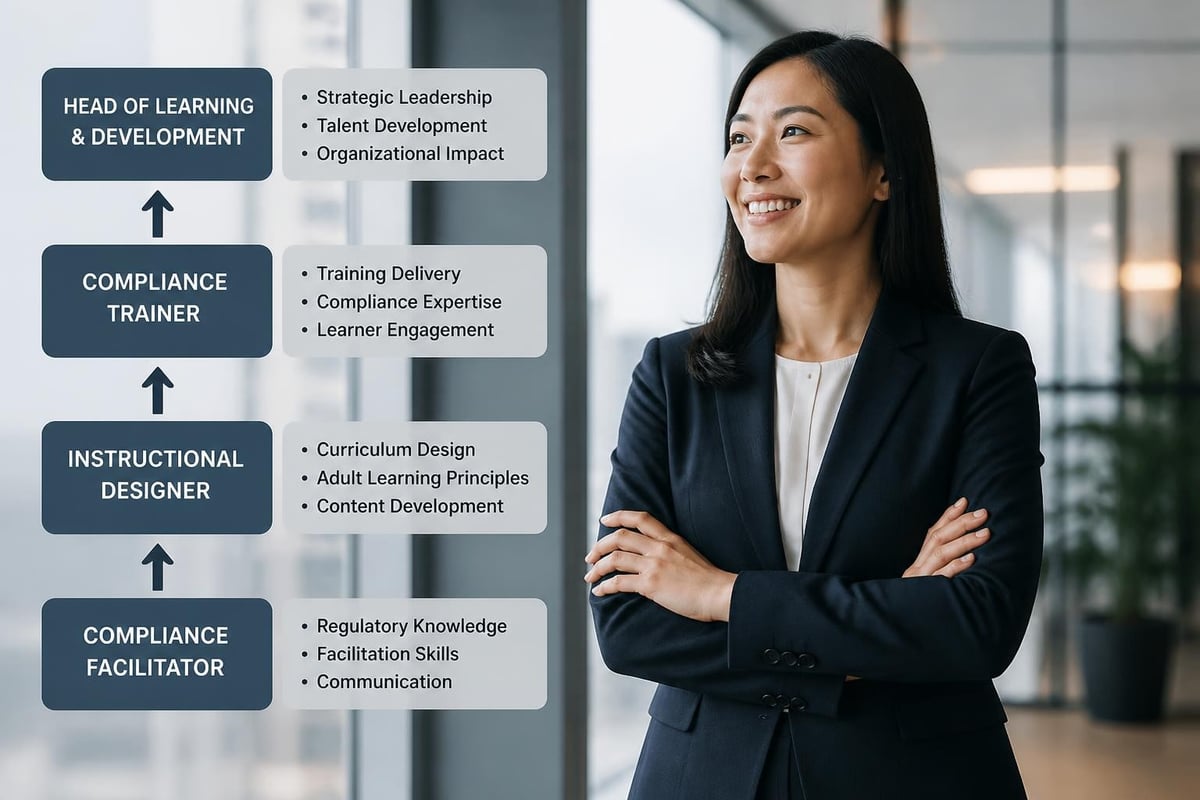
The training profession offers several career pathways for those working in financial services compliance education. Understanding these pathways helps both aspiring trainers and FSPs who need to recruit or develop training capability.
Entry-Level Positions
Compliance facilitators: Often former financial advisors or administrative staff who deliver pre-packaged training modules and maintain training records. This role provides exposure to the training profession whilst developing foundational facilitation skills.
Assessment administrators: Individuals who coordinate Regulatory Examinations, internal competency assessments, and maintain evidence of learning. This role builds understanding of assessment standards and regulatory requirements.
Mid-Level Roles
Instructional designers: Professionals who create learning content, develop assessment instruments, and design learning pathways aligned with regulatory frameworks. This specialisation requires both pedagogical knowledge and subject matter expertise.
Compliance trainers: Experienced facilitators who deliver complex regulatory training, particularly in FAIS, FICA, POPIA, and product knowledge areas. These professionals often hold relevant qualifications and practical experience in compliance or financial advice.
Training coordinators: Individuals who manage training logistics, scheduling, vendor relationships, and compliance reporting. This role bridges operational delivery and strategic planning.
Senior and Specialist Positions
The training profession in financial services increasingly recognises specialist roles that command premium remuneration and influence:
- Head of Learning and Development: Strategic role overseeing all training functions, aligning L&D with business strategy, and ensuring regulatory compliance
- Regulatory training specialists: Subject matter experts in specific regulatory domains who develop cutting-edge content and advisory services
- E-learning developers: Technical specialists who create digital learning experiences, simulations, and interactive assessments
- Competency assessors: Qualified professionals who conduct workplace assessments, practical observations, and competency verifications for FSCA purposes
According to the World Economic Forum’s Future of Jobs Report, reskilling and upskilling are among the top employer priorities globally, with training professionals playing a central role in organisational transformation.
Designing Effective Compliance Training for FSP Workflows
The training profession's impact is measured not by hours delivered but by behaviour change and competency development. Training professionals must design interventions that integrate seamlessly with broker workflows and produce measurable compliance improvements.
Needs Analysis for FSP Training
Effective training design begins with thorough needs analysis that considers multiple data sources:
- Regulatory gap analysis: Review FSCA requirements, recent TCF outcomes, and enforcement actions to identify priority areas
- Internal audit findings: Analyse compliance monitoring results, client file reviews, and quality assurance outcomes
- Performance data: Examine complaint trends, lapse rates, claims issues, and client feedback
- Stakeholder consultation: Interview key individuals, representatives, and compliance officers about challenges and knowledge gaps
- Competency assessments: Conduct baseline testing to identify specific knowledge or skill deficiencies
This comprehensive approach ensures training addresses actual gaps rather than perceived needs, maximising return on training investment.
Instructional Design Principles for Compliance Training
Training professionals must apply adult learning principles whilst meeting regulatory requirements. Effective compliance training incorporates:
Relevance and context: Use real scenarios from insurance broking, investment advice, and FSP operations. Generic examples fail to engage financial services professionals who need immediate application.
Incremental complexity: Structure content from foundational concepts to complex applications. For example, FICA training should progress from basic CDD requirements through EDD scenarios to suspicious transaction identification.
Practice opportunities: Include case studies, role-plays, and practical exercises that simulate actual compliance decisions. Research from Harvard Business Review on learning in the flow of work emphasises embedding learning into daily activities rather than isolated training events.
Assessment for learning: Use formative assessments throughout training to identify misunderstandings and reinforce key concepts before summative evaluation.
Job aids and resources: Provide checklists, templates, and quick-reference guides that support on-the-job application. For instance, a FICA verification checklist accessible during client onboarding reinforces training whilst improving compliance.
Training Delivery Methods for FSPs
The training profession has expanded delivery options significantly, allowing tailored approaches for different learner populations and content types:
| Delivery Method | Best Used For | Advantages | Considerations |
|---|---|---|---|
| Face-to-face workshops | Complex concepts, ethics training, team building | High engagement, immediate feedback, relationship building | Higher cost, scheduling challenges, geographic constraints |
| Virtual instructor-led | Regulatory updates, product training, assessments | Cost-effective, broader reach, recorded for review | Requires technology comfort, potential engagement challenges |
| E-learning modules | Foundational knowledge, compliance basics, onboarding | Self-paced, consistent content, easy tracking | Limited interaction, requires self-discipline |
| Microlearning | Just-in-time support, refresher training, specific procedures | Convenient, targeted, mobile-accessible | Not suitable for complex topics |
| Blended programmes | Comprehensive competency development | Combines strengths of multiple methods | More complex to design and coordinate |
For independent brokers with limited time and resources, blended approaches that combine short e-learning modules with periodic virtual workshops often provide optimal balance between effectiveness and practicality.
Assessment and Competency Verification
The training profession's credibility depends heavily on assessment quality. Training professionals must design and implement assessments that satisfy both educational validity and regulatory requirements.
Types of Assessment in FSP Training
Knowledge assessments: Written examinations, online quizzes, and case study analyses that verify understanding of regulatory requirements, product features, and procedural knowledge. The Regulatory Examination series represents standardised knowledge assessment, but FSPs require additional internal assessments tailored to their specific product ranges and client markets.
Skills assessments: Practical demonstrations, role-plays, and observed activities that verify ability to perform tasks such as client needs analysis, suitability assessments, and FICA verification procedures.
Workplace assessments: On-the-job observations, client file reviews, and competency verifications conducted in the actual work environment. These assessments provide the most valid evidence of applied competency but require significant assessor expertise and time.
Portfolio assessments: Collection of work samples, reflective journals, and evidence of continuous professional development that demonstrate sustained competency over time.
Maintaining Assessment Integrity
Training professionals must ensure assessment results accurately reflect competency:
- Clear assessment criteria: Define specific, observable criteria for each competency being assessed
- Assessor training: Ensure assessors understand standards, apply criteria consistently, and provide constructive feedback
- Security measures: Protect examination content, prevent cheating, and maintain confidentiality
- Documentation: Maintain comprehensive records of assessment results, evidence, and remedial actions for FSCA inspection purposes
- Regular review: Validate that assessments remain current with regulatory changes and industry practice
According to SHRM’s learning and development research, organisations that invest in robust assessment systems see significantly higher returns on their training investments through improved performance and reduced compliance risk.

Technology and Digital Transformation in Training
The training profession has been profoundly impacted by digital technologies that expand reach, improve effectiveness, and enhance administrative efficiency. Training professionals in the financial services sector must leverage these tools strategically.
Learning Management Systems (LMS)
A robust LMS serves as the backbone of professional training operations, providing:
- Centralised content delivery: Host e-learning modules, documents, videos, and assessments in one accessible platform
- Automated administration: Track enrollments, completions, assessment results, and CPD credits
- Compliance reporting: Generate reports for internal audits, FSCA inspections, and management oversight
- Communication tools: Send training reminders, updates on regulatory changes, and learning recommendations
- Integration capability: Connect with HR systems, CRM platforms, and competency management tools
For independent brokers and smaller FSPs, cloud-based LMS solutions offer enterprise capabilities without substantial capital investment, making professional training infrastructure accessible.
Virtual Delivery Platforms
Video conferencing and virtual classroom platforms have become essential tools in the training profession, particularly for geographically dispersed representatives. Effective virtual training requires specific design considerations:
Engagement strategies: Use polls, breakout rooms, chat discussions, and interactive activities to maintain attention and participation throughout sessions.
Technical preparation: Conduct platform training for both facilitators and learners, provide technical support resources, and have backup plans for connectivity issues.
Content adaptation: Redesign face-to-face content for virtual delivery, typically shortening sessions, increasing interaction frequency, and providing more varied activities.
Recording and access: Record sessions for those unable to attend live and create an on-demand library of training resources.
Emerging Technologies
The training profession is exploring several emerging technologies with potential applications in FSP training:
Artificial intelligence: AI-powered adaptive learning systems that personalise content based on learner performance, chatbots that provide just-in-time learning support, and automated assessment marking for certain question types.
Virtual and augmented reality: Immersive simulations of client consultations, compliance scenarios, and regulatory examinations that provide safe practice environments.
Microlearning platforms: Mobile-accessible applications delivering bite-sized content, daily compliance tips, and quick knowledge checks integrated into workflow.
Learning analytics: Advanced data analysis identifying training effectiveness, predicting compliance risks, and recommending personalised development pathways.
The UNESCO-UNEVOC study on the future of TVET teaching examines how digitalisation is transforming the training profession globally, with implications for professional development and trainer competencies.
Professional Standards and Credentials for Trainers
The training profession benefits from standardisation through professional bodies, qualifications, and continuing professional development requirements. Training professionals serving the financial services sector should pursue relevant credentials that enhance credibility and competence.
Relevant Qualifications
National qualifications: The National Qualifications Framework (NQF) includes several qualifications relevant to the training profession, including the Certificate in Training and Development (NQF Level 5), Diploma in Training and Development (NQF Level 6), and Advanced Diploma in Training and Development (NQF Level 7).
ETDP SETA qualifications: The Education, Training and Development Practices Sector Education and Training Authority offers specific qualifications for assessors, moderators, and skills development facilitators.
Financial services qualifications: Training professionals specialising in FSP training should hold relevant regulatory qualifications (RE 5 for trainers of representatives, relevant product qualifications) to ensure subject matter credibility.
International certifications: Credentials such as the Chartered Institute of Personnel and Development (CIPD) qualifications provide internationally recognised professional standing.
Professional Bodies and Networks
Membership in professional associations supports ongoing development and networking within the training profession:
- Institute of People Management (IPM): South Africa's professional body for HR and people management professionals, including L&D specialists
- Southern African Society for Cooperative Education (SASCE): Focuses on work-integrated learning and professional education
- Financial Planning Institute (FPI): For trainers focusing on financial planning competencies and CFP® education
- Association for Savings and Investment South Africa (ASISA): Industry body offering insights into training needs and standards
Continuing Professional Development
The training profession, like the financial services sector it serves, requires continuous learning. Training professionals should engage in regular CPD activities:
- Regulatory updates: Attend webinars, workshops, and briefings on FAIS, FICA, POPIA, COFI, and emerging legislation
- Pedagogical development: Study adult learning theory, instructional design methodologies, and assessment practices through courses and conferences
- Technology skills: Develop proficiency with new learning technologies, platforms, and digital tools
- Industry knowledge: Maintain understanding of financial products, market trends, and business challenges facing FSPs
- Professional reading: Engage with research, case studies, and thought leadership in both L&D and financial services domains
The Cedefop report on trainer standards provides European perspectives on professionalising the training role that offer valuable insights for South African practitioners.
Measuring Training Effectiveness and Return on Investment
The training profession has increasingly embraced data-driven approaches to demonstrating value and improving outcomes. Training professionals must measure effectiveness at multiple levels and communicate results to stakeholders.
The Kirkpatrick Model in FSP Context
The classic four-level evaluation framework remains relevant when adapted for financial services compliance training:
Level 1 – Reaction: Gather participant feedback through post-training surveys measuring satisfaction, relevance, and engagement. While positive reactions don't guarantee learning, consistently negative feedback signals design or delivery issues requiring attention.
Level 2 – Learning: Assess knowledge acquisition and skill development through pre- and post-tests, practical assessments, and competency verifications. For regulatory training, this level directly relates to meeting FSCA requirements.
Level 3 – Behaviour: Observe application of learning in the workplace through file reviews, client consultation observations, and compliance monitoring. This level represents the true test of training effectiveness in changing day-to-day practice.
Level 4 – Results: Measure business impact through metrics such as reduced complaints, improved audit outcomes, decreased compliance breaches, faster licensing processes, and enhanced client retention.
Key Performance Indicators for FSP Training
Training professionals should track and report on metrics that matter to FSP leadership:
| Metric Category | Example KPIs | Data Sources |
|---|---|---|
| Participation | Training completion rates, CPD hours per representative, percentage of staff meeting minimum training requirements | LMS reports, attendance registers |
| Competency | RE exam pass rates, internal assessment scores, percentage of representatives competent in all required areas | Assessment results, competency matrices |
| Compliance | Audit findings related to training, FSCA inspection outcomes, training-related non-conformances | Audit reports, FSCA correspondence |
| Performance | Client complaints related to advice quality, product suitability scores, advice quality scores | CRM data, quality assurance reviews |
| Efficiency | Cost per learning hour, training administration time, time to competency for new representatives | Financial data, HR systems |
Continuous Improvement Processes
Professional training operations implement systematic improvement cycles:
Post-training review: After each programme, analyse evaluation data, assessment results, and facilitator observations to identify strengths and improvement opportunities.
Trend analysis: Quarterly or annually, review aggregated data to identify patterns in competency gaps, training effectiveness, and emerging needs.
Stakeholder consultation: Regularly engage representatives, compliance officers, and management to gather qualitative feedback on training relevance and impact.
Benchmark comparison: Where possible, compare training outcomes against industry benchmarks or peer organisations to identify relative performance.
Action planning: Translate insights into concrete improvements in content, delivery methods, assessment approaches, or administrative processes.
Challenges Facing the Training Profession in Financial Services
Training professionals working with FSPs navigate several persistent challenges that require strategic responses and ongoing adaptation.
Regulatory Change Velocity
South African financial services regulation evolves rapidly, with frequent amendments to FAIS, new Conduct Standards, POPIA implementation, COFI developments, and FSCA policy changes. Training professionals must:
- Establish monitoring systems to identify regulatory changes early
- Build relationships with regulators, industry bodies, and legal advisors for interpretation guidance
- Develop rapid content development processes that can update training materials quickly
- Create modular training designs that allow targeted updates rather than complete redesigns
- Maintain version control and documentation to demonstrate training currency during inspections
Limited Training Budgets
Many independent brokers and smaller FSPs operate with constrained budgets, viewing training as a compliance cost rather than strategic investment. Training professionals can address this challenge through:
Cost-benefit demonstration: Quantify training's impact on reduced compliance breaches, avoided penalties, improved client retention, and enhanced productivity.
Scalable solutions: Design programmes that can be delivered efficiently to large groups, leveraging technology to reduce per-learner costs.
Shared resources: Develop industry consortiums or training cooperatives where multiple FSPs share development and delivery costs.
Government incentives: Help FSPs access Skills Development Levy rebates and discretionary grants through proper documentation and reporting.
Engagement and Motivation
Financial advisors and brokers often perceive compliance training as tedious obligation rather than valuable development. Training professionals must design engaging, relevant interventions:
- Use realistic scenarios and case studies drawn from actual practice
- Emphasise practical application and immediate workplace relevance
- Incorporate interactive elements, discussion, and peer learning
- Recognise and reward learning achievement beyond compliance minimums
- Demonstrate clear links between competency development and business success
Diverse Learner Populations
FSP staff span enormous ranges in age, experience, educational background, technology comfort, and learning preferences. Training professionals must differentiate appropriately:
Foundational vs. advanced content: Offer multiple entry points based on prior knowledge and experience rather than one-size-fits-all programmes.
Multiple delivery formats: Provide options for face-to-face, virtual, self-paced, and blended learning to accommodate different preferences and constraints.
Support mechanisms: Create mentoring, peer learning groups, and additional assistance for those struggling with content or technology.
Cultural and language sensitivity: Develop materials in multiple languages where appropriate and ensure examples and references resonate across South Africa's diverse population.
Building Internal Training Capability for FSPs
Larger FSPs increasingly develop internal training capability rather than relying exclusively on external providers. Training professionals can guide this capability development through structured approaches.
Train-the-Trainer Programmes
Converting subject matter experts into competent facilitators requires systematic preparation:
Foundation training: Cover adult learning principles, presentation skills, questioning techniques, and classroom management basics.
Content expertise: Ensure trainers possess deep, current knowledge in their subject areas through qualification requirements and ongoing CPD.
Facilitation practice: Provide supervised delivery opportunities with feedback from experienced facilitators before independent delivery.
Resource provision: Supply facilitator guides, presentation materials, assessment tools, and administrative templates that support consistent delivery.
Ongoing support: Establish communities of practice, regular upskilling sessions, and coaching for internal facilitators.
Creating a Learning Culture
The training profession's ultimate goal extends beyond individual programmes to embedding continuous learning throughout organisations:
- Leadership modelling: Encourage senior leaders to participate in training, share learning experiences, and visibly prioritise development
- Learning recognition: Celebrate learning achievements, share success stories, and incorporate development into performance management
- Knowledge sharing: Create platforms for representatives to share insights, discuss challenges, and learn from each other
- Learning resources: Maintain libraries of books, articles, videos, and tools accessible to all staff
- Innovation encouragement: Reward representatives who identify improvement opportunities and develop new approaches
Succession Planning for Training Roles
Organisations should develop internal pipelines for training profession roles:
- Identify potential: Look for representatives with strong technical knowledge, communication skills, and genuine interest in helping others learn
- Provide exposure: Offer opportunities to co-facilitate sessions, develop content, or support training administration
- Support qualification: Sponsor relevant training qualifications and professional development for high-potential individuals
- Gradual responsibility: Increase training responsibilities incrementally with ongoing mentoring and feedback
- Career pathways: Clearly articulate how training roles fit within broader career progression and compensation structures
Special Considerations for Independent Broker Training
Independent brokers face unique training challenges that training professionals must address thoughtfully.
Time Constraints
Independent brokers juggle client service, business development, administration, and compliance, leaving limited time for training. Solutions include:
- Microlearning: Deliver content in 10-15 minute modules accessible between appointments
- Evening/weekend options: Schedule training outside business hours, with appropriate consideration for work-life balance
- Just-in-time delivery: Provide learning resources at point of need rather than scheduled programmes
- Efficient design: Focus training tightly on essential competencies, eliminating unnecessary content
- Recognition of prior learning: Assess existing competency and exempt brokers from redundant training
Resource Access
Independent brokers typically lack dedicated training departments, LMS platforms, or administrative support. Training professionals can help through:
Affordable technology: Recommend cost-effective or free platforms suitable for small operations (Google Classroom, cloud-based LMS solutions, video conferencing tools).
Shared infrastructure: Facilitate access to industry training resources, professional body offerings, or consortium arrangements.
Simplified administration: Provide templates, checklists, and procedures that independent brokers can implement without specialist knowledge.
External partnerships: Connect brokers with training providers offering value-for-money solutions aligned with their specific needs.
Peer Learning Networks
Independent brokers benefit enormously from learning with and from peers facing similar challenges. Training professionals should facilitate:
- Study groups: Organise small groups preparing for Regulatory Examinations or tackling complex compliance topics
- Discussion forums: Create online spaces for sharing questions, insights, and resources
- Case study sharing: Facilitate anonymised sharing of compliance scenarios and solutions
- Mentoring arrangements: Connect experienced brokers with newer practitioners for guidance and support
Implementing POPIA Training Programmes
With POPIA enforcement underway, FSPs require comprehensive training that the training profession must design and deliver effectively.
POPIA Training Content Framework
Comprehensive POPIA training for FSPs should address multiple knowledge domains:
Foundational concepts: Introduce personal information definitions, responsible party obligations, processing conditions, and information officer roles.
FSP-specific application: Translate general POPIA requirements into specific procedures for policy applications, claims processing, marketing activities, and third-party data sharing.
Practical procedures: Train staff on obtaining consent, handling data subject requests, conducting privacy impact assessments, and responding to breaches.
Documentation requirements: Ensure understanding of required records, processing registers, policy documents, and evidence trails.
Rights and obligations: Cover data subject participation rights, complaint procedures, and Information Regulator interactions.
POPIA Implementation Workshops
Beyond knowledge transfer, training professionals should facilitate implementation through structured workshops:
- Current state assessment: Review existing data handling practices, identify personal information flows, and conduct gap analysis against POPIA requirements
- Policy development: Collaboratively develop POPIA policies, processing procedures, and consent mechanisms appropriate to FSP operations
- Procedure implementation: Design practical workflows for data subject requests, breach response, vendor management, and ongoing monitoring
- Role clarification: Define responsibilities for information officers, representatives, administrative staff, and third-party service providers
- Communication planning: Develop approaches for communicating POPIA compliance to clients, building trust through transparent privacy practices
POPIA Competency Assessment
Training professionals must verify that FSP staff can apply POPIA knowledge practically:
Scenario-based assessments: Present realistic situations requiring POPIA application (client requests access to information, marketing consent requirements, suspected data breach) and evaluate responses.
Procedure demonstration: Observe staff executing POPIA procedures such as processing data subject requests or documenting consent.
Documentation review: Examine POPIA-related documents created by staff for completeness, accuracy, and compliance.
Ongoing monitoring: Incorporate POPIA compliance into regular file reviews and quality assurance processes.
The training profession plays a vital role in maintaining compliance, developing competencies, and supporting business success within South Africa's complex financial services regulatory environment. Training professionals who combine pedagogical expertise with deep regulatory knowledge create substantial value for FSPs navigating FAIS, POPIA, FICA, and COFI requirements.
Whether you're an independent broker seeking to enhance your team's competencies, an FSP building internal training capability, or a compliance officer ensuring regulatory training obligations are met, Holistic Compliance Management Solutions (Pty) Ltd offers specialised training services tailored to financial services providers. Our programmes cover Regulatory Examination preparation, FICA and RMCP implementation, POPIA compliance, and comprehensive compliance monitoring, all designed specifically for the realities of South African broker practice.
Schedule FICA training with our team to build practical competency in client verification, ongoing monitoring, and risk management. Our FICA training includes:
- Comprehensive coverage of CDD and EDD requirements with FSP-specific examples
- Practical RMCP drafting guidance and templates for independent brokers
- Workflow integration showing how to implement FICA within existing practice management systems
Who this is for: Independent brokers, regulated FSPs, compliance officers, and administrative staff responsible for client onboarding and FICA compliance in insurance broking and financial advisory practices.