
Risk Control Training for FSPs in South Africa
Risk control training has become a cornerstone of compliance excellence for financial service providers operating under South Africa's rigorous regulatory environment. Independent brokers, financial advisors, and FSPs face mounting pressure to demonstrate not only awareness of compliance obligations under FAIS, POPIA, FICA, and COFI, but also the practical capability to implement and maintain robust risk controls across their operations. Effective training programmes bridge the gap between theoretical regulatory knowledge and day-to-day implementation, transforming compliance from a tick-box exercise into a strategic advantage that protects clients, strengthens reputational capital, and mitigates the financial consequences of non-compliance.
Understanding the Regulatory Landscape for Risk Control Training
South Africa's financial services sector operates under a complex web of interconnected legislation designed to protect consumers, prevent financial crime, and maintain market integrity. The Financial Advisory and Intermediary Services Act (FAIS) establishes the foundation for how FSPs conduct business, whilst the Financial Sector Conduct Authority (FSCA) oversees enforcement and standards.
The Protection of Personal Information Act (POPIA) introduced fundamental obligations regarding data processing, requiring FSPs to implement technical and organisational measures that safeguard client information throughout its lifecycle. This legislation intersects directly with the Financial Intelligence Centre Act (FICA), which mandates customer due diligence, record-keeping, and suspicious transaction reporting.
Core Compliance Frameworks for FSPs
Risk control training must address multiple regulatory pillars simultaneously, creating integrated competency rather than siloed knowledge:
- FAIS compliance covering fit and proper requirements, product categorisation, disclosure obligations, and conflict of interest management
- POPIA requirements for lawful processing, purpose specification, information quality, security safeguards, and data subject rights
- FICA obligations including client identification, verification procedures, beneficial ownership determination, and ongoing monitoring
- COFI principles emphasising fair treatment of customers, product suitability, clear communication, and transparent fee structures
The NIST SP 800-50 Revision 1 framework provides valuable guidance for building organisational training programmes that link awareness, role-based training, and behavioural change to risk management objectives, principles equally applicable to financial services compliance training.

Designing Effective Risk Control Training Programmes
A structured approach to risk control training begins with identifying specific competency gaps within your FSP's operations. Independent brokers typically require different training emphases compared to multi-advisor practices or corporate FSP entities, yet all share fundamental compliance obligations.
Training Needs Assessment Framework
| Assessment Area | Key Questions | Documentation Required |
|---|---|---|
| Role-specific risks | What compliance exposures exist for each position? | Job descriptions, risk registers |
| Current competency | What regulatory knowledge gaps exist? | Assessment results, audit findings |
| Regulatory updates | Which recent changes affect operations? | Regulatory bulletins, industry updates |
| Historical incidents | Where have compliance failures occurred? | Incident reports, complaints data |
| Client demographics | What special considerations apply? | Client profiles, product mix analysis |
Effective risk control training extends beyond annual refresher sessions. Research presented in a systematic review on safety interventions demonstrates that behaviour change requires repeated reinforcement, practical application opportunities, and contextual learning that mirrors real workplace scenarios.
Building Competency Across Compliance Domains
Independent brokers and financial advisors require practical, immediately applicable training that fits within their operational constraints. Module-based learning allows progressive skill development whilst maintaining business continuity:
Foundation modules establish baseline regulatory literacy across FAIS definitions, key person requirements, representative status, and mandates. This foundational layer ensures every team member understands their legal position within the FSP structure.
Intermediate modules develop procedural competency in client onboarding workflows, risk profiling methodologies, needs analysis techniques, and product disclosure requirements. These sessions should incorporate actual forms, templates, and documentation used daily.
Advanced modules address complex scenarios including beneficial ownership determination, politically exposed person identification, high-risk client management, and enhanced due diligence triggers. Case studies drawn from FSCA enforcement actions provide powerful learning opportunities.
Implementing POPIA and FICA Risk Controls Through Training
The intersection of POPIA and FICA creates particularly challenging compliance obligations for FSPs. Risk control training must equip staff to navigate data protection requirements whilst simultaneously fulfilling anti-money laundering and counter-terrorism financing obligations.
Practical POPIA Implementation for FSPs
Training programmes should translate POPIA's eight conditions into concrete operational procedures:
- Accountability: Designate an Information Officer and document processing activities through a PAIA manual
- Processing limitation: Establish lawful bases for collecting and processing client data at each touchpoint
- Purpose specification: Define clear, legitimate purposes for data collection and communicate these to clients
- Further processing limitation: Implement controls preventing data use beyond original purposes
- Information quality: Create validation procedures ensuring accuracy and completeness
- Openness: Develop transparent privacy notices explaining processing activities
- Security safeguards: Deploy technical and organisational measures protecting personal information
- Data subject participation: Establish procedures for access requests, corrections, and objections
For independent brokers, compliance monitoring services can provide ongoing support in maintaining these controls through regular assessments, template updates, and guidance on emerging regulatory interpretations.

FICA Risk Management and Control Training
FICA compliance demands sophisticated risk assessment capabilities that many brokers develop through focused training. Staff must understand not merely the mechanics of client identification but the underlying risk indicators that trigger enhanced scrutiny.
Customer due diligence training elements:
- Document verification techniques for South African identity documents, passports, company registration certificates, and trust deeds
- Face-to-face verification alternatives for remote client onboarding
- Beneficial ownership determination for companies, trusts, partnerships, and other legal entities
- Source of funds and source of wealth enquiries appropriate to client risk profiles
- Ongoing monitoring triggers and account review procedures
Risk categorisation competencies:
Training should develop practical judgment in applying risk-based approaches. Low-risk clients such as pensioners conducting straightforward transactions require standard due diligence. High-risk indicators including complex ownership structures, unusual transaction patterns, politically exposed person status, or operations in high-risk jurisdictions demand enhanced measures.
The Risk Management and Compliance Programme (RMCP) forms the documented foundation of a broker's FICA compliance. Training must ensure responsible persons understand their RMCP's contents, can implement its procedures consistently, and recognise when updates are required.
COFI and Treating Customers Fairly in Risk Control
The Conduct of Financial Institutions (COFI) Bill represents a fundamental shift towards outcomes-based regulation emphasising fair customer treatment throughout the product lifecycle. Risk control training must prepare FSPs for this expanded regulatory focus.
Fair Treatment Outcomes Framework
COFI training should address six customer outcomes that define fair treatment:
| Outcome | Training Focus | Practical Implementation |
|---|---|---|
| Culture of fairness | Leadership commitment, ethical decision-making frameworks | Values workshops, ethical dilemma scenarios |
| Product design | Suitability assessment, target market identification | Product analysis exercises, client matching protocols |
| Clear information | Plain language communication, disclosure adequacy | Communication template reviews, readability testing |
| Suitable advice | Needs analysis rigour, product knowledge depth | Role-playing advisory conversations, product training |
| Service standards | Responsiveness, complaint handling, ongoing support | Service level agreements, complaint resolution procedures |
| After-sales care | Policy servicing, claims handling, retention practices | Claims process walkthroughs, servicing standards |
Independent brokers must embed these outcomes within their advice processes, transitioning from transactional product placement to holistic client relationship management. Training programmes should therefore emphasise behavioural skills including active listening, empathetic communication, and ethical reasoning alongside technical compliance knowledge.
Developing Role-Specific Risk Control Competencies
Different positions within an FSP structure carry distinct compliance obligations requiring tailored training approaches. A one-size-fits-all programme fails to build the specific competencies each role demands.
Key Individual Training Requirements
Key individuals approved by the FSCA shoulder ultimate responsibility for the FSP's compliance. Their training must encompass:
- Regulatory interpretation and application across all relevant legislation
- Oversight mechanisms for monitoring representative conduct
- Board reporting requirements and governance structures
- Enforcement trends and regulatory expectations
- Strategic compliance planning and resource allocation
Representative and Advisor Training Pathways
Representatives directly serving clients require deep competency in advice delivery, documentation standards, and ethical conduct. Training priorities include:
Product knowledge: Understanding features, benefits, risks, costs, and exclusions across all products offered, with particular emphasis on complex products such as structured investments or offshore portfolios.
Needs analysis methodology: Applying systematic approaches to understanding client circumstances, objectives, risk tolerance, and constraints before making recommendations.
Record-keeping discipline: Documenting advice processes, client instructions, and decision rationales that demonstrate compliance with replacement rules, suitability requirements, and fair treatment principles.
Conflict identification and management: Recognising situations where personal interests, remuneration structures, or external relationships may compromise objectivity.
Administrative and Support Staff Training
Support personnel handling client data, processing applications, or managing documentation require focused training on:
- Data protection practices and POPIA compliance in daily tasks
- Confidentiality obligations and secure information handling
- FICA documentation requirements and verification procedures
- Quality control checks and error prevention techniques
Measuring Training Effectiveness and Behavioural Change
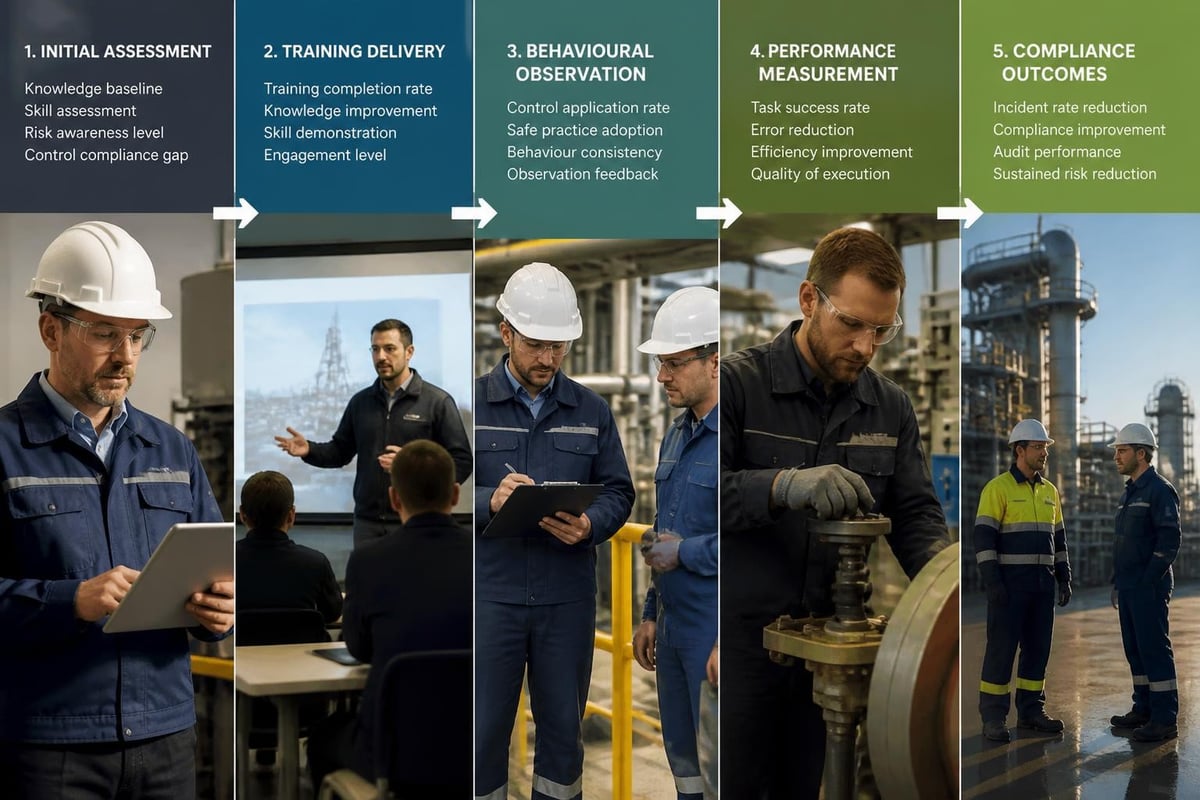
Risk control training delivers value only when it translates into sustained behavioural change and improved compliance outcomes. Measuring effectiveness requires moving beyond attendance registers and post-session assessments to genuine performance indicators.
Evidence-Based Training Evaluation
Recent research on security training limitations demonstrates that traditional training approaches often fail to produce lasting behavioural change, particularly when learners perceive low immediate relevance or face competing operational pressures. These findings highlight the importance of embedding compliance competencies within daily workflows rather than treating training as a separate event.
Leading indicators of training effectiveness:
- Reduction in documentation errors during compliance reviews
- Improved quality scores during file audits
- Decreased client complaints related to disclosure or suitability
- Enhanced detection rates for suspicious transactions
- Faster identification and escalation of compliance queries
Lagging indicators of programme success:
- Regulatory inspection outcomes and deficiency notices
- Enforcement actions or penalties imposed
- Client remediation exercises required
- Complaint upholds and ombud rulings
- Professional indemnity claims related to compliance failures
Continuous Improvement Methodologies
Training programmes should incorporate feedback loops that identify emerging competency gaps and adjust content accordingly. Quarterly compliance meetings provide opportunities to discuss recent challenges, share lessons from near-misses, and update procedures based on regulatory guidance.
Post-incident reviews following compliance failures offer particularly valuable learning opportunities. Rather than punitive responses, adopt constructive approaches that analyse root causes, identify systemic weaknesses, and strengthen controls through targeted training interventions.
Technology-Enabled Risk Control Training Solutions
Digital learning platforms enable FSPs to deliver consistent, scalable training whilst accommodating the constraints of independent broker practices. Technology also facilitates ongoing competency development between formal training sessions.
Learning Management System Benefits
Modern learning platforms provide:
- Flexible access: Representatives complete modules during non-client hours, maintaining business continuity
- Progress tracking: Compliance officers monitor completion rates and assessment scores across the FSP
- Version control: Updates automatically deploy to all users when regulatory changes occur
- Evidence generation: Detailed records demonstrate training provision during regulatory inspections
- Microlearning opportunities: Brief modules reinforce key concepts without disrupting workflows
Practical Simulation and Scenario-Based Learning
Interactive scenarios immerse learners in realistic situations requiring application of risk control principles. Effective scenarios might include:
- A client seeking to invest large cash amounts without clear legitimate source
- Complex family trust structures requiring beneficial ownership determination
- Vulnerable client situations demanding enhanced suitability assessment
- Product switching requests potentially indicating unsuitable churning
- Data subject access requests requiring POPIA-compliant responses
The ILO’s training materials demonstrate how practical, sector-adaptable training packages can build risk control capacity, with many modules offering train-the-trainer components suitable for developing internal compliance champions.
Building a Sustainable Risk Control Training Culture
Long-term compliance excellence emerges from organisational culture rather than isolated training events. Independent brokers and FSPs must cultivate environments where continuous learning, ethical decision-making, and proactive risk management become default behaviours.
Leadership Commitment and Tone from the Top
Key individuals set the cultural tone through their words and actions. When leadership prioritises compliance, allocates resources to training, participates in learning activities, and holds representatives accountable for standards, the entire organisation recognises risk control as fundamental rather than optional.
Cultural indicators of compliance maturity:
- Open discussion of compliance challenges without fear of punishment
- Proactive identification and escalation of potential issues
- Voluntary knowledge sharing amongst representatives
- Integration of compliance considerations in business planning
- Recognition and reward systems acknowledging compliance excellence
Peer Learning and Communities of Practice
Independent brokers benefit significantly from structured peer interaction that shares practical implementation approaches. Regular forums addressing common challenges create collaborative problem-solving whilst building professional networks.
Discussion topics might include:
- Practical approaches to complex beneficial ownership scenarios
- Client communication strategies for POPIA rights and consent
- File organisation systems meeting record-keeping requirements
- Technology solutions streamlining compliance workflows
- Regulatory interpretation questions and collective guidance-seeking
Regulatory Exam Preparation and Professional Development
Representatives entering the financial services industry must pass the FSCA's Regulatory Examinations demonstrating baseline competency. Structured preparation forms an essential component of comprehensive risk control training.
RE Exam Training Approaches
Examination preparation should extend beyond memorisation to develop genuine understanding of regulatory principles, their rationale, and practical application. Effective programmes combine:
Structured curriculum coverage: Systematic progression through all examination syllabus sections including FAIS, general code of conduct, specific product regulations, and fit and proper requirements.
Practice assessments: Regular testing under examination conditions builds familiarity with question formats, time management skills, and knowledge retention.
Application exercises: Connecting theoretical concepts to real advisory scenarios deepens understanding and improves both examination performance and practical competency.
Peer study groups: Collaborative learning reinforces difficult concepts and provides mutual support throughout preparation periods.
Compliance Monitoring and Ongoing Risk Control
Training delivers maximum value when integrated within broader compliance monitoring frameworks that identify gaps, verify implementation, and drive continuous improvement.
Compliance File Review Procedures
Regular file audits assess whether trained competencies translate into compliant documentation. Review checklists should cover:
| Review Element | Assessment Criteria | Training Linkage |
|---|---|---|
| Client identification | Valid FICA documents, verification notes | FICA due diligence training |
| Needs analysis | Comprehensive fact-find, documented objectives | Advisory process training |
| Product disclosure | Complete mandates, product information, fee disclosures | FAIS disclosure requirements |
| Suitability rationale | Clear explanation linking recommendations to needs | Advice justification training |
| Client consent | POPIA processing consent, financial planning agreement | Data protection training |
| Ongoing review | Annual contact, portfolio reviews, changed circumstances | Client retention training |
Findings from compliance monitoring feed directly back into training priorities. Patterns of deficiency indicate competency gaps requiring remedial focus, whilst consistent excellence validates training effectiveness.
Independent Compliance Assessment
External compliance reviews provide objective evaluation of risk control implementation across the FSP. Independent assessors bring regulatory expertise, industry benchmarking, and fresh perspectives that identify blind spots internal processes may miss.
These assessments typically evaluate:
- Governance structures and oversight mechanisms
- Policy documentation completeness and currency
- Representative competency and training records
- File quality and documentation standards
- System controls and technology utilisation
- RMCP adequacy and implementation
Addressing Specific Risk Scenarios in Training
Generic compliance training often fails to prepare representatives for nuanced real-world situations requiring professional judgment. Scenario-based modules addressing specific risk categories build decision-making confidence.
Vulnerable Client Protections
Training must sensitise representatives to vulnerability indicators and appropriate protective responses:
- Elderly clients potentially experiencing cognitive decline or undue influence
- Financially unsophisticated clients requiring enhanced explanation and simplified options
- Language barriers necessitating translation or additional explanation time
- Health conditions affecting decision-making capacity or product suitability
- Life transitions such as bereavement, divorce, or retrenchment creating heightened vulnerability
Representatives should practice adapting communication styles, simplifying complex concepts, identifying appropriate support persons, and documenting enhanced suitability assessments.
High-Risk Product Training
Complex products including structured notes, hedge funds, offshore investments, and alternative investments require specialised training covering:
Product mechanics: How returns are calculated, capital protection levels, liquidity constraints, and exit penalties.
Risk disclosure: Articulating downside scenarios, counterparty risks, currency exposures, and total cost impacts in client-appropriate language.
Suitability frameworks: Determining which client profiles align with product risk-return characteristics and which circumstances contraindicate recommendation.
Regulatory obligations: Understanding specific disclosure requirements, cooling-off periods, and documentation standards for higher-risk categories.
Technology and Cyber Risk Training
FSPs increasingly rely on digital platforms for client interaction, data storage, and business operations, creating cyber risk exposures requiring specific risk control training:
- Phishing recognition and reporting procedures
- Secure password practices and multi-factor authentication
- Encrypted communication for sensitive client information
- Remote access security protocols
- Incident response procedures for suspected breaches
- Business continuity arrangements following system failures
FSP Licensing and Risk Control Foundations
New FSPs navigating the licensing process must establish robust risk control frameworks from inception. Training forms a critical component of demonstrating compliance readiness to the FSCA.
Licence Application Training Requirements
The FSCA assesses whether applicant FSPs possess adequate competency, systems, and controls to conduct financial services business compliantly. Training documentation demonstrates:
Key individual competency: Qualifications, experience, and ongoing professional development evidencing capability to oversee the FSP's compliance obligations.
Representative preparation: Training plans ensuring all representatives achieve regulatory examination success and receive role-specific compliance training before client interaction.
Operational readiness: Staff training on policies, procedures, systems, and controls the FSP will implement.
Ongoing development: Commitments to continuous training maintaining and enhancing competency as regulations evolve.
Establishing Training Infrastructure
New FSPs should implement scalable training infrastructure supporting current needs and future growth:
- Document training policies specifying frequency, content, delivery methods, and attendance requirements
- Maintain training registers recording participant attendance, assessment results, and competency verification
- Establish relationships with external training providers for specialised content
- Allocate budgets ensuring training receives adequate resource priority
- Designate training coordinators responsible for programme delivery and monitoring
Risk control training represents a strategic investment that protects your FSP from regulatory penalties, reputational damage, and operational disruption whilst simultaneously enhancing service quality and client outcomes. By building deep competency across FAIS, POPIA, FICA, and COFI requirements through structured, practical training programmes, independent brokers and financial advisors transform compliance from a burden into a competitive advantage. Holistic Compliance Management Solutions (Pty) Ltd specialises in providing compliance and training services tailored to FSPs operating in South Africa's demanding regulatory environment, helping you build sustainable risk control capabilities that protect your practice and serve your clients with excellence.
Schedule FICA training for your FSP team
For: Independent brokers, regulated FSPs, compliance officers, and new market entrants requiring practical FICA and RMCP implementation
Our comprehensive training programme includes:
- Practical customer due diligence procedures and documentation workshops
- Risk-based approach implementation for your specific client base
- RMCP drafting guidance and template customisation
- Ongoing compliance monitoring support and regulatory update briefings
Contact Holistic Compliance Management Solutions today to build robust risk control competencies that safeguard your practice and demonstrate regulatory excellence.