
Outsourced Chief Compliance Officer Guide for SA FSPs
The compliance landscape for South African Financial Service Providers (FSPs) has never been more demanding. Between the Financial Advisory and Intermediary Services Act (FAIS), Protection of Personal Information Act (POPIA), Financial Intelligence Centre Act (FICA), and the recently implemented Conduct of Financial Institutions Act (COFI), independent brokers and financial advisors face a regulatory burden that requires dedicated expertise. Many practices are discovering that an outsourced chief compliance officer delivers professional oversight without the overhead of a full-time senior appointment. This strategic approach allows independent brokerages to access specialist knowledge whilst maintaining operational flexibility and managing costs effectively.
Understanding the Outsourced Chief Compliance Officer Model
An outsourced chief compliance officer provides the strategic compliance leadership traditionally delivered by an in-house executive, but on a flexible engagement basis. This model has gained significant traction in the South African financial services sector as regulatory complexity has intensified.
The arrangement typically involves a compliance professional or firm assuming responsibility for designing, implementing, and overseeing your compliance management system. Unlike consultants who advise on specific projects, an outsourced chief compliance officer takes ongoing accountability for your compliance posture.
Key Responsibilities in the South African Context
For FSPs operating under FAIS, the outsourced chief compliance officer assumes several critical functions:
- Regulatory intelligence and interpretation: Monitoring FSCA pronouncements, guidance notices, and regulatory changes
- Compliance framework design: Developing policies, procedures, and controls aligned to FAIS, POPIA, FICA, and COFI requirements
- Risk assessment and management: Conducting regular compliance risk assessments and implementing mitigation strategies
- Training delivery and coordination: Ensuring representatives meet Continuous Professional Development (CPD) requirements
- Reporting and governance: Providing board-level compliance reporting and maintaining regulatory relationships
The Basel Committee has published comprehensive principles on managing third-party risk in financial services, which provide a global framework for evaluating outsourced compliance arrangements.
How Outsourcing Differs from Traditional Consulting
Traditional compliance consultants deliver discrete projects-perhaps a POPIA gap analysis or FICA manual review. An outsourced chief compliance officer embeds within your practice's governance structure.
| Aspect | Traditional Consultant | Outsourced Chief Compliance Officer |
|---|---|---|
| Engagement duration | Project-based (weeks/months) | Ongoing relationship (years) |
| Accountability | Advisory only | Direct responsibility for compliance outcomes |
| Integration | External advisor | Virtual member of management team |
| Scope | Specific deliverables | Comprehensive compliance oversight |
| Reporting | Final reports | Regular board reporting and continuous monitoring |
This distinction matters considerably when the FSCA conducts inspections. An outsourced chief compliance officer demonstrates continuous oversight rather than periodic interventions.

Regulatory Framework Considerations for South African FSPs
South Africa's regulatory environment creates specific considerations when engaging an outsourced chief compliance officer. The Financial Sector Conduct Authority (FSCA) maintains clear expectations about compliance oversight within FSPs.
FAIS Act Requirements
The FAIS Act requires every FSP to have adequate risk management and compliance arrangements. Whilst the Act doesn't mandate a dedicated compliance officer for smaller practices, the principle of proportionality applies. Your compliance resources must match your risk profile.
An outsourced chief compliance officer can fulfil this requirement provided:
- The engagement agreement clearly defines responsibilities and authority
- The individual possesses appropriate qualifications and experience
- Regular oversight activities are documented and evidenced
- The FSP's governing body maintains ultimate accountability
The FSCA's guidance emphasises substance over form. Simply appointing someone externally without genuine oversight creates regulatory risk rather than managing it.
POPIA Compliance Obligations
The Protection of Personal Information Act creates mandatory Information Officer responsibilities. Many FSPs designate their compliance officer as the Information Officer, making POPIA expertise essential for any outsourced chief compliance officer.
Critical POPIA responsibilities include:
- Maintaining the information processing register
- Conducting privacy impact assessments for new products or processes
- Managing data subject requests (access, correction, deletion)
- Overseeing data breach response protocols
- Coordinating with the Information Regulator when required
Your outsourced chief compliance officer should demonstrate specific POPIA competency beyond general compliance knowledge.
FICA and COFI Integration
Financial Intelligence Centre Act compliance demands ongoing customer due diligence, transaction monitoring, and suspicious transaction reporting. The FINRA regulatory guidance on outsourcing functions provides useful parallels for managing these responsibilities through third parties.
For FSPs that provide compliance practice assistance including FICA RMCP drafting, the outsourced chief compliance officer should coordinate these technical deliverables with broader risk management frameworks.
The Conduct of Financial Institutions Act (COFI), which commenced implementation in 2024, introduces enhanced conduct standards. Your outsourced chief compliance officer must translate COFI principles into operational procedures that prevent customer detriment whilst maintaining commercial viability.
Benefits of the Outsourced Model for Independent Brokers
Independent financial brokers and smaller FSPs gain distinct advantages from outsourcing the chief compliance officer function. These benefits extend beyond simple cost savings.
Cost Efficiency and Predictability
Employing a senior compliance professional typically costs R800,000 to R1.5 million annually when factoring in salary, benefits, office costs, and professional development. An outsourced chief compliance officer generally represents 30-50% of this expense.
Monthly cost comparison for a mid-sized independent brokerage (10-15 representatives):
| Cost Element | Full-time CCO | Outsourced CCO |
|---|---|---|
| Base compensation | R50,000 – R80,000 | R15,000 – R30,000 |
| Benefits (retirement, medical) | R12,000 – R20,000 | Included in fee |
| Office and equipment | R3,000 – R5,000 | Not applicable |
| Professional development | R2,000 – R4,000 | Included in fee |
| Total monthly | R67,000 – R109,000 | R15,000 – R30,000 |
These figures reflect typical South African market rates as of 2026.
Access to Specialist Expertise
Compliance spans multiple disciplines: regulatory interpretation, legal analysis, technology implementation, training delivery, and forensic investigation. Few individuals excel across all domains.
Outsourced providers typically employ teams with complementary specialisations. When your practice faces a complex POPIA data breach, you access information security expertise. When implementing new investment products, you draw on product governance specialists.
This breadth proves particularly valuable given South Africa's evolving regulatory landscape. The FSCA's Twin Peaks model continues maturing, creating interpretation challenges that benefit from diverse technical perspectives.
Scalability and Flexibility
Independent brokerages experience fluctuating compliance demands. Licence applications, product launches, regulatory inspections, and remediation projects create workload peaks that overwhelm fixed resources.
An outsourced chief compliance officer scales engagement intensity to match these demands. During routine periods, you maintain baseline oversight. When launching a new tied product or responding to an FSCA query, you increase support without permanent headcount changes.

Implementation Framework for FSPs
Transitioning to an outsourced chief compliance officer requires methodical planning. Rushing the change creates governance gaps that expose your practice to regulatory risk.
Phase 1: Needs Assessment and Scoping
Begin by documenting your current compliance arrangements and identifying gaps. This assessment should examine:
- Regulatory obligations inventory: List all applicable laws, regulations, and codes
- Current compliance activities: Document existing controls, monitoring, and reporting
- Resource analysis: Evaluate current compliance spending and staff allocation
- Risk profile: Assess your practice's inherent risks based on size, products, and client base
- Strategic objectives: Consider growth plans that may alter compliance requirements
This groundwork enables meaningful discussions with potential providers. You'll articulate specific needs rather than requesting generic compliance services.
Phase 2: Provider Selection Criteria
Not all compliance providers offer genuine chief compliance officer capabilities. Evaluate candidates against rigorous criteria:
Essential qualifications and experience:
- FSCA-recognised compliance qualifications (RE qualification minimum; CPLP, CFP, or legal credentials preferred)
- Minimum five years' compliance experience within South African financial services
- Demonstrated FAIS, POPIA, FICA, and COFI knowledge
- Track record managing FSCA inspections and regulatory engagements
Service delivery model assessment:
- Clear definition of services included versus additional fees
- Documented escalation protocols for urgent compliance matters
- Technology platforms used for monitoring and reporting
- Backup arrangements if primary contact becomes unavailable
Request references from current FSP clients with similar profiles to your practice. The SIFMA guidance on cloud outsourcing offers useful due diligence frameworks applicable to compliance service providers.
Phase 3: Contractual Structuring
Your service agreement must address regulatory accountability whilst maintaining operational flexibility. Critical contractual provisions include:
- Scope definition: Specific deliverables, frequency of activities, and exclusions
- Reporting lines: How the outsourced chief compliance officer interfaces with your board or owners
- Information access: Rights to systems, records, and personnel necessary for oversight
-
- Confidentiality and data protection: POPIA-compliant handling of client and business information
- Liability and insurance: Professional indemnity coverage and limitation of liability clauses
- Termination and transition: Notice periods and knowledge transfer obligations
The Financial Stability Board's toolkit on third-party risk management provides comprehensive guidance on contractual controls for outsourced arrangements.
Phase 4: Integration and Onboarding
Successful implementation requires active onboarding. Plan for a 60-90 day integration period during which your outsourced chief compliance officer:
- Conducts comprehensive compliance baseline assessment
- Reviews and updates compliance manual and policies
- Meets key personnel and representatives
- Establishes monitoring and reporting rhythms
- Identifies quick-win improvements and priority remediation items
During this phase, maintain heightened communication frequency. Weekly check-ins ensure alignment and build the working relationship essential for effective oversight.
Operational Excellence with an Outsourced CCO
Once implemented, maximising value from an outsourced chief compliance officer requires deliberate operational practices. These disciplines ensure the arrangement delivers strategic benefit rather than becoming an administrative checkbox.
Establishing Effective Communication Rhythms
Regular interaction maintains compliance visibility without creating meeting fatigue. Recommended cadences for independent brokerages:
| Activity | Frequency | Duration | Participants |
|---|---|---|---|
| Compliance dashboard review | Monthly | 30 minutes | Key person, outsourced CCO |
| Full compliance report | Quarterly | 60 minutes | Board/owners, outsourced CCO |
| Training sessions | Quarterly | 90 minutes | All representatives, outsourced CCO |
| Ad-hoc consultations | As needed | 15-30 minutes | Relevant staff, outsourced CCO |
| Annual compliance review | Annually | Half day | Board/owners, outsourced CCO |
Technology facilitates this rhythm. Cloud-based compliance management systems enable continuous monitoring with structured reporting at defined intervals.
Leveraging Technology for Continuous Monitoring
Modern compliance relies on systems rather than manual review. Your outsourced chief compliance officer should implement technology addressing:
- File review and quality assurance: Sampling client files against FAIS conduct standards
- Transaction monitoring: Identifying unusual patterns warranting FICA investigation
- Training tracking: Recording CPD activities and qualification maintenance
- Complaint management: Logging, investigating, and reporting complaints to the FSCA
- Policy distribution and attestation: Ensuring representatives acknowledge procedures
The NIST cybersecurity supply chain guidance addresses technology vendor risk management-relevant when your outsourced chief compliance officer introduces compliance platforms.
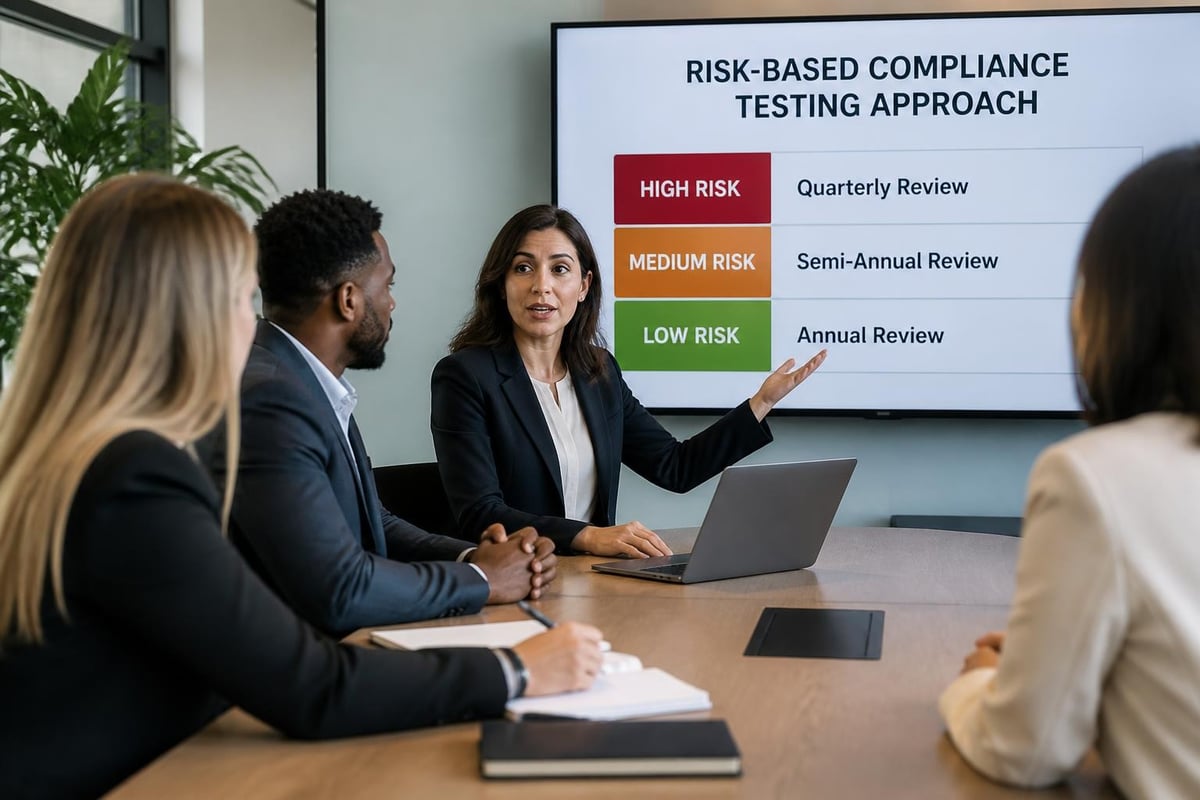
Risk-Based Compliance Testing
Your outsourced chief compliance officer should implement risk-based testing rather than attempting comprehensive review of all activities. This approach concentrates resources where risks concentrate.
Annual testing plan framework:
- High-risk areas (quarterly testing): Replacement business, vulnerable clients, high-value transactions
- Medium-risk areas (semi-annual testing): Standard advice processes, file documentation, product due diligence
- Lower-risk areas (annual testing): Administrative procedures, archiving practices, general governance
Testing results inform training needs and control enhancements. Patterns of non-compliance trigger targeted interventions before they escalate into regulatory concerns.
Managing Third-Party Risk in Outsourced Compliance
Outsourcing your chief compliance officer creates a third-party dependency requiring its own risk management. This meta-compliance challenge demands specific controls.
Ongoing Provider Performance Assessment
Your board maintains ultimate accountability for compliance despite outsourcing operational responsibilities. Demonstrate effective oversight through:
- Service level agreement monitoring: Track deliverable completion against contractual commitments
- Quality review: Periodically assess the accuracy and usefulness of compliance advice
- Regulatory feedback integration: Consider FSCA inspection findings as provider performance data
- Benchmarking exercises: Compare your compliance posture against industry peers
The AICPA SOC reporting framework provides useful attestation standards. Requesting SOC 2 reports from compliance providers demonstrates rigorous vendor governance.
Business Continuity Planning
What happens if your outsourced chief compliance officer becomes unavailable? Illness, business failure, or contractual disputes could disrupt compliance oversight at critical moments.
Mitigation strategies include:
- Documentation standards: Require comprehensive process documentation that enables continuity
- Multi-person engagement: Ensure at least two individuals from the provider know your business
- Transition planning: Maintain updated transition plans identifying alternative providers
- Knowledge retention: Keep core compliance expertise in-house even whilst outsourcing leadership
These controls prevent outsourcing from becoming an unmanageable dependency.
Data Security and Confidentiality Considerations
Your outsourced chief compliance officer accesses sensitive information: client records, business financials, strategic plans, and regulatory correspondence. POPIA obligations require demonstrable information security.
Essential due diligence areas:
| Control Domain | Assessment Questions |
|---|---|
| Access management | How is access to client data controlled and logged? |
| Encryption | Are client records encrypted in transit and at rest? |
| Vendor management | If subcontractors are used, how are they vetted and managed? |
| Incident response | What breach notification procedures exist? |
| Physical security | Where are records stored and what physical controls apply? |
Document these controls in your POPIA processing agreements and review them annually.
COFI Implementation Through Outsourced Compliance
The Conduct of Financial Institutions Act represents South Africa's most significant regulatory evolution since Twin Peaks implementation. An outsourced chief compliance officer should lead your COFI transition.
Conduct Risk Identification and Assessment
COFI shifts focus from technical compliance to customer outcome protection. Your outsourced chief compliance officer should facilitate conduct risk assessment workshops identifying:
- Product design risks: Features that may not suit target markets or create poor outcomes
- Sales process risks: Incentive structures or sales techniques creating mis-selling potential
- Service delivery risks: Communication gaps, complaint handling failures, or operational errors harming clients
- Governance risks: Insufficient oversight or conflicts of interest compromising customer interests
This assessment translates abstract COFI principles into tangible risk scenarios specific to your practice.
Culture and Conduct Integration
COFI emphasises organisational culture as a compliance driver. Unlike rules-based requirements, culture assessment requires qualitative judgment-an area where outsourced expertise proves valuable.
Your outsourced chief compliance officer should implement culture indicators:
- Staff surveys: Periodic assessments measuring ethical climate and compliance support
- Incident pattern analysis: Reviewing complaints and errors for cultural root causes
- Remuneration alignment: Evaluating whether incentive structures reward customer-centric behaviour
- Leadership observation: Assessing whether management demonstrates conduct commitment
These insights inform board reporting on conduct risk, a COFI regulatory expectation.
Fair Value and Product Governance
COFI requires providers to deliver fair customer value. For tied agents and multi-tied intermediaries, this creates complex analysis requirements around product selection and recommendation rationales.
An outsourced chief compliance officer develops frameworks assessing:
- Comparative product features and pricing within categories
- Commission structures and their impact on advisor recommendations
- Product provider value delivery (claims service, investment performance, policy servicing)
- Suitability of product ranges for your client demographics
This governance creates defensible product selection that withstands regulatory scrutiny.
Training and Development Coordination
Representative competence remains fundamental to FAIS compliance. Your outsourced chief compliance officer should coordinate comprehensive training programmes addressing both regulatory knowledge and practical skills.
Regulatory Examination Preparation
Representatives require Class of Business qualifications before providing advice. An outsourced chief compliance officer coordinates regulatory exam training ensuring representatives meet qualification requirements efficiently.
Training coordination includes:
- Identifying qualification gaps when onboarding new representatives
- Scheduling preparatory training ahead of examination attempts
- Tracking qualification expiries and re-qualification requirements
- Maintaining the FSP's training register as required by FAIS
This administrative function proves time-consuming when managed ad-hoc but becomes systematic under dedicated compliance oversight.
Continuous Professional Development Management
Beyond initial qualifications, representatives must complete CPD annually. Your outsourced chief compliance officer should:
- Develop annual CPD plans aligned to practice needs and regulatory changes
- Deliver in-house training on compliance, products, and regulatory updates
- Coordinate external training providers for specialised topics
- Maintain CPD records evidencing compliance with FSCA requirements
- Escalate CPD deficiencies before they create licensing risks
Structured CPD moves beyond tick-box compliance to genuine capability development.
FICA and POPIA Training Programmes
Anti-money laundering and data protection create specific training needs. Representatives must understand:
- Customer due diligence requirements for different risk categories
- Suspicious transaction indicators and reporting obligations
- POPIA principles and their application to client data handling
- Information security practices preventing data breaches
Your outsourced chief compliance officer should deliver targeted FICA and POPIA training at onboarding and refresher sessions annually.
Financial and Operational Metrics for Success
Measuring outsourced chief compliance officer effectiveness requires defined metrics. These indicators demonstrate value to stakeholders whilst identifying improvement opportunities.
Compliance Health Indicators
Track leading indicators predicting compliance outcomes:
- File review pass rates: Percentage of client files meeting quality standards on first review
- Training completion rates: Timeliness of CPD and qualification achievement
- Control effectiveness: Results of compliance testing across risk areas
- Issue closure rates: Speed of remediating identified compliance gaps
- Near-miss incidents: Potential compliance breaches identified and prevented
The PwC Global Compliance Survey provides benchmarking context for these metrics across financial services organisations.
Cost-Benefit Analysis Framework
Annually assess the financial impact of your outsourced arrangement:
Benefits quantification:
- Salary and overhead savings versus full-time employment
- Avoided regulatory penalties through improved compliance
- Efficiency gains from systematic processes
- Representative productivity improvements from streamlined training
Cost tracking:
- Monthly or fixed fees paid to provider
- Technology platform costs
- Additional consulting for special projects
- Internal staff time coordinating with outsourced CCO
This analysis informs renewal negotiations and validates the outsourcing decision.
Regulatory Relationship Quality
An often-overlooked metric: your relationship quality with the FSCA. An effective outsourced chief compliance officer should improve regulatory standing through:
- Timely and accurate regulatory reporting
- Professional handling of FSCA queries and inspections
- Proactive engagement on interpretation questions
- Demonstrated compliance improvement trajectories
Track FSCA interaction outcomes, inspection findings, and enforcement actions as provider performance indicators.
Common Implementation Challenges and Solutions
Despite substantial benefits, outsourcing chief compliance officer functions creates predictable challenges. Anticipating these obstacles enables proactive mitigation.
Challenge: Authority and Influence Limitations
External compliance officers sometimes lack the organisational authority to drive necessary changes. Representatives may perceive outsourced providers as less relevant than internal leaders.
Solutions:
- Clearly communicate board support for the outsourced chief compliance officer's authority
- Include the outsourced CCO in management meetings and strategic discussions
- Empower the outsourced CCO to escalate issues directly to ownership
- Recognise compliance achievements publicly, reinforcing the function's importance
Authority flows from demonstrated competence and visible executive support rather than organisational chart positioning.
Challenge: Information Access and System Integration
Compliance oversight requires comprehensive information access. Outsourced providers working remotely may face practical barriers accessing systems, records, or personnel.
Solutions:
- Implement cloud-based practice management systems accessible to the outsourced CCO
- Establish secure file-sharing protocols for sensitive document review
- Schedule regular on-site visits for physical file reviews and staff interaction
- Create standardised reporting templates that systematise information flow
Technology largely solves this challenge when deliberately implemented.
Challenge: Cultural Disconnect
Compliance culture requires shared values and behavioural norms. External providers may struggle understanding your practice's unique culture and client relationships.
Solutions:
- Invest in thorough onboarding covering practice history, values, and client demographics
- Include the outsourced CCO in social and team-building activities when practical
- Encourage informal communication alongside formal reporting structures
- Seek providers with similar cultural values and practice philosophies
Cultural alignment improves with time and intentional relationship investment.
South African Regulatory Developments Impacting Outsourcing
The compliance landscape continues evolving. Forward-looking FSPs consider emerging regulatory trends when structuring outsourced arrangements.
Conduct Authority Supervisory Approach
The FSCA's supervisory strategy increasingly emphasises conduct outcomes over technical compliance. This shift creates specific demands on compliance functions.
Your outsourced chief compliance officer should demonstrate:
- Outcome measurement capabilities beyond process compliance
- Customer value assessment methodologies
- Conduct risk identification frameworks
- Culture and behaviour monitoring approaches
These capabilities distinguish strategic compliance partners from administrative compliance checkers.
Technology and Digital Transformation
As financial services digitalise, compliance oversight must address technology risks. Robo-advice, digital onboarding, and automated portfolio management create novel compliance challenges.
An outsourced chief compliance officer should bring digital compliance expertise:
- Algorithm governance for automated advice systems
- Digital customer journey compliance review
- Cybersecurity and information security oversight
- Fintech vendor due diligence frameworks
These capabilities prove especially valuable for smaller practices lacking in-house technology expertise.
Environmental, Social, and Governance Integration
ESG considerations increasingly influence financial services regulation globally. South Africa will likely adopt sustainability disclosure and product governance requirements aligned to international standards.
Forward-thinking outsourced providers develop ESG compliance capabilities positioning clients ahead of regulatory curves rather than scrambling when requirements finalise.
Practical Implementation Checklist
FSPs considering an outsourced chief compliance officer should work through this decision and implementation framework:
Initial assessment (weeks 1-2):
- Document current compliance arrangements and identify gaps
- Calculate fully-loaded cost of compliance function (internal staff, systems, training)
- Define specific compliance outcomes required from outsourced provider
- Identify internal stakeholders requiring involvement in selection process
Provider selection (weeks 3-6):
- Research potential providers with FSP client experience
- Request detailed capability statements and service descriptions
- Conduct reference calls with current clients
- Evaluate qualification, experience, and specialist expertise
- Assess cultural fit and communication style
- Review proposed technology platforms and methodologies
Contracting (weeks 7-8):
- Negotiate service scope, deliverables, and exclusions
- Define reporting structures and governance arrangements
- Establish performance metrics and service level agreements
- Clarify POPIA responsibilities and data handling protocols
- Confirm professional indemnity insurance coverage
- Execute service agreement with appropriate legal review
Onboarding (weeks 9-16):
- Provide comprehensive business overview and historical context
- Grant system access and information sharing protocols
- Conduct baseline compliance assessment
- Develop prioritised compliance improvement roadmap
- Introduce outsourced CCO to all representatives and key staff
- Establish regular meeting rhythms and communication channels
Ongoing management (quarterly):
- Review compliance dashboard and key performance indicators
- Assess provider service delivery against contractual commitments
- Update compliance risk assessment for business changes
- Evaluate cost-benefit of arrangement versus alternatives
- Identify emerging regulatory developments requiring attention
This structured approach reduces implementation risk whilst building sustainable compliance governance.
Outsourced chief compliance officer arrangements offer independent financial brokers and FSPs a viable pathway to professional compliance oversight without the cost burden of senior permanent appointments. By combining specialist regulatory expertise with flexible engagement models, these partnerships enable smaller practices to maintain rigorous standards whilst focusing resources on client service and business development. Whether you're navigating FAIS requirements, implementing POPIA controls, managing FICA obligations, or preparing for COFI, the right outsourced compliance partner becomes a strategic asset rather than a necessary expense. Holistic Compliance Management Solutions (Pty) Ltd provides independent compliance and training services specifically designed for Financial Service Providers throughout South Africa, offering the expertise and practical support that transforms compliance from regulatory burden into competitive advantage.
Schedule a FICA training consultation
For: Independent brokers, regulated FSPs, and compliance officers seeking structured FICA and RMCP implementation support.
Your consultation includes:
- Comprehensive FICA compliance gap analysis for your practice
- Customised RMCP drafting guidance aligned to your risk profile
- Practical training on customer due diligence and transaction monitoring procedures